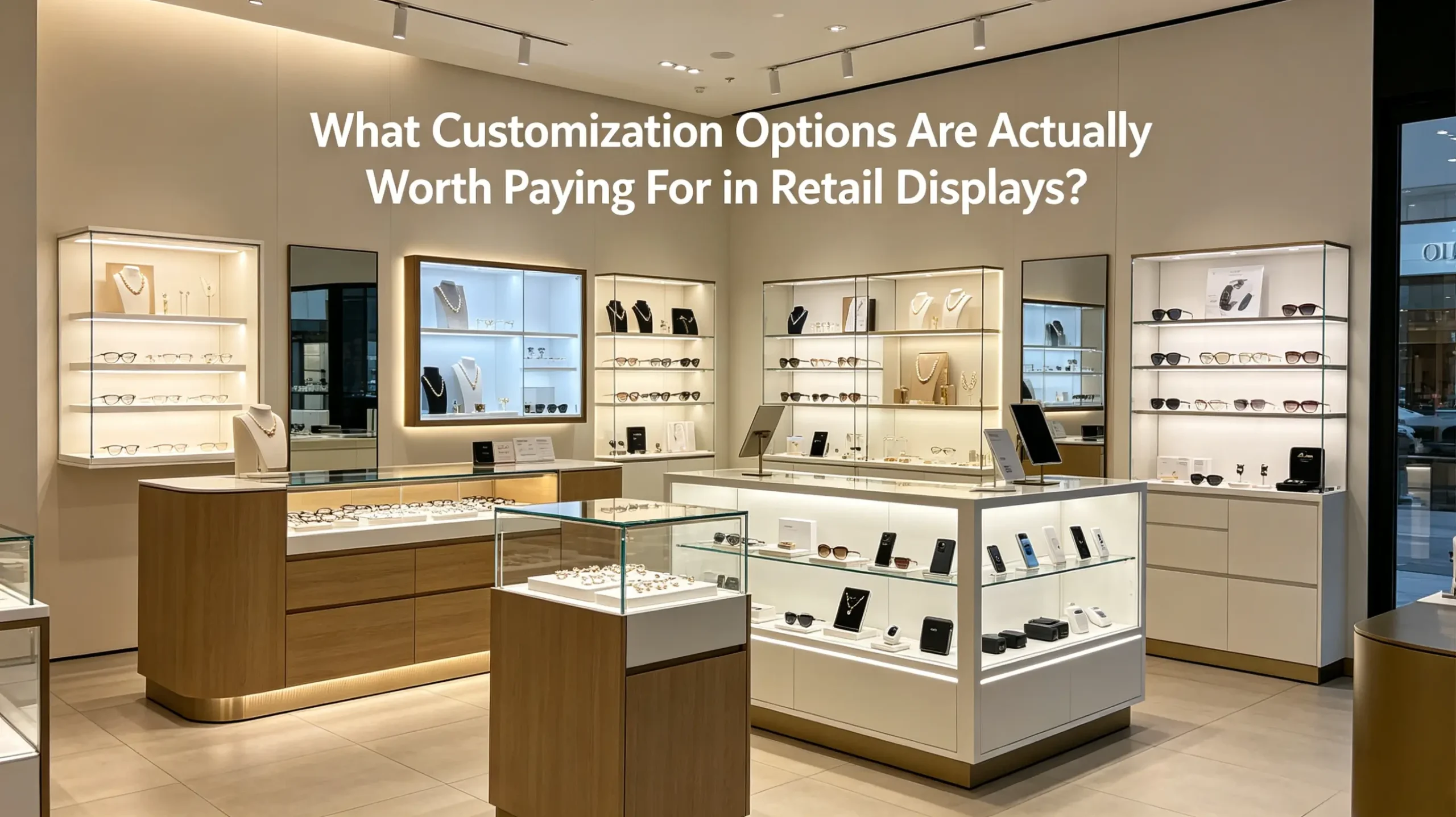
What Customization Options Are Actually Worth Paying For in Retail Displays?

The truly worthwhile and cost-adding customization options for retail display cabinets mainly include five practical features: ADA-compliant size adjustment, adjustable layered LED lighting, anti-theft tempered glass, modular assembly structure, and brand-exclusive paint etching. Other fancy decorations and non-essential special-shaped customization come with high premium costs and are unlikely to increase store foot traffic and conversion rates. When small and medium-sized American businesses purchase commercial retail display cabinets, they prioritize investing their budget in the above-mentioned functional customizations. The overall cost-effectiveness is much higher than upgrading the appearance.
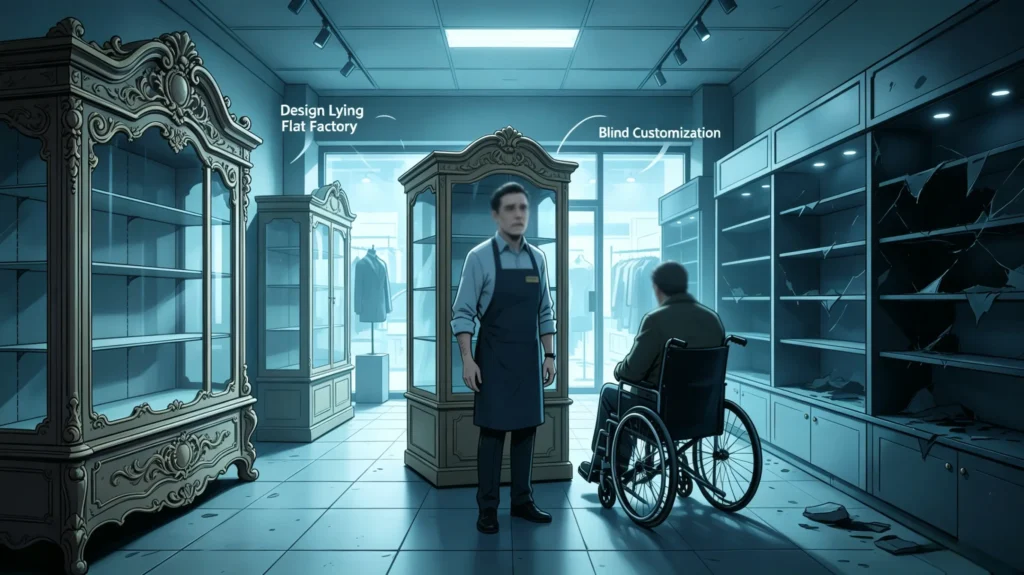
What pitfalls and pain points might you encounter if you blindly customize display cabinets?
- Excessive investment in decorative patterns and customized special shapes has not improved the display effect of the goods, and the duration that customers stay in the store has not changed. This approach is completely unable to increase sales.
- Ignoring the ADA compliance size customization, the cabinet arrived but did not meet the standards for entering the mall. The aisle width and display height did not meet the requirements, making it impossible to successfully open a dedicated store.
- Choosing low-cost and simple lighting customization, the products frequently broke down after using for half a year. The local repair costs in the US were extremely high, and the subsequent expenses far exceeded the customized price difference saved in the early stage.
- Directly purchasing standardized finished cabinets without customizing the depth and width according to the store area has led to a crowded aisle that does not comply with the passage standards for American supermarkets, resulting in the loss of wheelchair customers.
Which retail display case customization features are worth the extra cost?
1.Is ADA Compliant customization worth the extra budget alone?
It’s definitely worth it; this is a necessity for US retail stores.
Standard ready-made display cases have uniform dimensions, making it difficult to fit the specific space and aisle width of each store.
US brick-and-mortar stores and street-front shops have clear ADA (American Association of Retailers) regulations, with strict requirements on cabinet height, depth, and aisle clearance.
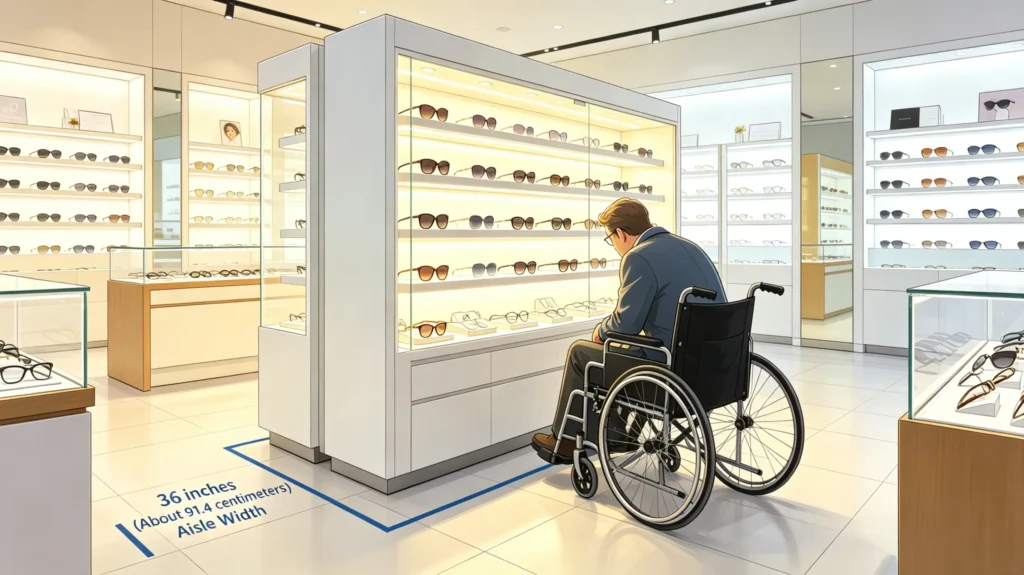
Custom-sized display cases can precisely match the store space, allowing for a standard 36-inch walkway and a 36-inch accessible display counter, avoiding issues like delivery that can’t be installed or mall-mandated modifications.
Suitable for: eyewear stores, small jewelry stores, department store counters, and small boutiques under 500 square feet.
2.Is it worth paying to upgrade to layered adjustable LED lighting?
It is highly recommended to upgrade. This is the core customization for increasing the transaction rate of the products.
The ordinary basic light bulbs offer a monotonous light, making small jewelry and eyeglass frames appear dull and difficult to attract customers to stop and take a closer look.
Layered independent dimming LED customization allows for adjusting the light intensity according to the height of the goods. There is no reflection or color difference inside the glass cabinet.
At the same time, this customized lamp complies with the low energy consumption electricity usage standards of the United States. It can save electricity costs over the long term and also aligns with the local green business consumption preferences.
Luxury-simplified and small-sized high-priced goods stores. The revenue increase brought about by customized lighting can quickly cover the customization costs.
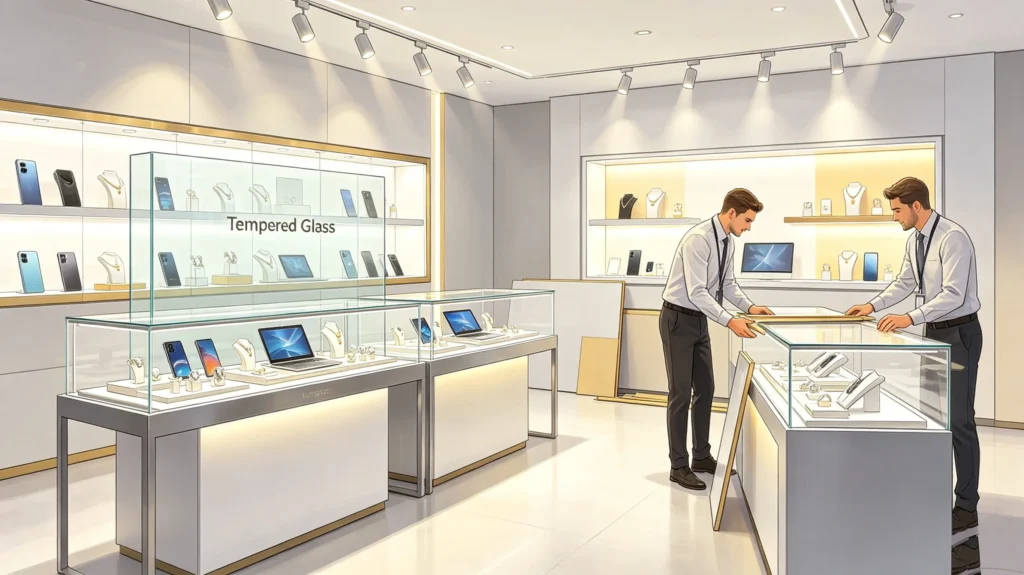
3.Is it necessary to spend extra money to customize thickened, explosion-proof, and burglarproof tempered glass?
For stores dealing with high-value goods, this customization must be chosen.
Ordinary thin glass is prone to shattering upon impact. When jewelry, brand glasses, and small electronic items are stolen, merchants will suffer significant losses.
The thickened tempered glass is integrated with the lock mechanism for customized design. This enhances both the anti-theft and impact resistance capabilities. Many local commercial insurance policies in the United States will reduce the insurance premiums for stores equipped with display cabinets with anti-theft glass. In the long run, this can result in a significant savings in fixed expenses.
4.Are modular, modular cabinet designs suitable for US retail stores?
Suitable for all retailers who have the need for seasonal changes and store expansion.
The integrated fixed large display cabinet cannot be disassembled. When the store needs to adjust the display or add new dedicated cabinets, the entire unit has to be replaced, which incurs extremely high costs.
The modularly customized cabinet can be freely assembled and disassembled, enabling flash stores and multi-store merchants to repeatedly transport and reuse it.
In the later stage of expanding the business area of the store, only the same-sized modules need to be supplemented, without the need to purchase a complete set of display cabinets anew. Long-term operation can significantly reduce the cost of repeated purchases.
5.Should stores charge extra for exclusive brand paint finishes and logo etching customization?
The basic single-color paint finish and small logo engraving offer very good value for money. Complex relief designs and large-scale three-dimensional patterns are not recommended.
The display cabinets with unified brand color scheme can enhance the visual memory of the store. Local customers passing by are more likely to remember the store, thereby increasing the repeat purchase rate.
For independent small stores and chain outlets on the streets in the United States, basic logo customization can be carried out. Without incurring high premium costs, it is possible to create a distinct difference from competing stores in the vicinity.
Which types of custom retail display cabinets are completely unnecessary to spend extra money on?
1.This type of customization only serves a decorative purpose and cannot bring actual benefits in terms of customer traffic, product display, or compliance. It is recommended to abandon it directly.
2.Complex three-dimensional carvings and irregularly shaped curved cabinets: High premium, occupy display space, are difficult to clean, and do not conform to the minimalist American retail aesthetic.
3.Extra-thick, non-standard custom-made cabinets: Excess depth only encroaches on aisles, violates ADA standards, and does not increase the amount of merchandise that can be displayed.
4.Rare and special stone materials and metal plating: High maintenance costs, easily scratched and discolored, and deteriorates even faster in humid regions of the United States.
5.Multi-layered and redundant partitions: Fixed partitions cannot be adjusted, have a narrow range of compatible products, and limit future display adjustments.
How should customized budgets be allocated for different US retail formats?
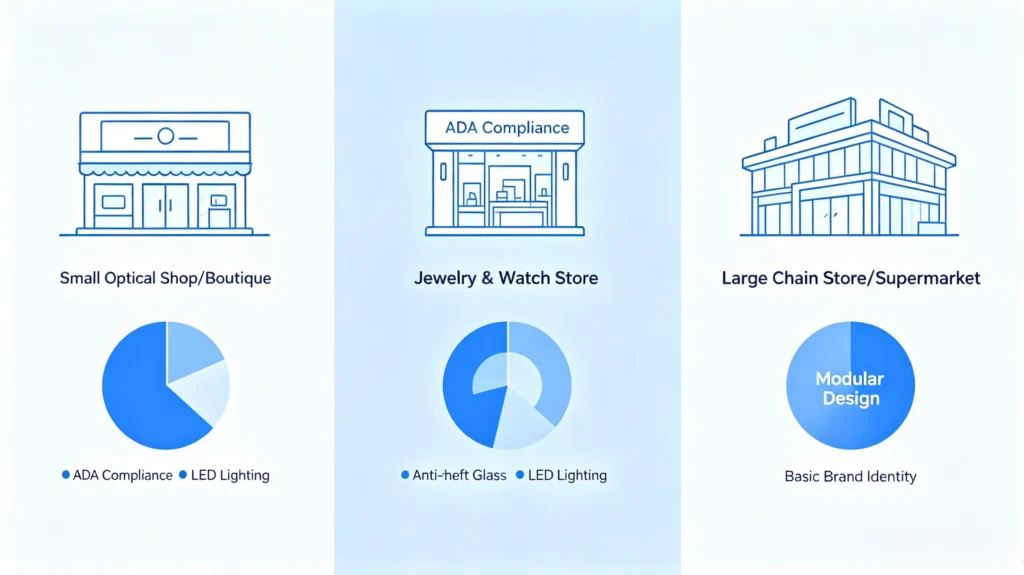
Small optical shops, street boutiques (within 500 square feet)
Budget focus: ADA size customization + layered adjustable LED lighting. Due to limited store space,
priority is given to ensuring that the cabinets fit the space and that passage is compliant. Lighting enhances the display quality of eyeglasses and accessories, while all other decorative customizations are reduced.
Jewelry and watch boutiques
Budget Focus: Anti-theft tempered glass + layered dimming LED
With high unit prices for store merchandise, anti-theft and visual appeal are key considerations. The dimensions will be based on standard market specifications, requiring only minor adjustments to fit the store layout.
Large multi-brand stores and chain supermarket counters
Budget focus: Modular cabinetry + basic brand logo finish
Stores frequently adjust display zones; modular cabinetry allows for flexible modifications, maintaining a unified brand appearance and chain image; basic standard lighting is selected.
What are some practical tips for American businesses to save money when customizing retail display cases?
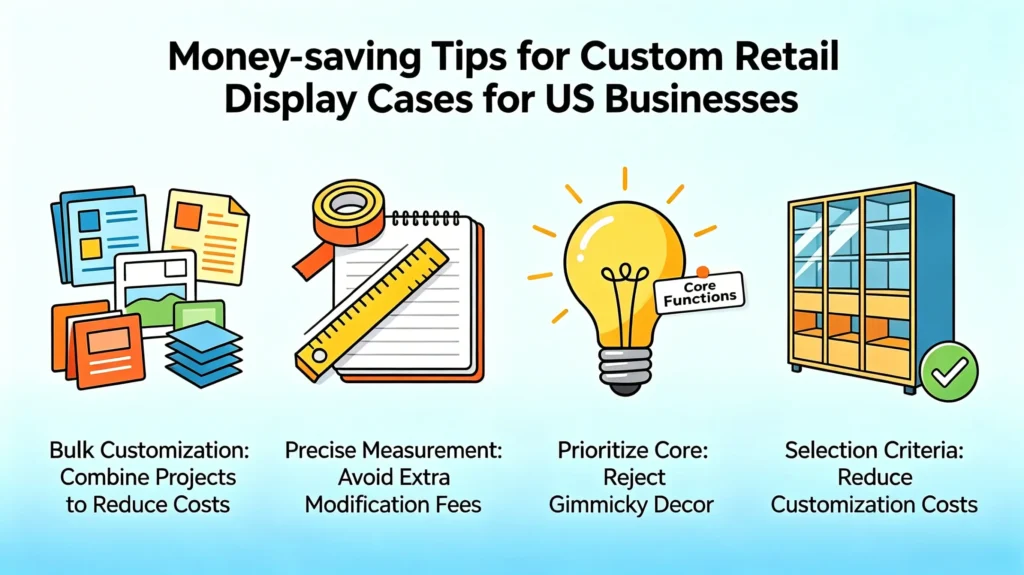
1.Bulk customization of multiple cabinets reduces the factory’s markup on individual custom pieces, making it much more cost-effective than ordering a single cabinet individually.
2.Precisely measuring store layout and aisle width before opening allows for finalizing ADA dimensions in one go, avoiding additional processing fees from modifications.
3.Only the five core practical customizations mentioned earlier are retained; all exterior decorative upgrades are eliminated to control the overall budget.
4.Standard market-based cabinet frames are used, with upgrades only to lighting, glass, dimensions, and other functional configurations, avoiding the need for entirely custom-made irregular frames.
Summarize
There are no standardized options for custom retail display cases. To determine if it’s worth the investment, consider only two factors: whether it complies with the ADA (American Retail Association) guidelines for US stores, and whether it directly increases sales or provides long-term cost savings.
Size compliance, lighting, burglarproof glass, modular structure, and basic branding are high-return customization options for the vast majority of US retail stores. Purely decorative designs and special material customizations offer very low returns, and we do not recommend businesses increase their budget for these.
If you are planning to open a physical store in the US and are unsure which cost-effective retail display case customization options are suitable for your store, please provide your store area, main product categories, and photos of the premises. We will provide a free, customized solution and detailed quote, offering advice within 24 hours.