How Museum-Grade Custom Showcases Doubled a Jewelry Store’s Average Transaction Value

Many people think that museum display cases have nothing to do with jewelry stores. In fact, it is quite the opposite – high-end jewelry is essentially “wearable collection items”. The exhibition needs of the two are almost completely the same: to protect valuable items, to focus visual attention, to create a sense of scarcity, and to give customers a psychological hint that “this thing is very precious”. Raising the standard of luxury retail display to the museum level is equivalent to directly raising customers’ consumption expectations from “buying jewelry” to “collectibles”, and the increase in the average transaction value is a natural result.
Complete Showcase List and Design Details
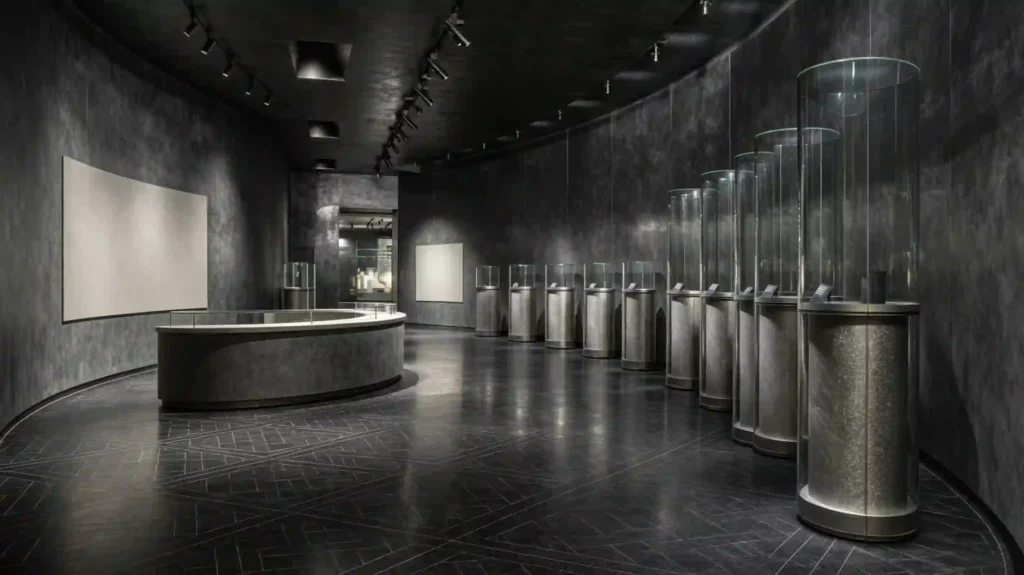
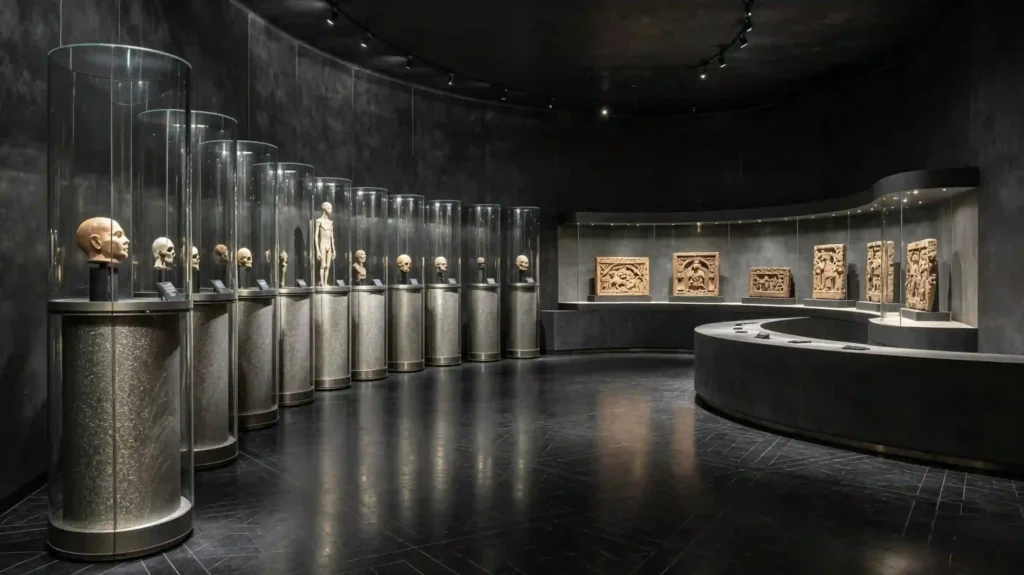
The entire store adopts an arc-shaped circulation design, and follows an overall dark-toned and sophisticated style: the walls are made of dark gray textured cement paint, the floor is covered with dark-colored matte geometric pattern tiles, and all the lighting is composed of key track-mounted spotlights, without any global main lights. It is in perfect alignment with the lighting environment design of a museum.
All display cases in the project are custom-made for jewelry stores, perfectly fitting the curvature of the space with no wasted space. A detailed list is as follows:
| Display Case Type | Quantity Deployed | Placement Location | Core Display Application |
|---|---|---|---|
| Full-Height Cylindrical Freestanding Display Cases | 24 units | Arranged along walls on both sides of the main aisle | Independent display of single high-value jewelry pieces, creating a ceremonial visitor flow |
| Curved Island Low Display Counters | 2 sets | Entrance corners and central area of the space | Bulk display of try-on styles, balancing sales conversion and traffic flow guidance |
| Curved Wall Recessed Display Cases | 3 sets | Full inner curved wall surface | Set display of jewelry collections, driving add-on sales |
| Flagship Ring-Light Freestanding Display Cases | 2 units | Store focal point and VIP room entrance | Exclusive display for signature high-end custom pieces, setting brand value benchmark |
| Low-Profile Compact Cylindrical Display Cases | 4 units | Next to lounge areas and traffic flow corners | Accent display for small accessories, boosting impulse purchase conversion |
The design details are broken down one by one, and each one corresponds to the actual on-site effect:
1.Top-mounted cylindrical independent display cabinet
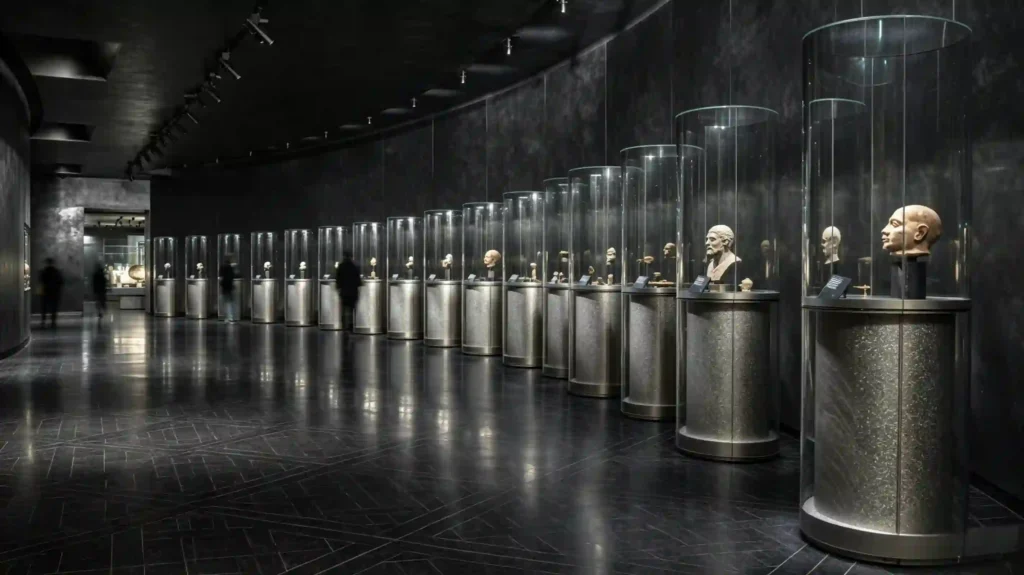
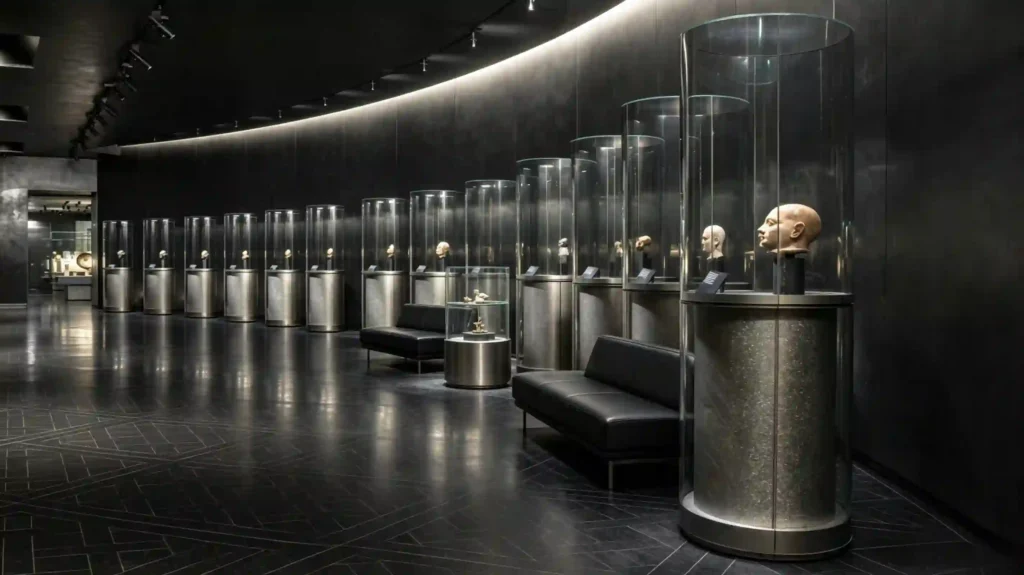
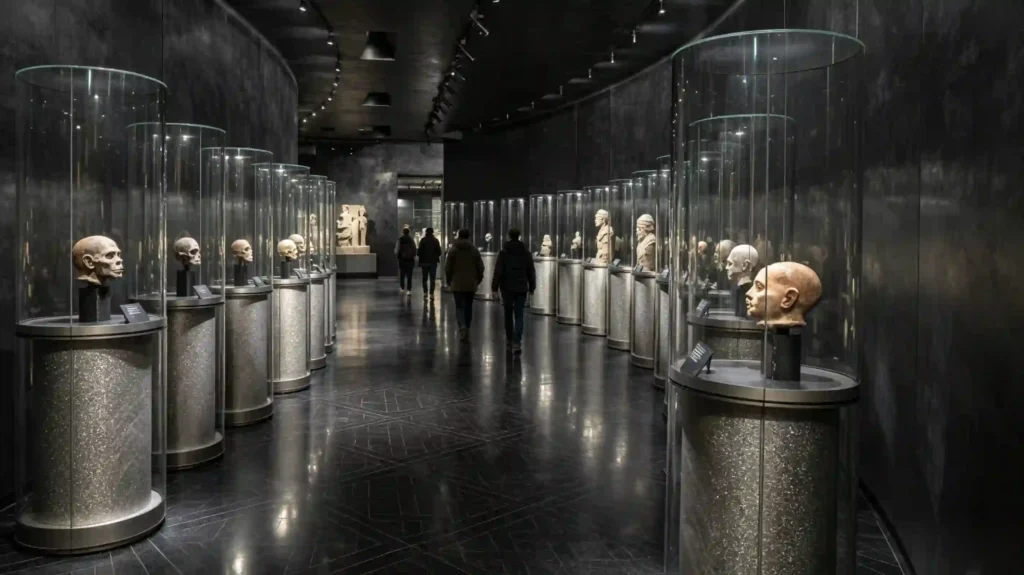
This is the model with the largest number of stores. It is also the core element that creates the atmosphere of the museum. A whole row is evenly arranged along the curved wall surface. The base is made of brushed metal with a granular texture, which is fingerprint-resistant and scratch-resistant. On top is a full arc-shaped ultra-clear glass ceiling design. There are no seams for assembly and no extra metal frames, giving a clean and transparent visual effect.
Each cabinet holds only one piece of jewelry. At the top, there is a dedicated track-mounted spotlight that precisely shines on the exhibits. The surrounding environment is dimmed. When customers walk along the passage, their eyes will be naturally drawn to each piece of jewelry, and they will naturally slow down their pace, experiencing exactly the same feeling as when visiting the museum’s artifact exhibition area. Each piece of jewelry has its own “unique item” aura.
The safety standards are directly benchmarked against museum display cabinets: laminated explosion-proof glass, embedded anti-theft locks, and UV-resistant coatings. This not only ensures that the gemstones do not fade but also completely eliminates concerns about the safety of valuable items. As the classic model of our custom display cases for business, this standalone cabinet is almost a must-have for high-end jewelry stores to enhance their upscale image.
2.Arc-shaped island low display cabinet
Two sets of island-style counters are custom-made along the spatial curvature. The cabinet bodies are made of dark gray matte material of the same color as the wall. A ring of low-profile ultra-white glass encircles the countertop, which is precisely at the height of the customer’s waist and abdomen. It is just within reach for the salesperson to take the goods and try them on.
This kind of display cabinet is mainly used to display relatively basic and frequently tried-on styles. After customers browse through the individual cabinets, they can stop here at the island to try them on. The sales process is very smooth. Because the entire space has an arc-shaped flow, the island has also been rounded off with the same arc degree, without any sharp right angles. When customers walk around, there is no sense of oppression, and they are more likely to stay.
3.Arc-shaped wall-mounted display cabinet
The built-in long display cabinet along the inner curved wall is completely embedded in the wall. The cabinet body is flush with the wall surface, and there is no obvious border around the cabinet. The visual integrity is extremely strong.
The interior of the cabinet is divided into multiple layers for display, specifically designed to hold jewelry from the same series. For example, necklaces, bracelets and earrings with the same design are placed together in sets, allowing customers to immediately see the complete matching effect. This makes it very easy to trigger subsequent purchases. The lighting is provided by a diffused light strip hidden at the top of the cabinet. The light is soft and not dazzling, and it does not cause glare on the gemstones. The texture is excellent, and it is completely consistent with the display concept of the museum’s relief exhibition area.
4.Premium circular light independent display cabinet
Two high-end display cabinets specially designed for the flagship product were placed at the most central position of the store and at the entrance of the VIP room. They act as the “value anchor points” for the entire store.
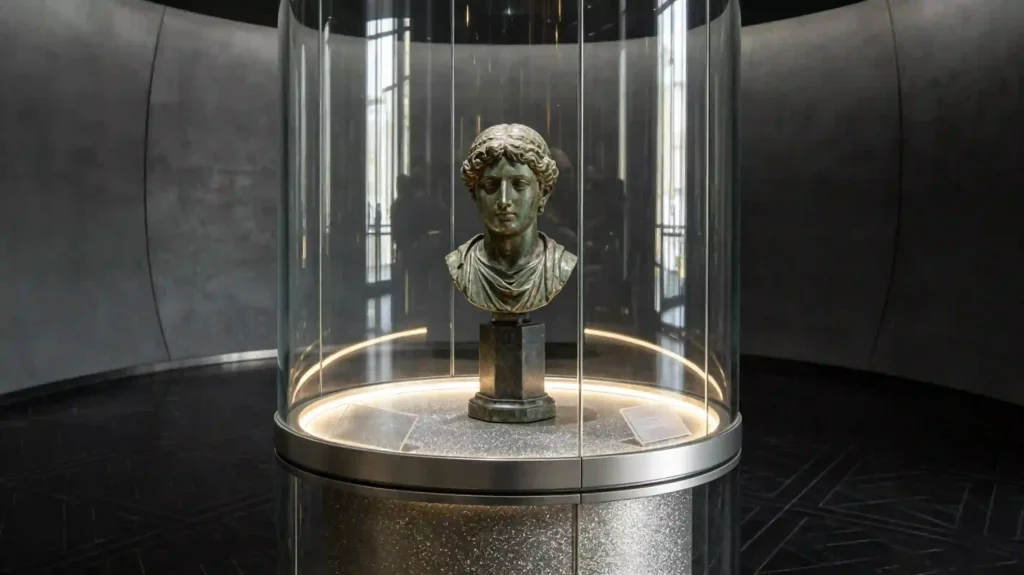
Unlike ordinary round cabinets, this one has a thicker base and a stronger texture. The interior of the glass cover is equipped with a hidden circular warm light strip that provides 360-degree ambient lighting. The jewelry is placed in the center, and the iridescent colors can be seen from every angle. Standing from any direction, it is truly exquisite. Additionally, a frosted illuminated countertop has been added at the bottom, enhancing the overall atmosphere. Customers will simply can’t help but stop and take a closer look when passing by.
Many high-net-worth clients were drawn into the store by the exhibits in these two cabinets. Even if they didn’t purchase the flagship product in the store, they would choose other mid-to-high-priced items. This is equivalent to using one exhibit to raise the overall price expectation of the entire store.
5.Low-profile small cylindrical display cabinet
A reduced-sized cylindrical display case is placed next to the black leather sofa in the lounge area and at the corner of the passage. It is mainly used to display small accessories such as rings and earrings.
The customer got tired from shopping and sat down to rest. His gaze fell upon these small cabinets just then. He could simply ask the salesperson to bring out the items for him to try on without having to get up and go to the counter. It was very easy to make a casual purchase. Don’t underestimate these small items. Many sales figures are achieved through the combination of “main stone + accessories”. The increase in conversion rate is entirely due to such detailed design.
The core reason for doubling the average order value
Many people may wonder: It’s just a matter of changing the cabinet, how could the average order value double? In fact, it’s not the function of the cabinet itself that makes the difference, but the display logic of this set of museum display cases that fundamentally changed the consumption psychology of the customers. We reviewed the operational data for six months and the main reasons are threefold:
- The value expectations have been directly elevated, and customers are no longer sensitive to prices.
The display cases in an ordinary jewelry store are obvious indicators that it’s a “sales counter”. When entering, customers will instinctively ask themselves, “Is it worth this price?” But when entering a museum-level exhibition area, the environment, lighting, and the texture of the display cases will all give customers a strong psychological hint: The items here are of a collection-grade level, and it’s normal for them to be expensive.
The customers’ consumption mentality has shifted from “choosing based on cost-effectiveness” to “choosing the items they like”, and their tolerance for prices has significantly increased. The data shows that after the renovation, the number of inquiries from customers about items priced above 3000 US dollars has increased by more than three times compared to before.
- The movement path was extended, resulting in a significant increase in the dwell time, with the connection rate doubling or more.
The curved flow line combined with the design of separate cabinets on both sides makes customers want to walk around the entire store. They must follow the path and complete a full circle. The average time spent in the store has increased from the original 7.8 minutes to 21.5 minutes.
The longer the stay time, the more opportunities there are for sales and customer communication. Coupled with the integrated display cabinets, customers can easily shift from “buying one item” to “buying a set”. We have conducted statistics and found that the cross-selling rate in the store has increased from 20% before the renovation to 46% after the renovation. This is the most crucial support for the increase in average transaction value.
- Individual items are displayed separately to enhance the sense of scarcity, resulting in a significant increase in the sales of high-priced items.
The design of one piece per cabinet makes each piece of jewelry a “unique exhibit”, creating a strong sense of scarcity. Customers won’t feel that “this style is everywhere”, but instead will have the mentality of “if you miss it, you’ll never get it again”, significantly shortening the decision-making cycle.
The data speaks for itself: Before the renovation, high-priced items priced above $500 accounted for only 8% of the total sales; after the renovation, this proportion rose to 28.7%. With the increase in the proportion of high-priced items, it was only natural that the average transaction value doubled.
Open a new store or renovate your existing one!
In fact, not only jewelry stores, but all high-end retail brands can adopt this museum-level exhibition concept. A good custom jewelry display is never just a simple “storage cabinet”; rather, it is a hidden sales tool that helps the brand tell its story and provide value endorsement for the products.
As a professional commercial display furniture supplier, we have always applied museum-level craftsmanship and exhibition logic to various high-end retail scenarios. Whether it’s for chain brands that need bulk display cases for retail stores, or individual stores that want to do full-customization, this proven logic has the ability to significantly enhance the performance of your store.