
Custom Copper Reception Counter: A B2B Guide to Height, Shape & Design

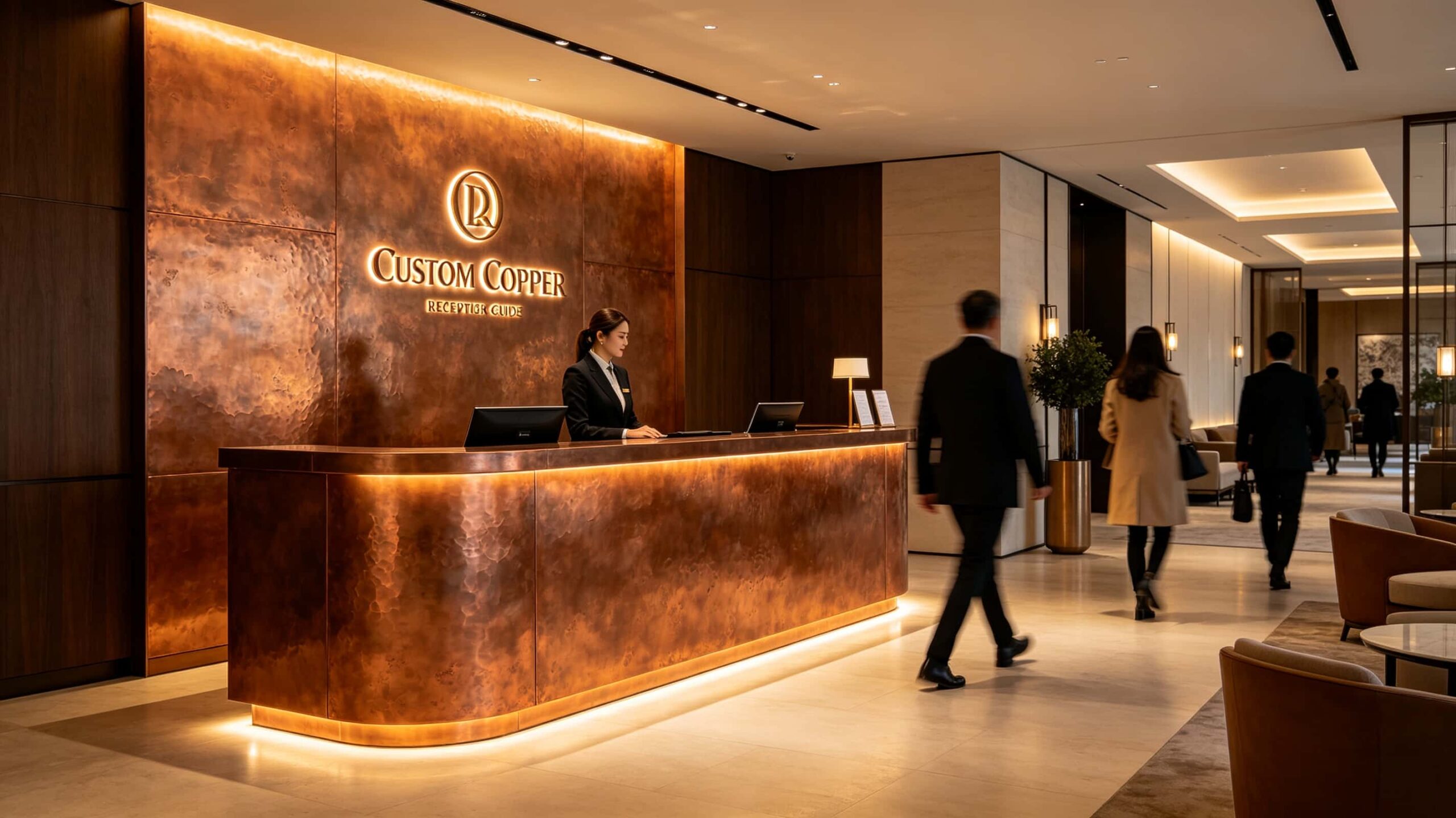
A custom copper reception counter is not a one-size-fits-all purchase. This guide breaks down the exact heights, shapes, color pairings, built-in features, and layout tricks that help facility managers, hotel owners, and architects specify a desk that works ergonomically and visually.
Most buyers come to us after a failed Google search for standard dimensions or after receiving wildly different quotes. They have seen beautiful hammered copper reception counter photos online, but no one explains the practical specs that decide whether the desk works on day one. This guide fixes that. We will cover hard numbers, material trade-offs, and factory-level details you will not find in a brochure.
How high should a reception counter be?
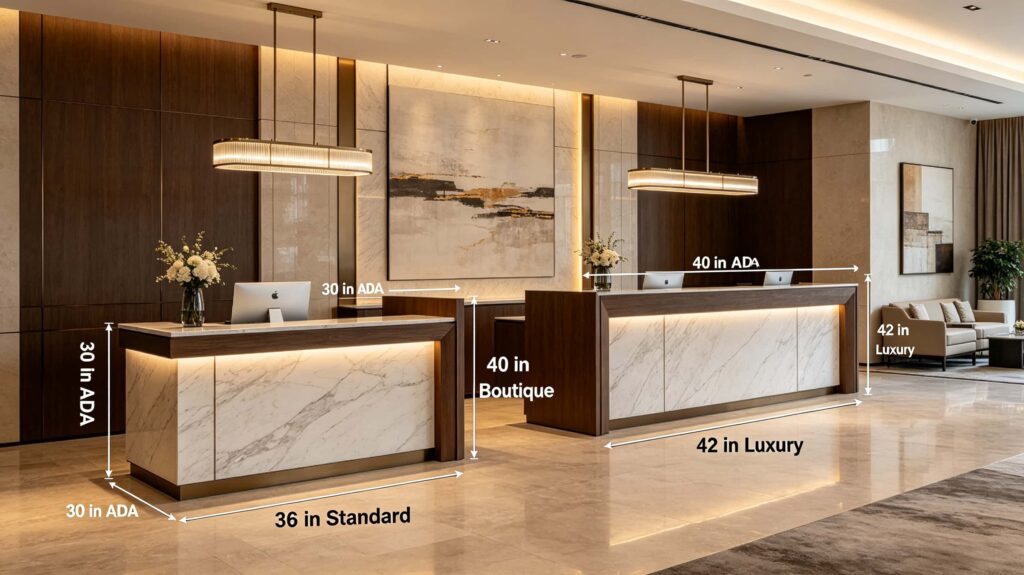
The short answer is 36 inches for standard commercial use and 42 inches for luxury hospitality desks. The extra height on a high-end copper counter adds visual presence and gives standing staff a more commanding posture. For ADA-compliant sections, keep a 30-inch lowered transaction area at least 36 inches wide.
Height affects both guest interaction and staff fatigue. A desk that is too low forces receptionists to hunch forward. A desk that is too high makes visitors feel like they are talking to a wall. Use the following reference points when specifying your custom copper reception counter:
- 30 inches: Required lowered section for wheelchair access. Keep this portion clear of sharp copper edges.
- 34–36 inches: Standard commercial reception height. Works well for seated or standing staff with a tall chair.
- 38–40 inches: Common in boutique hotels and medical offices. Adds a slight separation without feeling intimidating.
- 42 inches: Luxury hotel and high-end corporate standard. Pairs well with a raised guest side at 36 inches for a two-tier transaction surface.
| Height | Best For | Guest Feel | Staff Ergonomics |
| 30 in | ADA section | Accessible | Requires low chair |
| 36 in | Offices, clinics | Approachable | Works standing or seated |
| 40 in | Boutique hotels | Upscale but warm | Standing preferred |
| 42 in | Luxury hotels, banks | Commanding | Standing only |
If you are specifying a two-tier custom copper reception counter, keep the upper guest writing surface between 30 and 36 inches and the inner staff work surface at 28 to 30 inches. This hides desk clutter and computer screens from visitors while keeping the copper face as the visual hero.
What is the ideal shape for a reception desk?
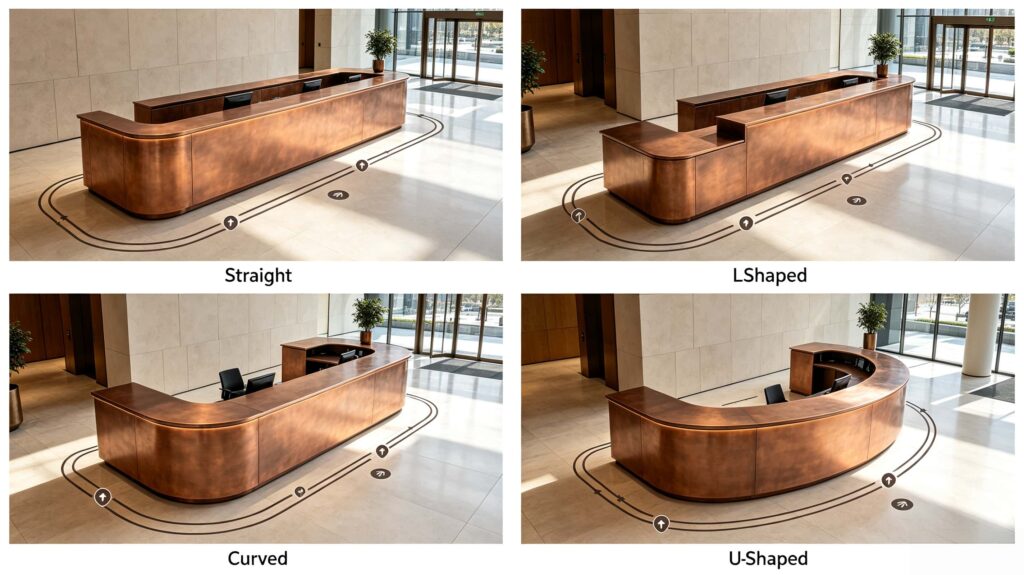
There is no single ideal shape. Curved desks work best for large, open lobbies with heavy foot traffic. L-shaped desks suit corner placements and multitasking teams. Straight copper reception counters remain the most cost-effective choice for compact offices or narrow entry corridors. Choose based on room geometry first.
Shape determines traffic flow, staff capacity, and fabrication cost. A curved custom copper reception counter requires more forming labor and a larger shipping crate. An L-shaped desk often ships in two sections and joins on site. A straight desk is the fastest to produce and install.
- Curved: Best for wide lobbies, hotel entrances, and spaces with multiple entry points. Directs guests naturally toward the center. Expect 15–25% higher fabrication cost than straight.
- L-shaped: Ideal for corner placement or dual-function reception areas. Gives one staff member a private work wing. Requires precise field measurements.
- Straight: Most efficient for narrow rooms. Easy to specify, ship, and install. Works well with a backlit copper panel for branding.
- U-shaped: Rare for copper due to cost, but useful in very high-traffic security checkpoints. Consider only if floor plan demands three-sided access.
| Shape | Space Required | Traffic Flow | Relative Cost |
| Straight | 6–10 ft width | Linear | Lowest |
| L-shaped | Corner, 8×8 ft min | Two-direction | Mid |
| Curved | 10+ ft width | Radial, smooth | Highest |
| U-shaped | 12×12 ft plus | Controlled | Very high |
Before choosing a shape, mark the main entry door swing, column locations, and fire egress paths on your floor plan. A beautiful curved copper reception desk placed too close to a door swing becomes a liability. Factory engineers often catch these issues when clients send a simple PDF floor plan.
What color looks best with copper?
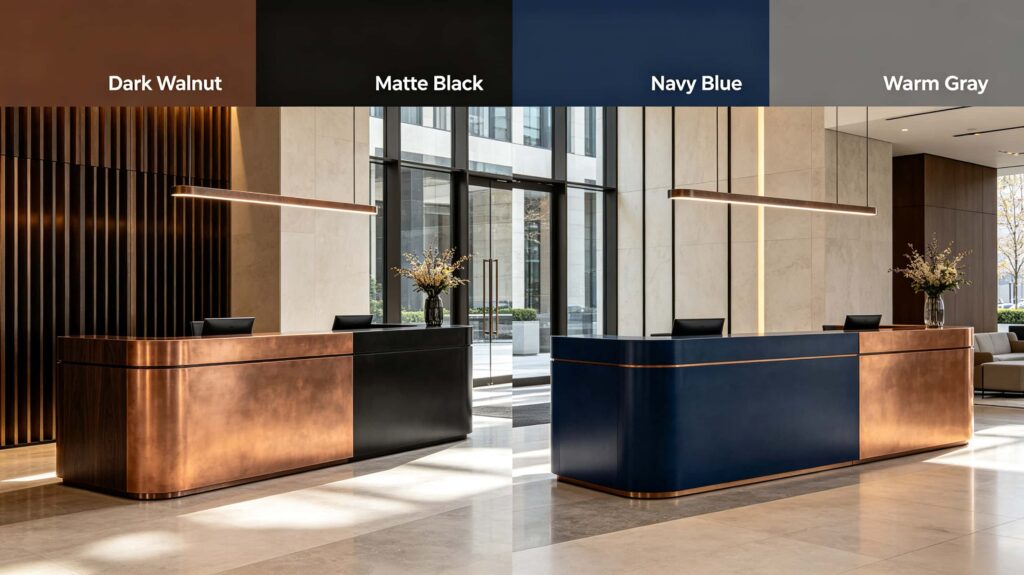
Dark walnut, matte black, and navy blue are the three safest high-contrast partners for a copper reception counter. These colors absorb light and let the copper surface glow without looking flashy. Avoid bright reds, oranges, or yellows—they compete with copper’s natural warmth and cheapen the overall look.
Copper is a living finish. It ranges from bright penny tones to deep chocolate brown depending on patina and sealant. Your surrounding palette should anchor that variation, not fight it. Here is how each recommended color works:
- Dark walnut: Adds a warm, traditional luxury feel. Works exceptionally well with oil-rubbed copper panels in boutique hotels and law offices.
- Matte black: Creates a modern, industrial edge. Best for tech headquarters, high-end retail, and urban restaurants. Use blackened steel or powder-coated aluminum frames.
- Navy blue: A quieter alternative to black. Pairs beautifully with aged or hammered copper and gives a coastal or hospitality mood.
- Warm gray or greige: A safe neutral if your brand does not allow dark colors. Keep it warm to avoid making copper look pink or orange.
| Pairing | Vibe | Best Application |
| Copper + dark walnut | Classic, rich | Hotels, law offices |
| Copper + matte black | Modern, bold | Tech firms, retail |
| Copper + navy blue | Sophisticated, calm | Resorts, clinics |
| Copper + warm gray | Subtle, flexible | Corporate lobbies |
Do not pair copper with bright white walls alone. The contrast can make the desk feel too orange. If your walls are white, add a dark wood reception backdrop or install a navy blue feature wall behind the custom copper reception counter.
What should a reception desk have?
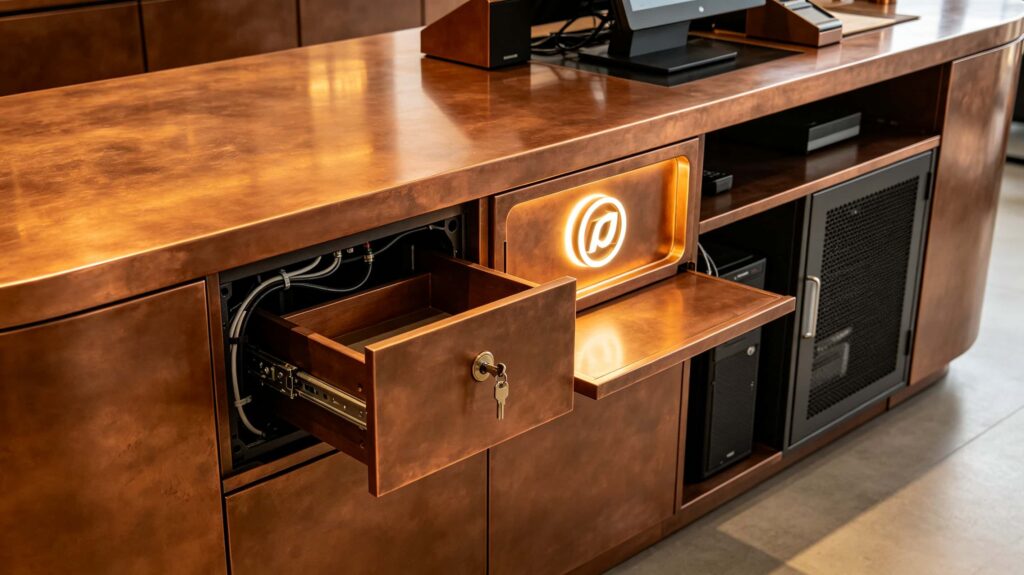
Every custom copper reception counter should include hidden cable management, at least one lockable drawer, and an illuminated logo space. These three elements separate a professional commercial desk from a decorative showpiece. Cable trays prevent tripping hazards; lockable storage secures guest logs and devices; a backlit logo builds brand recall.
These features are easy to overlook during design but expensive to retrofit. Specify them before the copper panels are cut. Otherwise you end up drilling holes through a finished patina on site, which is never clean.
- Hidden cable management: Include a recessed channel or removable back panel with grommets for power, data, and USB ports. Keep all wires below the counter and out of guest sight lines.
- Lockable drawers: At least one legal-size or shallow drawer with a cam lock. Hotels need space for registration cards, key packets, and lost-and-found items.
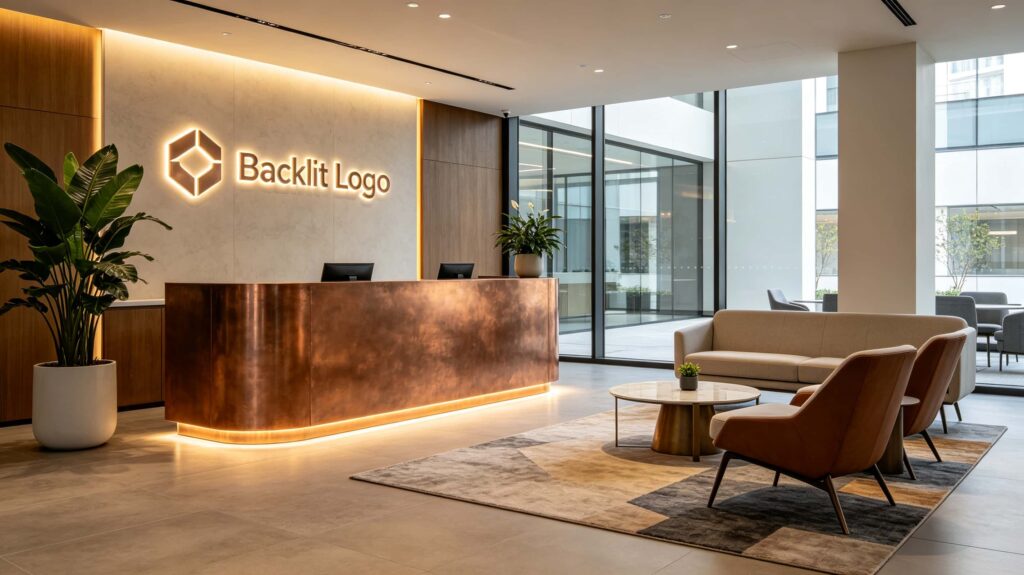
- Illuminated logo space: A recessed pocket on the front copper face or a backlit acrylic panel above the desk. Use low-voltage LED strips for even glow without heat damage to the copper.
- Transaction shelf: A 6–10 inch deep lower shelf on the guest side for purses, bags, or signature forms. This reduces leaning on the copper edge.
- Ventilated equipment cabinet: If the desk houses a computer tower or mini fridge, include a vented door and a lockable compartment.
Factory insider tip: always request a shop drawing that shows the exact cutout locations for grommets, logo pockets, and drawer slides before production begins. Copper panels cannot be easily modified after patina is applied.
How to decorate an office reception area?
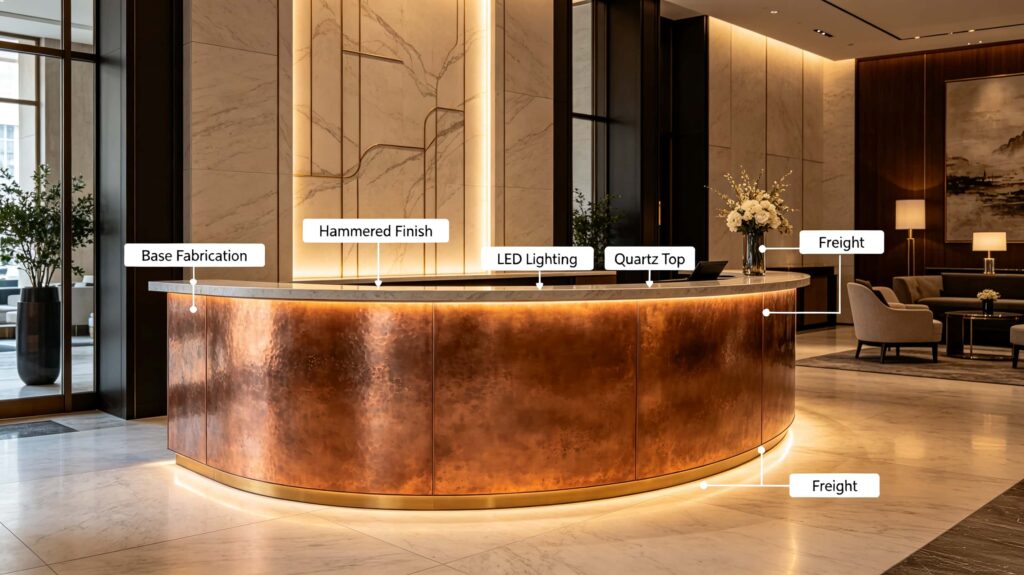
Start with three layers: LED accent lighting, large plants, and strong branding. LED strips under the copper counter or behind the front panel create depth. Plants soften the metal’s hard edges. A wall-mounted or countertop logo in backlit acrylic or brushed steel reinforces the brand without adding clutter.
Decoration should support the desk, not hide it. A custom copper reception counter is already a focal point. Overdecorating with too many frames or fake flowers dilutes the impact. Keep the area around the desk clean and purposeful.
- LED accent lighting: Install a warm 2700K–3000K strip under the front lip or inside a recessed toe-kick. This makes the copper appear to float and highlights the hammered texture.
- Plants: Use one large floor plant, such as a fiddle leaf fig or rubber tree, on one side of the desk. Avoid small pots scattered across the counter—they block sight lines.
- Strong branding: Mount a backlit logo behind the desk at eye level, about 60–66 inches from the floor. For copper desks with a matte black wall, use white or warm white lettering.
- Seating: Provide two guest chairs or a small bench at a 45-degree angle to the desk. This keeps the front face unobstructed.
- Flooring transition: If possible, change flooring material or add a rug under the reception zone. This visually defines the waiting area and reduces noise near the copper counter.
| Decoration Element | Purpose | Pro Tip |
| LED strip lighting | Depth, floating effect | Use warm white, not cool blue |
| Large floor plant | Softens metal | Keep below 4 ft to avoid blocking |
| Backlit logo | Brand recall | 60–66 in mounting height |
| Guest seating | Comfort, flow | Angle chairs slightly outward |
| Area rug | Zone definition | Low pile to avoid tripping |
Hammered copper reception counter vs smooth copper: which finish wins?
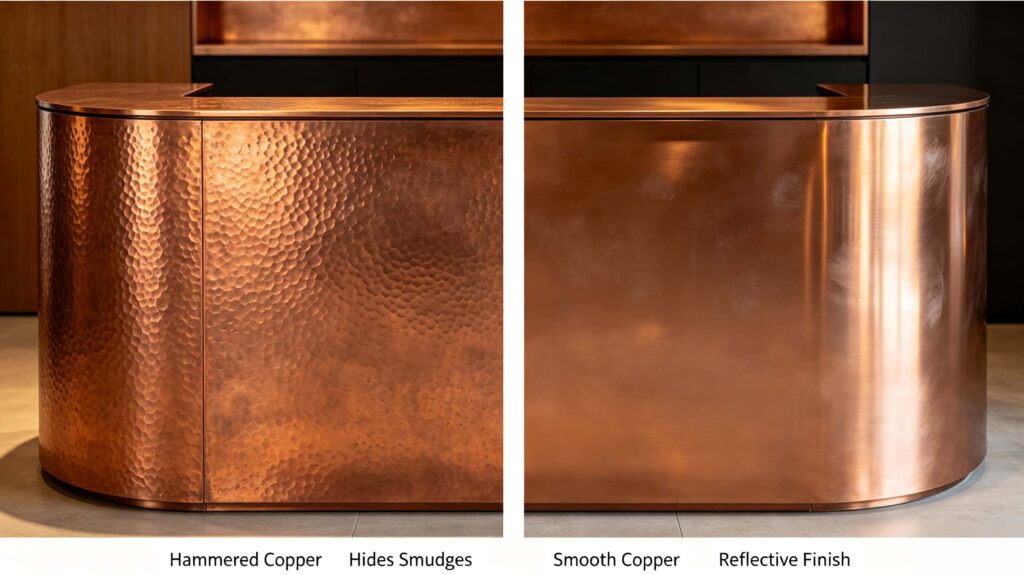
Hammered finishes hide fingerprints and minor dents better than smooth copper, but they cost 15–25% more due to hand labor. Smooth copper offers a mirror-like modern look but requires more maintenance. For high-traffic hotel lobbies, hammered copper is usually the smarter long-term investment.
The texture also changes how light behaves. A hammered copper reception counter scatters light across thousands of tiny facets, so scratches and smudges disappear. Smooth copper acts like a mirror and shows every touch. If your front desk staff cannot polish the surface daily, choose hammered.
Hammered copper: Hand-textured, hides wear, adds acoustic diffusion slightly, ideal for luxury hotel and restaurant settings.
Smooth copper: Reflective, sleek, easier to clean if sealed, best for low-traffic corporate offices or minimalist interiors.
Brushed copper: A middle ground with linear grain. Hides fingerprints better than smooth but not as much as hammered.
Aged or patina copper: Darker, warmer, and more forgiving. Often chosen for heritage buildings or moody hospitality spaces.
| Finish | Fingerprint Resistance | Maintenance | Relative Cost |
| Hammered | High | Low | +15–25% |
| Brushed | Medium | Medium | +5–10% |
| Smooth | Low | High | Baseline |
| Aged patina | High | Low | +10–20% |
Factory insider tip: if you choose smooth copper, insist on a high-quality clear powder coat or automotive-grade lacquer. Raw smooth copper oxidizes unevenly in high-humidity lobbies and can look blotchy within months.
Commercial reception desk materials: where copper fits
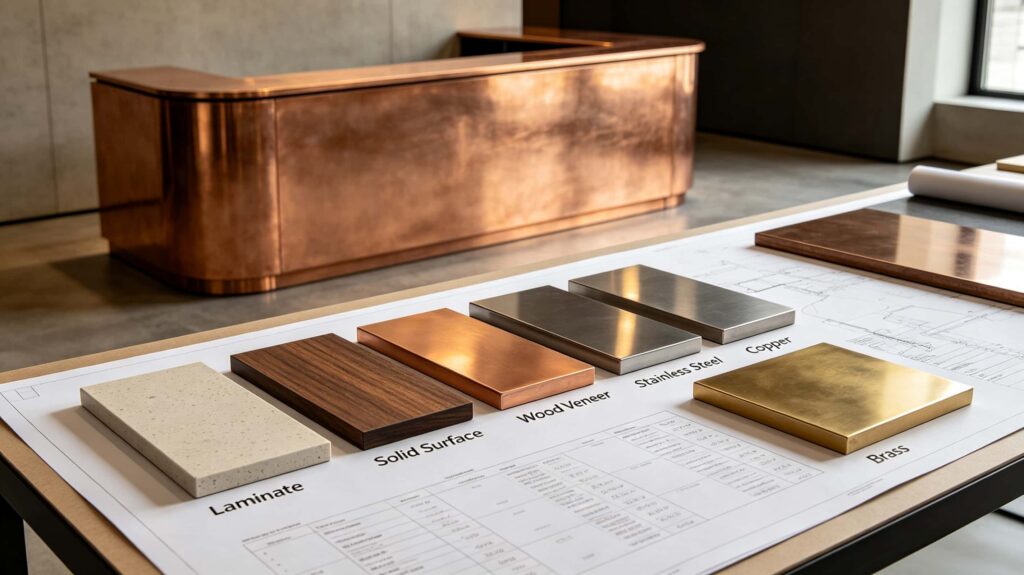
Copper sits between warm wood and cold stainless steel. It costs more than laminate and solid surface, but less than rare stone or solid brass. Copper gives you natural antimicrobial properties, a unique patina, and high perceived value—making it ideal for luxury retail, hotels, and corporate headquarters.
Not every project needs a full custom copper reception counter. Some clients use copper only for the front face, with a quartz or walnut top. Others wrap a structural steel frame in hammered copper sheets. Understanding where copper fits among commercial reception desk materials helps you allocate budget correctly.
- Laminate: $1,500–$4,000. Cheap but looks disposable. No real copper finish lasts.
- Solid surface: $3,000–$8,000. Seamless and easy to repair, but lacks metal warmth.
- Wood veneer: $3,500–$9,000. Warm but scratches easily. Needs frequent refinishing.
- Stainless steel: $5,000–$14,000. Durable but cold and industrial. Shows fingerprints unless brushed.
- Copper: $8,000–$35,000. Highest visual impact, antimicrobial, develops character over time.
- Solid brass: $15,000–$50,000+. Similar luxury feel but heavier and often more expensive than copper.
| Material | Cost Range | Durability | Luxury Feel |
| Laminate | $1.5k–$4k | Low | Low |
| Solid surface | $3k–$8k | Medium | Medium |
| Wood veneer | $3.5k–$9k | Medium | High |
| Stainless steel | $5k–$14k | High | Medium |
| Copper | $8k–$35k | High | High |
| Brass | $15k–$50k+ | High | Very high |
For most commercial projects, a custom copper reception counter with a wood or quartz top offers the best balance of warmth, durability, and brand statement.
Luxury hotel reception desk cost: what to budget
A custom luxury hotel reception counter in copper typically ranges from $8,000 to $35,000 depending on size, finish, and integrated lighting. Freight, crating, and site access can add 10–18%. Budget at least $12,000 for a small boutique desk and $20,000+ for a full-scale 10-foot curved unit.
Many hotel owners are surprised by the ancillary costs. The copper desk itself is only part of the total. You also need to pay for factory drawings, shipping insurance, and sometimes a third-party rigging crew if the desk cannot fit through a standard doorway.
- Base fabrication: $150–$350 per linear foot for a simple straight copper counter. Curved units run higher.
- Hammered finish upcharge: 15–25% of base metal cost.
- Integrated LED lighting: $40–$90 per linear foot for channels, diffusers, and drivers.
- Quartz or wood top: $50–$120 per square foot installed.
- Crating and freight: $800–$2,500 depending on distance and crate size.
- Site measurement and templating: $500–$1,500 if not using a local installer.
| Desk Type | Size | Estimated Total Cost |
| Straight boutique | 6 ft | $8,000–$14,000 |
| L-shaped corporate | 8×8 ft | $14,000–$22,000 |
| Curved hotel | 10–12 ft | $20,000–$35,000 |
| Two-tier luxury | 12+ ft | $28,000–$40,000+ |
Always ask if the luxury hotel reception desk cost includes the clear protective coating. Some factories quote raw copper only, and the client must pay extra for sealing on site.
How to choose a copper reception desk factory
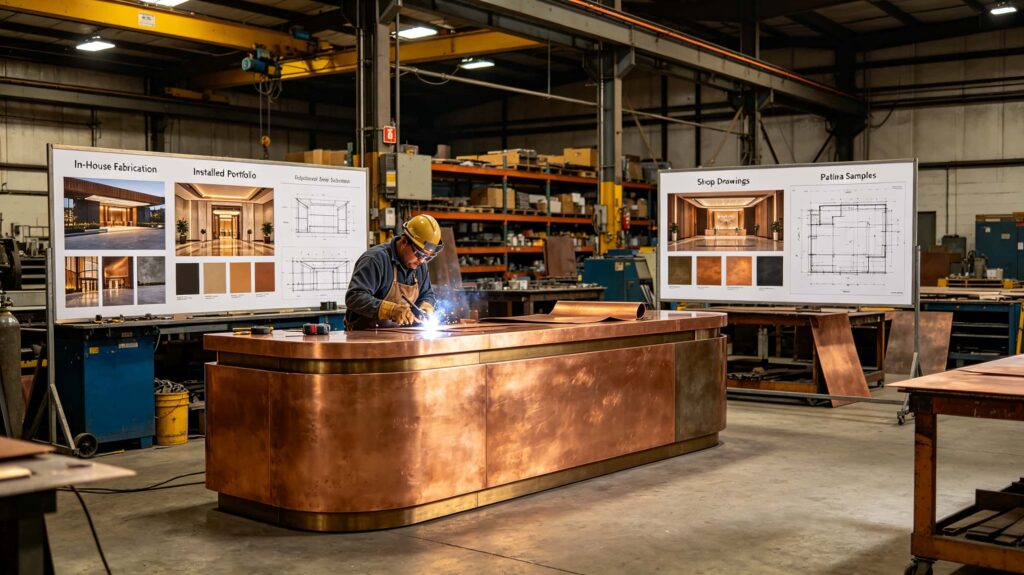
Look for a factory that does its own copper forming and welding in-house, not one that buys pre-made panels. Ask for photos of recent hotel or office installations, not just renderings. A good copper reception desk factory will provide shop drawings before production and never charge for basic 3D concept views based on your floor plan.
This is where many buyers get burned. A factory with no copper-specific experience will treat the metal like stainless steel, which leads to warped panels, uneven patina, and visible weld seams. Verify their process before you commit.
- In-house copper fabrication: Do they cut, bend, and weld copper sheets on their own floor? If not, quality control is limited.
- Portfolio of installed work: Ask for at least three recent hotel or commercial lobby photos. Video walkthroughs are even better.
- Shop drawings before deposit: A serious factory will send elevation drawings, section views, and wiring plans before asking for payment.
- Patina samples: Request three small copper samples with the exact finish you want. Lighting changes patina dramatically.
- Freight and installation support: Do they crate for export? Can they coordinate with your local installer or GC?
Factory insider tip: a reliable copper reception desk factory will offer free 3D design views from a simple PDF floor plan. If they ask for a large deposit before any drawings, walk away. We routinely produce a basic 3D concept in two working days once we receive a floor plan with door swings and column locations.
Get a quote now!
Stop guessing at dimensions and finishes. If you are planning a custom copper reception counter, send us your floor plan today. Our engineers will turn your PDF or hand sketch into a 3D design with exact height, shape, finish, and lighting options—at no cost and with no obligation. Factory insider tip: mention this guide and we will include a free set of patina samples and a basic shop drawing review with your 3D concept. Email your floor plan to our design team now and get a reception desk that fits your space perfectly, not just a pretty picture.
We can also customize the entire store’s fixtures and mall kiosks for you. Please check here!