
Before Opening a Small Ice Cream Shop You Need to Know These

Thinking about opening a small ice cream shop? Don’t jump into leasing and construction right away — get a few things straight first. A well-designed 20-30 sqm shop can outperform similar-sized locations by 30% in daily sales. This article walks through a real ice cream shop design case, covering space planning, counter layout, color schemes, lighting, and cost breakdowns — everything you need to figure out before opening. Whether this is your first shop or you’re expanding to a second location, these lessons apply.
1. Space Allocation: Make a Small Shop Feel Spacious
People often think smaller means cheaper. Not true — wasted space is the biggest cost of all.
The Golden Ratio for a 25 sqm Shop
This design is based on roughly 25 square meters of usable space, the most common size for mall or street-side ice cream shops.
| Area | Percentage | Approx. Size | Purpose |
|---|---|---|---|
| Counter & prep zone | 35% | 8-9 sqm | Production, pickup, cashier — the revenue engine |
| Dining & seating | 40% | 10 sqm | 12-16 seats, boosts average order value |
| Walkways & traffic flow | 15% | 3-4 sqm | Customer entry/exit, staff movement |
| Storage & restroom | 10% | 2-3 sqm | Inventory, cleaning supplies |
Don’t skip seating. Takeaway-only shops usually run 20%-30% lower average order value. Customers who sit down are far more likely to add a drink or side. Even 6-8 seats completely changes the experience.
Tricks to Visually Enlarge the Space
This design uses a few techniques that make 25 sqm feel more like 30+:
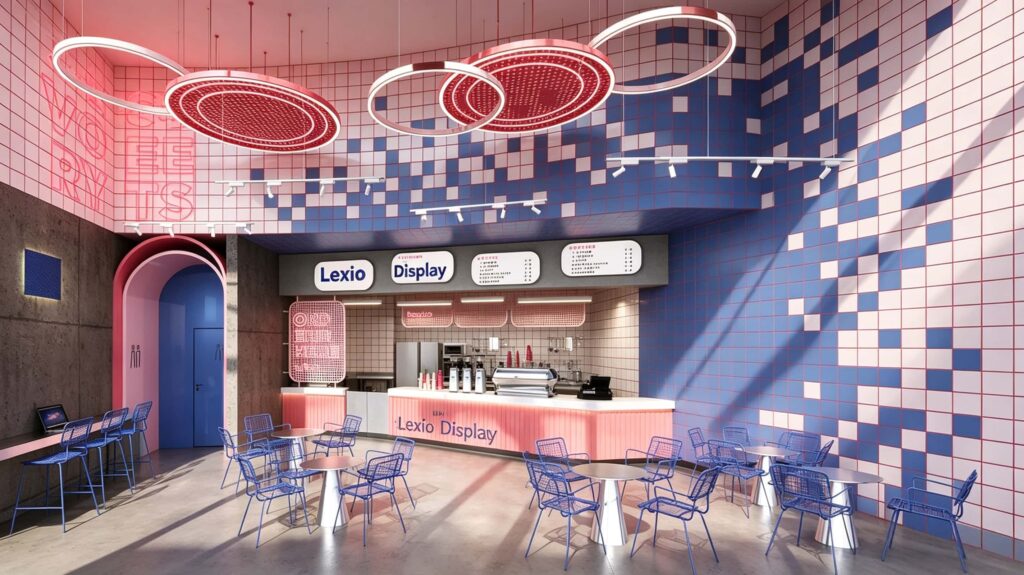
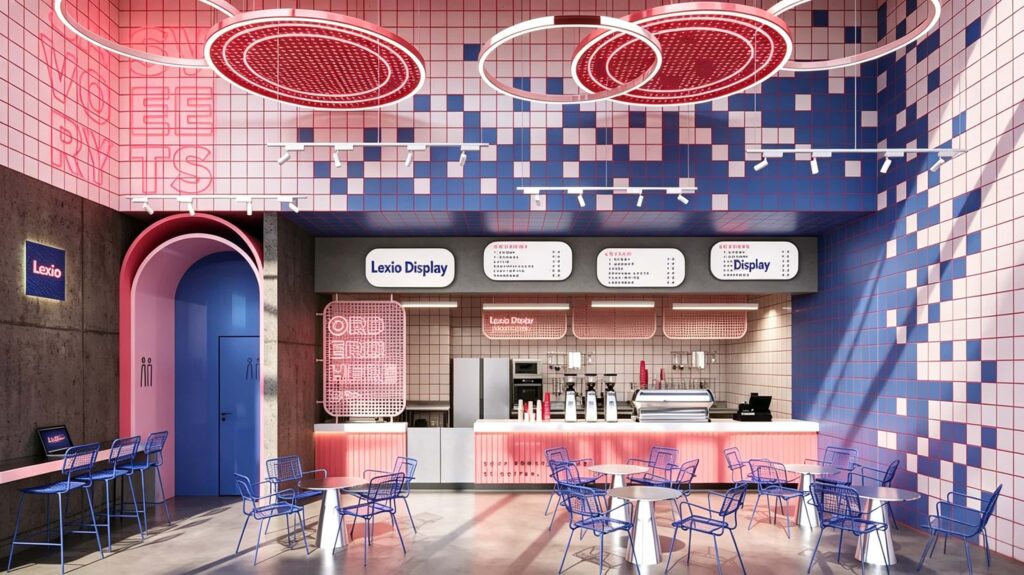
- Vertical patterns draw the eye up. The blue-and-white gradient mosaic tile wall runs floor to ceiling, making the ceiling feel higher.
- Mirrors and reflective surfaces. Glossy finishes on the counter reflect the seating area across the room, doubling the perceived space.
- High ceilings + statement lighting. Those ring-shaped pendant lights hang high, pulling people’s gaze upward. No cramped feeling here.
2. Counter Design: The Heart of Any Ice Cream Shop
The counter is the most important part of an ice cream shop. It’s the first thing customers see, and where your staff spends all day.
Ideal Counter Dimensions
Don’t guess at heights — these numbers come from real-world trial and error.
| Element | Height | Why It Matters |
|---|---|---|
| Customer-side counter | 110cm | Comfortable ordering height, no craning or hunching |
| Staff work surface | 90cm | Ergonomic standing height, less fatigue on long shifts |
| Display case top | 120-130cm | Eye-level for customers — every flavor visible at a glance |
| Counter depth | 70-80cm | Too narrow and equipment won’t fit, too wide and staff can’t reach across |
Workflow: Left-to-Right Assembly Line
The counter layout in this design is intentional. Staff don’t need to run back and forth.
Left side: Prep station — freezers, ingredient bins, toppings, all restocking happens here
Center: Production zone — ice cream machines, topping station, where the magic happens
Right side: Pickup & cashier — POS system, packaging, pickup counter
Customers order and pay on the right, staff make it in the middle, hand it off on the right. One clean flow, no crossing paths. One person can handle a rush.
Where to Put the Display Case for Maximum Sales?
Dead center, facing the entrance, at eye level. People walk in and immediately see a full case of ice cream — bright colors, lots of flavors. Impulse buys go through the roof.
Don’t tuck the display case in a corner or low to the ground. If people can’t see it, they won’t buy it.
3. Color & Style: Why Young People Want to Post About It
These days, if your ice cream shop isn’t Instagrammable, you might as well not exist. Doesn’t mean you need an expensive build — you need a memorable identity.
Why Pink and Blue?
Roughly 70% of ice cream customers are women, ages 16-35. This demographic naturally gravitates toward pink and pastel palettes.
- Primary colors: Klein blue + cherry blossom pink — Strong contrast, great for photos, instantly recognizable on social media
- Neutrals: White + light gray — Balances the bold colors, keeps things clean and prevents visual fatigue
- Accent: Bright red — Used in the pendant lights and line details. Adds energy without making everything too sweet.
Word of warning: Don’t use more than three main colors. Too many and it gets chaotic — photos look cheap and cluttered. The cleaner your background, the better your product pops.
Style Vibe: Modern American Diner
This design channels a “modern take on the classic American diner” — retro tile work and arched doorways, but with clean, minimal lines.
Why this direction?
- High recognition value — won’t blend in with every other shop on the street
- Cost-effective — most of the impact comes from color and form, not expensive materials
- Timeless — Trendy fads fade fast. This clean retro look won’t feel dated in 3-5 years.
Built-In Photo Spots
Plan for this from the start. Where will people take pictures for Xiaohongshu and Instagram? This design has three natural photo-ready spots:
- The arched entryway — Pink frame + blue door. One standing shot and you’ve got a cover photo.
- The gradient tile wall — Full wall of blue-and-white squares. Works as a backdrop for everything.
- Tables under the ring lights — Soft overhead light makes food and people look great.
4. Lighting: It Makes or Breaks How Good Ice Cream Looks
The same scoop of ice cream looks twice as appealing under the right light. Under bad lighting, even premium ingredients look dull.
Three Types of Lighting, Three Jobs
| Light Type | Purpose | Color Temp Recommendation |
|---|---|---|
| Main ambient (ring pendants) | Overall illumination, atmosphere | 4000K neutral white — not too warm, not too cold |
| Track spotlights | Highlight counter and display case | 3500K warm white — makes food look rich and appetizing |
| LED strip / accent | Under-counter, wall details | Warm tone — adds depth and layering |
Critical note: Use food-specific lighting inside the display case. Regular white light makes pink and yellow ice cream look gray and lifeless. Food-grade warm light makes cream and fruit colors pop.
Common Lighting Mistakes to Avoid
- Skip cool white light (6000K+). The whole shop feels like a clinic. Zero appetite appeal.
- Don’t use only one type of light. Flat, even lighting means no depth — photos look boring.
- Don’t dim the seating area too much. Shadows on people’s faces make them want to leave.
5. Seating Layout: Balancing Turnover and Comfort
More seats isn’t always better in a small shop. Pack them too tight and people feel squeezed — they finish and bolt.
Seat Mix in This Design
14 seats total, across three types:
| Seat Type | Quantity | Best For | Turnover Speed |
|---|---|---|---|
| Small round tables (2-seat) | 4 tables = 8 seats | Friends, couples — your core customers | Medium, 20-30 min |
| Wall counter bar seats | 4 seats | Solo visitors, people waiting | Fast, 10-15 min |
| Flexible / combinable | 2 seats | Groups when needed, can join tables | Variable |
Why not all 2-tops? Solo customers make up a lot of traffic. One person buying ice cream doesn’t need a whole table, and sitting alone at a big table feels awkward. Wall bar seats are made for this and get used constantly.
Minimum Spacing Rules
- At least 80cm between tables for people to squeeze past
- When chairs are pulled out, there’s still room to walk behind — no bumping backs
- 1.2 meters minimum between counter and first row of tables — prevents the line from blocking everything
6. Traffic Flow: Speed Is Decided During Design, Not During Rush Hour
Chaotic peaks aren’t always slow staff — often it’s bad traffic flow design.
Customer Flow: Enter → Order → Wait → Pickup → Sit / Leave
A smooth customer journey looks like this:
- Walk in, immediately see the counter and menu
- Order and pay at the counter
- Wait off to the side, not blocking the next person in line
- Pick up order, walk to seating without cutting back through the line
In this design, the waiting area and pickup are on the right side of the counter. The ordering line forms on the left, pickup on the right. Two separate streams, no collision.
Staff Flow: No Turning, No Backtracking
A well-designed counter means staff can reach 80% of what they need without moving their feet.
- Frequently used ingredients go in the fridge right next to the work station
- Cups, spoons, napkins live in drawers directly under the pickup counter
- Trash bin within foot reach — no walking back and forth to throw things away
These details add up. Shave 10 seconds off each order and you’re serving a dozen more customers per hour during peaks.
7. Cost Breakdown: How Much to Actually Budget
Most people only budget for construction and end up 2x over. List every cost category so you know what you’re getting into.
Startup Costs for a 25 sqm Ice Cream Shop (Reference)
| Category | Cost Range (USD approx.) | Share | Notes |
|---|---|---|---|
| Key money / deposit | $4,200-$11,200 | 20% | Varies by location. Mall shops usually have no key money. |
| Construction & renovation | $8,400-$14,000 | 30% | Plumbing, electrical, walls, flooring, ceiling |
| Custom counter + display case | $4,200-$7,000 | 15% | Stainless steel + stone top, includes display case cabinetry |
| Equipment (machines, freezers) | $7,000-$11,200 | 25% | New is expensive. Used cuts cost in half but carries risk. |
| Furniture, lighting, decor | $1,400-$2,800 | 5% | Metal chairs are affordable — lighting and decor add up |
| Initial inventory + packaging | $700-$1,400 | 3% | Opening stock |
| Licenses & permits | $420-$700 | 2% | Health permit, business license, etc. |
Total: roughly $26,000-$48,000. Normal range lands around $28,000-$35,000, depending on location and equipment choices.
How Long Until Break-Even?
Well-run mall ice cream shops can net $4,200-$7,000/month in peak season, $1,400-$2,800 in slow months. On average, 8-14 months to break even is realistic. Prime locations can hit it in six months.
FAQ
What’s the absolute minimum size for an ice cream shop?
Takeaway-only works in 10 sqm — just a counter, no seats. If you want dine-in experience, go for at least 20 sqm. Any less and you can barely fit any seats, plus it feels cramped.
Mall shop vs. street shop — which is better?
Mall locations have steady foot traffic and weather doesn’t matter, but rent is high and you’ll pay percentage fees. Street shops have more flexible rent and you set your own hours, but traffic is inconsistent and weather hits hard. Beginners usually fare better starting with a mall location — lower risk overall.
Do I have to buy brand new ice cream equipment?
Not necessarily. A new imported machine runs $4,000-5,000+, while a reliable used one can be $1,500-2,000. But only go used if you know machines, or bring someone who does. Compressor failures are expensive to fix. A broken machine is no bargain.
What do you do about the off-season after summer?
It’s the real challenge for ice cream shops. Two approaches: either expand the menu — hot drinks, waffles, baked goods for winter — or go seasonal-only. Short-term mall leases and pop-up models let you make money half the year and rest the other half.
Is the health permit hard to get?
Easier than full restaurants, since ice cream shops typically have no open flame and no cooking fumes. But waterproofing, handwashing stations, and sanitation requirements are non-negotiable. Check your local health department standards before building — reworking after the fact costs a fortune.
Final Thoughts
Opening an ice cream shop seems simple — you’re just selling scoops, right? But the details add up fast. Square meter allocation, counter height, light temperature — every design decision eventually shows up in your sales numbers.
If you’re planning an ice cream shop, or looking to redesign an existing location, we’ve designed and built custom retail and food service spaces for 100+ shops worldwide, handling everything from concept drawings and construction docs to manufacturing and installation. Whether it’s a small mall kiosk or a full street-front store, drop us a message with your vision — we’ll put together a detailed proposal and budget.
Reach out today for a free ice cream shop design budget checklist.
WhatsApp:+8617722245723