AI + Touchscreen + Contactless: The 3 Big Trends in US Custom Kiosks for 2026 — Those Who See It Are Already Winning

In 2026, the competition for custom kiosks in the US is no longer about who has the cheaper casing. AI, touch screens, and contactless technology – these three terms have clearly defined the dividing line between winners and runners-up. If you are still debating “whether to incorporate AI vision” or “whether contactless is a mere illusion of demand”, this blog is your stop-loss guide. We will use the practical experience from real deployments to break down these three trends one by one – without resorting to jargon, just explaining how to implement and make money.
Trend 1: AI is no longer “dumb”; it’s becoming the best salesperson in kiosks
In the past, self-service terminals merely responded passively, moving when pressed. By 2026, AI technology enabled Kiosks to develop eyes, ears, and even the ability to understand human emotions. This is not a laboratory novelty; it is a proven approach that we have implemented in fast food and retail settings across North America.
Machine vision: Place an order with just a glance, without even touching the screen.
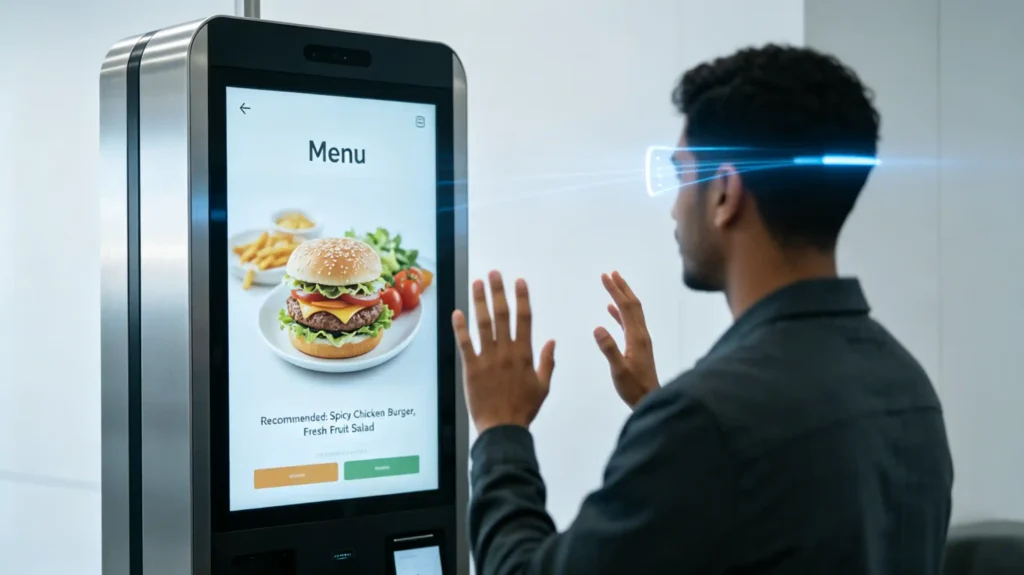
The cost of the camera module has dropped to an insignificant level, but its value has been severely underestimated. Our test conducted at a Burger King chain in California clearly showed that when customers approached with their plates, the overhead camera recognized the dish combination and a prompt “Would you like another serving of avocado? Add $1.99” appeared on the screen. This logic increased the purchase rate by 21%.
More importantly, it solved the biggest enemy of touchscreen interaction – greasy fingers. When your hands are covered in sauce, visual gestures like hovering or nodding to confirm are the saviors. The requirements for the US market in 2026 are straightforward: avoid using your hands if possible. Visual AI has finally made “touchless ordering” no longer just a gimmick.
Voice interaction has gone from an optional feature to a standard feature, finally making it usable in noisy environments
In the past, whenever the word “Kiosk” was mentioned, people would shake their heads and say, “The kitchen is so noisy that it’s impossible to hear clearly.” But the perspective was wrong. With the new beamforming microphone array combined with the side-ear noise reduction chip, now the system only recognizes the speaker who is within 60 centimeters directly in front of the machine. A fried chicken brand in Tampa City has implemented voice ordering at the lane pickup counter, and the recognition accuracy rate reached 92% even amid the engine roar.
What’s more exciting is that voice is becoming a compliant channel for people with disabilities to access. The number of ADA lawsuits in the US has been increasing year by year. A Kiosk that can understand “Please read the menu for me” is often more useful than simply enlarging the font. Every penny you spend on AI voice is actually reducing legal risks.
Prediction Engine: What to sell isn’t decided by customers, it’s decided by AI
Don’t get it wrong. It’s not about taking away the option of choice. It’s about making the recommendations feel as natural as having a trusted friend. When Kiosk collects transaction data, time periods, weather conditions, and even local event information, its product recommendations suddenly become “so smart it’s scary”. We have a customer in Chicago who sells milk tea. The machine automatically moves the hot drink sequence to the top screen on Friday afternoons during the cooling period and weakens the ice cream entry.
Can you guess the result? The sales of hot drinks increased by 34% compared to the previous week, and they made no changes at all; they only turned on the prediction switch. This is the AI value of the custom Kiosk in the United States in 2026: packaging tasks that only human trainers can do into standardized modules, and whoever uses it makes the profit.
Trend 2: Touch screens are engaged in a “sensory arms race” – feel, look and feel are all indispensable
Many people say, “In the future, everything will be in the form of voice and gestures, and touch screens will be phased out.” This is wrong. Touch screens are not dead; instead, they have entered a competition at the millimeter level. Because when AI solves the problem of intelligence, touch screens must solve the problem of “satisfaction”.
Tactile feedback gives the glass the feel of physical buttons.
You must have witnessed customers repeatedly tapping the self-service machine three times but getting no response, and then getting so angry that they slapped their palms. In 2026, truly skilled customizers will ask you: “Do you want piezoelectric haptic feedback or electrostatic haptic feedback?” Sounds mysterious, but it’s just a simple question: Make the glass give vibration or texture feedback at the moment of finger contact, simulating the confirmation feeling of pressing a physical key.
This not only reduces operational anxiety but also significantly reduces accidental touches. In a ticket-issuing machine at a Dallas cinema, after adding local haptic feedback, the average operation time for customers was shortened by 7 seconds, and the return rate dropped by 18%. These details are real money in the face of peak passenger flow.
Outdoor light-resistant and fingerprint-resistant, transforming it from “visible” to “pleasing to the eye”
In the United States, numerous drive-thru restaurants, gas stations, and outdoor ordering areas are bathed in sunlight, with the screens turning completely white. The solution for 2026 is no longer simply increasing brightness; instead, it involves an integrated approach of optical alignment, low-reflective coating, and automatic color temperature adjustment.
The outdoor self-service ticket vending machines we delivered in Arizona remain clear at 12 noon, and the anti-fingerprint coating significantly reduces the amount of fingerprint residue. This may not sound glamorous, but it determines the brand’s level. Imagine a high-end burger restaurant with a machine covered in fingerprints and a grayish screen right at the entrance. Even the best meat won’t fetch a good price. The touch screen experience is the storefront.
Multi-screen interaction and curved surfaces transform the interaction into the brand’s domain
A single screen is a tool, while multiple curved screens connected together form a spatial installation. This year, we saw at several high-end retail showrooms in California that custom kiosks would use 32-inch curved vertical screens for menu display, with a small horizontal screen below for quick checkout, and a transparent LED screen on the side to show dynamic videos.
The entire interaction path was deliberately designed as “first view – then select – finally impulse purchase”. This is not about adding more components; it’s about psychology. Even more wonderfully, all these screens can be driven by an Android or Windows motherboard, and the maintenance cost has not doubled. For brands that want to establish an experience barrier in American malls, this is the best ammunition.
Trend 3: Contactless is not just a slogan, but the bottom line for compliance, hygiene, and trust
Some people might think that the term “post-pandemic era” has become overused. However, in the public terminal market of the United States, contactless technology has been included in many state and commercial real estate bidding documents. It is not a selling point; rather, it is a prerequisite.
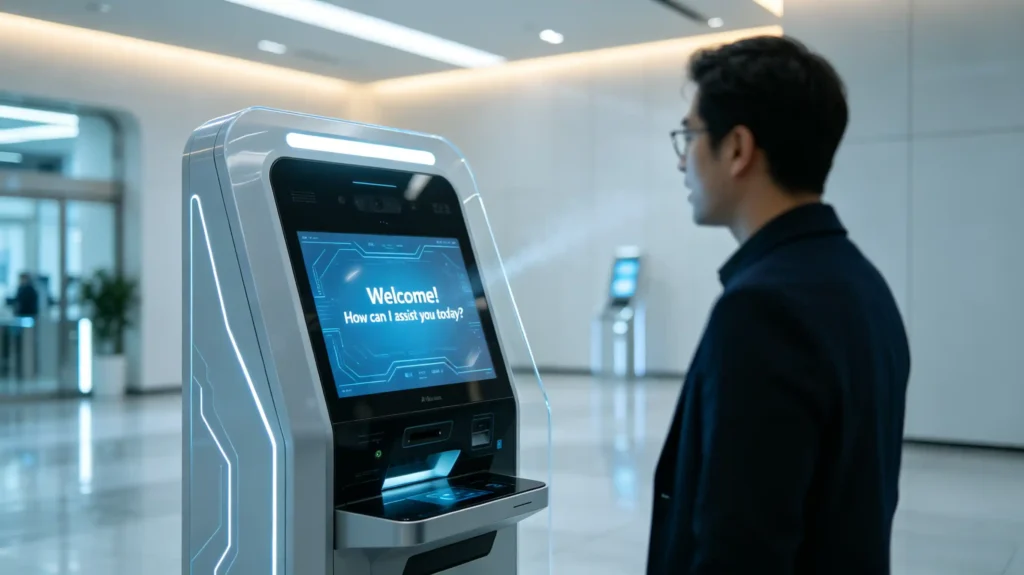
Air gestures and hovering interaction: From “optional” to “mandatory”
In the first half of the year, when we provided self-check-in terminals for Los Angeles Airport, the customers explicitly stated that they must support non-contact gesture wake-up and selection within a range of 3 centimeters. Why? Because thousands of people touch the same screen every day, the health department is closely monitoring it.
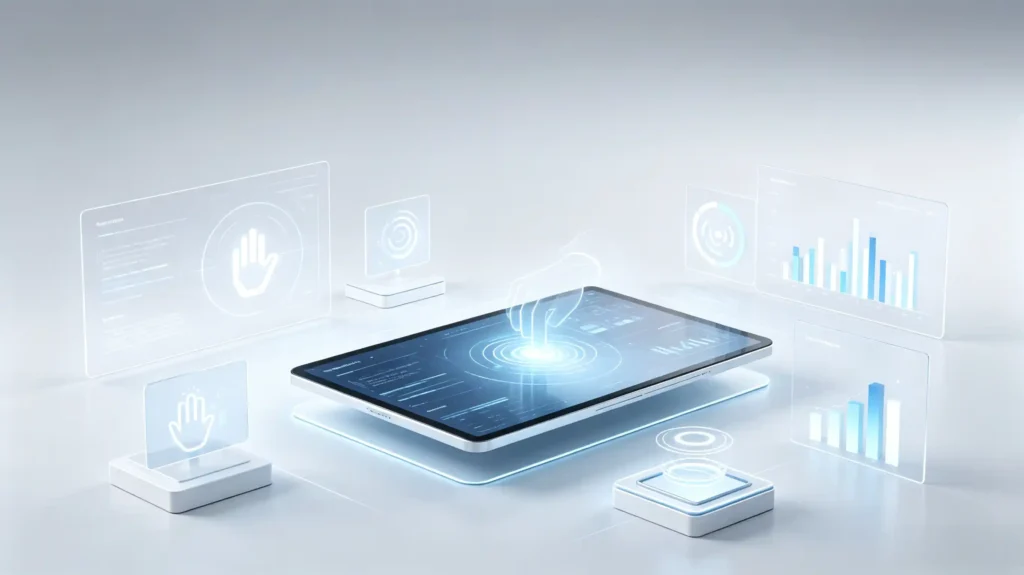
Currently, the solution being used is an infrared sensor matrix. When your hand hovers over the screen and moves across it, it is equivalent to sliding. Hovers for one second means a click. The accuracy rate has been very stable after iterations. The cost of implementing this technology is much lower than what many people think – the cost of adding a single device is less than 60 US dollars. Compared to the brand crisis caused by a single health complaint, is this money well spent? There’s no need to calculate.
NFC and smartphone control: Users control their kiosks with their own screens
This is also the most underestimated direction in 2026. Instead of having users touch the public screen, it would be better to make their mobile phones the remote control. By simply touching the NFC area, a lightweight control interface pops up on the phone’s web page. All the choices can be made on the phone itself, while the Kiosk is only responsible for issuing tickets or delivering goods.
Starbucks has already implemented this in some experimental stores. When we replicated this logic for a salad brand in New England, we found that the average customer stay time actually increased instead of decreasing – because they were more patient when selecting ingredients on their own phones, and the purchase rate rose by 11%. At the same time, the mobile app control naturally tied payment and membership, eliminating the worry of customers missing out on points.
Making hygiene “visible”: Using lights and screens to tell customers I am clean
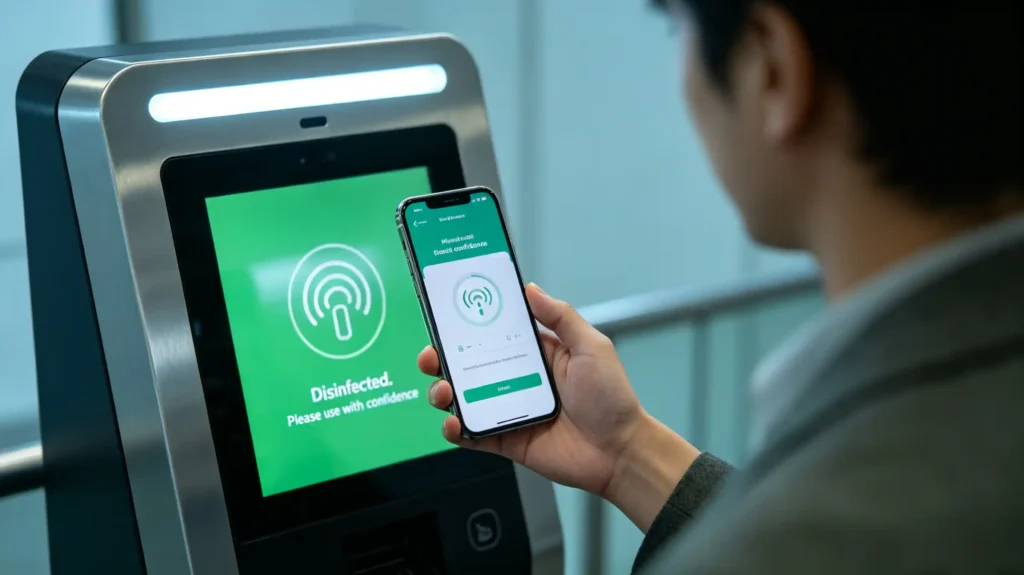
The demand for cleanliness among American users is very concrete. You can’t just say “We are cleaning”. You have to show them. Nowadays, custom kiosks are increasingly incorporating UV-C disinfection indicator light strips. After disinfection, the entire light strip turns green, and the screen displays a greeting like “Disinfected. Please use with confidence”. Also, the machine is equipped with a volatile organic compound sensor. If it detects the residue from alcohol wiping, it will automatically extend the ventilation time.
These small designs do not directly contribute to sales, but they significantly increase usage rates. We have conducted statistics and found that Kiosks with visible cleanliness indicators have a 34% higher usage rate at transportation hubs compared to ordinary machines. Trust can be designed.