PU Leather vs. Velvet: Which Lining is Best for Your Custom Display Cabinet?

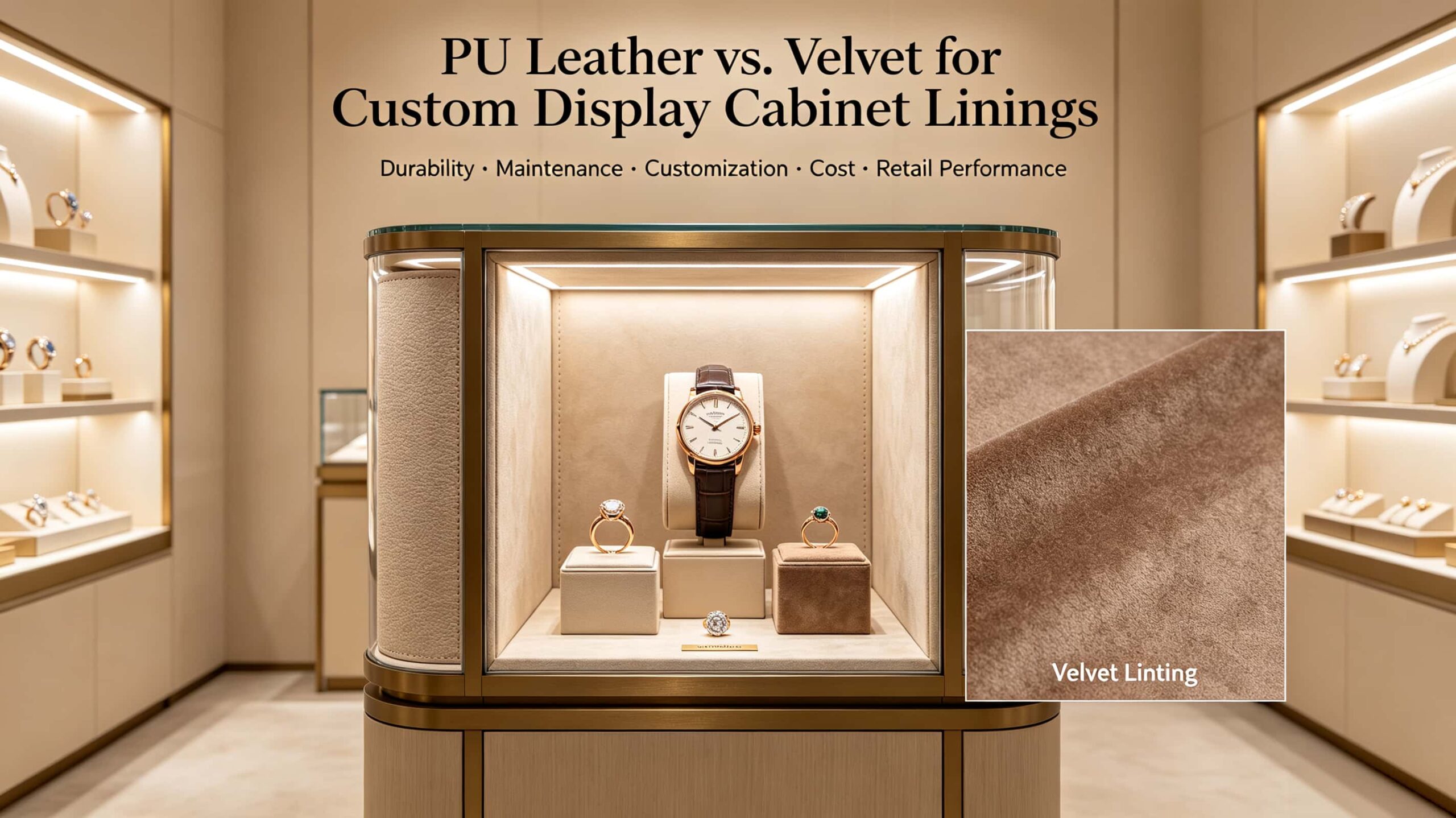
PU leather outperforms velvet for most custom display cabinet linings because it resists scratches, repels dust, wipes clean instantly, and holds a premium look for years—while velvet only wins in specific heritage or soft-touch scenarios.
PU leather is a synthetic polyurethane-coated material that mimics genuine leather’s appearance and feel while offering superior resistance to scratches, dust, and moisture. Velvet, by contrast, is a woven fabric with a dense pile that creates a soft, luxurious texture but demands more careful maintenance and shows wear faster. This article compares both linings across durability, maintenance, customization, cost, and real-world display performance so you can choose the right interior for your cabinets.
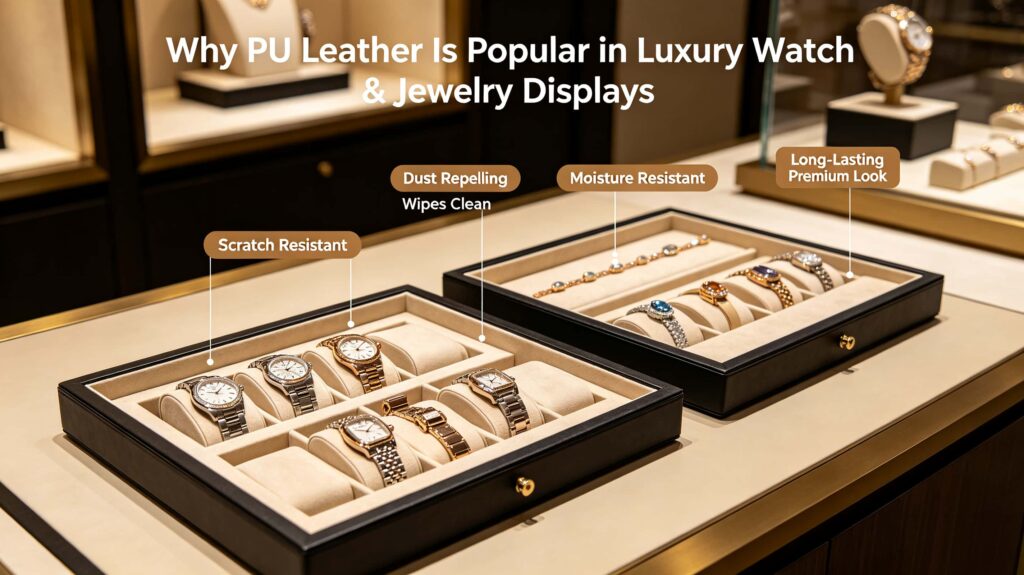
Why is PU leather lining popular in luxury watch and jewelry displays?
PU leather dominates luxury watch and jewelry displays because it resists scratches from metal clasps and gemstones, wipes clean in seconds, and delivers a consistent high-end look that velvet cannot maintain over years of daily use. In high-traffic retail environments, that durability translates directly into lower replacement costs and always-presentable counters.
Here’s what makes PU leather the go-to lining for watch and jewelry counters:
- Scratch resistance: Metal watch bands, clasps, and loose gemstones slide across PU leather without leaving permanent marks. Velvet fibers snag and tear under the same treatment.
- Dust and debris control: PU leather has a closed, non-porous surface. Dust, fingerprints, and oil from hands stay on top and wipe away with a microfiber cloth.
- Easy maintenance: No vacuuming, no brushing, no lint rollers. A damp cloth handles 95% of daily cleaning tasks.
- Premium appearance: PU leather holds its color and sheen far longer than velvet, which matts down and fades in high-touch areas.
- Moisture resistance: Spilled perfume, cleaning alcohol, or accidental water drips bead up on PU leather instead of soaking in.
For watch counters specifically, the difference is dramatic. A velvet-lined tray that sees 50 customers a day will show visible wear within three to six months. A high-density PU leather tray in the same position often looks new after two years.
How to customize a display cabinet with PU leather lining?
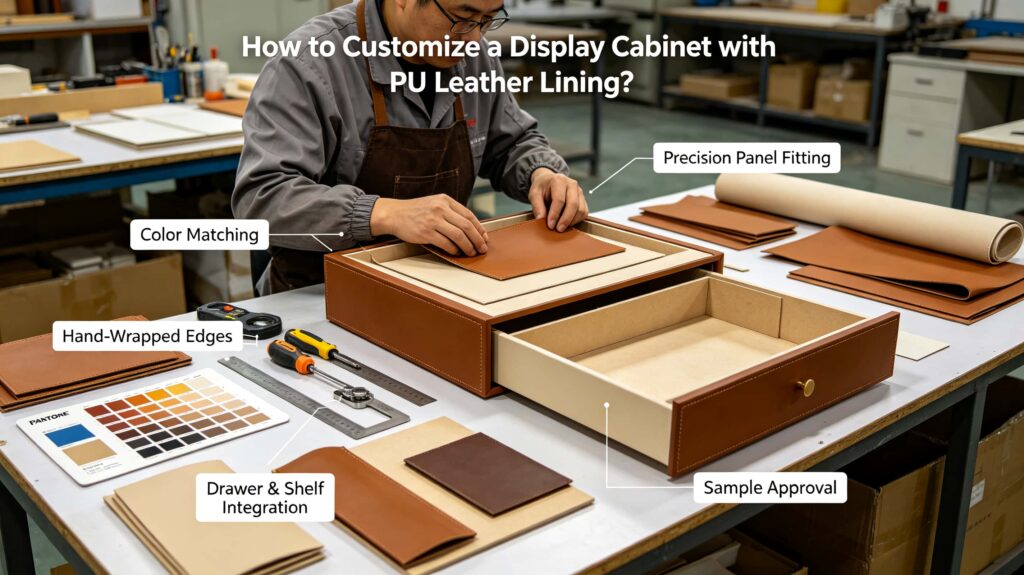
As a source factory, we customize PU leather linings by matching your exact color card, die-cutting panels to fit every shelf and drawer, and hand-wrapping edges for a seamless finish. You send the color reference, we send back a sample for approval before production begins.
The customization process follows a clear path:
- Color matching: Provide any color card—Pantone, RAL, or a physical fabric swatch. We match the PU leather to your brand palette.
- Panel fitting: We measure every shelf, drawer, and divider. The PU leather is cut to precise dimensions, not trimmed on-site.
- Edge finishing: Hand-wrapped edges prevent peeling and give the lining a built-in, furniture-grade look.
- Drawer and shelf integration: Linings sit flush with cabinet interiors, so drawers glide without catching on loose material.
- Sample approval: We produce a physical sample of the lined shelf or drawer for your sign-off before mass production.
Factory insider tip: Many cheap display cases use only ordinary velvet fabric. Within a few months, the fabric starts to shed fibers. In our factory, we use high-density PU leather, hand-stitch the edges, and apply eco-friendly glue on the bottom layer to ensure no unpleasant smell. That last point matters more than most buyers realize—cheap adhesives off-gas for weeks, and your showroom smells like a chemical plant instead of a luxury boutique.
What are the standard sizes for PU leather lined cabinets?
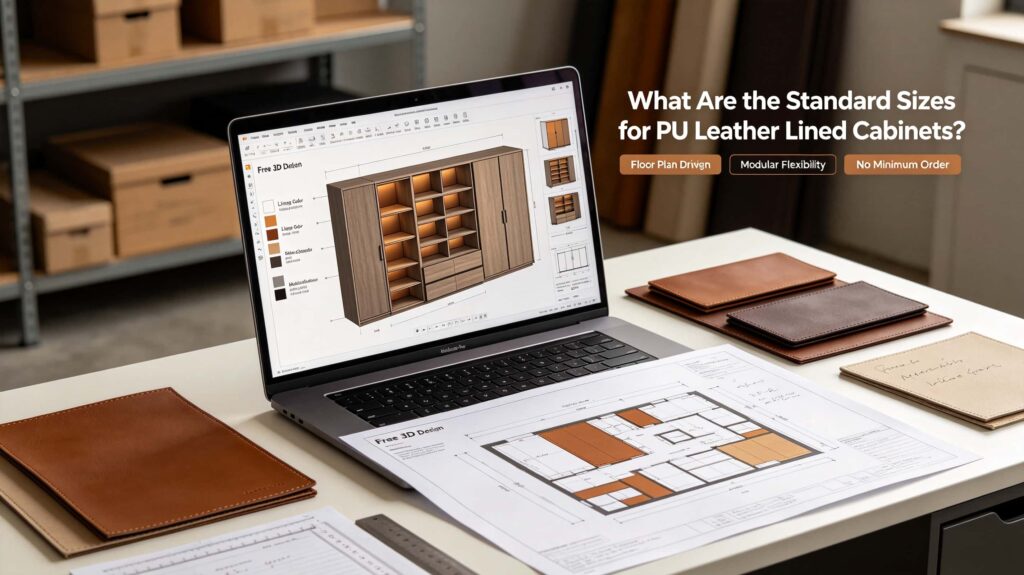
There are no fixed standard sizes because every store layout differs. We build each cabinet to your floor plan, offer 3D design, and adjust dimensions to fit your space, traffic flow, and display needs. Standardization only applies to the PU leather rolls and panel thicknesses—not the cabinet footprint.
Here’s how sizing actually works with a custom factory:
- Floor plan driven: You provide the store layout, we design cabinets to fit exact wall lengths, corners, and aisle widths.
- 3D design: Before production, you see a rendered 3D model of the cabinet in your space, including lining color and shelf configuration.
- Modular flexibility: Cabinets can be designed as standalone units or connected runs, with PU leather lining applied consistently across all modules.
- Adjustable interiors: Shelf heights, drawer depths, and divider positions are set during design, not after manufacturing.
- No minimum order for custom sizes: We handle one-off boutique pieces and full-store rollouts with the same sizing process.
If you have a floor plan, you can get a 3D design and a precise quote without committing to production. That’s the fastest way to see whether PU leather or velvet suits your space.
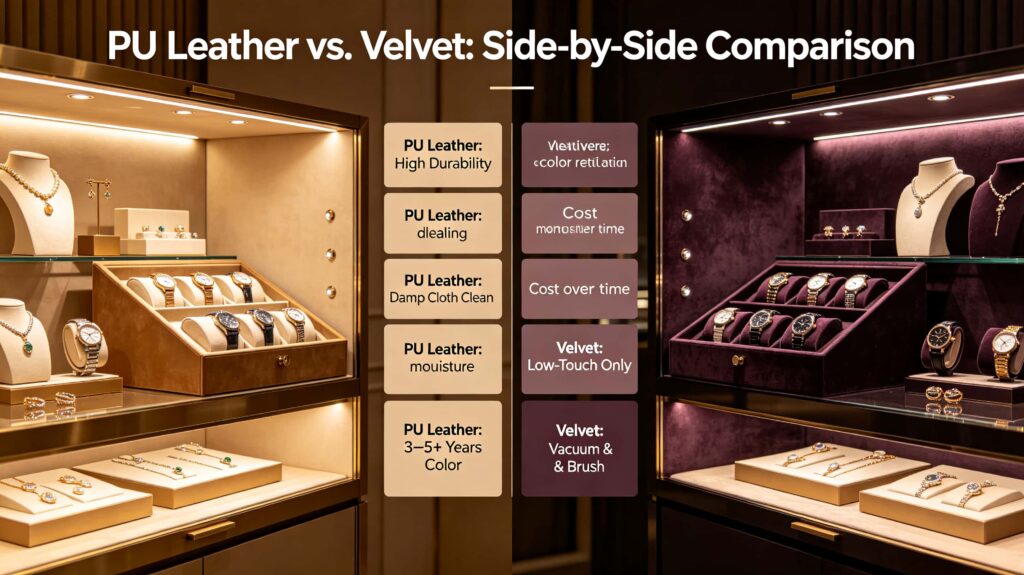
PU leather vs. velvet: side-by-side comparison
The table below summarizes the core differences based on real factory production and retail performance data.
| Feature | PU Leather | Velvet |
|---|---|---|
| Scratch resistance | High | Low |
| Dust and lint | Repels | Attracts |
| Cleaning method | Damp cloth | Vacuum or brush |
| Moisture resistance | High | Low |
| Color retention | 3–5+ years | 6–12 months in high-touch areas |
| Premium feel | Sleek, modern | Soft, traditional |
| Custom color matching | Excellent | Good |
| Cost over 3 years | Lower (fewer replacements) | Higher (frequent replacement) |
| Best for | Watches, jewelry, high-traffic displays | Heritage brands, low-touch display, soft-touch presentation |
When velvet still makes sense for display cabinets
Velvet remains the better choice for low-touch, heritage-focused displays where softness and tradition outweigh maintenance concerns. Antique jewelry, archival pieces, and brands with a vintage aesthetic often benefit from velvet’s deep matte finish and gentle surface.
Consider velvet if:
- Your display items are lightweight and rarely handled.
- The cabinet sits behind glass with minimal customer contact.
- Your brand identity leans traditional, romantic, or antique.
- You replace linings seasonally as part of a visual merchandising refresh.
- You need a specific deep color that PU leather cannot replicate exactly.
Even then, choose a high-density velvet with a tight pile. Cheap velvet is the worst of both worlds—it shows wear quickly and still requires careful maintenance.
Cost analysis: PU leather vs. velvet over time
PU leather typically costs 15–30% more upfront than standard velvet, but it lasts three to five times longer in high-traffic retail environments. The total cost of ownership favors PU leather for any cabinet that sees daily customer contact.
Breakdown for a standard 1.2-meter watch counter:
- Initial lining cost: PU leather $180–$260; velvet $120–$180.
- Replacement cycle: PU leather 3–5 years; velvet 6–18 months.
- Cleaning labor: PU leather 2 minutes/day; velvet 8–10 minutes/day.
- Downtime for replacement: PU leather 1 day every 4 years; velvet 1 day every year.
- Customer perception: PU leather maintains a crisp, premium look; velvet shows matting and fading within months.
Over a five-year period, a single velvet-lined counter can cost 2–3 times more than a PU leather-lined counter when you factor in replacements and daily maintenance labor.
Material quality: what to look for in PU leather lining
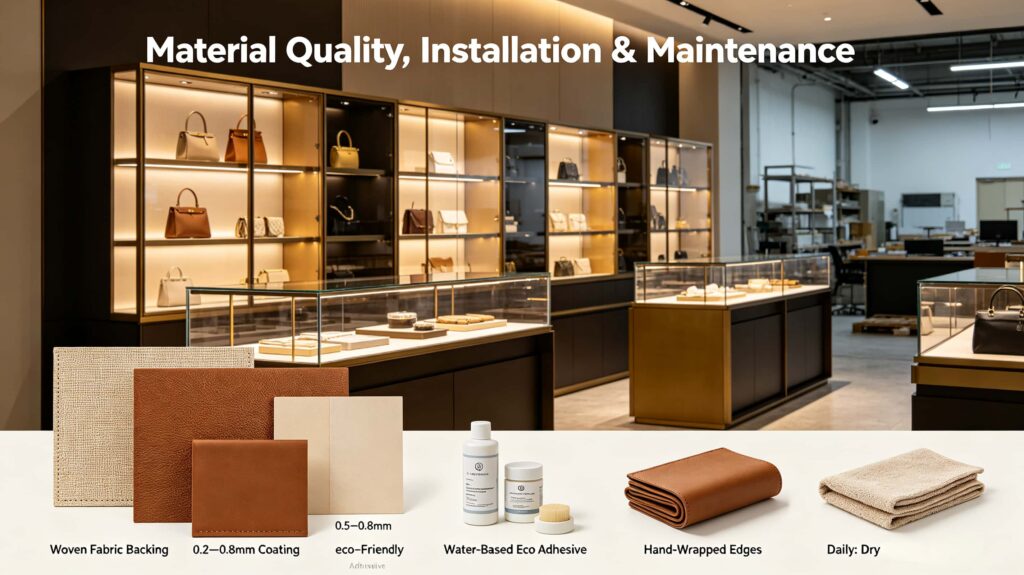
Not all PU leather is equal. Low-grade PU leather peels within a year, cracks at fold points, and releases odor for weeks. High-density PU leather with a woven backing and eco-friendly adhesive performs like genuine leather at a fraction of the cost.
Check these quality markers:
- Backing material: Woven fabric backing prevents stretching and tearing. Non-woven backing is weaker.
- Coating thickness: 0.5–0.8mm coating balances softness and durability. Thinner coatings wear through faster.
- Adhesive type: Water-based eco-friendly adhesives have no harsh smell. Solvent-based adhesives off-gas.
- Edge treatment: Hand-wrapped edges with sealed seams outlast glued or stitched edges.
- Colorfastness: Rub the surface with a white cloth. If color transfers, the dye is cheap.
Factory insider tip: Many cheap display cases use only ordinary velvet fabric. Within a few months, the fabric starts to shed fibers. In our factory, we use high-density PU leather, hand-stitch the edges, and apply eco-friendly glue on the bottom layer to ensure no unpleasant smell. This is the difference between a cabinet that smells like a new car and one that smells like a chemical warehouse.
Installation and maintenance: PU leather vs. velvet
PU leather installs faster because it does not stretch or shed during cutting, and it maintains its shape without special tools. Velvet requires careful handling to avoid crushing the pile and needs regular brushing to keep its appearance.
Maintenance routines differ significantly:
- PU leather daily: Wipe with a dry microfiber cloth. For fingerprints, use a slightly damp cloth.
- PU leather monthly: Apply a small amount of vinyl conditioner to maintain suppleness.
- Velvet daily: Brush with a soft bristle brush to lift crushed fibers.
- Velvet monthly: Vacuum with a brush attachment on low suction.
- Velvet stain response: Blot immediately. Velvet absorbs liquids and oils permanently.
For any retail environment where customers touch the display, PU leather wins on maintenance alone.
Environmental and health considerations
PU leather with water-based adhesives and low-VOC coatings meets indoor air quality standards for retail spaces. Velvet can trap dust mites and allergens, which matters for jewelry stores where customers lean close to the display.
Key points:
- PU leather: Choose low-VOC, phthalate-free formulations. Request material safety data sheets.
- Velvet: Natural fibers biodegrade, but synthetic velvet is petroleum-based.
- Adhesives: Water-based adhesives are the standard for premium PU leather lining.
- Odor: Properly cured PU leather has no smell after 48 hours. Cheap PU leather can off-gas for weeks.
- Recyclability: PU leather is not widely recyclable. Velvet can be incinerated or decomposed depending on fiber content.
FAQ: PU leather and velvet display cabinet linings
Is PU leather better than velvet for jewelry display?
PU leather is better for jewelry display in most retail settings because it resists scratches from metal settings, repels dust, and wipes clean without damaging the surface. Velvet only outperforms PU leather when the display is rarely touched and the brand aesthetic specifically calls for a soft, traditional look.
Answer in detail: Jewelry pieces with prongs, clasps, and sharp edges snag velvet fibers over time. PU leather’s smooth surface lets those same pieces slide without leaving permanent marks. For stores that open and close displays daily, PU leather also reduces cleaning time from minutes to seconds per tray. The exception is high-end antique jewelry presented in a museum-style setting where velvet’s softness is part of the experience.
Does PU leather lining smell bad?
High-quality PU leather with eco-friendly water-based adhesive has no noticeable smell after 48 hours of curing. Cheap PU leather with solvent-based glue can off-gas for weeks, producing a chemical odor that transfers to displayed items and disappoints customers. Always request a sample before production.
Answer in detail: The smell comes from adhesives and low-grade coatings, not the PU leather itself. In our factory, we use water-based adhesives and allow proper curing time before packing. If you receive a PU leather cabinet that smells like glue or plastic, the manufacturer cut corners on adhesive quality. That smell can linger for months and affect customer perception.
H3: How long does a custom PU leather display cabinet take to produce?
Custom PU leather display cabinet production typically takes 15–25 days after design approval, depending on complexity, size, and order quantity. Sample approval adds 3–5 days. Rush orders can be accommodated for an additional fee, but never skip the sample stage—color and texture look different in person than on a screen.
Answer in detail: The timeline breaks down into design (3–5 days), sample production and approval (3–5 days), material procurement (2–3 days), main production (10–15 days), and quality inspection plus packing (2–3 days). For multi-store rollouts, we produce in batches to maintain consistency. Shipping time depends on destination and freight method.
H3: Can you match my brand’s Pantone color for PU leather?
Yes, we match Pantone, RAL, and physical color card references for PU leather lining. Send us the color code or a physical swatch, and we produce a sample for your approval before production. Color matching accuracy is typically within 1–2 shades for solid colors, and we adjust the formula until you approve the sample.
Answer in detail: Color matching works best when you provide a physical reference, not just a digital code. Screens vary, lighting varies, and PU leather coatings absorb color differently than fabric. We recommend sending a swatch of your brand material, a paint chip, or a printed color card. For metallic or pearlescent finishes, we produce a sample panel first because those effects are harder to match precisely.
H3: Which lining is better for high-humidity climates?
PU leather is better for high-humidity climates because it resists moisture absorption, does not support mold growth on its surface, and wipes dry quickly. Velvet absorbs ambient moisture, becomes heavy and matted, and can develop mildew in tropical or coastal environments without constant climate control.
Answer in detail: In humid climates, velvet linings require dehumidifiers running continuously to prevent mildew. PU leather tolerates humidity fluctuations without changing texture or appearance. If your store is in a coastal city or tropical region, PU leather is the practical choice. Even in climate-controlled malls, power outages or HVAC failures can expose velvet to damaging moisture.
H3: Can I replace velvet lining with PU leather in an existing cabinet?
Yes, existing cabinets can be retrofitted with PU leather lining. We measure the interior panels, produce custom-cut PU leather pieces, and either ship them for local installation or handle the retrofit at our factory if the cabinet can be transported. Retrofit costs are typically 40–60% of a new cabinet.
Answer in detail: Retrofitting requires removing the old lining, cleaning the substrate, and applying the new PU leather with proper adhesive and edge wrapping. If the cabinet has complex curves or built-in lighting, the retrofit takes longer. We recommend sending photos and dimensions of the existing cabinet for an accurate retrofit quote. In many cases, the upgraded lining makes the cabinet look new again.
PU leather for performance, velvet for tradition
For 90% of custom display cabinet applications—especially watch counters, jewelry trays, and high-traffic retail displays—PU leather is the better lining. It lasts longer, cleans faster, resists damage, and maintains a premium appearance that velvet cannot match over time. Velvet remains a valid choice for low-touch, heritage-focused displays where softness and tradition are the priority.
Ready to upgrade your display cabinets with custom PU leather lining? Send us your floor plan today and receive a 3D design with your exact color match, shelf configuration, and lining specification. Our factory handles everything from sample approval to production and shipping—no middlemen, no guesswork, no chemical smells.
Email your floor plan now. Get your 3D design within 48 hours. Let’s build a display cabinet that looks premium and stays premium.