Curved Tempered Glass Display Cabinet Manufacturers: The Ultimate B2B Sourcing Guide

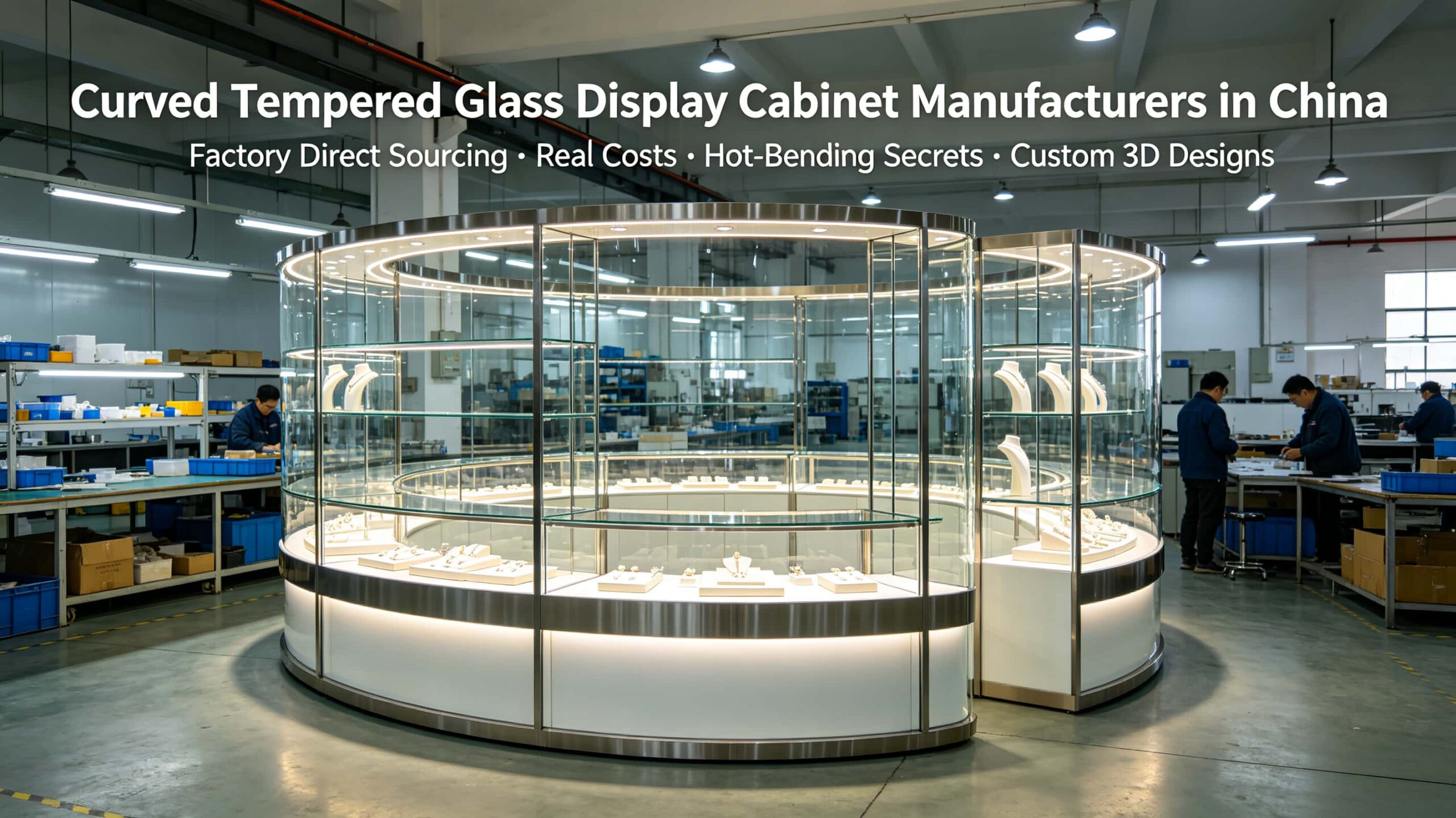
Sourcing curved tempered glass display cabinets from China? This guide reveals top manufacturers, real costs ($1,500–$5,000+), hot-bending secrets, and how to get a custom 3D design from a factory directly. Plus factory insider tips. Avoid costly mistakes. Read on. Now.
A curved tempered glass display cabinet manufacturer is a specialized B2B factory that hot-bends low-iron glass at 600°C+ into precise curves, then tempers it for strength and safety. These suppliers produce bent glass showcases, vitrines, and merchandisers for retail, museums, and luxury brands, offering custom radii, lighting, and hardware.
Who are some reputable tempered glass manufacturers in China?
Reputable tempered glass manufacturers in China are concentrated in Guangdong, Zhejiang, and Jiangsu. They own CNC hot-bending molds, low-iron glass lines, and in-house tempering. Look for 10+ years in bent glass, ISO 9001, and export records to the EU or US. Skip trading companies that outsource bending.
- Guangdong (Foshan, Dongguan): The epicenter for retail display glass. Factories here pump out thousands of curved showcases monthly.
- Zhejiang (Hangzhou, Ningbo): Strong in architectural bent glass and custom steel molds. Good for large radii.
- Jiangsu (Suzhou, Nanjing): Precision-focused. Many serve medical and luxury jewelry brands.
- Key marker: They use low-iron glass (ultra-clear) to avoid the green tint that ruins curved displays.
- Hot-bending molds: In-house molds ensure repeatable radii. Outsourced molds add 15–20% cost and 2 weeks lead time.
Factory tips: Ask for a “mold library list.” Top factories keep 200+ reusable molds for common radii like R300, R500, and R800. If your curve matches an existing mold, you skip the $300–$1,200 tooling fee entirely. I’ve seen buyers save 40% just by adjusting their design to a standard radius.
| Region | Strength | Typical MOQ | Lead Time |
|---|---|---|---|
| Foshan | Retail showcases | 20–50 units | 25–35 days |
| Hangzhou | Architectural curves | 10–30 units | 30–45 days |
| Suzhou | Luxury vitrines | 5–20 units | 35–50 days |
But how do you actually vet these factories? Don’t just look at their website. Ask for a video walkthrough of the bending line. Request a sample curve. Check if they use autoclave-free tempering (better for thin bent glass). And always verify the low-iron glass supplier—most use Pilkington or AGC, but some switch to cheap float glass. That’s a red flag.
Where can I buy a custom curved glass display cabinet?
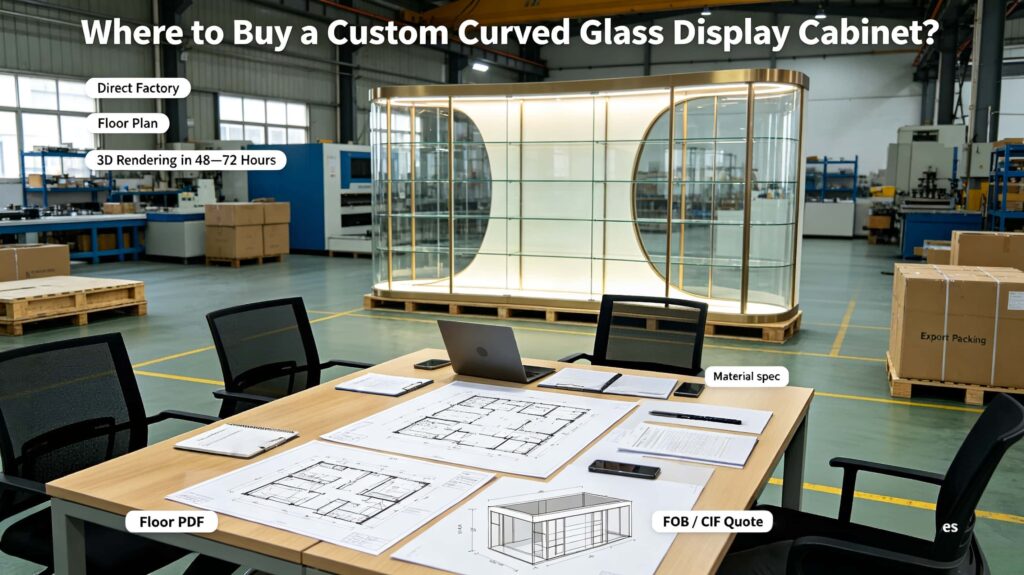
You can buy a custom curved glass display cabinet directly from a Chinese factory—not a trading company. Send your floor plan, 3D sketch, or hand-drawn layout. Factories with in-house design teams return a 3D rendering and quote within 48–72 hours. This is the fastest, cheapest route for 20+ units.
- Direct factory route: Best for 20+ units. Saves 20–40% vs. trading firms.
- What to send: Floor plan (PDF/DWG), height, curve radius, glass thickness (6mm–12mm), and lighting needs.
- What you get back: 3D design, material spec, FOB/CIF price, and production schedule.
- Red flags: Factories that refuse to share mold photos or tempering certificates.
So where do you find these factories? Alibaba is a start, but it’s flooded with traders. Better: attend Canton Fair (Phase 2 for glass). Or join sourcing groups on LinkedIn. But the real shortcut is to ask a bent glass showcase supplier for a factory introduction. Many will refer you if you’re not a competitor.
Here’s a practical tip: When you send your floor plan, mark the “critical curve zones.” Tell them where radius tolerance must be ±1mm, not ±3mm. This forces the bending team to use a better mold and slower cooling. It adds maybe 5% to cost, but it prevents gaps between glass and frame. I’ve seen too many projects fail because the curve was off by 5mm.
How much is a curved glass display cabinet?
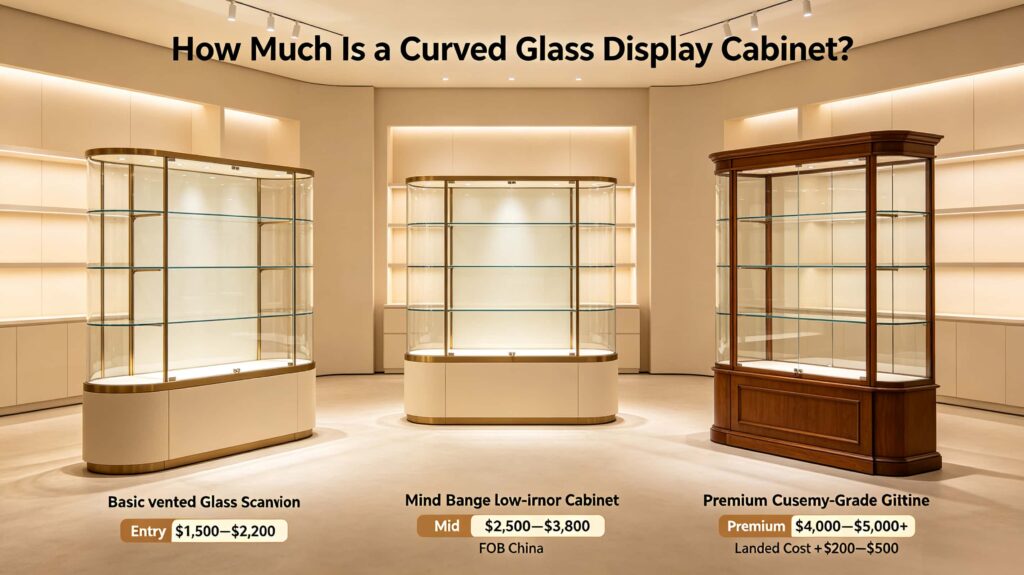
A curved glass display cabinet costs $1,500 to $5,000+ per unit, depending on size, glass thickness, curve complexity, lighting, and hardware. Basic 1-door bent glass showcases start near $1,500. Large museum-grade vitrines with climate control exceed $5,000. This is your realistic custom curved glass display cabinet price range.
- Entry level ($1,500–$2,200): 6mm bent glass, 1 shelf, LED strip, powder-coated steel base.
- Mid range ($2,500–$3,800): 8mm low-iron glass, 2–3 shelves, lockable doors, adjustable feet.
- High end ($4,000–$5,000+): 10–12mm glass, anti-reflective coating, museum lighting, humidity control.
- Cost drivers: Curve radius (tighter = pricier), mold fee ($300–$1,200 one-time), glass tint, and export packaging.
| Feature | Budget | Mid | Premium |
|---|---|---|---|
| Glass thickness | 6mm | 8mm | 10–12mm |
| Glass type | Clear float | Low-iron | Low-iron + AR |
| Shelves | 1 | 2–3 | 4+ adjustable |
| Lighting | LED strip | Dimmable LED | Museum-grade |
| Lock | None | Key lock | Digital lock |
| Price | $1,500–$2,200 | $2,500–$3,800 | $4,000–$5,000+ |
But wait—these prices are FOB China. Add shipping, insurance, and import duties. For a 40HQ container, shipping to the US West Coast runs $3,000–$5,000. So your landed cost per unit can jump by $200–$500. Always ask for a CIF quote to compare.
For a full glass display cabinet cost guide, factor in these hidden fees:
- Mold amortization: If you order 10 units, the $800 mold adds $80 per unit.
- Packaging: Custom foam and crates add $50–$150 per unit.
- QC inspection: Third-party inspection costs $300–$500 per order.
- Payment terms: 30% deposit, 70% before shipment is standard. But you can negotiate 20/80 for large orders.
Why is curved glass so expensive?
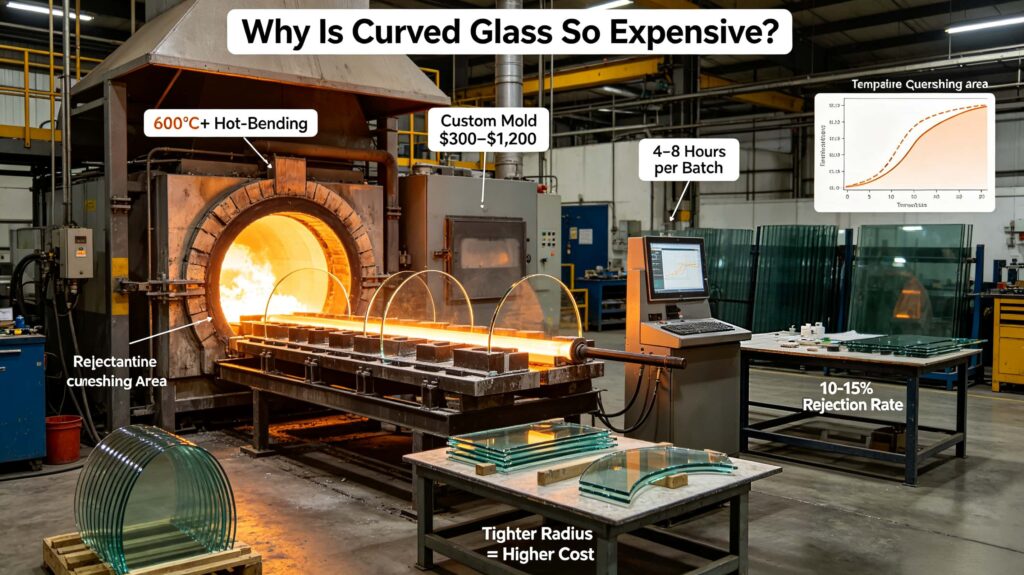
Curved glass is expensive because it must be hot-bent at 600°C+ over a custom mold, then slowly cooled to avoid stress fractures. This process takes 4–8 hours per batch. The mold alone costs $300–$1,200. And tempering curved glass is trickier than flat glass—rejection rates run 10–15%.
- Step 1: Cutting. Low-iron glass is cut to size, edges polished.
- Step 2: Heating. Glass sits on a steel or ceramic mold, enters a 600°C+ furnace.
- Step 3: Bending. Gravity or press-bending forces the glass to sag into the curve.
- Step 4: Annealing. Slow cooling over 2–4 hours prevents internal stress.
- Step 5: Tempering. Reheated to 650°C, then air-quenched. This locks in strength.
The 600°C hot-bending process is what makes curved glass so costly. You can’t just heat flat glass and bend it like a plastic sheet. It takes precision. If the temperature is off by 10°C, the glass cracks. If the mold is warped, the curve is uneven. If cooling is too fast, it shatters during tempering.
Factory Insider Tips: Some factories reuse molds for years. Others cheap out on mold material. A good mold is made from heat-resistant steel or special ceramics. A bad mold is made from regular steel that warps after 20 cycles. Ask how many cycles their molds last. If they say “hundreds,” they’re either lying or using top-tier molds. If they say “50–100,” that’s realistic.
Also, tighter curves cost more. A gentle R800 curve is easy. A tight R200 curve requires a more complex mold, slower bending, and higher rejection rates. So if your design can use a gentler curve, do it. You’ll save 15–25%.
What is curved glass called?
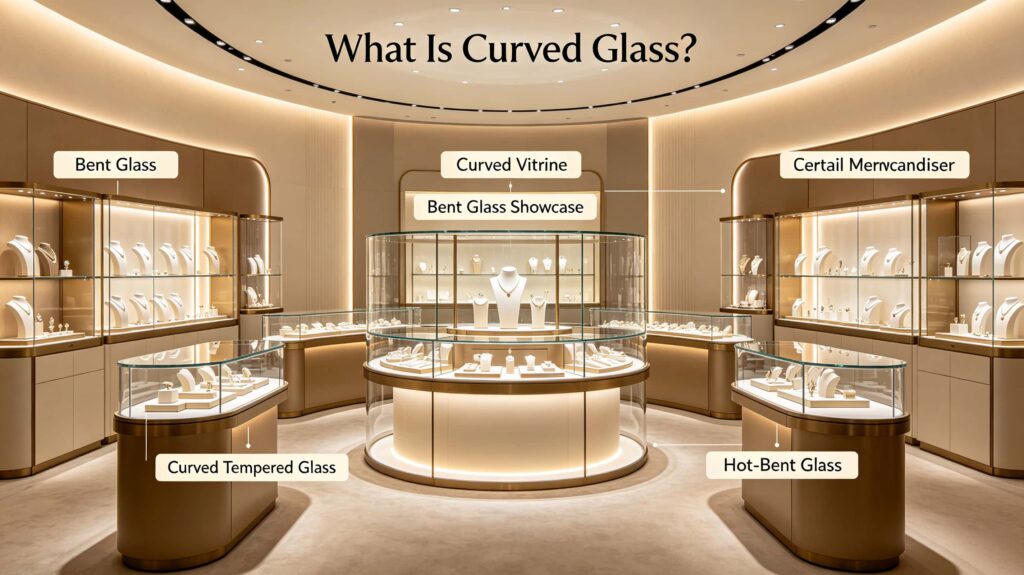
Curved glass is called bent glass in the glass industry. For display cabinets, it’s also called curved vitrine or bent glass showcase. Architects say “curved glass.” Retailers say “bent glass display.” Both mean the same thing: glass that has been permanently shaped into a curve.
- Bent Glass: The technical term. Covers any curved glass, from automotive to architectural.
- Curved Vitrine: A display cabinet with curved glass, often used in museums and luxury boutiques.
- Bent Glass Showcase: A retail display case with curved glass front or sides.
- Curved Tempered Glass: Emphasizes the tempering step. This is the strongest type.
- Hot-Bent Glass: Refers to the process. You’ll see this in factory quotes.
So when you search for a bent glass showcase supplier, you’re looking for a factory that makes all of the above. Don’t get confused by terminology. Just ask for “curved tempered glass for display cabinets.” That’s clear.
What is another name for a glass display cabinet?
Another name for a glass display cabinet is a vitrine, showcase, or merchandiser. In museums, it’s a vitrine. In retail, it’s a showcase. In luxury jewelry, it’s a merchandiser. All refer to a glass-enclosed cabinet for displaying products.
- Vitrine: From French. Common in museums and art galleries. Often implies climate control.
- Showcase: Retail term. Can be countertop or floor-standing. Usually has sliding doors.
- Merchandiser: High-end retail term. Often includes lighting and rotating shelves.
- Display Case: Generic term. Can be glass, acrylic, or wood.
- Curio Cabinet: Home furniture term. Usually wood with glass panels.
If you’re sourcing from a bent glass showcase supplier, they’ll understand all these terms. But for clarity, always describe the function: “floor-standing curved glass showcase with 3 shelves and LED lighting.” That leaves no room for confusion.
FAQ: Curved Tempered Glass Display Cabinet Manufacturers
What is the typical lead time for custom curved glass display cabinets?
Typical lead time is 25–50 days after deposit, depending on complexity. Simple designs with standard molds ship in 25–30 days. Custom molds and tight radii add 10–15 days. Add 7–10 days for sea freight to the US or EU. Always buffer two weeks.
Can I order just one curved glass display cabinet?
Yes, but expect a higher unit price. Factories prefer 20+ units to amortize mold costs. For one unit, you’ll pay the full mold fee ($300–$1,200) plus a small-batch surcharge (15–30%). Some factories refuse single orders entirely. Try a bent glass showcase supplier that specializes in prototypes.
How do I verify a factory’s quality before ordering?
Ask for a video of their bending line, a sample curve (you pay shipping), and three references from past clients. Check if they use low-iron glass from Pilkington or AGC. Request a tempering certificate. And always use a third-party inspection before shipment. That $300 inspection saves thousands in rework.
What glass thickness is best for a curved display cabinet?
For retail showcases, 6mm–8mm low-iron glass is standard. For large museum vitrines, 10mm–12mm. Thicker glass holds curves better and feels more premium. But it also weighs more and costs 20–30% more. If your cabinet is under 1.5m tall, 6mm is fine. Above that, go 8mm.
How do I get a 3D design for my custom cabinet?
Send your floor plan, sketch, or even a napkin drawing to a factory’s design team. Include height, width, curve radius, and intended use. Most factories return a 3D rendering within 48–72 hours. This service is usually free if you’re serious about ordering. But don’t ask for 10 revisions—factories hate that.
Ready to Source Curved Tempered Glass Display Cabinets? Send Your Floor Plan Now.
Stop guessing. Stop overpaying. Send us your floor plan, sketch, or CAD file today. Our factory partners will return a free 3D design and a detailed quote within 48 hours. We’ll tell you exactly which molds are available, how to cut costs, and how to avoid the 10 most common bending defects.
Don’t settle for flat glass. Demand the curve.
Email your floor plan to our sourcing team.
Get your 3D design and custom curved glass display cabinet price in 2 days.
Factory insider tip: If you mention this guide, we’ll waive the mold fee on your first order (up to $800 value). That’s real savings. That’s how you source smart.
Contact us now. Your competitors already have.