Why a Custom Mall Kiosk is Your Cheapest Ticket to Retail Success (Factory Direct)

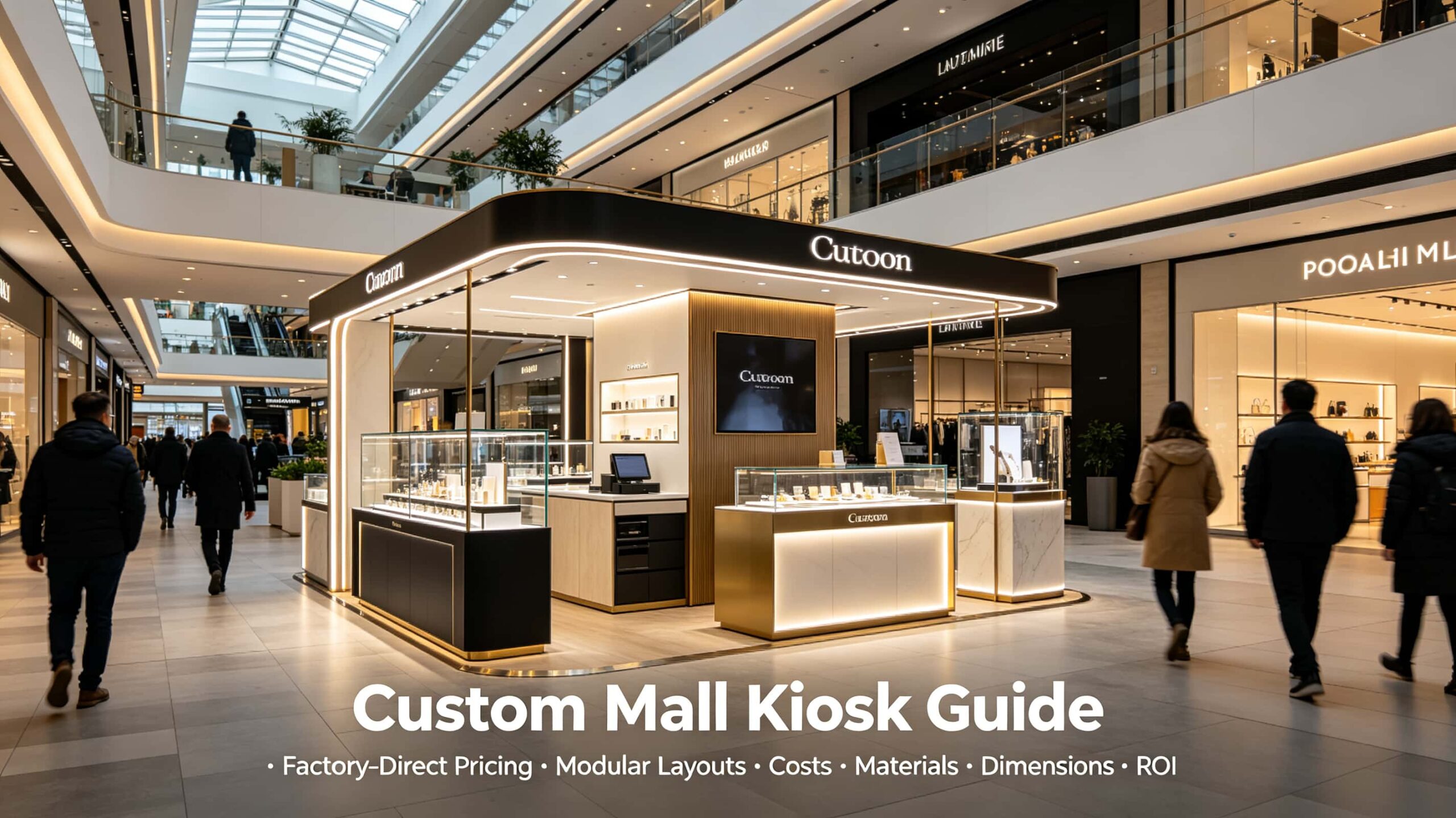
Custom mall kiosks maximize retail ROI via factory-direct pricing and modular layouts. This guide details costs, materials, dimensions, and design strategies.
A custom mall kiosk is a modular, factory-built retail structure designed for high-traffic commercial spaces. It integrates storage, point-of-sale counters, lighting, and branding into a compact footprint, built to mall regulations and shipped directly to your location for rapid assembly.
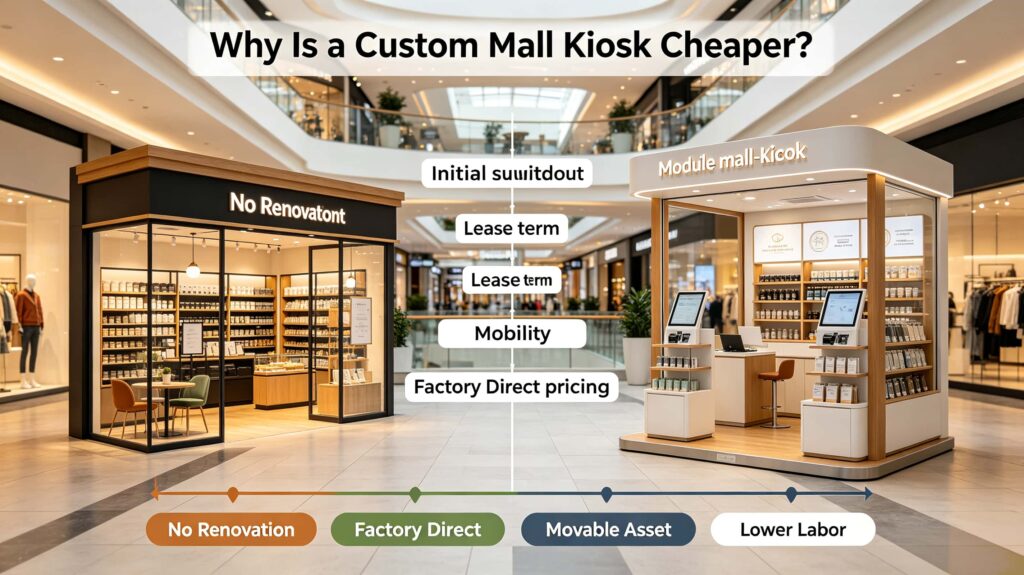
Why is a custom mall kiosk cheaper than a traditional store?
A custom mall kiosk eliminates major overhead costs like building renovations, permanent plumbing, and long-term leases. You pay for a movable asset, not a fixed property. Factory-direct pricing further cuts middleman markups, making kiosks the most capital-efficient entry into physical retail today.
- No permanent renovation costs – Skip HVAC installation, flooring, and permanent lighting.
- Low rent and flexible lease terms – Malls typically offer 3, 6, or 12-month leases.
- Factory-direct pricing – Buying straight from the manufacturer cuts 30-50% of retail markups.
- Movable asset – If your location fails, you can relocate or resell the kiosk easily.
- Lower labor costs – No need for specialized contractors; modular kiosks assemble in hours.
| Cost Factor | Traditional Store | Custom Mall Kiosk |
|---|---|---|
| Initial Buildout | $50,000+ | $3,000 – $15,000 |
| Lease Term | 3-5 years | 3-12 months |
| Renovation | Required | None |
| Mobility | None | High |
What is the best material for a mall kiosk?
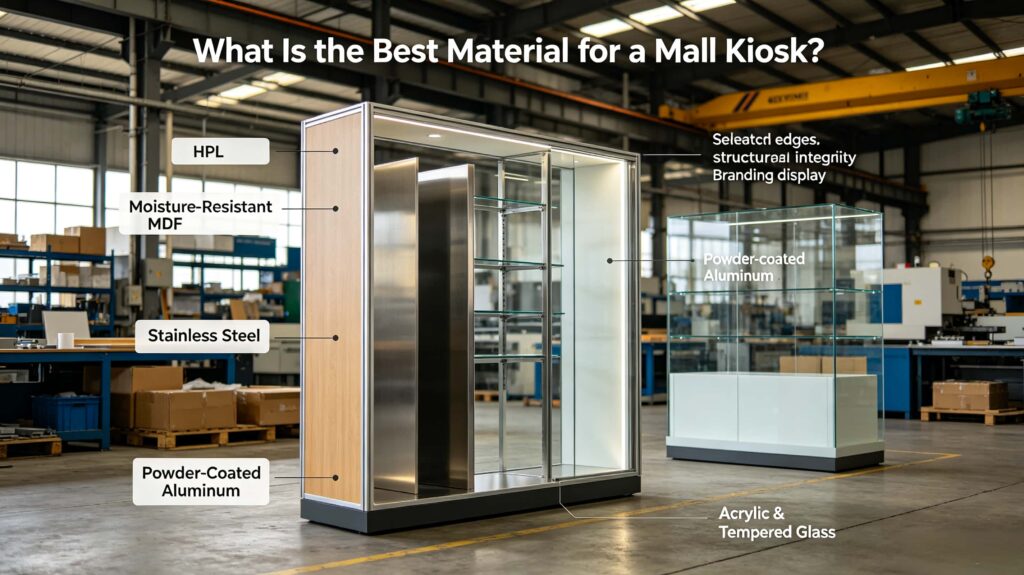
The best materials balance durability, weight, and visual appeal. High-pressure laminate (HPL) offers scratch resistance and endless colors. Moisture-resistant MDF provides a solid core. Stainless steel and powder-coated aluminum add structural integrity, while acrylic enhances branding displays.
- HPL (High-Pressure Laminate) – Scratch-resistant, available in hundreds of finishes.
- Moisture-resistant MDF – Solid core, easy to carve, ideal for painted surfaces.
- Stainless steel – NSF-approved, perfect for food and beverage kiosks.
- Powder-coated aluminum – Lightweight, rust-proof, great for structural frames.
- Acrylic and tempered glass – High-end display zones for jewelry or electronics.
Factory Insider Tip: Always request edge-banding on every exposed MDF panel. Mall environments have high humidity. Unsealed edges absorb moisture, causing swelling within months. Sealed edges ensure your kiosk looks new for years.
What are the standard dimensions for a mall kiosk?
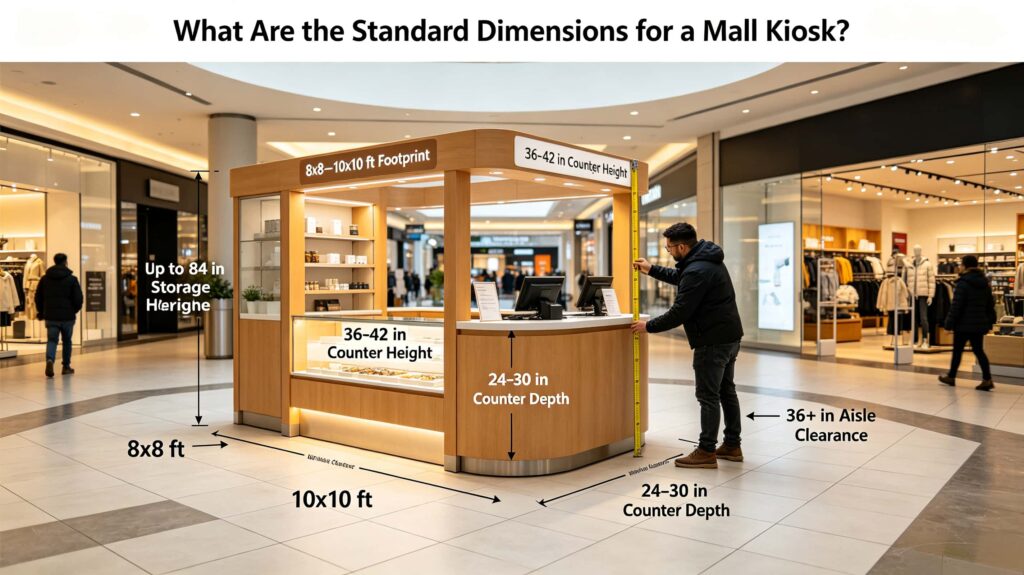
Standard mall kiosk dimensions depend on mall regulations and workflow. A typical center kiosk is 8×8 to 10×10 feet. The counter height should be 36 to 42 inches, with a counter depth of 24 to 30 inches to accommodate POS systems, storage, and staff movement.
- Footprint – 8×8 feet to 10×10 feet (confirm with mall management).
- Counter height – 36 inches for ADA compliance, 42 inches for standing service.
- Counter depth – 24 to 30 inches for standard POS and storage.
- Aisle clearance – Minimum 36 inches around the kiosk for customer flow.
- Storage height – Up to 84 inches to maximize vertical retail space.
| Dimension | Standard Range | Best For |
|---|---|---|
| Footprint | 8×8 ft to 10×10 ft | Center court kiosks |
| Counter Height | 36-42 inches | ADA / Standing service |
| Counter Depth | 24-30 inches | POS, storage, prep |
| Aisle Clearance | 36+ inches | Customer traffic |
How much does a custom mall kiosk cost?
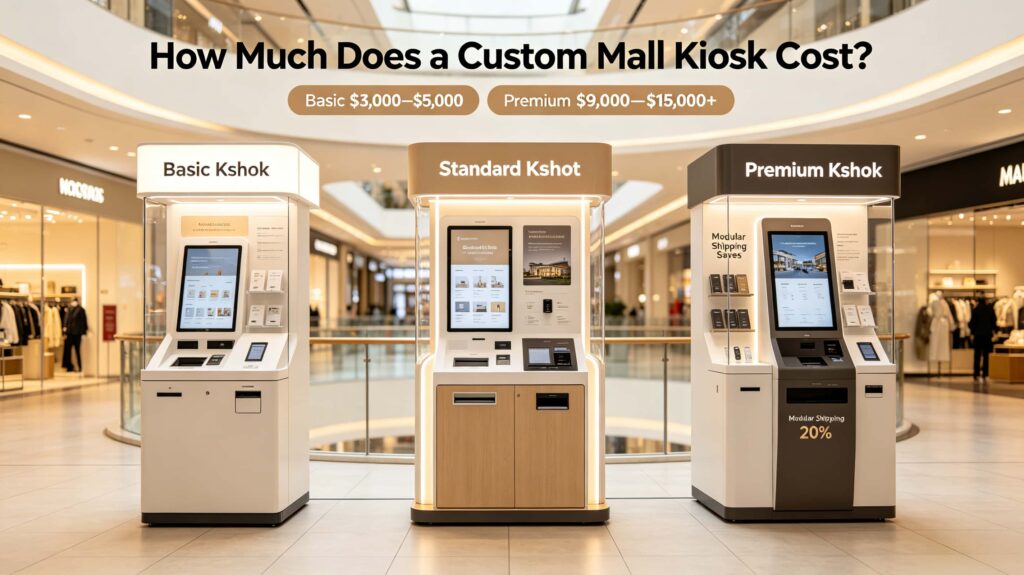
Factory-direct custom mall kiosks range from $3,000 to $15,000, depending on size, materials, and electrical complexity. Basic kiosks start around $3k. Premium kiosks with integrated LED, glass displays, and premium hardware can reach $15k. Modular shipping saves 20% on installation.
- Basic Kiosk ($3,000 – $5,000) – Simple counter, open shelving, basic laminate.
- Standard Kiosk ($5,000 – $9,000) – LED lighting, lockable drawers, acrylic displays.
- Premium Kiosk ($9,000 – $15,000+) – Glass showcases, custom woodwork, integrated POS.
- Shipping – Modular flat-pack shipping saves 20% compared to assembled units.
- Installation – 2-3 hours for modular units; no specialized labor required.
How to design a mall kiosk for maximum ROI?
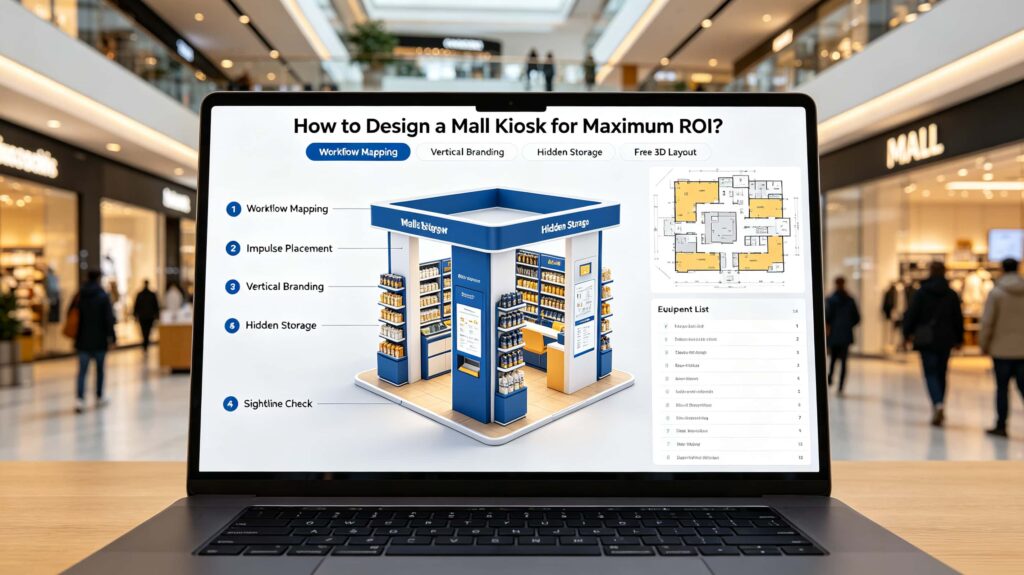
Maximizing ROI requires workflow mapping and strategic product placement. Place impulse items facing the main walkway. Keep the transaction zone separate from the queue. Use vertical space for branding. Get a 3D layout from your factory to validate sightlines before production.
- Workflow mapping – Order → pay → fulfill. Keep these zones separate.
- Impulse placement – Put high-margin items facing the main walkway.
- Vertical branding – Use the top 2 feet for logos and lighting.
- Hidden storage – Keep backstock out of customer sight.
- Free 3D layout – Validate ergonomics and mall compliance before paying a deposit.
Why choose a factory-direct kiosk manufacturer?
Factory-direct manufacturers eliminate middlemen, cutting costs by 30-50%. They provide free 3D designs, engineering support, and modular shipping. You get direct quality control, custom sizing, and faster lead times. This partnership ensures your kiosk meets mall regulations and your budget.
- Cost reduction – 30-50% cheaper than buying through distributors.
- Free 3D design – See your kiosk before production begins.
- Engineering support – Factories know mall electrical and ADA codes.
- Modular shipping – Flat-pack design cuts freight costs significantly.
- Quality control – Direct communication with the production line.
FAQ
How long does it take to manufacture a custom mall kiosk?
Typically 4 to 8 weeks after finalizing the 3D design. Modular kiosks ship in 2 to 4 weeks. Add 1 week for complex electrical work or custom glass. Rush options exist but increase costs by 20-30%.
Planning ahead is critical. Mall lease dates are strict. Always add a 2-week buffer to your manufacturing timeline for shipping and on-site assembly. Communicate your deadline to your factory early to secure production slots.
Do mall kiosks need to meet ADA compliance?
Yes, most US malls require ADA-compliant counter heights. Include a 36-inch-high section for wheelchair access. Confirm specific mall regulations before production. A factory experienced with US malls will pre-engineer this into your 3D layout.
Compliance is not optional. Fines for non-compliant retail structures can reach thousands of dollars. It is cheaper to integrate ADA height requirements during the design phase than to modify a finished kiosk on-site.
Can I ship a custom kiosk to multiple locations?
Yes. Modular factory-direct kiosks are designed for flat-pack shipping. You can replicate the exact same kiosk for multiple malls. This ensures brand consistency. It also reduces future manufacturing costs because the engineering and design work is already complete.
Consistency drives brand recognition. Replicating a proven kiosk design minimizes risk. Your factory can store the design files and produce identical units on demand, simplifying your expansion strategy.
What electrical requirements should I plan for?
Plan for 20 to 30 amps of dedicated power for standard kiosks. Espresso machines and refrigerators require dedicated circuits. LED lighting draws minimal power. Always request a pre-assembled electrical harness from your factory to simplify on-site wiring.
Malls have strict amperage codes. Exceeding your allocated power can result in fines or forced shutdowns. Work with your factory to calculate exact electrical loads before submitting plans to mall management.
Ready to launch your mall kiosk without the guesswork? Send us your floor plan and equipment list today. We will return a free 3D layout and a factory-direct quote within 48 hours.
Our team has manufactured custom mall kiosks for retailers across 14 countries. We know the codes, the workflow, and the hidden costs. Click “Contact” now. Attach your plan. Get your 3D design. No obligation. No sales pressure. Just a factory insider’s honest layout review.
Your kiosk is your cheapest ticket to retail success. Let’s build it right the first time.