
How to Choose the Right Bar Counter Material: Wood vs. Marble vs. Stainless Steel

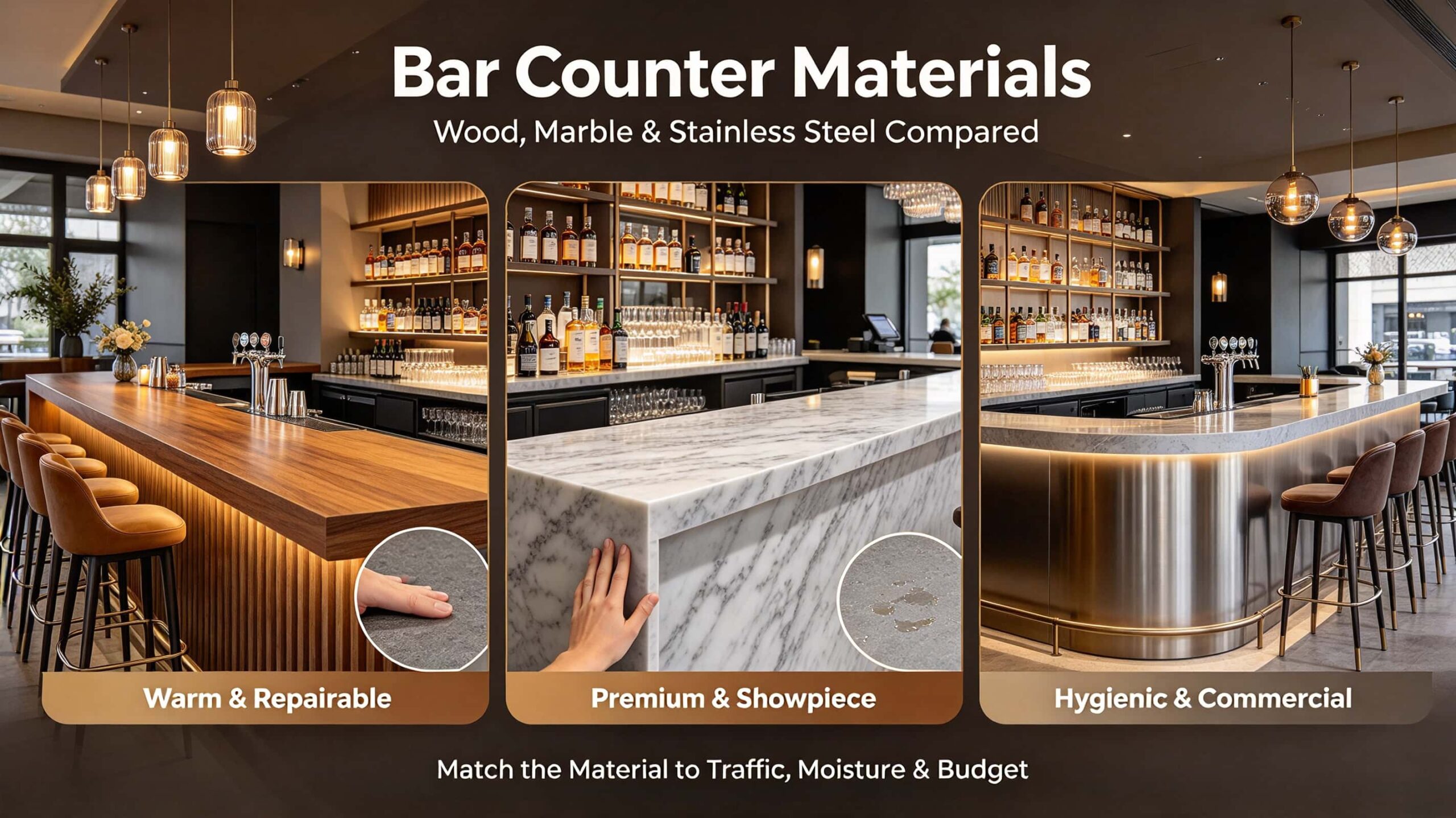
Wood gives you warmth and easy repairs at a low price, marble gives you a showpiece that needs sealing, and stainless steel gives you hygiene and zero fuss. Match the material to traffic, moisture, and budget, not to photos.
A bar counter material is the top surface layer of the bar, the part guests touch, lean on, spill on, and judge. It must handle weight, heat, liquid, and daily cleaning while matching the joinery below. Wood, marble, and stainless steel cover more than 90 percent of the bar tops we fabricate.
Which Bar Counter Material Actually Wins?
Pick stainless steel for commercial volume, marble for a signature look in a low-mess space, and wood for residential bars that need warmth without a scary invoice. Most of the projects we quote end up mixing two of them: a wood front panel with a stone or steel top.
Here is the fast version we give clients who call on a Tuesday and need a number by Friday.
| Your situation | Go with | Why |
|---|---|---|
| Busy restaurant, 200+ covers a night | Stainless steel | Survives chemical cleaning, hot pans, and knocks |
| Hotel lobby or wine bar, low food service | Marble | Reads as luxury, holds a shine under lighting |
| Basement bar, family use, tight budget | Wood (butcher block or oak) | Cheapest entry, sandable, repairable on site |
| Outdoor or poolside bar | Stainless steel frame with stone top | Water and sun kill wood fast |
| Home bar with heavy cocktail use | Wood top with sealed stone insert | Balance of cost, warmth, and spill control |
| Chef’s counter or live-cooking bar | Stainless steel | Heat and grease tolerance |
- Cheapest to install: butcher block wood
- Cheapest to own over 10 years: stainless steel (fewest re-finishing cycles)
- Highest visual impact per dollar: marble
- Easiest DIY repair: wood
- Worst at resisting red wine and citrus: untreated marble
Wood Bar Counters: Warm, Repairable, and Forgiving on Budget
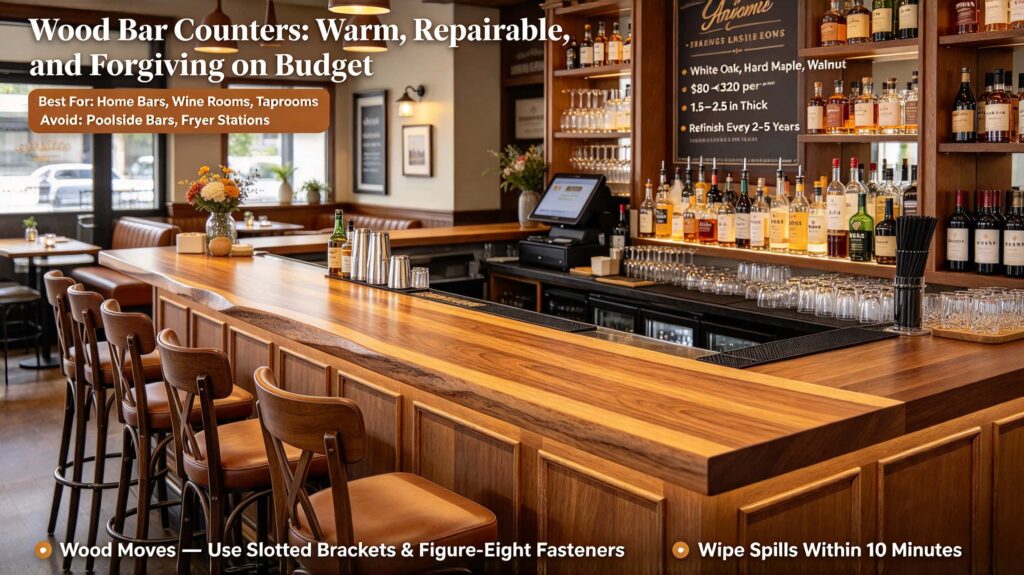
Wood is the material we install most often in homes, and the one that comes back for the fewest complaints. It feels warm at the elbow, dampens glass noise, and can be sanded back to new after five years of abuse. It also costs the least to start.
Where wood works best
Wood suits residential bars, speakeasy-style venues, tasting rooms, and any space where guests sit for an hour and lean on the counter. It is a poor choice for kitchens with open flame nearby, and a bad choice outdoors unless you accept annual refinishing as a hobby.
- Best for: home bars, wine rooms, cafés, brewery taprooms
- Avoid for: poolside bars, uncovered patios, heavy fryer stations
- Species that hold up: white oak, hard maple, walnut, iroko
- Species to skip: pine, rubberwood, anything soft enough to dent with a bottle base
Wood specs, sizes, and price
| Spec | Typical range |
|---|---|
| Thickness | 1.5 in to 2.5 in (38 mm to 64 mm) |
| Standard bar height | 42 in (1067 mm) |
| Standard counter height | 36 in (914 mm) |
| Seating overhang | 12 in to 15 in |
| Price, butcher block | $80 to $180 per linear foot |
| Price, white oak | $130 to $240 per linear foot |
| Price, walnut | $170 to $320 per linear foot |
| Refinish interval | 2 to 5 years |
| Finish | Hardwax oil, conversion varnish, or polyurethane |
Two things drive the price more than species: how the top is built (edge-glued strips vs. a solid slab) and the edge profile. A slab walnut top with a live edge can cost four times a glued-up oak top of the same length.
The maintenance reality nobody mentions
Wood moves. A 10-foot maple top will expand and shrink across the seasons, and if the fabricator screws it down tight at every fixing point, it will crack. We use slotted brackets and figure-eight fasteners so the top can float. If your installer bolts it rigid, expect a split by year three.
- Re-oil every 3 to 6 months in a home setting
- Wipe spills within 10 minutes, especially citrus and spirits
- Never leave a wet glass ring overnight; it lifts the finish
- Keep a small tin of matching wax for touch-ups
Marble Bar Counters: Premium Look, Real Maintenance
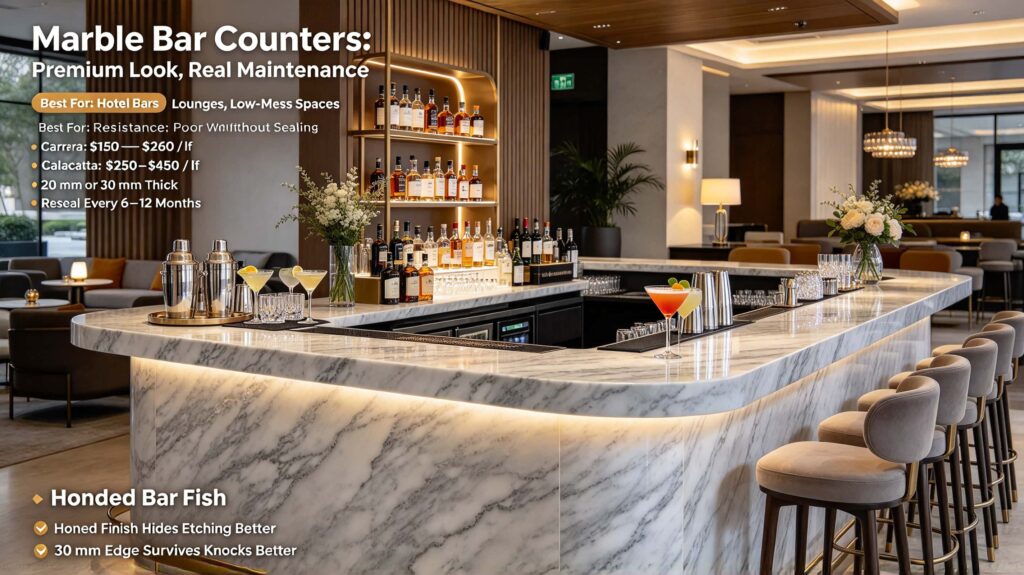
Marble is the material that sells photographs. It is also the one that generates the most callbacks from clients who did not read the care sheet. It is soft for a stone, it stains, and it etches. If you accept that, nothing else looks quite like it under bar lighting.
What marble actually does well
Marble handles heat better than wood and far better than laminate. It stays cool to the touch, which matters for pastry and cocktail stations. It also takes a polish that reads as expensive from across the room, and that is worth real money in hospitality.
- Hardness: around 3 to 4 on the Mohs scale (calcite-based)
- Heat tolerance: good, but thermal shock can crack it
- Stain resistance: poor without sealing
- Etch resistance: poor against wine, lemon, vinegar, cola
- Best finish: honed rather than polished, if the bar sees food service
Marble specs, sizes, and price
| Spec | Typical range |
|---|---|
| Thickness | 20 mm (3/4 in) or 30 mm (1 1/4 in) |
| Substrate required | Continuous plywood or MDF subtop |
| Max unsupported overhang | 8 in, then needs corbels or steel |
| Price, Carrara | $150 to $260 per linear foot |
| Price, Calacatta | $250 to $450 per linear foot |
| Price, quartz alternative | $120 to $230 per linear foot |
| Sealing interval | Every 6 to 12 months |
| Weight | About 6.5 lb per sq ft at 20 mm |
Where marble fails on a bar top
Three places. The front edge where guests lean and chip it. The drip line where spilled drinks sit against the sealant. And the area around a sink or ice well, where standing water finds every pinhole in the sealer. Honed finishes hide etching better than polished ones, and a 30 mm edge survives knocks that a 20 mm edge will not.
If a client insists on marble but runs a busy food bar, we push them toward quartz or a marble-look porcelain. Same visual read, none of the etching calls.
Stainless Steel Bar Counters: The Commercial Workhorse
Stainless steel is what you specify when the bar has to work every night for a decade without a maintenance budget. It takes hot pans, bleach, scrubbing pads, and dropped bottles. It also scratches, shows fingerprints, and sounds loud, which is why it rarely appears in a quiet lounge.
Steel in commercial settings
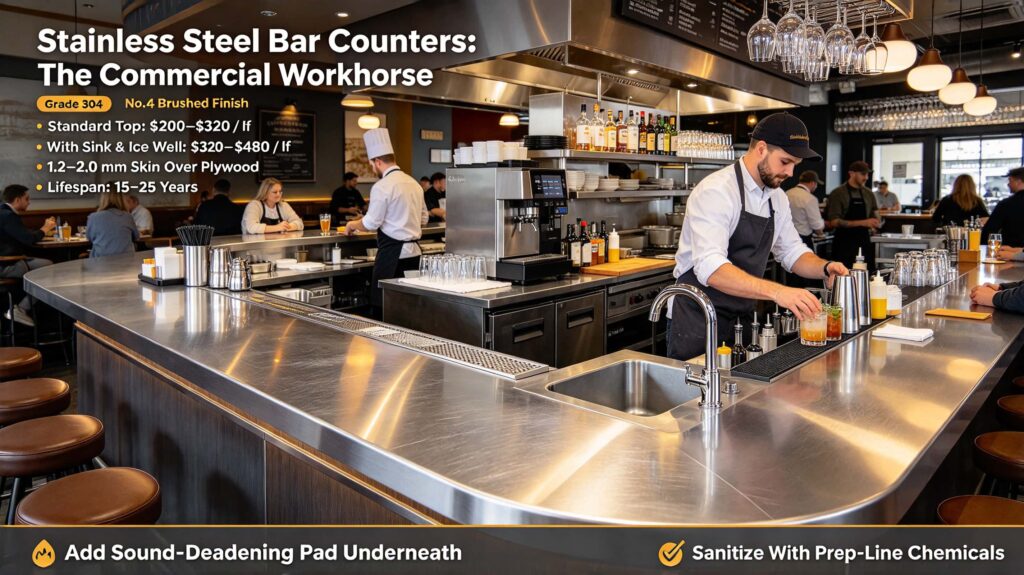
Stainless wins on hygiene and lifespan. A 304-grade top with a No. 4 brushed finish will outlive the cabinetry beneath it. Bars that fail health inspections rarely fail because of steel, and steel can be sanitized with the same chemicals used on the prep line behind it.
- Grade to specify: 304 (or 316 for coastal and poolside)
- Finish: No. 4 brushed (hides scratches), 2B mill (cheaper, shows everything)
- Backing: 1.2 mm to 1.5 mm skin over 18 mm plywood or a steel frame
- Noise: add a sound-deadening pad underneath or every glass becomes a drum
Steel specs, sizes, and price
| Spec | Typical range |
|---|---|
| Skin thickness | 1.2 mm to 2.0 mm |
| Edge options | Square, rolled, marine edge, integrated drip rail |
| Custom fabrication | Welded and blended on site, or shop-built sections |
| Price, standard top | $200 to $320 per linear foot |
| Price, with sink and ice well | $320 to $480 per linear foot |
| Price, 316 marine grade | Add 25 to 40 percent |
| Lifespan | 15 to 25 years in commercial use |
Wood vs. Marble vs. Stainless Steel
| Factor | Wood | Marble | Stainless Steel |
|---|---|---|---|
| Warmth to touch | High | Low | Low |
| Scratch resistance | Low | Medium | Medium (shows fine scratches) |
| Stain resistance | Medium | Low | High |
| Heat resistance | Low | High | High |
| Noise level | Quiet | Medium | Loud |
| Repair method | Sand and re-oil | Polish or replace section | Blend with abrasive pad |
| Weight | Light to medium | Heavy | Medium |
| Upfront cost | $80 to $320 / lf | $150 to $450 / lf | $200 to $480 / lf |
| 10-year upkeep cost | Medium | High | Low |
| Best setting | Residential, tasting rooms | Lounges, hotel bars | Commercial kitchens, busy bars |
How Bar Type Changes the Decision
The same material performs differently depending on where the bar sits and who leans on it. We ask three questions before quoting: who stands behind it, who sits in front of it, and what gets spilled.
Home basement bar
Wood wins here almost every time. Humidity swings in basements are brutal on stone adhesive and on steel seams, and a wood top can be refinished by the owner with a $30 sander. Add a sealed stone insert around the sink if cocktails get messy.
Restaurant or hotel bar
Stainless for the working side, and your feature material for the guest side. Splitting the top into two surfaces costs roughly 15 to 20 percent more than a single-material top and saves years of maintenance headaches.
Outdoor or poolside bar
Stainless steel frame with a stone or porcelain top, never solid wood. UV, chlorine, and rain will destroy a wood top in two seasons unless it is iroko or teak with a marine finish, and even then it needs annual work.
Edge Profiles, Thickness, and Overhang Rules
Most bar failures we get called to fix are not material failures. They are overhang failures. A 14-inch stone overhang with no corbel will crack, and no sealer on earth will prevent it.
| Element | Recommended spec |
|---|---|
| Bar height overhang (knee space) | 12 in to 15 in |
| Unsupported stone overhang | 8 in maximum |
| Unsupported wood overhang | 12 in maximum |
| Overhang support spacing | Corbels or steel brackets every 24 in to 36 in |
| Stone thickness at a seating edge | 30 mm, or 20 mm with a laminated edge |
| Steel gauge for a work top | 1.5 mm minimum |
- Always run the substrate under stone across the full overhang
- Never rely on adhesive alone at a cantilever
- Ask for a drip groove under the front edge of stone tops
- Round or bullnose edges survive crowds better than square edges
5 Questions That Decide the Material for You
Answer these honestly and the choice usually makes itself.
- How many drinks land on this counter per night? Under 30, wood is fine. Over 100, go steel.
- Will anyone put a hot pan down? If yes, cross wood off the list.
- Is the bar outdoors or in a humid basement? Then stone and steel beat wood.
- Who cleans it, and with what? If the answer is “staff with bleach,” marble is out.
- What is your 10-year budget, not your day-one budget? Marble usually loses this one.
Mistakes We See on Site
- Sealing marble once at installation and never again
- Screwing a solid wood top tight to the cabinet at every point
- Specifying 20 mm marble with a 16-inch overhang and no brackets
- Buying 2B mill stainless and discovering every fingerprint
- Skipping the sound pad under steel, then wondering why the bar is deafening
- Choosing a material from a photo without checking the sample under the actual bar lighting
Frequently Asked Questions
Is marble a bad choice for a bar counter?
No, but it is a high-maintenance choice. Marble etches from wine, citrus, and vinegar and needs resealing every 6 to 12 months. It suits low-food-service lounge bars far better than busy restaurant counters.
Which bar counter material is the cheapest?
Butcher block wood is the cheapest upfront, typically $80 to $180 per linear foot. Over ten years, stainless steel often costs less because it needs almost no refinishing.
Can I use wood for a commercial bar top?
Yes, with a hard species like white oak or maple, a conversion varnish finish, and a plan for refinishing every 2 to 3 years. Avoid it behind fryers or open flame.
How thick should a bar counter be?
Wood tops usually run 1.5 to 2.5 inches. Marble is commonly 20 mm or 30 mm, with 30 mm preferred at seating edges. Stainless steel is a 1.2 to 1.5 mm skin over a structural substrate.
Does stainless steel scratch easily?
It shows fine scratches, especially in a polished finish. A No. 4 brushed finish hides them well and can be re-blended in place with an abrasive pad.
What is the standard bar counter height and overhang?
Bar height is 42 inches, counter height is 36 inches, and a seating overhang runs 12 to 15 inches deep.