
How to Choose Right Wall Cabinet for Your Shop?


Choosing the right wall cabinet for your shop comes down to five practical checks: the job it does, your layout, the material, the size, and the build quality. Get those right and the cabinet sells for you; get them wrong and it just eats wall space. Quick definition: A wall cabinet for shop use is a wall-mounted retail storage and display unit made from MDF, plywood, metal, or glass for boutiques, convenience stores, salons, and coffee shops. It combines closed storage with open display so your space stays tidy and sellable.
Start with the Job, Not the Look
Decide what the cabinet must hold before you pick a finish. A retail wall cabinet that mixes open display with closed stock works for most small shops. If you sell bulky items, give more space to shelves; if you sell small high-value pieces, add glass and locks.
- Write down your five heaviest products and your five longest products.
- Count how many items need to be visible to customers.
- Count how much backstock must hide behind doors.
- Check whether staff need to reach the top shelf every day.
If you are searching how to choose a wall cabinet for a retail shop, start with this list. It stops you from buying a pretty cabinet that cannot hold your actual stock.

What the Reference Design Gets Right
The case title we’re working from is “Clean Retail Wall Cabinet with Open Display + Closed Storage.” That design works because it shows product at eye level and hides clutter below. It suits boutiques, salons, and small convenience stores without making the wall feel heavy.
- Upper open shelves: good for featured products and best wall cabinet design for small boutique layouts.
- Glass doors in the middle: good for retail wall cabinet with glass doors and open shelves.
- Lower closed cabinets: good for bags, tools, cleaning supplies, and backstock.
- Adjustable shelves: good when your product mix changes.
- Neutral finish and simple handles: easy to match with your shop’s brand.
In the reference photos, the clean lines do a lot of work. Don’t cover that up with too many colors. Keep the cabinet quiet and let the product speak.

Pick Materials That Survive Daily Retail Use
Match the material to traffic, moisture, and weight. For most shops, plywood or MDF with a good laminate finish is the sweet spot; metal frames add durability; glass adds display value but needs safe handling. Don’t choose by color alone.
A quick material comparison
| Material | Best for | Watch out for |
|---|---|---|
| Plywood | Busy shops, heavier stock, long life | Higher cost than basic MDF |
| MDF + laminate | Clean finishes, boutiques, salons | Keep edges sealed against moisture |
| Metal frame | Industrial looks, heavy shelves | Can feel cold; check powder coating |
| Glass | High-value displays, cosmetics | Needs safe packing and strong shelves |
| Solid wood | Premium brand look | Moves with humidity; needs good finishing |
- For wall cabinet material for retail store projects, ask for the core board, not just the surface color.
- Check the edge banding. Cheap edges fail first.
- If your shop is damp, avoid raw MDF near the floor.
- Ask how shelves are supported. Pins are fine; cheap pins are not.

Get the Size and Depth Right
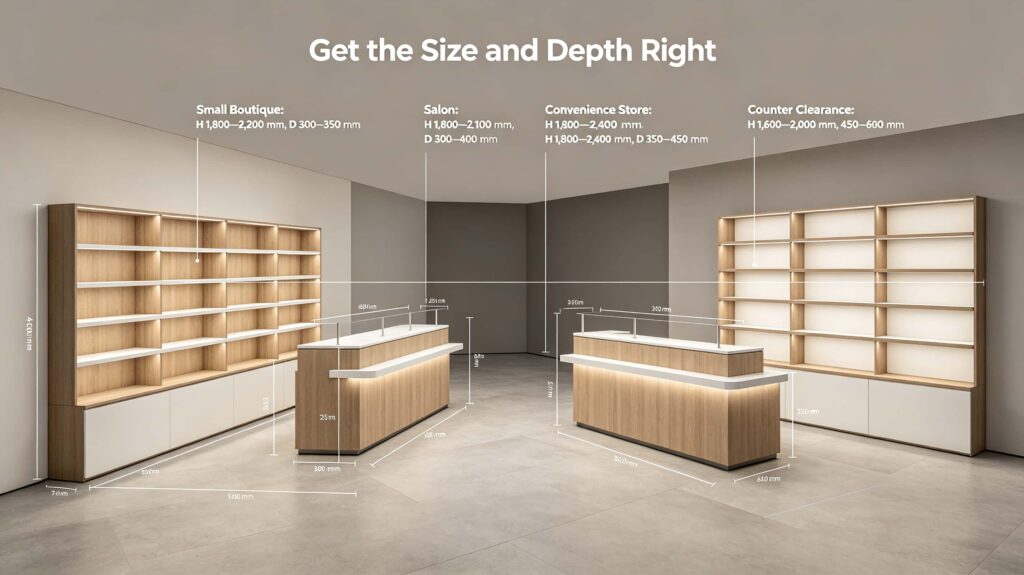
Measure the wall, then measure your longest product and tallest bottle. A shop wall cabinet dimensions and depth plan should leave breathing room above the counter and enough depth for backstock. Depth matters more than height for daily use.
Simple size guide
| Shop type | Suggested height | Suggested depth | Why |
|---|---|---|---|
| Small boutique | 1,800–2,200 mm | 300–350 mm | Shallow display, easy reach |
| Salon | 1,800–2,100 mm | 300–400 mm | Products and tools |
| Convenience store | 1,800–2,400 mm | 350–450 mm | More backstock |
| Coffee shop | 1,600–2,000 mm | 300–350 mm | Cups, retail beans, small stock |
- Leave at least 450–600 mm between the counter and the bottom of the cabinet.
- Don’t go deeper than 450 mm unless you really need backstock.
- Check door swing and handle clearance before you approve the drawing.
- For wall cabinet for convenience store checkout area, keep the top shelf reachable by staff.
Balance Display and Storage
Put the stuff you want customers to touch at eye level and the stuff you don’t want them to touch behind doors. A good wall-mounted display cabinet is usually 60–70% display and 30–40% closed storage. Adjust that split by how much backstock you carry.
- Use open shelves for new arrivals, impulse buys, and best sellers.
- Use glass doors for high-value items that still need to be seen.
- Use solid doors for bags, receipts, cleaning items, and staff tools.
- Add one lockable section if you keep cash-adjacent stock or small expensive items.
- For custom wall display cabinet for salon projects, plan a locked drawer for tools.

Doors, Shelves, and Lighting
Choose doors for security and dust control, adjustable shelves for changing stock, and LED strip lighting for visibility. Glass doors sell product; solid doors hide mess. Don’t over-light the top shelf and leave the bottom dark.
- Use tempered glass if you choose glass doors.
- Make shelves adjustable every 32 mm or so.
- Put LED strip light near the front edge, not at the back.
- Use a warm-neutral light around 3000–4000K for most retail displays.
- Hide the driver and wires inside the cabinet, not on top.

Match the Cabinet to Your Shop Layout
Draw your counter, door swing, and walking path before you approve a cabinet. A wall cabinet layout for small shop spaces has to keep checkout clear and aisles open. Corner cabinets and shallow shelves often beat a deep cabinet that crowds customers.
- Mark the wall width, height, and any sockets or switches.
- Check where customers stand when they pay.
- Keep the cabinet away from the door swing.
- Use a corner cabinet if you have dead space.
- Send a photo of the wall with a tape measure visible—it saves a lot of guessing.

Custom or Ready-Made?
Go custom when your wall is odd, your brand needs a specific look, or you need production consistency across several shops. Ready-made works for quick, low-volume needs. For a custom retail wall cabinet, ask for shop drawings before paying.
Custom vs ready-made at a glance
| Point | Custom cabinet | Ready-made cabinet |
|---|---|---|
| Fit | Made to your wall | Standard sizes |
| Brand look | Your color, logo, layout | Limited finishes |
| Minimum order | Depends on factory | Usually one unit |
| Lead time | Longer, but predictable | Faster if in stock |
| Best use | Multi-shop rollouts, odd walls | Quick single-shop fix |
- Ask for a production drawing with dimensions.
- Confirm shelf load and wall-fixing method.
- Ask how the cabinet will be packed for shipping.
- For retail shop fitting cabinet projects, order one sample first if you can.

Compare Quotes Without Getting Burned
Compare structure, hardware, finish, packing, and lead time—not just the price per unit. A cheap retail shop fitting cabinet quote often skips wall brackets, adjustable shelves, or protective packing. Ask what is included and what is extra.
- Is the back panel included?
- Are wall brackets and screws included?
- Are shelves adjustable or fixed?
- Is LED lighting included or extra?
- Is packing export-grade?
I’ll be blunt: a low quote that leaves out brackets and packing is not a low quote. It is a surprise bill later. Ask for a line-by-line quote and compare like for like.
Quick Decision Charts
Use these charts as a starting point, then confirm with your own measurements. They are based on the clean open-display and closed-storage design in the reference case. If your shop is unusual, send a photo and sketch—don’t force the chart.
| If this is true… | Then choose… |
|---|---|
| You sell small high-value items | Glass doors + locks |
| You need lots of backstock | More closed lower cabinets |
| Your wall is narrow | Shallow depth + tall shelves |
| You change displays often | Adjustable shelves + open display |
| You need several shops to match | Custom shop cabinet production |
| You have a tight budget | Simple MDF + laminate, fewer extras |
Final checklist before you order
- Wall width, height, and depth confirmed.
- Product sizes and weights checked.
- Display vs storage split agreed.
- Material and finish chosen.
- Door type and lock plan chosen.
- Lighting and wiring plan checked.
- Packing and lead time confirmed.
Ready to Turn Your Wall Cabinet Idea into Production?
If you have a sketch, photo, or reference design, we can turn it into a production-ready custom shop cabinet. Send dimensions, material and finish, quantity, and target budget. We’ll confirm structure and quote before you place the production order.
- Send your wall photo with a tape measure in the frame.
- Send your product photos and the heaviest item’s weight.
- Tell us your finish color, handle style, and whether you need locks.
- Tell us your quantity and target delivery date.
- Ask for a production drawing before you pay.
If the drawing looks right, place the production order and we’ll start making your wall cabinet for shop to your size, finish, and layout. That is how you get a cabinet that fits your shop—not one you have to fit your shop around.