
Custom Ice Cream Shop Counter Ideas: How to Attract More Customers

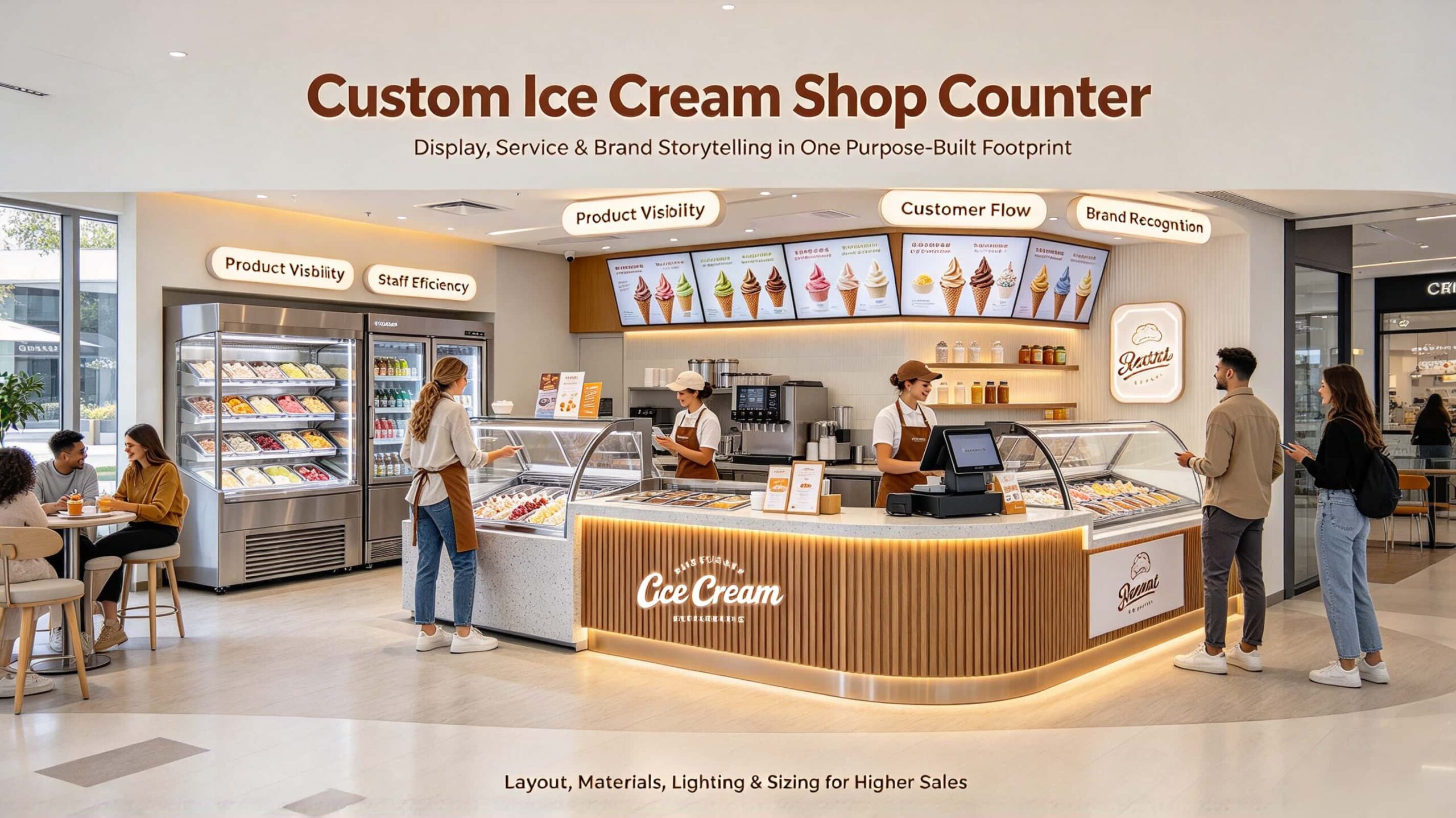
A custom ice cream counter blends display, service, and brand storytelling to pull people in and boost sales. This guide shares proven layouts, materials, lighting, and sizing ideas so your shop turns curious passersby into loyal, repeat customers.
A custom ice cream shop counter is a purpose-built service and display station designed around your specific floor plan, menu, and brand identity. Unlike generic retail fixtures, it controls product visibility, customer flow, and staff efficiency in one footprint, directly shaping how long guests stay and how much they spend per visit.
Why Your Ice Cream Counter Matters More Than Your Menu
Your counter is the first physical touchpoint customers experience, and it decides whether they walk in or walk past. A well-designed counter showcases your product, speeds up service, and communicates quality before anyone takes a bite. Get this element right, and everything else in your shop becomes easier to sell.
- First impression: 70% of purchase decisions happen in the first few seconds of viewing a display.
- Throughput: An efficient counter layout can cut average service time by 20-35%.
- Average ticket size: Strategic topping and add-on placement lifts upsells by 15-25%.
- Brand recall: Custom shapes, colors, and finishes make your shop memorable.
- Staff ergonomics: Proper counter height reduces fatigue and turnover during peak hours.
Think of it this way: your menu tells people what you sell, but your counter convinces them to buy it. That distinction drives real revenue.
Custom Ice Cream Shop Counter Ideas That Drive Foot Traffic
The most effective counters combine a clear visual focal point with an easy customer path. Curved and angled designs consistently outperform straight-line counters because they invite browsing and reduce crowding. Below are five concepts that work across small, medium, and large shops, each with a distinct advantage.
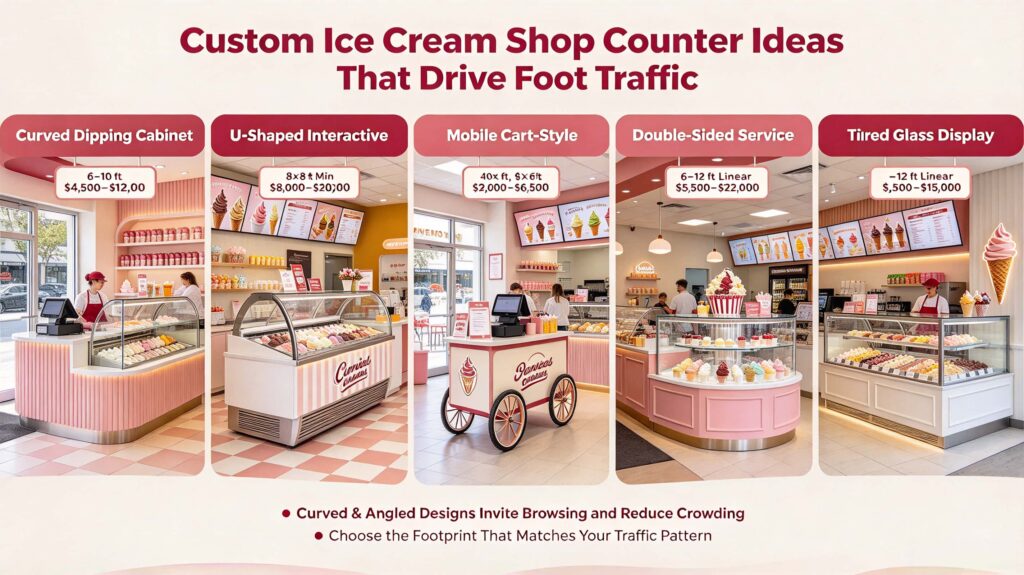
1. The Curved Dipping Cabinet Counter
A curved front softens the space and draws the eye toward your display glass. This shape works especially well in narrow shops because it reduces sharp corners and lets customers approach from multiple angles without bumping into each other.
- Best for: Boutique shops, 400-900 sq ft spaces
- Typical length: 6-10 feet
- Display capacity: 8-16 tubs or 3-6 dipping cabinets
- Price range: $4,500 – $12,000
- Key benefit: Higher product visibility from the entrance
2. The U-Shaped Interactive Counter
A U-shaped counter surrounds staff on three sides and puts product within arm’s reach of the customer. It creates a natural theater effect where scooping becomes part of the entertainment.
- Best for: High-volume shops with 2-3 servers working simultaneously
- Footprint: 8 x 8 ft minimum
- Display capacity: 12-24 tubs
- Price range: $8,000 – $20,000
- Key benefit: Fastest service speed during rush periods
3. The Mobile Cart-Style Counter
A wheeled or modular cart gives you flexibility to reposition during events, festivals, or seasonal peaks. Many operators use one as a secondary station near the entrance or patio.
- Best for: Pop-ups, seasonal shops, event catering
- Footprint: 4 x 6 ft
- Display capacity: 4-8 tubs
- Price range: $2,000 – $6,500
- Key benefit: Relocates in under five minutes
4. The Double-Sided Service Counter
Two service faces let you handle dine-in and takeout customers at the same time. This setup eliminates the bottleneck that happens when one line blocks another.
- Best for: Shops near busy sidewalks or with high delivery order volume
- Footprint: 10 x 4 ft
- Display capacity: 16-32 tubs across both sides
- Price range: $9,000 – $22,000
- Key benefit: Separates ordering from pickup
5. The Tiered Glass Display Counter
Tiered shelving inside tempered glass creates a museum-style presentation. Every scoop, topping, and cone is visible without bending or squinting.
- Best for: Premium and gelato-focused shops
- Footprint: 6-12 ft linear
- Display capacity: 10-20 flavors
- Price range: $5,500 – $15,000
- Key benefit: Justifies higher price points through perceived quality
Best Materials for Custom Ice Cream Counters
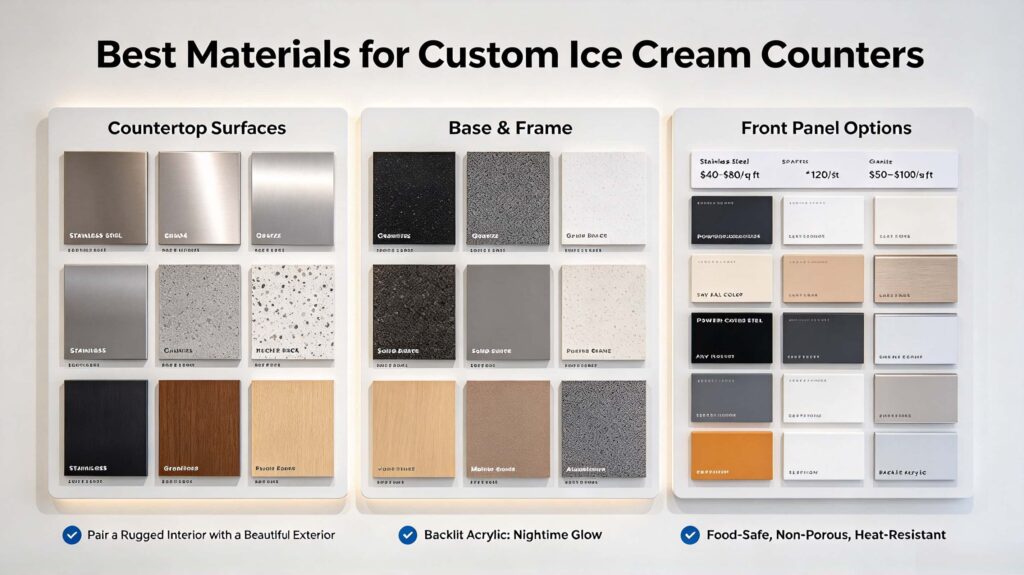
Material choice affects hygiene, durability, and how premium your shop feels. Stainless steel remains the industry standard for food-contact surfaces, while wood and stone handle the customer-facing aesthetic. The smartest builds pair a rugged interior with a beautiful exterior.
Countertop Surfaces
- Stainless steel 304: $40-$80 per sq ft, best for food safety, easy to sanitize
- Quartz: $60-$120 per sq ft, non-porous, resists stains and scratches
- Granite: $50-$100 per sq ft, heat resistant, heavy, requires sealing
- Butcher block wood: $30-$60 per sq ft, warm look, needs frequent oiling
- Solid surface acrylic: $45-$90 per sq ft, seamless joints, repairable
Base and Frame Materials
- Powder-coated steel: Best structural strength, available in any RAL color
- Marine-grade plywood: Lightweight, ideal for mobile carts
- Aluminum extrusion: Rust-proof, great for humid coastal shops
- Recycled HDPE: Eco-friendly selling point, withstands heavy moisture
Front Panel Options
- Glass with vinyl graphics: Low cost, easy to update seasonally
- Backlit acrylic: Creates glow, draws attention at night
- Tile or stone veneer: Premium feel, higher installation cost
- Chalkboard panels: Rotating menu flexibility, casual vibe
Lighting and Display Strategies That Sell More Scoops
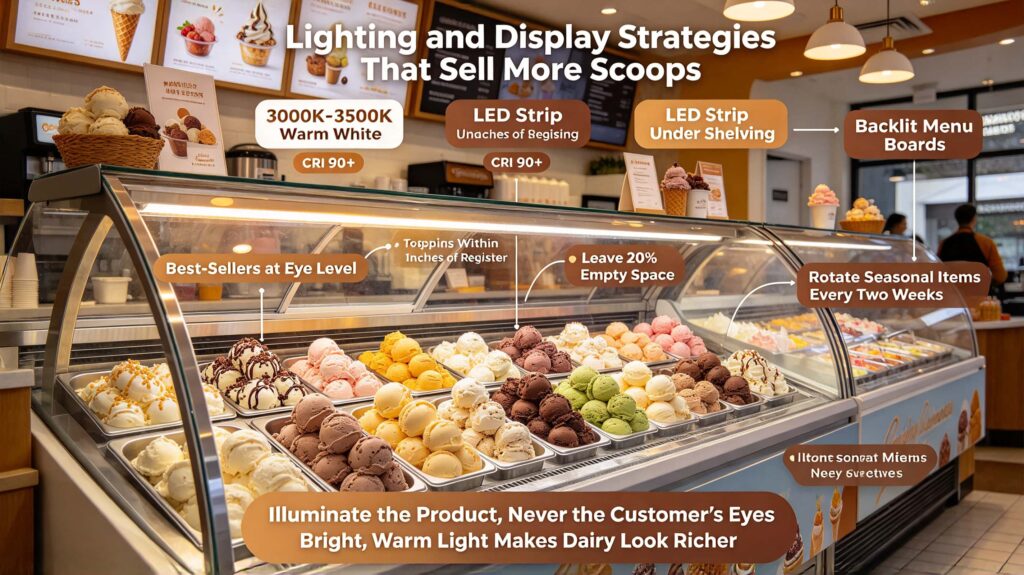
Lighting does more for ice cream sales than almost any other design element. Bright, warm-white light makes dairy products look richer and more appetizing, while cool light makes them appear dull. Position lights so they illuminate the product, never the customer’s eyes.
- Color temperature: 3000K-3500K makes ice cream look creamy and fresh
- LED strip under shelving: Eliminates shadows inside display cases
- CRI rating: Choose 90+ for accurate color rendering of toppings
- Backlit menu boards: Increase order speed and reduce questions
- Accent spotlights: Highlight signature flavors or seasonal specials
Display Layout Rules
- Place best-selling flavors at eye level, roughly 48-60 inches from the floor.
- Group colors intentionally: alternate bright and neutral tones for contrast.
- Keep toppings within 12 inches of the register for impulse add-ons.
- Leave 20% empty space so the display never looks picked over.
- Rotate seasonal items to the front every two weeks.
Layout and Sizing: What Works for Different Shop Types
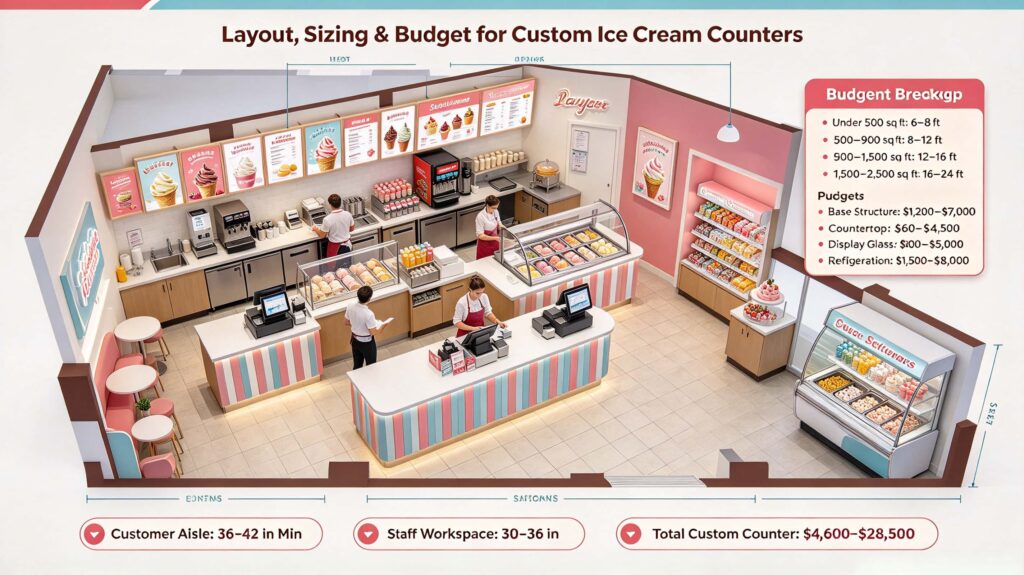
Counter dimensions must match your traffic pattern, not just your available wall space. A counter that is too long wastes labor, while one that is too short creates queues that spill out the door. Use the table below as a starting benchmark for your shop size.
| Shop Size | Recommended Counter Length | Service Positions | Seating Capacity |
|---|---|---|---|
| Under 500 sq ft | 6-8 ft | 1-2 | 0-8 |
| 500-900 sq ft | 8-12 ft | 2 | 10-20 |
| 900-1,500 sq ft | 12-16 ft | 2-3 | 20-40 |
| 1,500-2,500 sq ft | 16-24 ft | 3-4 | 40-60 |
| Over 2,500 sq ft | 24+ ft or dual counters | 4+ | 60+ |
Critical Clearances
- Customer aisle: 36-42 inches minimum for comfortable two-way flow
- Staff workspace behind counter: 30-36 inches
- Distance from counter to seating: 48 inches to allow chair pull-out
- Register to display case: 18-24 inches for easy reaching
Color, Branding, and Themed Counter Designs
Your counter should look like it belongs to your brand and no one else’s. Generic white counters disappear into the background, while a branded counter becomes a photo opportunity that customers share online. That free exposure is worth more than most paid advertising.
- Retro 1950s: Mint green, chrome trim, checkered floors, neon signage
- Minimalist modern: Matte black, white quartz, hidden LED strips
- Artisan gelato: Warm walnut wood, brass hardware, hand-lettered signage
- Tropical: Rattan panels, palm accents, pastel terrazzo tops
- Industrial: Concrete tops, exposed steel, Edison bulb lighting
Branding Placement Tips
- Put your logo on the front panel at 40-48 inches high for photos.
- Use a consistent accent color across the counter, menu, and packaging.
- Add a small hashtag decal near the register to encourage social posts.
- Keep signage under three fonts to avoid a cluttered appearance.
Budget Breakdown for Custom Ice Cream Counters
Custom counters range from $2,000 for a simple mobile cart to over $25,000 for a fully integrated dual-sided station. Most independent shops land between $6,000 and $14,000 for a counter that includes display glass, refrigeration, and branded finishes.
| Component | Low End | Mid Range | High End |
|---|---|---|---|
| Base structure | $1,200 | $3,000 | $7,000 |
| Countertop | $600 | $1,800 | $4,500 |
| Display glass | $800 | $2,200 | $5,000 |
| Refrigeration | $1,500 | $3,500 | $8,000 |
| Lighting | $200 | $600 | $1,500 |
| Branding/graphics | $300 | $900 | $2,500 |
| Total | $4,600 | $12,000 | $28,500 |
Ways to Reduce Cost Without Losing Impact
- Choose quartz over granite for the top surface.
- Use powder-coated steel instead of full stainless on non-food panels.
- Buy standard-depth dipping cabinets and customize only the surround.
- Phase the build: start with the main counter, add a second station later.
How to Choose the Right Counter Manufacturer
The right fabricator understands health codes, refrigeration, and retail flow, not just cabinetry. Ask for shop drawings, refrigeration specs, and at least three installed references before signing anything. A good manufacturer will also visit your space or work from your floor plan to catch problems early.
- Ask about NSF certification for all food-contact surfaces.
- Confirm lead times: custom builds typically take 6-10 weeks.
- Request a 3D rendering before production begins.
- Check warranty terms on refrigeration and structural components.
- Verify installation support or provide a local installer list.
Frequently Asked Questions
How much does a custom ice cream shop counter cost?
Most custom counters cost between $6,000 and $14,000, depending on size, materials, refrigeration, and branding. Simple mobile carts start around $2,000, while large dual-sided stations with premium finishes can exceed $25,000.
What is the best material for an ice cream countertop?
Stainless steel 304 is the best choice for food-contact zones because it is sanitary, durable, and easy to clean. Quartz or granite works well for customer-facing surfaces where appearance matters more than direct food contact.
How long does it take to build a custom ice cream counter?
Typical production takes 6-10 weeks from approved drawings to delivery. Complex builds with integrated refrigeration or custom glass may take 12 weeks or more, so plan around your opening date.
What height should an ice cream counter be?
Standard service counters are 36 inches high, which suits most standing customers and staff. If you offer seating at the counter, use a 42-inch bar height with stools around 30 inches.
Do I need refrigeration built into the counter?
Yes, if you serve scooped ice cream. Dipping cabinets keep product at the correct temperature and are usually integrated directly into the counter base for efficiency and appearance.
Can I customize the counter to match my brand colors?
Absolutely. Powder coating, laminate, acrylic graphics, and tile all accept custom colors. Most manufacturers offer color matching to your exact brand palette.
Ready to Build a Counter That Sells?
Your counter is not just furniture. It is your best salesperson, your brand ambassador, and the engine of your daily revenue. The right custom design pulls people in from the sidewalk, speeds up your line, and makes every scoop look irresistible.
Send us your floor plan today and receive a 3D design of your custom ice cream shop counter. Our team will show you exactly how your counter will look, fit, and function before you spend a single dollar on production. Reply now with your layout, and let’s turn your shop into the busiest spot on the block.