Custom Museum Display Cabinets: Everything You Need to Know Before Ordering

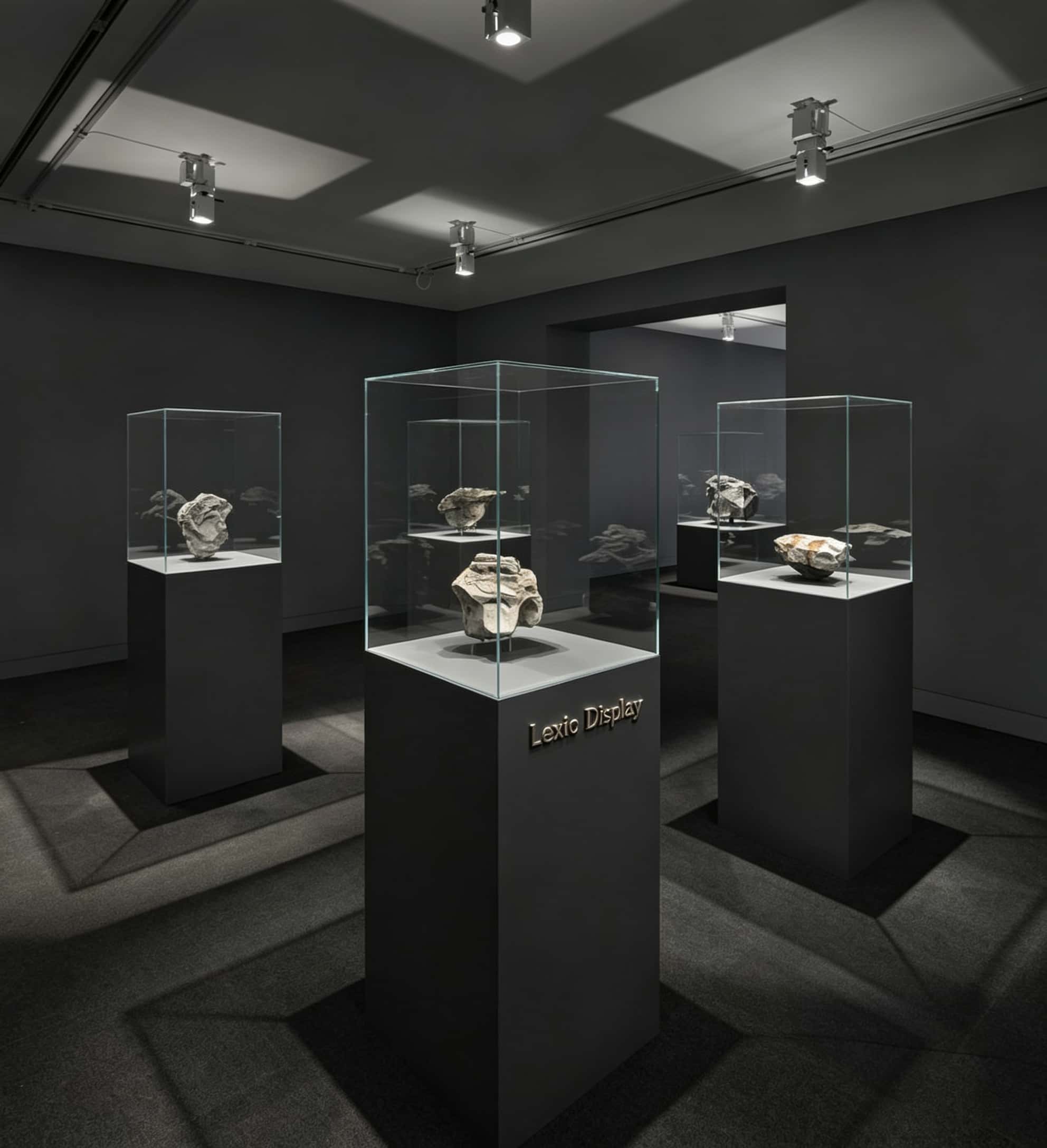
You know, finding the right display cabinet for a museum is not like picking a bookshelf from IKEA. The standard showcases you see online? Most of them just don’t work. Either the glass has that ugly green tint, the lock feels like a toy, or the lighting makes your artifact look dead. I still remember a crazy project from last year — a client emailed me photos of a black glossy rotating cylindrical glass display cabinet they saw at a jewelry fair and said, “I want exactly this vibe, but taller, with UV-protected glass, for a bronze statue.” That’s when the real headache started. If you have ever tried to order a custom museum display cabinet, you already know: one tiny mistake in spec, and you end up with a very expensive dust collector. So in this post, I will walk you through every single thing you must know before you pay a single dollar. No fluffy theory, just real talk from someone who has made all the mistakes.
1. First, figure out what exactly you need — do not skip this
You’d be surprised how many museums and galleries start looking for a manufacturer before they even know the exact purpose of the cabinet. Ask yourself:
- What artifact are you displaying? (textile, metal, paper, organic material…)
- What’s the weight and dimension? Not just the object size — think about the internal mounting space.
- Will visitors view it from 360 degrees, or just the front?
- Do you need the cabinet to rotate? (Like that black glossy rotating cylindrical glass display cabinet I mentioned earlier — perfect for small high-value items, but a nightmare if you don’t plan the motor and power supply.)
Write down a simple spec sheet, even if it’s on a napkin. Something like:
Item: Ancient jade pendants (5 pcs)
Display method: Suspended on transparent fishing line
Cabinet type: Free-standing cylinder
Rotation: Yes, 1 rpm, silent motor
View: 360° glass
Internal climate: Passive humidity control (silica gel tray)
Base finish: Black high-gloss
This will save you endless back-and-forth emails later. Trust me.
2. Material showdown: Glass vs. Acrylic — they are NOT the same
Most people think “transparent = same.” Big mistake. For museum-grade display, material choice directly affects conservation, clarity, weight, and cost. Let’s break it down with a simple table:
| Property | Ultra-clear Low-iron Glass | Standard Acrylic (PMMA) |
|---|---|---|
| Light transmittance | 91–92% | 92–93% |
| UV blocking option | Easy (laminated interlayer) | Needs coating, less durable |
| Scratch resistance | ★★★★★ | ★★☆☆☆ |
| Weight (same size) | Heavy (2.5x acrylic) | Light |
| Price per sq ft | $60 – $120 | $30 – $60 |
| Anti-reflective coat | Available | Rarely good |
| Yellowing over time | Never | Yes, after 5–10 years |
| Best for | Permanent museum exhibits | Temporary shows, traveling |
Now, if you want that sleek black glossy rotating cylindrical glass display cabinet look, you probably need glass — because acrylic scratches way too easy when the rotating mechanism attracts dust. Also, black glossy base shows every fingerprint, so ask for an anti-fingerprint nano-coating on the base panel. Few suppliers offer this, but it’s a lifesaver.
For organic materials like old paper or leather, always go with laminated glass that blocks 99% UV. The extra $30–$50 per panel is nothing compared to restoring a damaged artifact.
3. Lighting and climate control — the invisible killer of exhibits
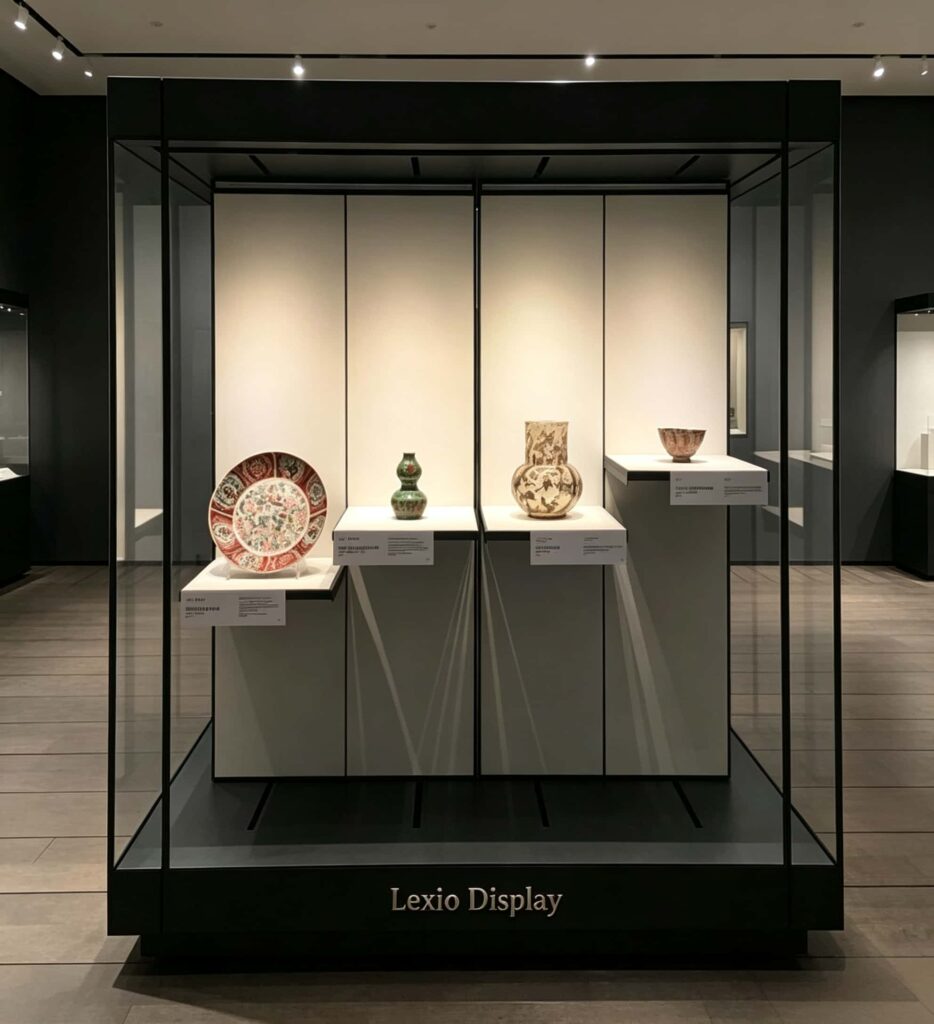
Lighting is not just “make it bright.” You can ruin a 300-year-old textile in six months with the wrong LED strip. I learned this the hard way.
➤ Light source: Use LED with CRI (Color Rendering Index) > 95. Anything below 90 makes colors look flat. For museums, 3000K warm white is standard, 4000K max.
➤ Heat management: Never place LED drivers inside the sealed display area. The temperature rise can be 3–5°C, and that’s enough to warp wood or accelerate chemical decay. Put the driver in the base compartment, ventilated.
➤ Fiber optic lighting: Beautiful but expensive. If you have a black glossy cylindrical showcase and you want starry-spotlight effect on a rotating jewelry piece, fiber optic from the top is magic. Budget around $200–$500 extra for the light source box.
➤ Climate control: For sensitive collections, you need an active microclimate system. A small cabinet (1–2 cubic meter) typically uses a silica gel compartment + small hidden fan; cost adds $300–$600. For large cabinets, full active humidity control units can hit $2000+. Don’t forget to ask about the condensation trap if your museum is in a humid area.
I always tell clients: when you discuss customization, ask the factory to show you a thermal camera image of the cabinet with lights on for 8 hours. If they can’t provide it, walk away.
4. Security that actually matters — not just a fancy lock
Museum display cabinets are not retail showcases. The security level must match the object’s value. Here’s what you really need:
- Laminated security glass: At least 2 layers of glass with PVB interlayer. Even if cracked, the glass stays in place. For ultra-high security, specify 6mm+6mm laminated with a total thickness of 11.5mm or above.
- Lock system: Don’t accept standard cam locks. Ask for Abloy or similar high-security key systems. Also, the lock should be hidden or flush, not sticking out. In rotating cylindrical cabinets, the lock is often under the top cap or behind a removable trim panel.
- Alarm integration: Make sure the cabinet frame has a pre-cut channel for magnetic contact sensors. You want “door open” and “vibration” detection. Some high-end black glossy rotating cylindrical glass cabinets even have a built-in tilt sensor because the rotation mechanism adds a new attack surface — if someone tries to force-stop the rotation, it triggers an alert.
- Screws and fixings: All external screws must be one-way security type or covered. You don’t want a visitor with a screwdriver stealing an artifact (yes, this happened in a European museum in 2019).
Quick checklist you can send to your supplier:
[ ] Laminated glass spec: ___mm + ___mm
[ ] Lock brand/model: _______________
[ ] Sensor cable exit hole: Yes / No
[ ] Anti-tamper screws: Yes / No
[ ] Base anchoring (for floor-standing cylindrical models): Yes / No
5. Custom shapes: cylindrical, polygon, wall-mounted, and pitfalls
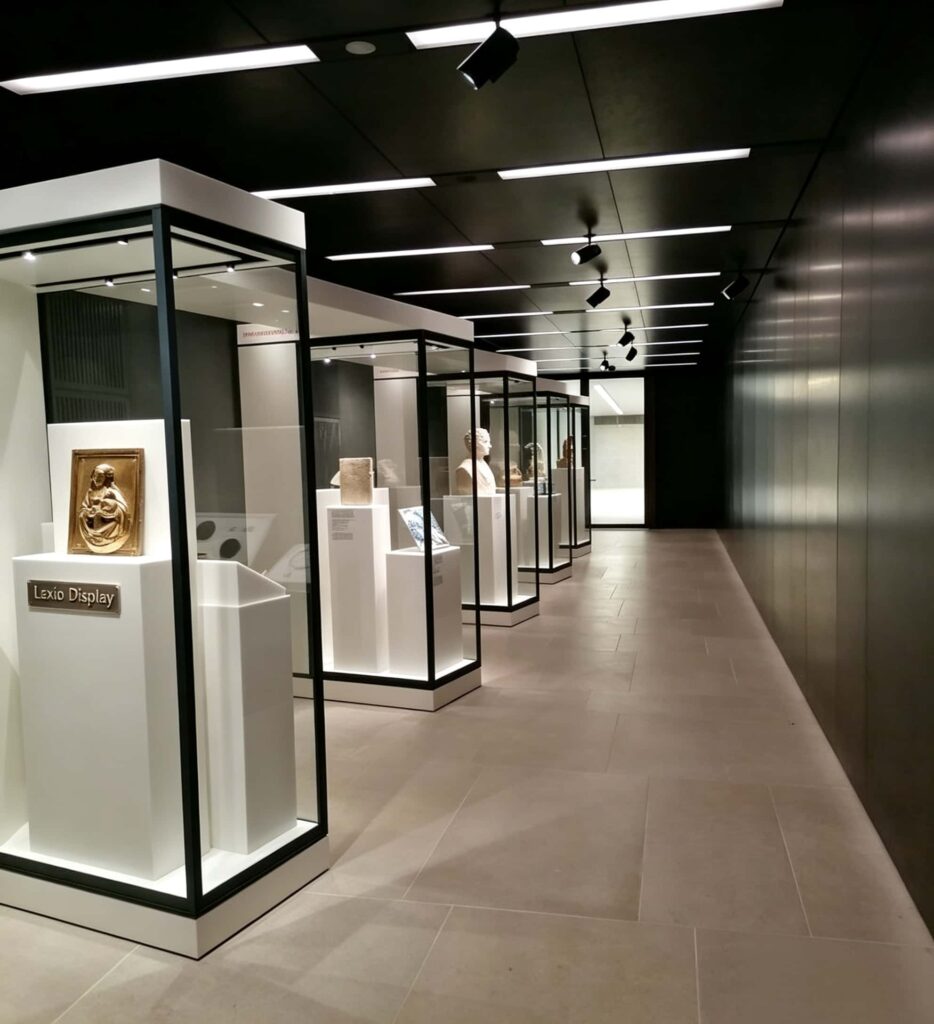
Museum display cabinets today are not all boring rectangles. Custom shapes can make your exhibition unforgettable. But each shape has its own technical headaches.
➤ Cylindrical cabinets
Perfect for 360° viewing. The black glossy rotating cylindrical glass display cabinet trend started in high-end jewelry and luxury watch museums, but now also used for fossils, rare manuscripts, and small sculptures. The tricky part: bending ultra-clear glass into a perfect cylinder without distortion. Only factories with a good glass bending oven can do it. Minimum wall thickness for a cylinder over 1.5m tall should be 8mm glass, otherwise it feels wobbly. Also, the rotation ring must be precision machined; cheap plastic rings will make noise after 6 months. Expect to pay 30–50% more than a rectangular cabinet of similar volume.
➤ Polygon cabinets (hexagonal, octagonal)
These look cool but glass edge joints are weak points. You MUST ask for mitered glass edges with structural UV glue, not a metal frame holding each panel. A metal frame blocks the view and looks cheap. Polygons also collect dust in the inside corners — plan for access holes for cleaning.
➤ Wall-mounted slim cabinets
Great for medals and flat documents. Depth is usually only 8–15 cm. Here the challenge is the hidden wall bracket. The cabinet should be hung like a heavy mirror, with a French cleat system rated for 2x the total weight. And you’ll need a tiny micro-switch on the door frame so that opening the cabinet automatically turns on the light — saves energy and creates a “wow” moment.
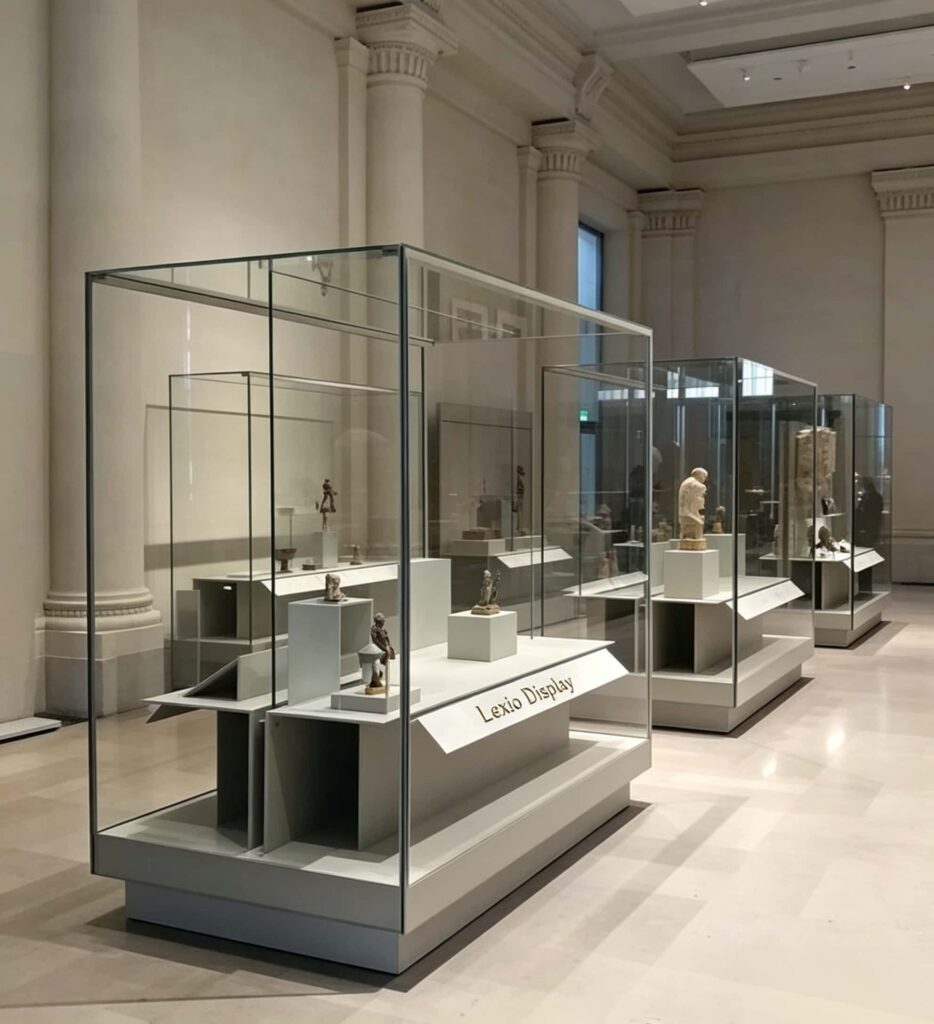
No matter the shape, ask for a 3D rendering with exact measurements of glass panels before production. A 2D drawing can hide warpage issues.
6. Budget and lead time — real numbers from the market
Let’s be real: a genuine museum-grade custom cabinet is not cheap. But if you know the price breakdown, you can avoid overpaying. Here’s what I’ve gathered from working with several Chinese factories and European distributors:
| Cabinet Type | Size (HxWxD cm) | Material Spec | Estimated Price (FOB China) | Lead Time |
|---|---|---|---|---|
| Standard rectangular freestanding | 180x80x60 | Ultra-clear glass, LED strip | $1,200 – $1,800 | 25–35 days |
| Cylindrical rotating (basic) | 160×50 dia. | Glass, manual rotation | $1,500 – $2,200 | 30–40 days |
| Cylindrical rotating (with motor) | 180×60 dia. | Glass, silent motor, black glossy base | $2,500 – $3,500 | 35–45 days |
| Wall-mounted slim | 100x80x12 | Anti-reflective glass, hidden lock | $800 – $1,200 | 20–30 days |
| Large walk-in display room | Custom | Climate control, security glass | $8,000 – $20,000+ | 50–70 days |
Note: These are factory prices without shipping, import duties, or installation. For example, shipping a cylindrical glass cabinet by sea from China to the US costs about $400–$800 depending on crate size, and you better pay for wooden crate export packaging (add $150–$250). Never choose cardboard box packaging for glass cabinets — I’ve seen too many broken base corners.
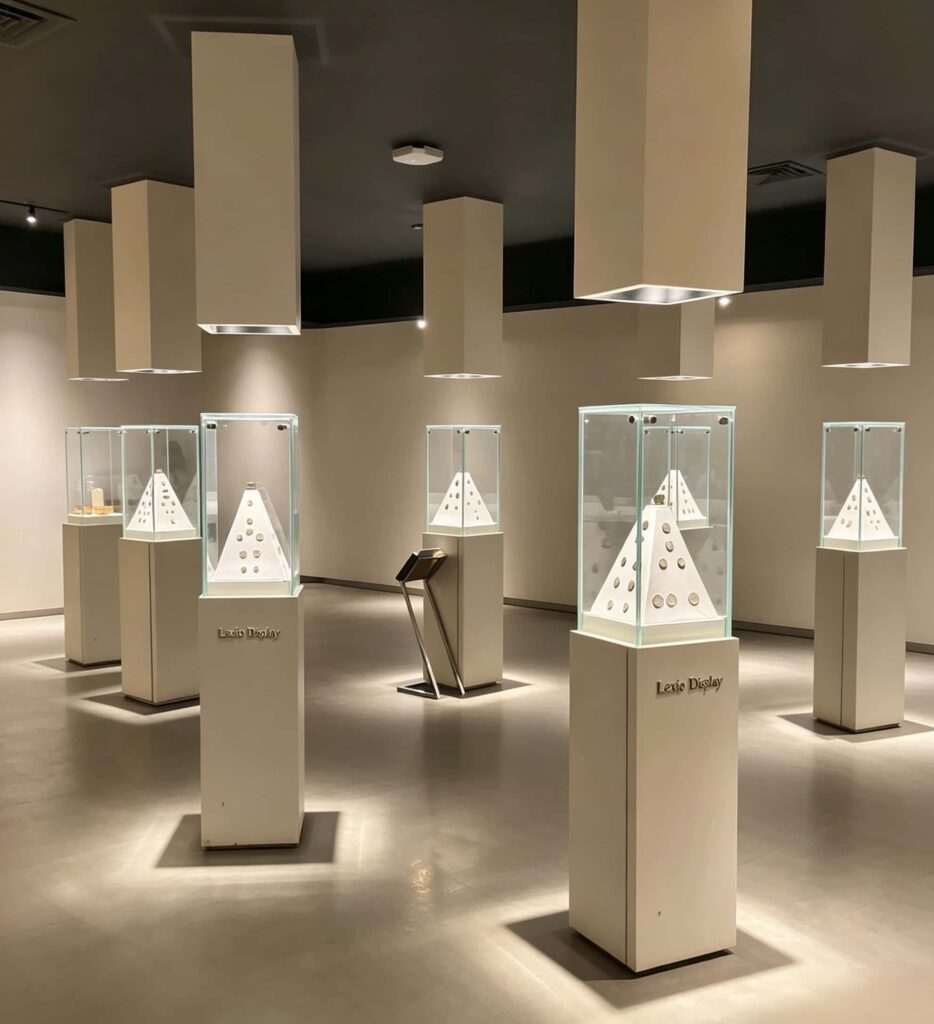
Also, motorized rotating models need extra attention: the motor lifespan matters. Ask for a motor rated for 50,000+ hours, brand like Oriental Motor or equivalent. No-name motors fail fast and repairing them inside a sealed black glossy base is a nightmare.
7. How to place an order without screwing up
So you have decided to move forward. Here’s a step-by-step to keep your sanity:
Step 1 – Send a clear RFQ (Request for Quotation)
Include: cabinet sketch with dimensions, glass spec, lock type, lighting CRI, color of base (e.g. RAL 9005 black glossy), rotation speed if any, target budget.
Step 2 – Ask for a sample panel, not just a brochure
A real factory can send you a small 10x10cm glass sample with your chosen coating and edge finish. Check the color tint under daylight. If you see green edges, it’s not ultra-clear.
Step 3 – Video call during production
Ask them to show you the half-finished cabinet via video. Look at the weld points, the glass edge polishing, and the base paint quality. The black glossy finish on a cylindrical base must be mirror-smooth. If you see orange peel texture, reject it.
Step 4 – Agree on shipping and installation support
Some suppliers offer remote video guidance for installation. For large rotating showcases, this is super helpful. Also confirm warranty: glass is usually not covered for breakage during shipping (buy insurance), but the rotation mechanism should be warranted for at least 2 years.
Step 5 – Test everything before putting the artifact in
Run the cabinet empty for 48 hours with lights on. Measure internal temp and humidity every 4 hours. Only if stable, place a dummy object for another day, then the real one. This patience pays off.
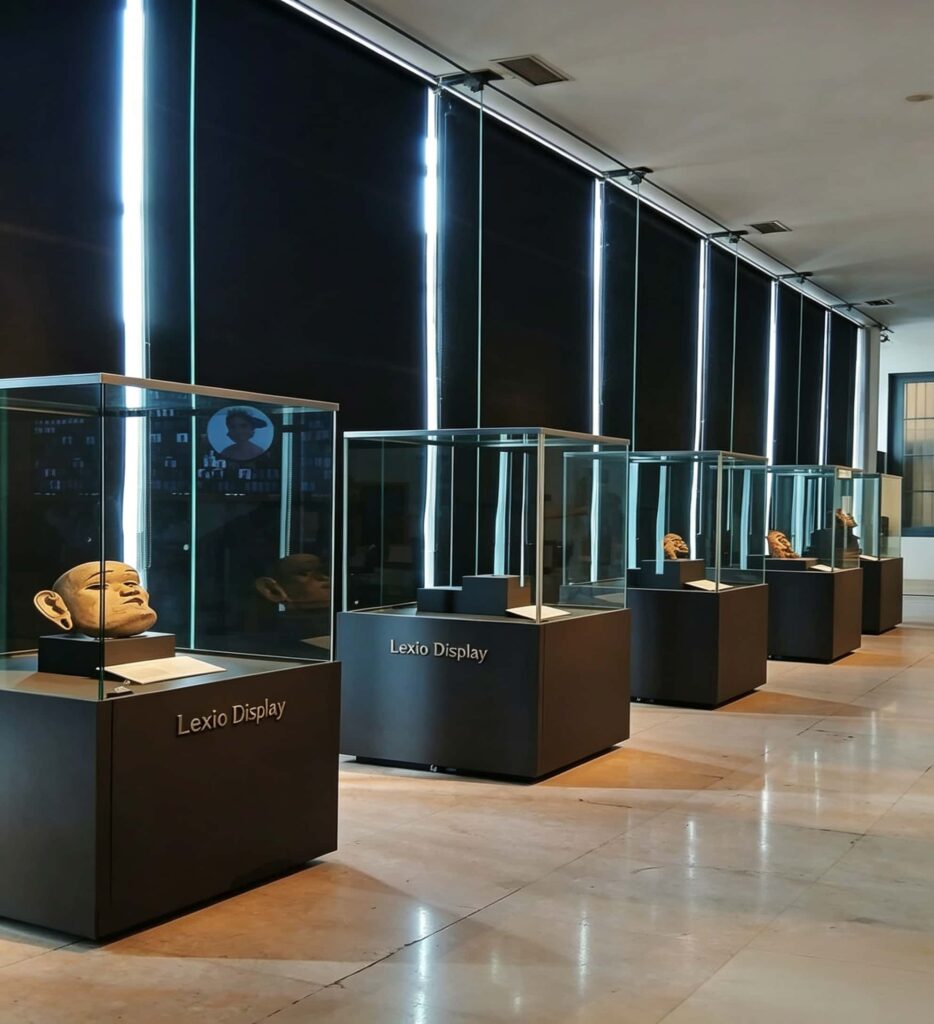
Contact us for custom one for you:
Ordering a custom museum display cabinet can feel overwhelming, but once you break it down into material, lighting, security, shape, and budget, it’s totally doable. Whether you need a simple rectangular showcase or a show-stopping black glossy rotating cylindrical glass display cabinet, the key is knowing the right questions to ask your supplier. Never compromise on glass quality and lock system — those are long-term investments. And always, always get that sample panel.
Hope this guide saves you from the mistakes I’ve seen (and made). If you have any questions about custom sizes or want a quotation for a similar design, just reach out. We have worked with museums, galleries, and luxury retail shops and can help you find a solution that matches your budget and style.
Looking for similar store layouts? Check out our best-selling rotating display showcase.Contact us today.