Custom Museum Display Cases: A Complete Sourcing Guide for Curators & Exhibitors

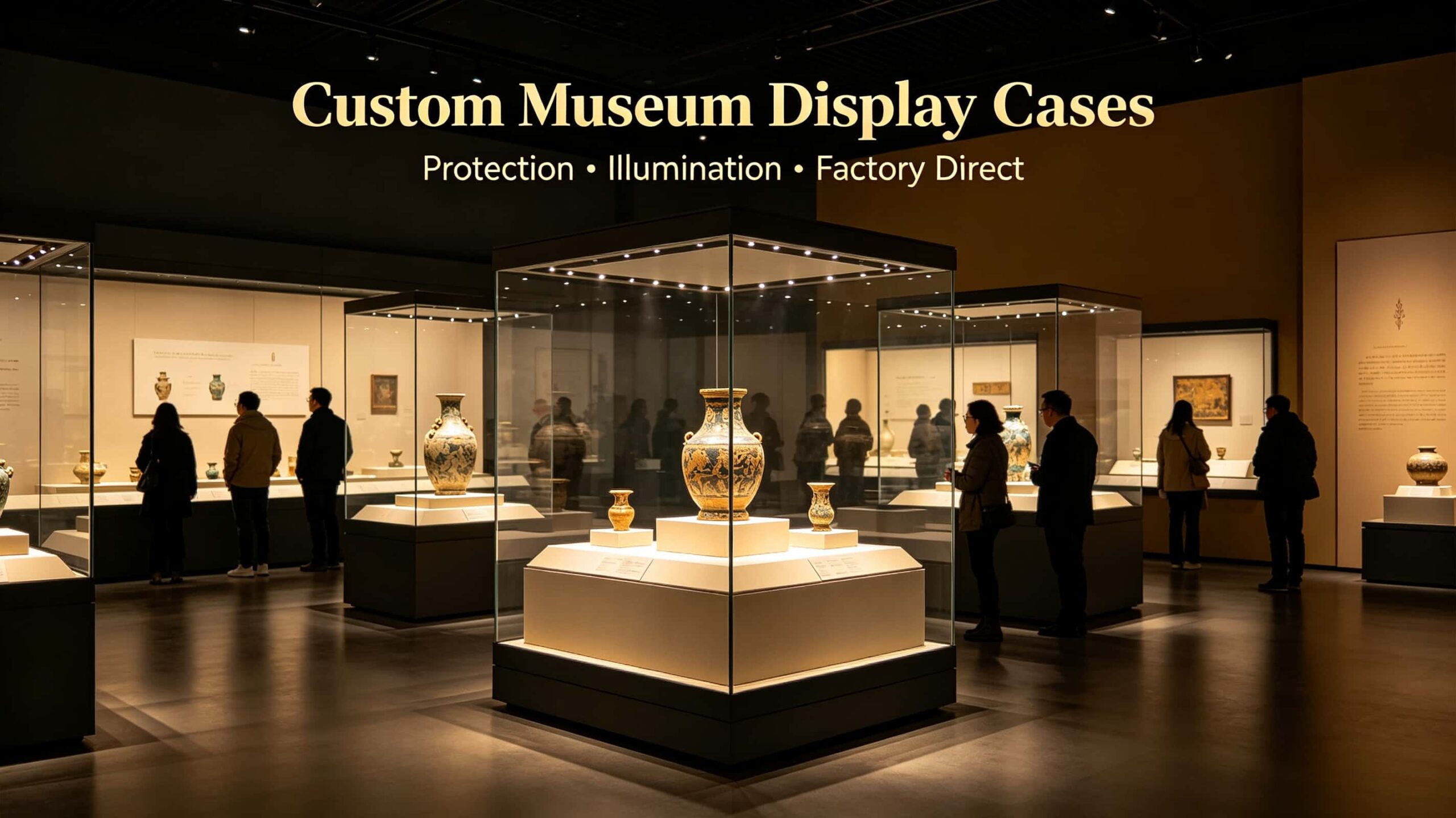
If you manage a gallery, museum, or high-end retail space, the way you present an artifact or product determines how the audience perceives its value. Custom museum display cases are not simply glass boxes—they are precision-engineered environments designed to protect, illuminate, and elevate the object inside. As a factory-direct manufacturer, I want to share the real sourcing knowledge that most suppliers never tell you, from terminology to true cost drivers and how to avoid overpaying.
Where Do Museums Get Their Display Cases?
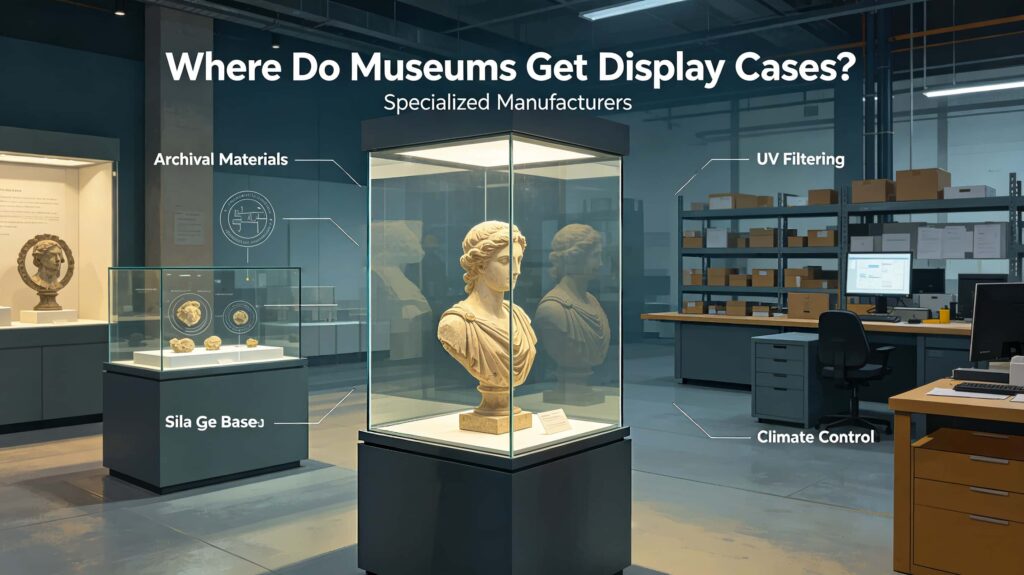
Museums typically source their display cases from specialized commercial display manufacturers rather than general furniture stores. These companies offer custom fabrication services, using archival-grade materials, UV-filtering glass, and precise climate-control engineering to protect sensitive artifacts over long periods. This ensures conservation standards are met.
Most established museums do not buy off-the-shelf. They work directly with a museum quality display cabinets factory because standard retail shelving simply cannot handle the environmental requirements. A 200-year-old textile needs a completely different microclimate than a bronze sculpture. The case must control humidity, filter ultraviolet light, and often include a sealed base for silica gel or passive buffering materials. When a museum contacts our factory, they usually come with a conservation report specifying the acceptable lux levels, relative humidity range, and temperature tolerance. Our job is to translate those scientific requirements into a physical enclosure that can be validated and maintained over decades. This is why many museums and large exhibition halls skip local distributors and source directly from the manufacturing plant.
Where Can I Find a Custom Display Case?
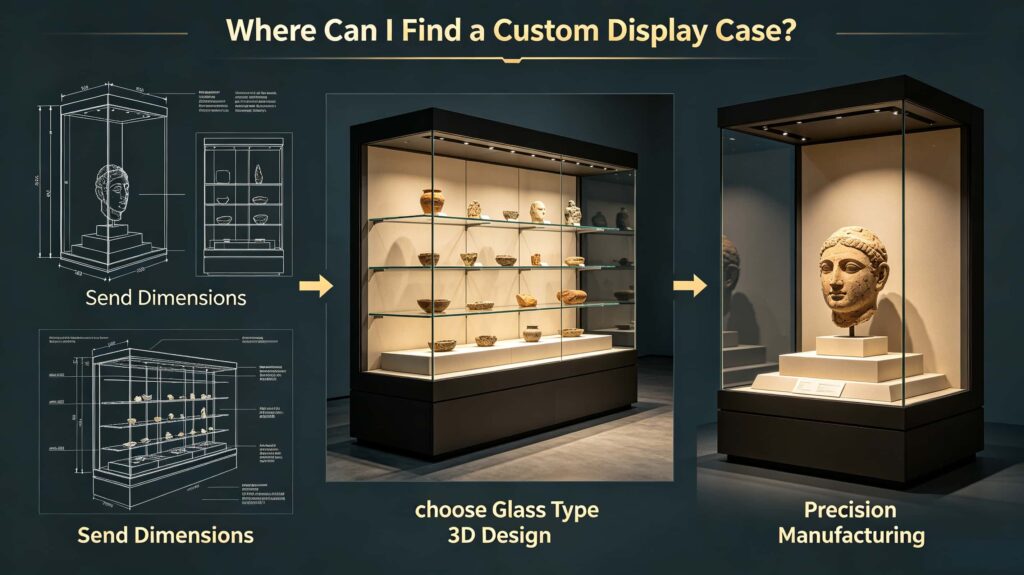
The best place to find a custom museum display case is directly from a professional B2B display manufacturer. You send them your artifact dimensions, desired glass type, and interior shelving layout. They will create a bespoke 3D design for your approval before manufacturing begins.
Finding a reliable partner is more important than finding the cheapest quote. When curators ask me where to start, I always recommend looking for a factory that can handle the full process in-house: metal fabrication, wood joinery, glass cutting, and electrical wiring for internal lighting. A fragmented supply chain leads to miscommunication. For custom archival display cases, the manufacturer must understand that the case itself is part of the conservation strategy. It is not enough to make a nice-looking box. The seals must be tested, the materials must pass Oddy testing for off-gassing, and the interior must be easily accessible for cleaning without disturbing the artifact. Before you place an order, ask for a detailed production drawing and a material breakdown. If they hesitate, move on.
What Are Museum Display Cases Called?
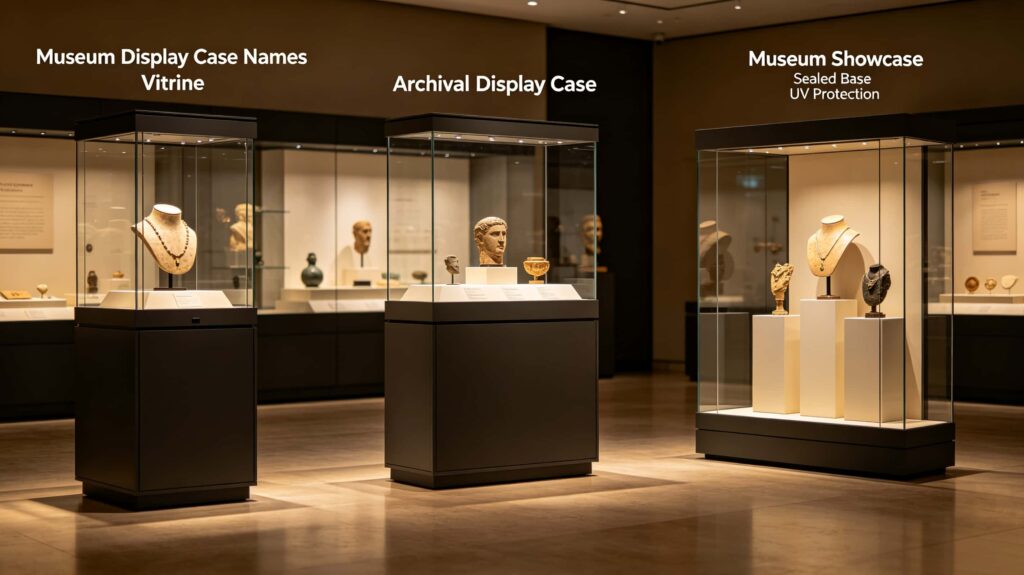
In the industry, they are formally referred to as “Vitrines,” “Archival Display Cases,” or simply “Museum Showcases.” Each term usually dictates the level of environmental control, security, and aesthetic finish required by the curator. These names are not interchangeable in professional practice.
A “vitrine” is the classic freestanding glass case you see in galleries, often with a top light and a lockable sliding door. An “archival display case” implies a higher standard of sealing and material purity—used for paper, textiles, or organic materials that are sensitive to pollutants. A “museum showcase” can be a broader term that includes wall-mounted units, table cases, or large built-in cabinetry. When you search for museum vitrines for sale, you will often find pre-made standard sizes. These are fine for retail displays but rarely meet the conservation standards of a serious collection. For anything irreplaceable, you need a bespoke build. Knowing the correct terminology helps you communicate your requirements to a manufacturer and avoid buying a retail display case when you actually need archival protection.
How Much Do Museum Display Cases Cost?
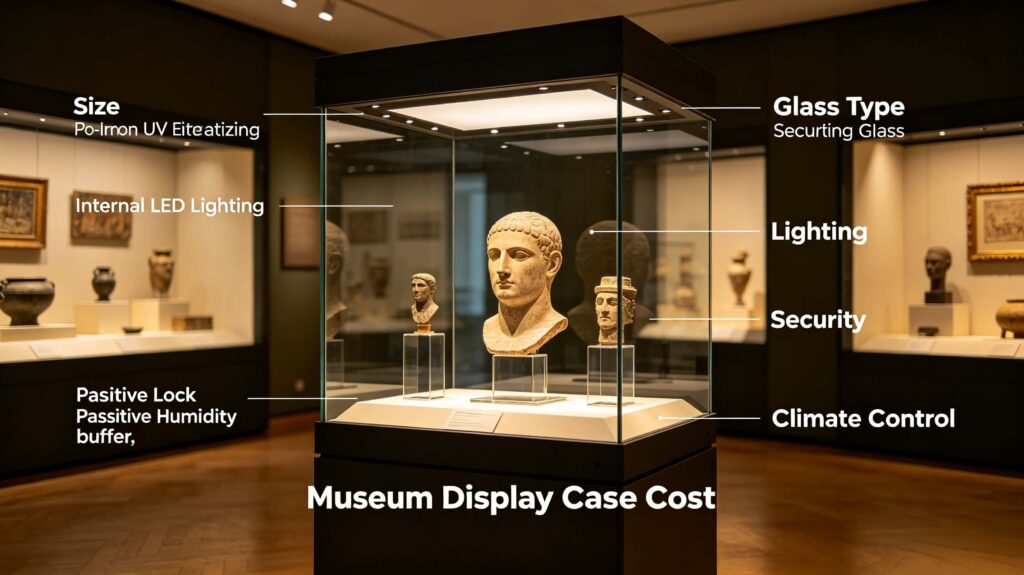
The cost varies widely based on size, glass type, internal lighting, and security specifications. For a simple custom freestanding case, you might start at $1,500, while massive, climate-controlled wall units with custom framing can run well over $10,000+.
I always tell potential clients that quoting a fixed price without seeing the specifications is meaningless. The same external dimensions can produce wildly different costs. A case with standard 6mm float glass costs far less than one using low-iron, UV-filtering laminated glass. A passive humidity-buffered base is cheaper than an active microclimate control system with a silent fan and data logging. Locking mechanisms also vary: a simple cam lock is inexpensive, but a high-security Abloy lock with an alarm contact adds to the bill. When you request a quote for custom museum display cases, be prepared to specify the object’s dimensions, weight, sensitivity to light, and whether you need internal lighting or climate control. This allows the factory to give you a realistic range instead of a bait-and-switch number.
Who Are Some Manufacturers of Museum Display Cases?
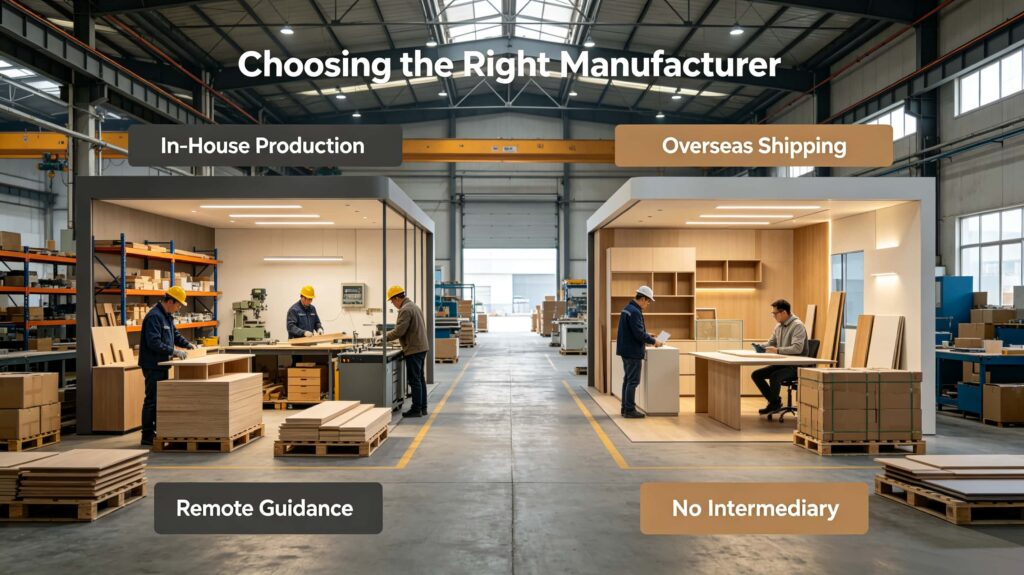
Reputable manufacturers are often specialized commercial furniture factories that handle everything from metal fabrication to professional glass fitting. Unlike retail furniture stores, these factories offer direct wholesale, highly customized solutions, and overseas shipping capabilities for international clients. This direct model saves you money.
As a factory ourselves, we compete with a handful of established professional museum showcase manufacturers around the world. Some focus only on domestic markets, while others, like us, regularly export to galleries and private collectors overseas. The advantage of working with an export-oriented factory is that we have experience crating fragile glass cases for sea freight, handling customs documentation, and providing remote installation guidance. A local retail fixture supplier might be convenient, but they rarely have the technical expertise to build a display case that will protect a valuable artifact for 20 years. They also typically mark up the price by 40-70% because they act as an intermediary. If you are sourcing for a museum, ask the factory directly whether they have built cases for institutional clients and whether they can provide references.
How to Create a Museum Display?
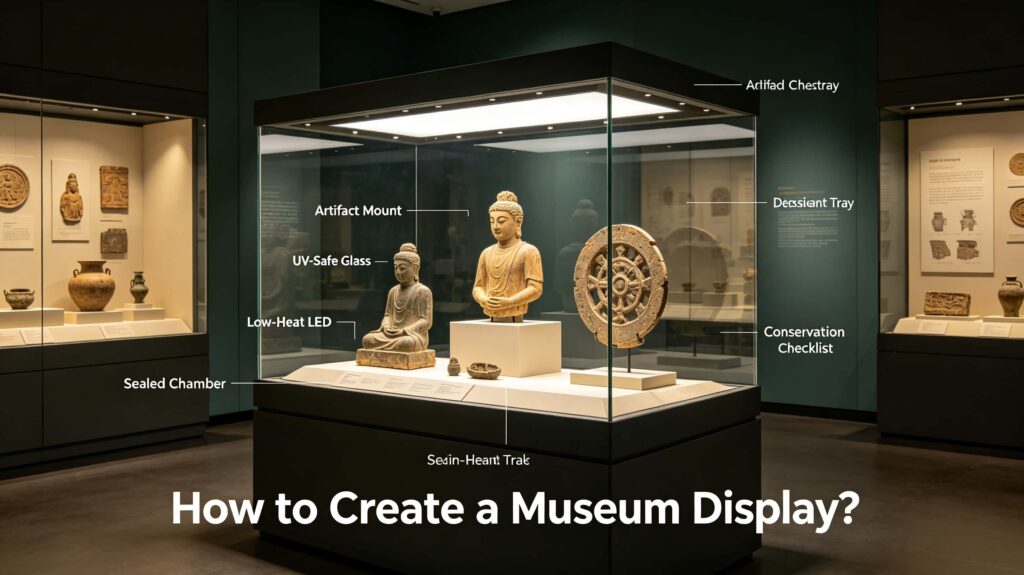
Creating a display involves careful planning: choosing the right artifact mount, selecting UV-safe glass, and incorporating appropriate LED lighting that highlights details without damaging the material. The key is collaboration with a manufacturer who understands museum-grade standards. This ensures proper conservation.
The first step is to understand your object. Is it light-sensitive? Does it require a stable relative humidity? Is it fragile or heavy? These answers drive the case design. For example, a large oil painting might only need a simple UV-filtering glass front with a sealed back panel. A collection of ancient manuscripts may need a fully sealed case with a desiccant tray and a low-oxygen environment.
The display mount is equally critical—brass or powder-coated steel mounts hold the object securely without touching vulnerable surfaces. LED lighting should be placed outside the sealed chamber or in a separate ventilated compartment to avoid heat buildup. When you work with a factory that understands these nuances, they will guide you through each decision. This is not a product you buy off a shelf; it is a collaborative engineering project. That is why we always start with a 3D rendering and material samples before cutting a single sheet of glass.
Ready to source your custom museum display cases without paying distributor markups? Send us your floor plan, artifact dimensions, and any conservation requirements you have. Our in-house engineering team will create a 3D rendering and a factory-direct quote with transparent material breakdowns. You work directly with the manufacturing floor—no agents, no hidden fees, no inflated showroom pricing. Contact us today and get your custom display case on the production schedule within 48 hours.
WhatsApp:+8617722245723
Email:sales@lexiodisplay.com