
How to Open a Small Perfume Store?

Opening a small perfume store means leasing a compact retail space, securing fragrance suppliers, and building a curated inventory around a clear customer profile. You need about $25,000–$60,000, a licensed location, and a layout that encourages testing. This guide covers the exact steps, costs, and store-design choices.
What does it cost to open a small perfume store?
A small perfume store usually costs $25,000 to $60,000 to open, depending on city, size, and inventory depth. Rent deposits, fixtures, and initial stock consume most of the budget. Keep 15–20% cash for the first six months. This range assumes a 400–800 sq ft store.
Budget for rent deposit, build-out, fixtures, first stock, and working capital—then add a 10% buffer.
- Rent deposit: 2–3 months upfront, often $4,000–$12,000
- Build-out and fixtures: $6,000–$18,000 for shelving, counter, lighting, and testers
- Initial inventory: $8,000–$20,000 for 40–80 SKUs
- Licenses and insurance: $500–$2,500
- Working capital: $5,000–$10,000 for payroll, utilities, and marketing
Typical startup budget for a 600 sq ft perfume store
| Expense | Low estimate | High estimate | Notes |
|---|---|---|---|
| Rent deposit | $4,000 | $12,000 | 2–3 months |
| Build-out | $6,000 | $18,000 | Keep fixtures modular |
| Initial stock | $8,000 | $20,000 | 40–80 SKUs |
| POS and security | $800 | $2,500 | Basic camera and alarm |
| Licenses and insurance | $500 | $2,500 | Varies by city |
| Launch marketing | $1,000 | $3,000 | Soft opening and local ads |
| Working capital | $5,000 | $10,000 | 6-month cushion |
| Total | $25,300 | $68,000 | Aim for mid-range |
Where should you locate a small perfume store?
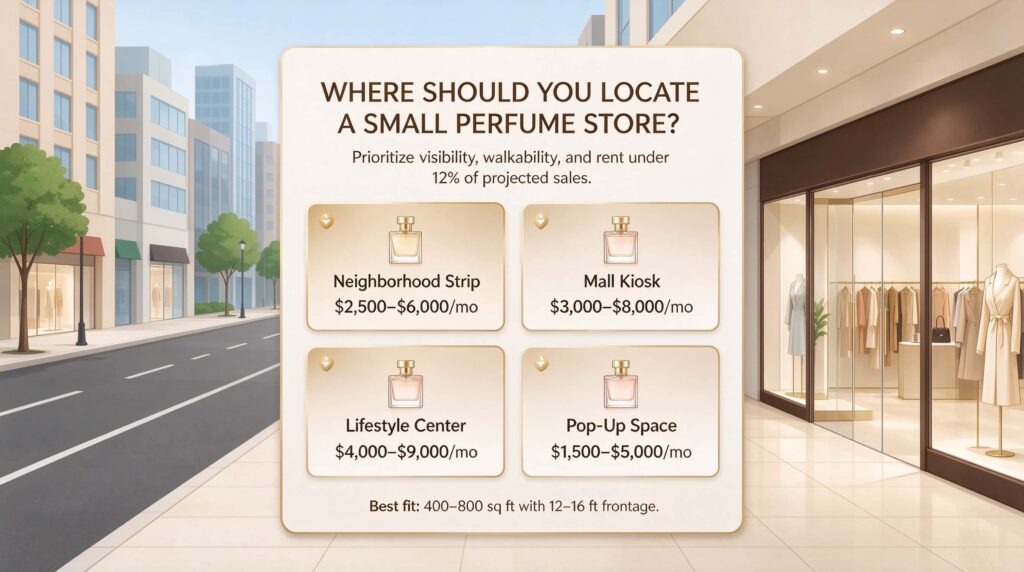
Put your small perfume store where customers already walk with time to browse: a busy neighborhood retail strip, a mall kiosk, or a lifestyle center near beauty and fashion stores. Foot traffic matters, but so does rent. A 400–800 sq ft space with 12–16 ft frontage usually works well.
Choose visibility, walkability, and a rent that stays below 12% of projected monthly sales.
- Street retail: Best for local identity; expect $2,500–$8,000 monthly rent
- Mall kiosk: Lower build-out cost; higher rent per sq ft
- Lifestyle center: Strong fit near salons, boutiques, and coffee shops
- Pop-up space: Good for testing a neighborhood before signing a lease
Location comparison
| Location type | Size | Typical rent | Best for |
|---|---|---|---|
| Neighborhood strip | 500–800 sq ft | $2,500–$6,000/mo | Repeat local customers |
| Mall kiosk | 100–250 sq ft | $3,000–$8,000/mo | High foot traffic |
| Lifestyle center | 400–700 sq ft | $4,000–$9,000/mo | Gift and impulse buyers |
| Pop-up | 200–500 sq ft | $1,500–$5,000/mo | Testing a market |
What licenses and permits do you need?
Most small perfume stores need a general business license, a sales-tax permit, and liability insurance. Some cities also require a signage permit or a fire-occupancy check. If you blend or fill products on site, ask about cosmetics or labeling rules before you sign a lease.
Confirm local zoning and sales-tax rules first—then get insurance before opening day.
- Business license: Register the entity and local permit
- Sales-tax permit: Required in most states
- Liability insurance: General liability and property coverage
- Signage permit: Often overlooked; check before ordering signs
- Fire and occupancy: Required for retail spaces in many cities
How do you choose perfume suppliers and inventory?
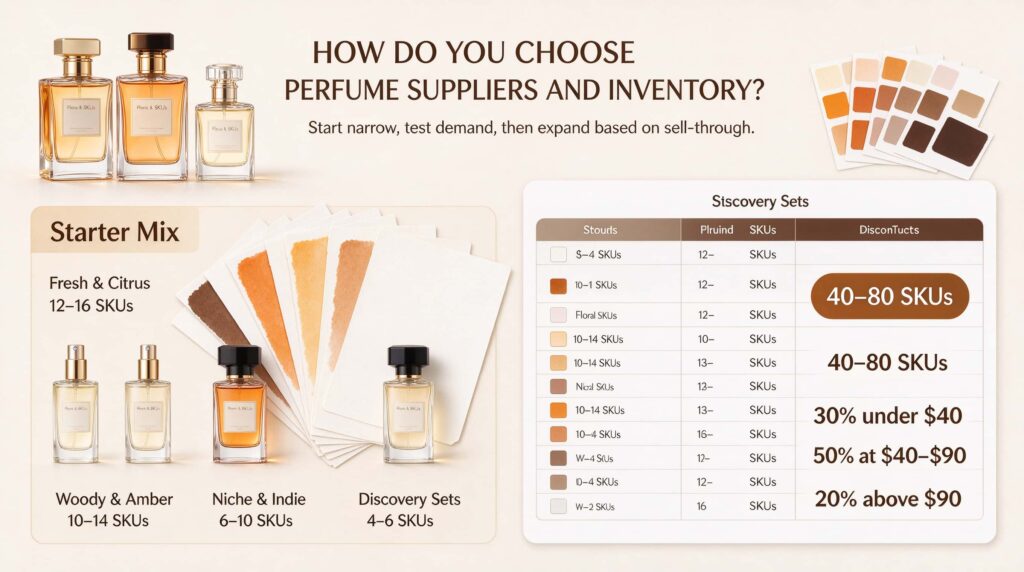
Start with 40–80 SKUs across three price bands: under $40, $40–$90, and $90–$180. Mix designer-inspired scents, niche brands, and a few local or indie lines. Order testers, ask about minimum order quantities, and avoid tying up cash in slow-moving stock.
Build a narrow, testable range first—then expand based on sell-through.
- Core scents: 60% of stock in best-selling families—fresh, woody, floral, amber
- Testers: At least one tester per SKU; budget $3–$8 per tester
- Price bands: 30% under $40, 50% at $40–$90, 20% above $90
- Reorder rule: Reorder when sell-through hits 70% in 30 days
- Supplier terms: Ask for net-30 terms and low minimums
Starter product mix
| Category | SKUs | Price range | Share of stock budget |
|---|---|---|---|
| Fresh and citrus | 12–16 | $28–$65 | 20% |
| Floral | 10–14 | $35–$85 | 18% |
| Woody and amber | 10–14 | $45–$120 | 22% |
| Niche and indie | 6–10 | $70–$180 | 25% |
| Discovery sets | 4–6 | $25–$60 | 15% |
How should you design a small perfume store?
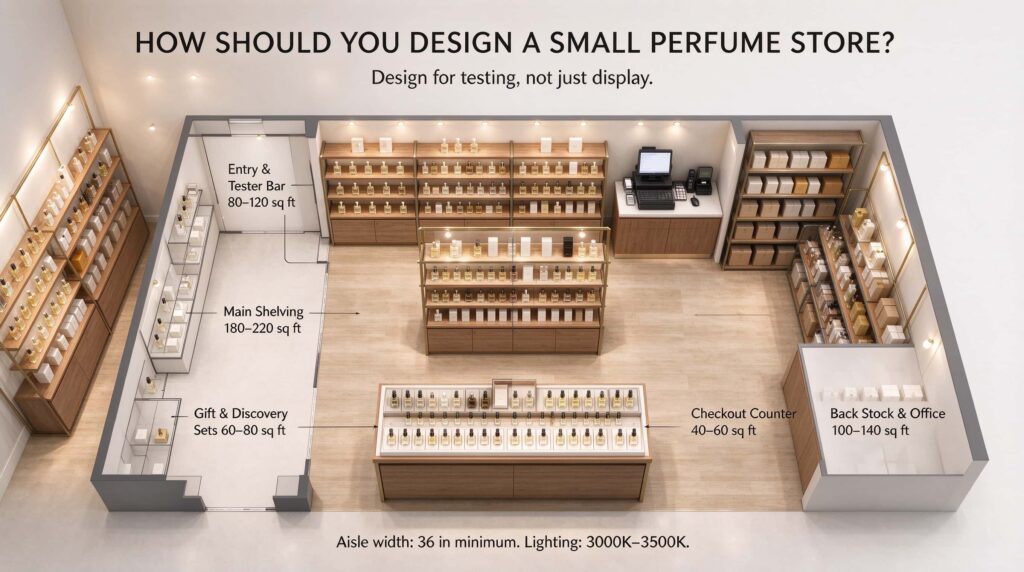
Design a small perfume store around testing, not display. Put a tester counter near the entrance, keep aisles at least 36 inches wide, and use lighting that shows true scent-bottle colors. Warm white light at 3000K–3500K works well. Shelving should be adjustable so you can reset the store without buying new fixtures.
Use a test-first layout with clear zones and durable, adjustable fixtures.
- Testing counter: 6–8 ft long, 36–42 in high, with 8–12 testers
- Shelving: 12–18 in deep, adjustable, powder-coated steel or oak
- Flooring: Luxury vinyl plank or sealed concrete, $4–$9 per sq ft
- Lighting: 3000K–3500K LED track lights, $80–$150 per fixture
- Signage: 24–36 in exterior sign; keep it readable from 30–50 ft
Recommended store zones for a 600 sq ft perfume store
| Zone | Size | Purpose |
|---|---|---|
| Entry and tester bar | 80–120 sq ft | Immediate sampling |
| Main shelving | 180–220 sq ft | Core inventory |
| Gift and discovery sets | 60–80 sq ft | Add-on sales |
| Checkout counter | 40–60 sq ft | Bagging and loyalty signup |
| Back stock and office | 100–140 sq ft | Storage and admin |
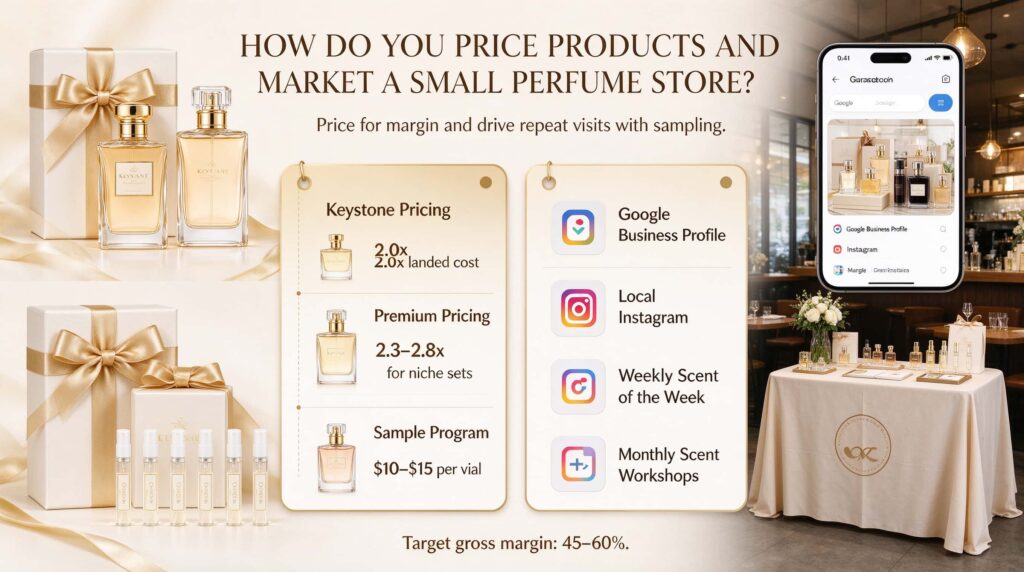
How do you price products and market a small perfume store?
Price for margin, not for the cheapest sticker. A small perfume store should target 45–60% gross margin on core stock. Market through Google Business Profile, local Instagram, and in-store events. A weekly “scent of the week” table and a $10–$15 sample program can drive repeat visits.
Price at 2.0–2.5x landed cost and market through local search plus in-store sampling.
- Keystone pricing: 2.0x landed cost for fast movers
- Premium pricing: 2.3–2.8x for niche and gift sets
- Sampling: $10–$15 sample vial, credited toward a full bottle
- Local SEO: Complete your Google Business Profile and post weekly
- Events: Host 2–4 scent workshops per month
Simple pricing example
| Item | Landed cost | Retail price | Gross margin |
|---|---|---|---|
| 50 ml fresh eau de parfum | $18 | $42 | 57% |
| 50 ml woody eau de parfum | $26 | $65 | 60% |
| Discovery set | $12 | $32 | 63% |
| Gift set | $34 | $85 | 60% |
What daily operations keep a small perfume store profitable?
Track four numbers daily: foot traffic, conversion rate, average transaction value, and tester-to-purchase rate. A healthy small perfume store converts 15–25% of visitors and keeps average transaction value at $55–$85. Clean testers, refill sample vials, and rotate window displays every two weeks.
Manage traffic, conversion, basket size, and stock turn—not just total sales.
- Daily huddle: 10 minutes on goals, testers, and stockouts
- Tester hygiene: Wipe bottles daily; replace testers every 6–8 weeks
- Stock turn: Aim for 4–6 turns per year
- Loyalty: Collect email or SMS at checkout; offer a birthday sample
- Staff script: Ask about scent preference before recommending price
Weekly KPI targets
| Metric | Target | Action if low |
|---|---|---|
| Conversion rate | 15–25% | Improve greeting and tester access |
| Average transaction | $55–$85 | Bundle samples and gift sets |
| Tester-to-purchase | 20–30% | Train staff on scent families |
| Gross margin | 45–60% | Review supplier costs |
| Repeat customer rate | 20–30% | Launch SMS loyalty reminder |
What are the biggest mistakes to avoid?
The biggest mistakes are overbuying inventory, choosing a cheap but hidden location, and treating the store like a display case instead of a testing room. Another common error is skipping working capital. Small perfume stores often need 6–9 months to find their best-selling mix.
Protect cash, test before you scale, and design for sampling from day one.
- Don’t spend 70% of budget on stock before testing demand
- Don’t sign a lease without checking signage rules
- Don’t buy deep on trends; start with 2–3 units per SKU
- Don’t skip a POS system that tracks sell-through by scent family
- Don’t rely only on walk-ins; build a local email list early
Frequently asked questions
These are the questions new perfume store owners ask most often. Keep the answers practical: focus on cost, licensing, inventory, and layout. If you’re still comparing spaces, start with a floor plan—it makes rent, fixtures, and stock decisions much easier to judge.
How much money do I need to open a small perfume store?
Most owners need $25,000–$60,000, including rent deposit, fixtures, first stock, and 6 months of working capital.
How many SKUs should a small perfume store carry?
Start with 40–80 SKUs across three price bands. Expand only after you track 30–60 days of sell-through.
Do I need a special license to sell perfume?
Usually a general business license and sales-tax permit are enough. Check local rules if you blend, fill, or label products on site.
What size store is best for perfume retail?
A 400–800 sq ft store works well. Keep at least 36-inch aisles and a 6–8 ft tester counter near the entrance.
How long does it take to open?
Plan for 8–16 weeks: 2–4 weeks for lease and permits, 3–6 weeks for build-out, and 2–4 weeks for stock and staff training.
Ready to turn your floor plan into a store customers remember?
Send us your floor plan today and we’ll return a practical 3D design for your small perfume store—layout, tester counter, shelving, lighting, and flow. Contact us now to get started.