
What Is a Mall Kiosk in 2026? The Ultimate FAQ for Business Owners

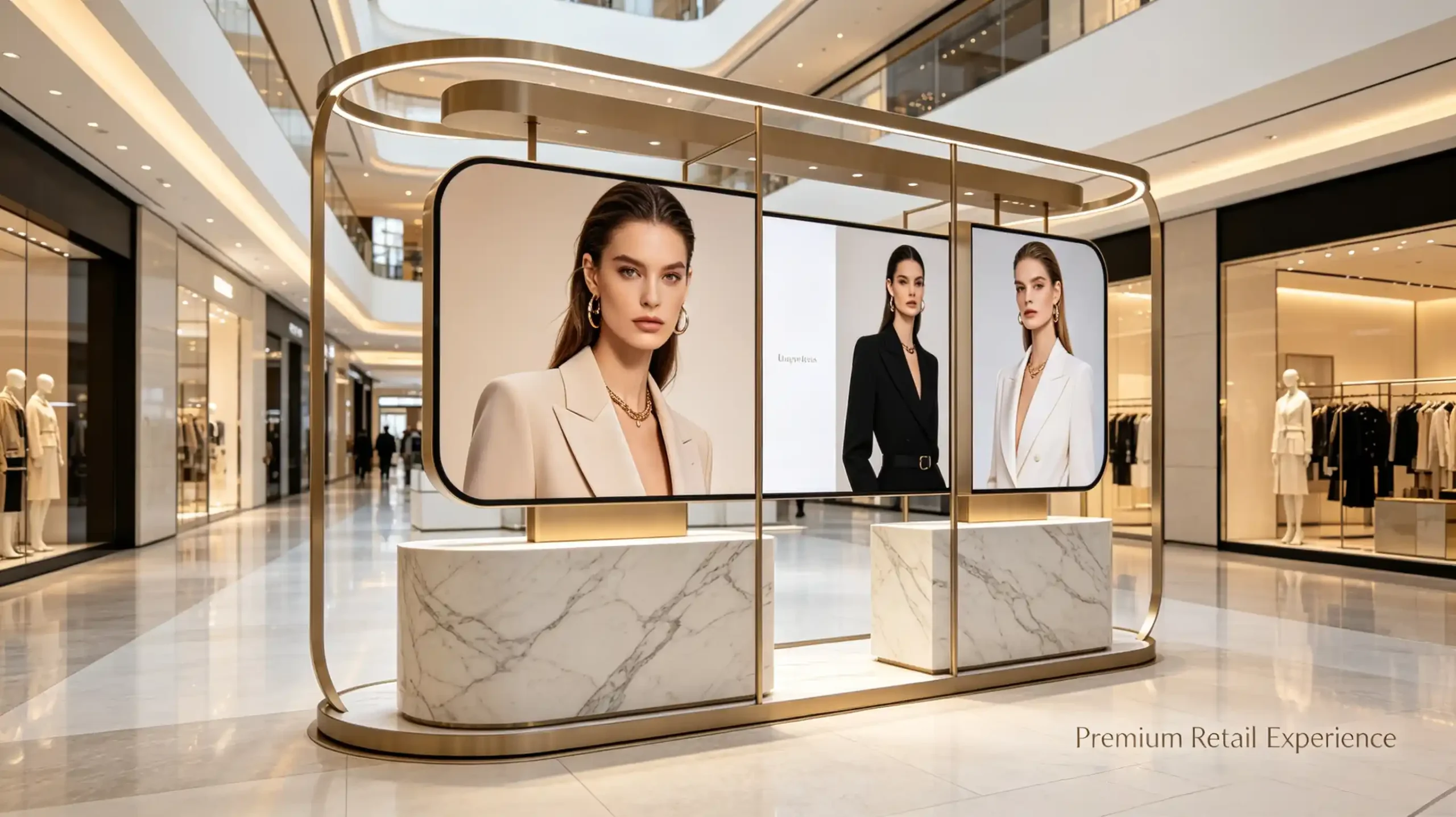
The mall kiosks (shopping terminals / sales booths) in 2026 are no longer the simple glass counters of ten years ago. They are small independent retail platforms located in the high-traffic areas of American shopping malls, covering three forms: physical sales, self-service, and brand pop-up. They generally adopt modular structures, intelligent interaction systems, and sustainable materials, and are the core solution for brands to enter offline traffic at a low cost. This FAQ is from the perspective of the purchaser and answers all the issues that business owners are most concerned about when making purchasing decisions, including supply chain, compliance, cost, and delivery.
What exactly will a Mall Kiosk be in 2026? How will it differ from the past?
In simple terms, a mall kiosk is a small retail outlet located in the public corridors, atriums or corridors of American shopping malls. Traditionally, it was a fixed counter for selling mobile phone accessories and jewelry. However, by 2026, this definition has been completely updated.
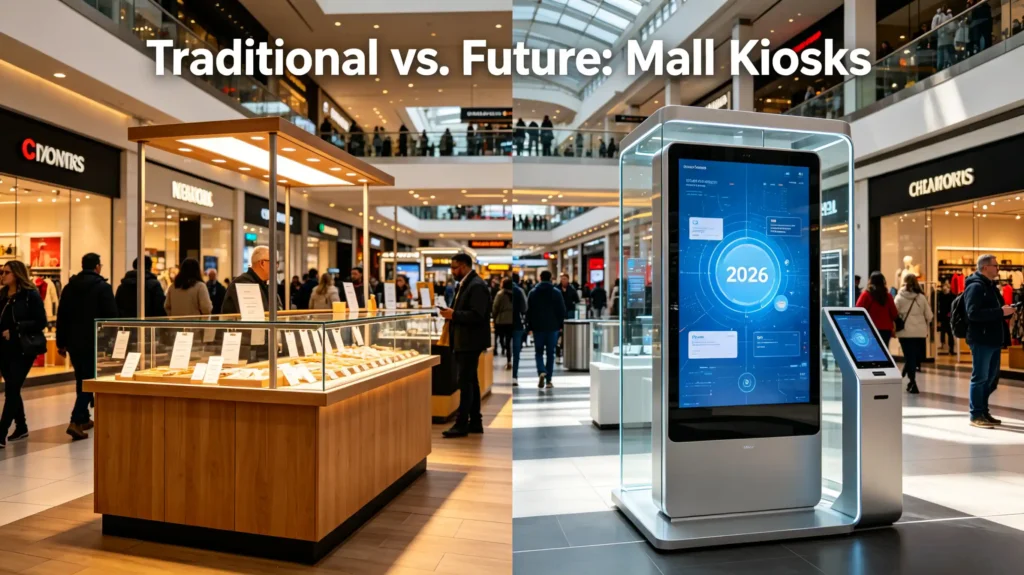
Today’s mall kiosks are mainly divided into three categories:
- Physical sales kiosks: manned by staff, selling fast-moving consumer goods such as cosmetics, snacks, and accessories. This is the most common form.
- Self-service terminals: unmanned, offering functions such as ordering, ticket collection, recharge, and information inquiry.
- Brand pop-up kiosks: short-term presence, focusing on new product launches, member activities, and limited-time promotions.
Compared to five years ago, the kiosk in 2026 has three essential changes.
- For one, modularization has become the mainstream. Instead of fixed installations done on-site with welding, it is now factory-prepared standard units that can be transported to the site and assembled for use. They are quick to disassemble and reassemble, and are particularly suitable for pop-up and seasonal operations.
- What’s more, intelligence has shifted from optional features to standard equipment. Touch screens, contactless payment, real-time inventory synchronization are almost basic configurations. Mid-to-high-end models also come with member identification, dynamic advertising screens and remote management backends. Industry data shows that over 65% of large retail chains in the United States have deployed kiosks with interactive functions in shopping malls.
- The biggest shift, sustainability requirements have undergone a comprehensive upgrade. Starting from 2025, mainstream shopping malls in the United States will gradually require kiosks to use low VOC materials and recyclable panels. Some high-end properties even require the provision of carbon footprint reports.
What is the typical delivery time for a custom-made Mall Kiosk? How stable is the supply chain?
Every purchasing manager asks this first. And for good reason – your answer decides when you can open and when your marketing kicks in.
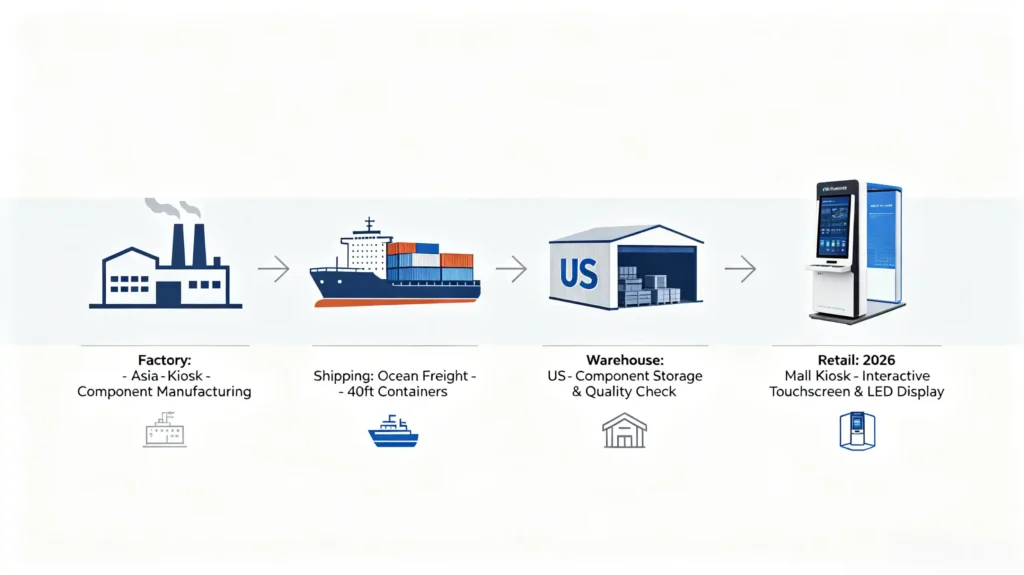
The complete timeline of the standard customization project
From the initial inquiry to the arrival of the goods at the site in the United States, the normal cycle is 8 to 16 weeks, which is divided into four stages:
| Phase | Typical Timeline | Key Details |
|---|---|---|
| Design & Engineering Confirmation | 5–15 business days | Includes floor plans, 3D renderings and structural drawings. Final timeline depends on the number of revision rounds. |
| Prototype Approval | 7–20 business days | A physical prototype is mandatory for highly customized builds. Simple standard units can skip this step and move directly to mass production. |
| Mass Production | 25–45 business days | Lead time varies by order volume and factory production schedule. Add 1–2 extra weeks during the peak season (Q3–Q4). |
| International Shipping | 15–35 days (ocean) / 5–7 days (air) | Ocean freight: 15–20 days to the US West Coast, 25–35 days to the US East Coast. Air freight cuts transit time but costs 3–5 times more. |
Procurement Practical Suggestions:
- Q4 Christmas project: Suppliers must be finalized by the end of June at the latest.
- Key electronic components should be stocked separately. Do not place orders until the structure is fully confirmed.
- At least keep one alternative supplier in reserve to avoid delays in the scheduling of a single factory.
What are the compliance requirements for entering American shopping malls? What are the material and fire safety standards?
I’ve seen this happen too many times. You spend weeks building your kiosk, ship it over, and then the mall tells you it fails fire code. No display, no sales. Rework costs a fortune – and you miss your launch date.
Fire safety and material requirements (mandatory requirements)
The building codes across the United States generally follow the ICC standards, and shopping malls have even stricter requirements for kiosks.
- Flame retardant grade: All surface materials must pass ASTM E84 or UL 723 tests, with the flame spread index ≤ 25 and smoke density ≤ 450.
- Wooden substrate: It must be treated with flame retardant, and ordinary density boards cannot be used directly.
- Foam materials: Decorative foam and soft packing must comply with UL 1975 standards, with the maximum heat release rate not exceeding 100 kilowatts.
- Aluminum-plastic panels: The same requirements apply, with the flame spread index ≤ 25 and smoke density ≤ 450.
ADA Accessibility Requirements
This is the aspect that is most easily overlooked, but also carries the highest risk of complaints. In 2026, the federal and state authorities in the United States will continue to strengthen their enforcement of accessibility for self-service terminals:
- The height of the counter operation surface should not exceed 36 inches (approximately 91 centimeters).
- At least 30×48 inches (approximately 76×122 centimeters) of wheelchair turning space should be reserved in front.
- The operable parts should be within reach and should not require straining or crouching.
- Self-service terminals with screens must support voice assistance and screen reading functions.
Other required documents for entry
- Insurance: General liability insurance should be at least 1 million US dollars per accident. The mall owner must be listed as an additional insured.
- Electrical certification: Electrical equipment must have UL 62368-1 or equivalent certification. Wiring must comply with local electrical regulations.
- Business license: Business license for the city where the business is located, sales tax registration; for food-related businesses, additional hygiene license and health certificates for employees are also required.
Don’t skip this: Before signing the purchase contract, make sure to obtain the “Kiosk Inclusion Guidelines” of the shopping mall and distribute it to the supplier. Ask them to confirm each item one by one to ensure compliance, rather than making changes after the work is completed.
How much does it cost to customize a Mall Kiosk? How can I calculate the cost to avoid pitfalls?
2026 Market Price Range (Based on 10-Foot Standard Retail Kiosk)
| Tier | Price Range (USD) | Ideal Use Case | What’s Included |
|---|---|---|---|
| Entry-Level | $8,000 – $15,000 | Startup brands, short-term pop-up activations | Standard cabinet structure, LED lighting, basic storage, regular glass |
| Upgraded | $15,000 – $25,000 | Established brands, long-term mall locations | Custom exterior finish, branded illuminated lettering, tempered glass, premium hardware fittings |
| Premium Custom | $25,000 – $50,000+ | Luxury brands, flagship kiosk locations | Specialty materials, smart interactive systems, full modular design |
Cost breakdown (taking the mid-range customized model as an example)
- Material cost: Approximately 62%. Includes metal frames, sheets, glass, lighting fixtures, and hardware.
- Labor cost: Approximately 18%. Time spent on cutting, bending, painting, and assembly.
- Design and certification: Approximately 10%. 3D design, structural engineering, and various testing and certification.
- Packaging and transportation: Approximately 10%. Export packaging, shipping, and customs clearance at the destination port.
- The remainder is factory profit and management expenses.
The most easily overlooked hidden costs
- Mall entrance fee: Many people are unaware that plus to the rent, when renting a space, one also needs to pay a decoration deposit, a public utility fee deposit, and some malls charge a one-time entrance fee.
- On-site installation fee: The cost for local workers to install is very high. For complex areas, it may be 3,000–8,000 US dollars.
- Electrical wiring fee: The connection of electricity by certified electricians needs to be calculated separately.
- Annual maintenance: Lamp replacement, hardware repair, software renewal, etc., cost approximately 5–8% of the equipment price each year.
- Lease termination restoration: Removing and restoring the floor when the contract expires is also an expense.
2026 Purchase Trend: Modular kiosks will see an initial purchase cost increase of approximately 15%, but they can be reused 3-5 times and do not require reinstallation during relocation. Based on a three-year usage cycle, the total cost of ownership (TCO) is more than 30% lower than that of traditional fixed kiosks.
Why is everyone choosing modular Kiosk in 2026? What are its advantages?
The modular kiosk is one of the fastest-growing product categories in the US retail industry over the past two years. 68% of brand customization projects now give priority to modular solutions.
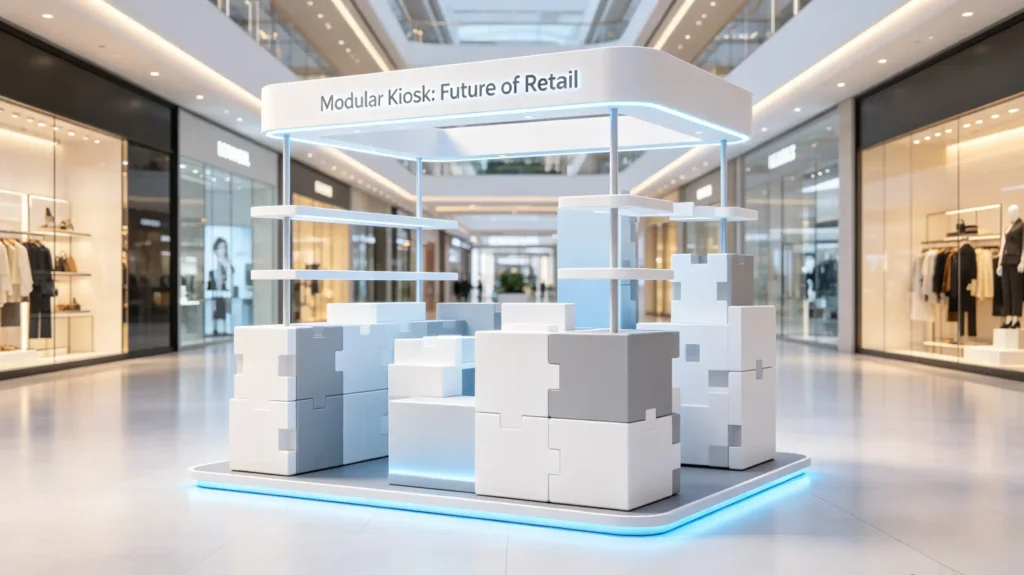
What is modular kiosk?
In simple terms, the kiosk is divided into several standard-sized “building blocks”. Each module is fully manufactured in the factory, including interior decoration, lighting, and electrical systems. After being transported to the site, they are assembled using a quick-install structure, and can be powered on and used immediately.
4 core advantages for modularity
- Fast delivery speed – 30-40%
Standard modules are either in stock or have a regular production plan, so there’s no need to start from scratch. For urgent flash projects, they can be implemented within 4 weeks. Traditional customization takes at least 8 weeks or more. - Can be reused
This is the most valuable aspect. Traditional kiosks are basically scrapped when they are removed from a location. The modular units can be disassembled and transported to the next store, with just a change of the storefront, and they can continue to be used. For brands that adopt multi-location rolling operations, they can save the cost of a new store for two years. - Function can be upgraded
The screen, payment module, and shelves all have standard interfaces. Next year, we plan to add a self-checkout function. We don’t need to replace the entire cabinet; we can simply replace the function module. - Low transportation and installation costs
The modular design allows for stacking during packaging, increasing the container utilization rate by 40%. This significantly reduces transportation costs. Installation does not require a professional construction team. Two ordinary workers can assemble a complete set in just half a day.
Under what circumstances is modularization not suitable?
- The site dimensions are extremely unique and the standard modules cannot fit in.
- The brand requires a 100% unique design, completely non-standard.
- Only one point will be constructed, and it is confirmed that it will not be moved for more than three years.
Also, for the procurement in 2026, it is recommended to give priority to the modular solution.
Should we add smart features? Which ones are genuinely necessary, and which ones are just a waste of money?
Almost every supplier will recommend all kinds of “advanced technologies” to you. But for the purchaser, the core question is only one: Can this money be recouped?
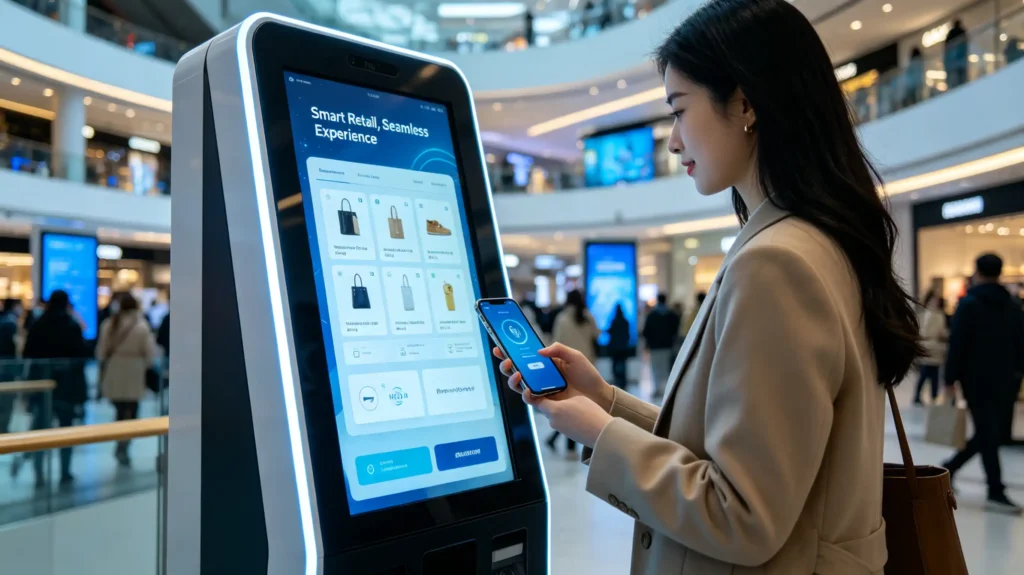
This will be a standard feature by 2026.
Don’t overthink these, just select them, because the customer has already assumed you’ll have them:
- 15 – 27 inch touch screen display, showcasing products and promotions
- Support for contactless payment via credit cards, Apple Pay, and Google Pay
- Real-time viewing of sales and inventory data in the background
- Wi-Fi 6 networking module, with FCC certification
Carefully implemented “cool features”
- AR try-on / try-on makeup: For beauty products and eyewear, it’s feasible to conduct trials. However, for ordinary fast-moving consumer goods, the return on investment is very low.
- Large interactive games: Attracting people flow is useful, but the proportion of converting to purchases is not high. They are more suitable for brand marketing budgets and not for sales kiosks.
- Complex mechanical structures: Elevating, rotating, automatic shipment, with high failure rates and expensive maintenance.
Procurement principle: First, calculate exactly how much money this function can save you and how much manpower it can save. For those that cannot be calculated, do not add them at all.
From selection to implementation, what is the complete procurement process?
For those who are doing it for the first time, they are prone to make mistakes. Here is a standard six-step procurement process for you. Follow it in order and you should generally avoid major errors.
Step 1: Internal Demand Confirmation (Most Important)
First, think these issues through clearly before looking for a supplier:
- What products are being sold? What are the sizes and weights?
- What are the dimensions of the designated space provided by the mall? What is the height limit?
- What is the total budget? What percentage of the budget is allocated for equipment?
- When is the plan to open? Work backward to determine the delivery time.
- Is it a long-term or short-term plan? Will the location be changed?
Many people immediately ask “How much does it cost to build a kiosk?”. The suppliers simply can’t provide an accurate price. The more specific the requirements are, the more accurate the quotations will be, and the fewer changes will be needed later.
Step 2: Supplier Selection
- Check certifications: Basic qualifications such as ISO 9001, UL, and CE must be in place.
- Review cases: Have you worked on similar American mall projects of the same category and grade?
- Ask about services: Can you provide fire protection drawings and certification documents that meet the requirements of the mall?
- Inspect the factory: If the volume is large, a third-party inspection or video inspection must be conducted.
Step 3: Design and Sample Making
- First, provide the floor plan and 3D effect diagrams to confirm the appearance.
- Then, provide the structural construction drawings to confirm the materials, processes, and circuit layout.
- For projects with large amounts or high complexity, it is essential to conduct physical sample production for confirmation.
Step 4: Mass Production and Quality Inspection
- Pre-delivery sample verification: Raw materials and process standards
- Mid-production inspection: Check progress and workmanship halfway through production
- Final inspection before shipment: Conduct full inspection or sampling inspection according to AQL 1.0/2.5 standards
You can send your own personnel to do it, or you can hire a third-party inspection agency like SGS or BV.
Step 5: Transportation and Customs Clearance
- Perform fumigation and export packaging before leaving the factory
- Find a freight forwarder who is familiar with the customs clearance of commercial goods in the United States
- Prepare all the customs clearance documents in advance to avoid port detention and the associated detention fees
Have a specific mall space you’re planning for? Send over the dimensions and we’ll put together a custom quote and timeline!!!