US-Made vs. Overseas Custom Retail Kiosks: Which Is Better for Your American Business?

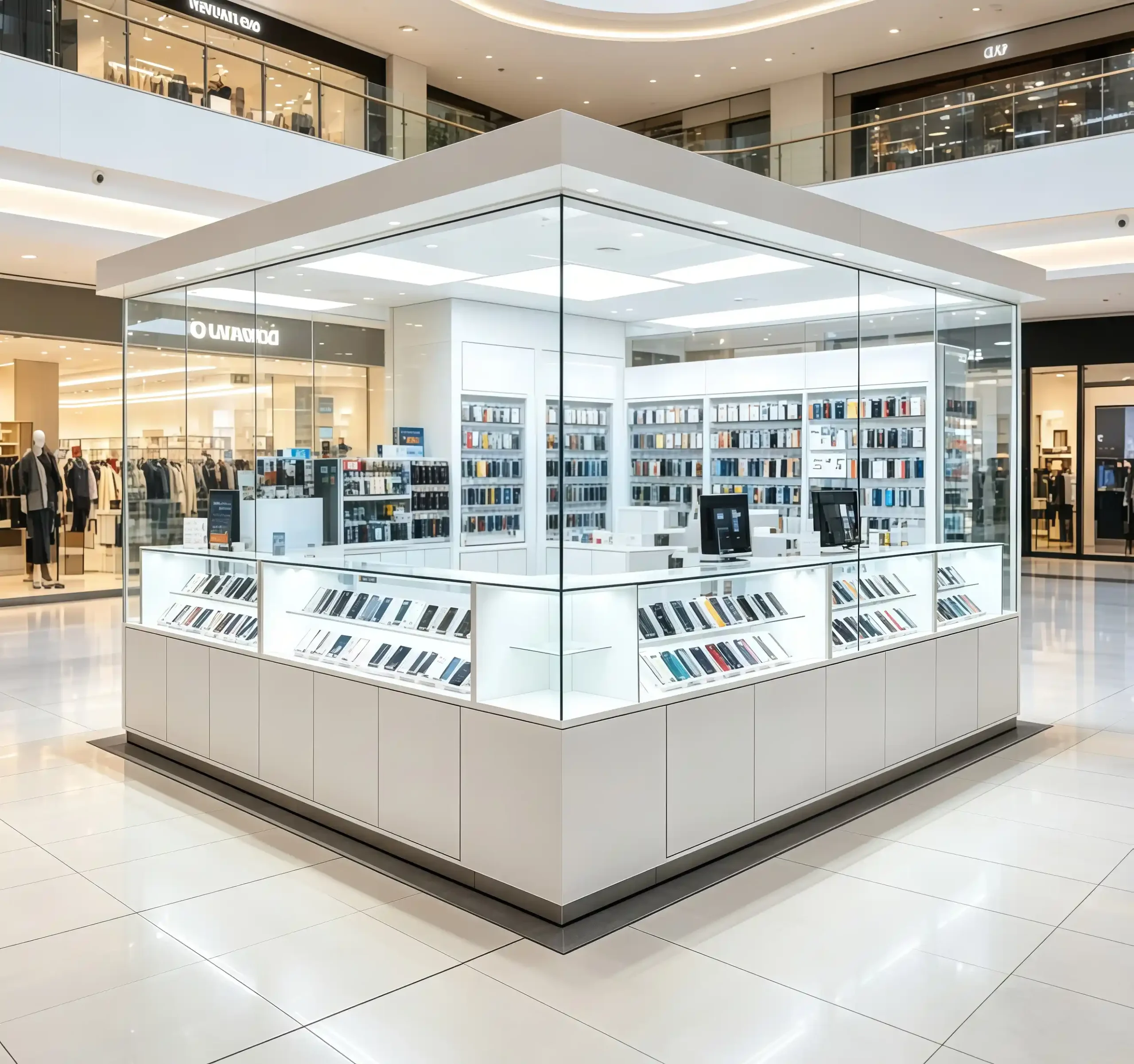
For the majority of American retail brands, mall operators, and pop-up business models, the overall benefits of choosing overseas custom retail kiosks are significantly higher than those of producing them domestically in the United States.
Especially for custom retail kiosks manufactured in Chinese factories, when fully meeting the quality and safety standards of the American market, they can typically save 30% to 50% of the procurement costs for American enterprises. They are the optimal choice for budget-sensitive, bulk-demanding, or high-customization-oriented American enterprises. Only for projects with extremely strict delivery requirements, single-unit purchases, and sufficient budgets, is local manufacturing in the United States temporarily advantageous.
How much cost can be saved by customizing retail kiosks overseas compared to manufacturing them in the United States?
Cost is the primary reason why the majority of American companies choose to outsource production overseas. The price difference between the two is far greater than many people expected.
The high cost of retail kiosks in the United States mainly stems from three aspects.
- Firstly, it is the labor cost. The hourly wage in the manufacturing industry in the US is 5 to 8 times that of Chinese factories, and retail kiosks are labor-intensive custom-made products, with labor accounting for over 40% of the total cost.
- Secondly, it is the raw materials. The prices of basic materials such as steel, acrylic, and sheet materials in the US are generally 20% to 30% higher than those in China.
- Finally, it is the factory and operation costs. The industrial land and environmental compliance costs in the US are much higher than those in China, and they will eventually be passed on to the product prices.
Based on the actual quotations, for standard 10-foot commercial retail kiosks of the same specifications and materials, the quotations from domestic factories in the United States usually range from 15,000 to 20,000 US dollars. While the factory prices from professional Chinese factories typically fall between 8,000 and 12,000 US dollars, the price difference is nearly half.
Even including subsequent costs such as shipping, customs clearance and tariffs, overseas procurement still has significant advantages. The shipping cost to the west coast of the United States for a single retail kiosk accounts for approximately 10% to 15% of the value of the goods, while on the east coast it is around 15% to 20%. After calculating all the landed costs, the total price is still 25% to 40% cheaper than that in the United States. The larger the purchase volume, the lower the unit cost of shipping, and the more obvious the cost advantage becomes.
Can retail kiosks made in China meet the quality standards of American department stores?
This is the issue that American customers are most concerned about. The answer is: We have professional retail kiosk factories in China. The products can fully meet and even exceed the average quality level of those in the United States.
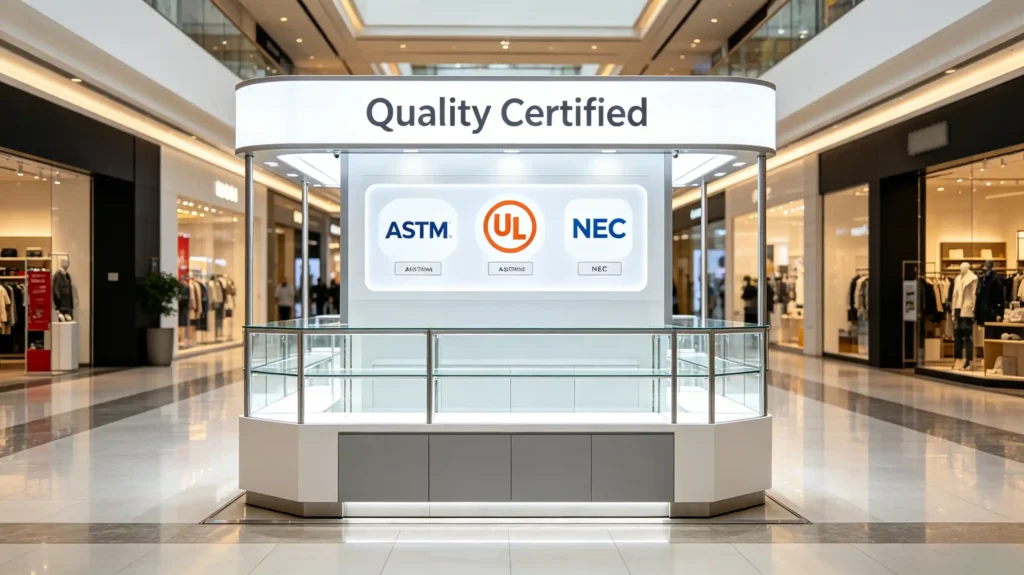
- Firstly, the material standards are compliant. Regular export factories will strictly use metal sheets, acrylic, and decorative materials that meet the ASTM standards of the United States. The environmental protection level meets the entry requirements of American shopping malls, and there will be no problems such as excessive formaldehyde or material deformation.
- The next is electrical safety certification. Retail kiosks usually contain electrical components such as lighting, sockets, and display screens. Professional factories will use all UL-certified electrical components. The overall circuit design complies with the US NEC electrical standards and can directly pass the electrical inspection of American shopping malls.
- The third advantage is that the process accuracy is guaranteed. Chinese factories generally use automated equipment such as CNC bending and laser cutting, which can control the size error within 0.5 millimeters. The joint gaps are uniform, and the surface spraying is smooth and flat. In contrast, many small local factories in the United States still rely on semi-handwork, resulting in inconsistent accuracy and stability.
- Finally, there is the complete quality inspection process. Regular factories will carry out three steps: pre-production sample verification, production process inspection, and final product inspection. Before packing, they will provide complete photos and video records, and also support customers in commissioning third-party quality inspection companies to conduct on-site inspections. Currently, a large number of shopping malls, airports, and retail kiosks of various brands in the United States are actually produced by Chinese factories on behalf of them.
Are the delivery cycles for custom-made retail kiosks from China really slower than those in their home country?
Many people assume that overseas production takes longer, which is actually a common misconception.
Most of the retail kiosk factories in the United States are small in scale and have limited production capacity. During peak seasons, the order backlog is very long. Under normal circumstances, it usually takes 12 to 16 weeks for a factory in the United States to go from confirming the design to delivering the finished product. If there is an order peak, it is not uncommon for the production cycle to exceed 20 weeks.
Chinese professional retail kiosk factories have sufficient production capacity and a mature supply chain. For standard customization projects, after confirming the design and paying the deposit, the production cycle is usually 6 to 8 weeks. Adding the shipping time, it takes 2 to 3 weeks to reach the west coast of the United States and 3 to 4 weeks to reach the east coast.
Calculated, the total delivery cycle to the West Coast is approximately 8 to 11 weeks, and to the East Coast it is about 9 to 12 weeks. This speed is actually faster than that of many domestic factories in the United States. For bulk orders, the production capacity advantage of Chinese factories will be more pronounced, while domestic factories may extend the delivery period due to insufficient capacity.
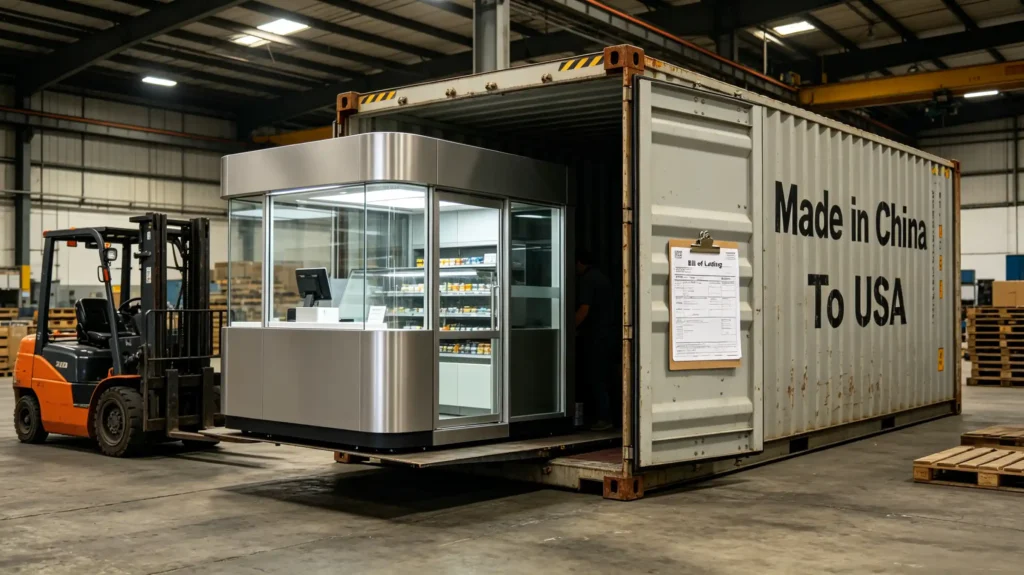
Can overseas factories meet the complex customization needs of retail kiosks?
In terms of customization flexibility, Chinese factories generally have a more significant advantage over their American counterparts.
The factories in the United States usually only excel in standardized, simple designs. When it comes to complex shapes, multi-functional integration requirements, either extremely high quotations are required or they simply cannot take on the job. However, China has a complete supply chain support, covering metal processing, woodworking, acrylic, printing, electronic components, and all other processes can be completed in the surrounding industrial belt.
Specifically, Chinese factories can support customized retail kiosks for all categories, including shopping kiosks in malls, beauty experience kiosks, food sales kiosks, self-service terminals, pop-up display kiosks, etc. Whether it’s curved shapes, illuminated letters, LED screens, interactive touch screens, or refrigerators, locks, storage spaces and other functional modules, they can be integrated as needed.
The order quantity is also very flexible. Many American factories require an order of 5 or even 10 units, while Chinese professional factories can handle custom orders with just 1 unit. This is very suitable for start-up brands to test the waters or for single-store projects. At the same time, they can also handle batch orders of dozens or hundreds of units, meeting the expansion needs of chain brands.
In addition, factories usually have professional design teams that can refine the production drawings based on the sketches, reference diagrams, or even textual descriptions provided by the clients. They will also offer optimization suggestions from the perspectives of structure and cost.
Which American companies are better suited to choose overseas customized retail kiosks?
Overseas customization is not suitable for all projects. For the following types of American enterprises, overseas procurement will yield the most significant benefits.
- The first category is chain retail brands. They need to purchase 10 or more units in bulk for store expansion or location updates. Bulk purchasing will further reduce shipping costs, resulting in the greatest overall cost advantage. At the same time, the quality and delivery are also more stable.
- The second category consists of shopping malls and property operators. They need to purchase multiple public area vending machines and service kiosks in a unified manner. With limited budgets, they have requirements for appearance and quality. Overseas customization can achieve better results with the same budget.
- The third category includes pop-up stores and event companies. The projects have clear design requirements and need highly customized solutions. They are sensitive to costs. The design and craftsmanship capabilities of Chinese factories can meet various creative styling demands.
- The fourth category consists of start-up brands and small and medium-sized businesses. For first-store or single-store projects, with limited budgets but wanting exclusive customized effects and not wanting to use standardized products available on the market. The minimum order quantity of 1 unit is very reasonable.
Conversely, if your project requires delivery within two weeks or necessitates frequent on-site modifications and adjustments, then a local factory in the United States would be a more suitable choice.
When looking for overseas retail kiosk suppliers, be sure to avoid these pitfalls:
- The first pitfall is to solely focus on the low price while ignoring the factory’s qualifications. Some suppliers offering exceptionally low prices may use inferior materials and un-certified electrical appliances to cut costs. As a result, the final products fail to pass the acceptance standards of American markets, causing even greater losses. Before entering into a partnership, it is essential to verify the factory’s export experience, relevant certifications, and past cases with American customers.
- The second pitfall is not verifying the details and drawings before production. It is quite normal for there to be deviations between custom products and one’s imagination. It is essential to create a prototype before production to confirm the materials, colors, and detailed production processes. Confirming the drawings before production can prevent losses of tens of thousands of dollars in the future.
- The third pitfall is not confirming the shipping cost. The shipping cost mainly depends on the quantity and volume of your goods, your delivery address and weight. So before the transportation, you must make sure whether your service is delivered to the door or to the port, and whether it includes customs duties or not. These are all very important matters.
How to launch your overseas custom retail kiosk project?
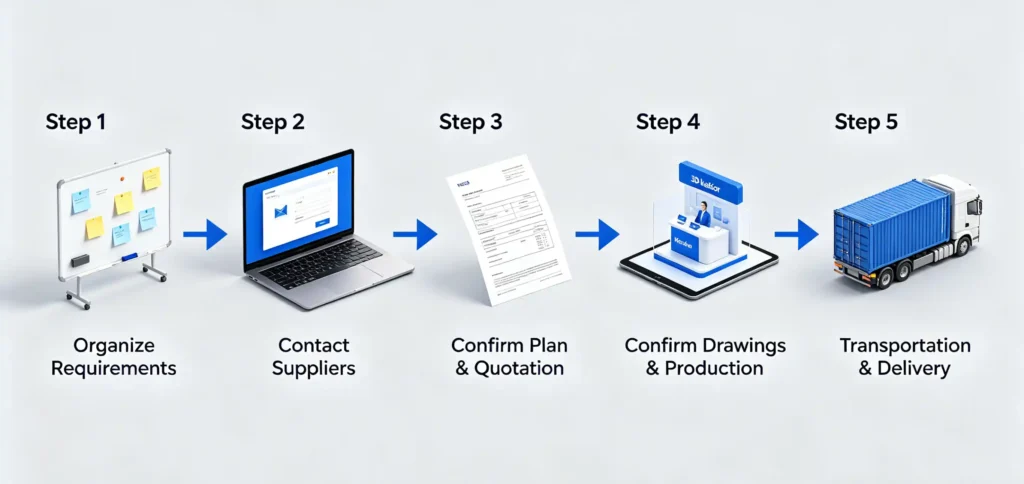
Step 1: Organize your requirements. This includes the size of the retail kiosk, its placement, functional requirements, reference images, as well as your budget and expected delivery time. The more detailed the information is, the more accurate the quotations and solutions you will receive.
Step 2: Contact professional suppliers. For example, Lexio Display. We have over 10 years of experience in serving the US market and specialize in the production and export of various customized retail kiosks and store furniture. We have served over 200 US retail brands, malls, and pop-up companies, and are familiar with all the standards and requirements of the US market.
Step 3: Confirm the plan and quotation. We will reply to your inquiry within 24 hours. Based on your requirements, we will provide a preliminary quotation and design suggestions. After both parties confirm the design plan, detailed production drawings and a formal quotation will be issued.
Step 4: Confirm drawings and production. After confirming the order, we will first provide you with construction drawings and simultaneously confirm the color, materials, and various details. The production process is synchronized with the schedule, and we support on-site inspection at any time.
Step 5: Transportation and Delivery. We offer a one-stop service from the factory to your designated address, including shipping by sea, customs clearance, and delivery. All you need to do is receive and inspect the goods.