Starting a Jewelry Retail Business? Don’t Miss These Display Cases

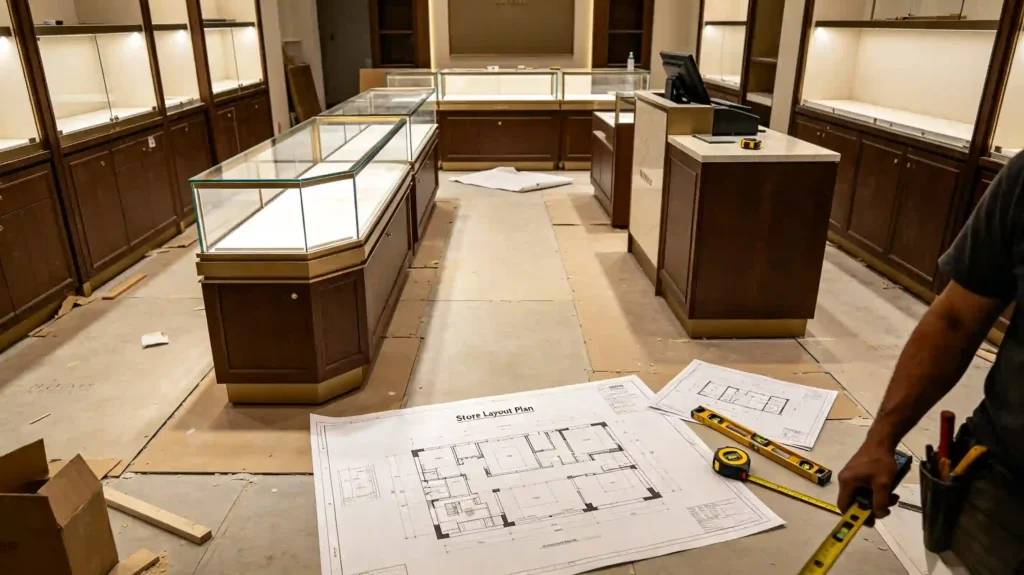
Starting a jewelry retail business? The first thing you need to lock down isn’t your store’s interior design or your logo — it’s your display cases. I’ve seen too many people lay the flooring first, then measure for cases. The result? Traffic flow gets stuck, lighting goes wrong, and within the first month they’re tearing everything out and starting over. Display cases directly impact your in-store conversion rate. This isn’t where you cut corners — but it’s also where people burn money the fastest. Here, I’ll break down what to buy, where sizing goes wrong, and the B2B negotiation details that actually matter.
Why are customers not staying? Eight times out of ten, the case height is driving them away
If your foot traffic is decent in the first three months but sales aren’t closing, the first thing you should measure is your counter height.
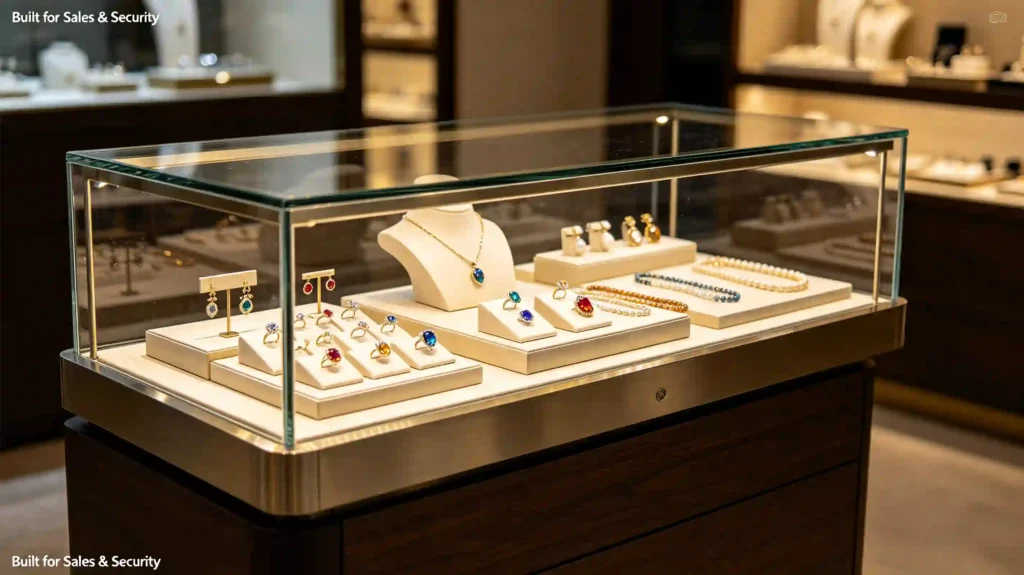
A client in Seattle selling handcrafted silver jewelry had his display counters built at 102cm high. Customers had to raise their shoulders just to point at the trays — nobody wanted to try anything on. Later, he replaced the main display area with 78cm seated-height counters, paired with comfortable bar stools. Once customers sat down, they weren’t in a rush to leave. Average transaction value jumped 40%.
So before you decide on height, get clear on what you’re selling:
- Engagement rings, high-end gold pieces: customers mostly browse standing up. Counter height at 100–105cm works best. A slight downward gaze reveals the details most clearly.
- Silver jewelry, beaded pieces, affordable luxury: customers need to sit and take their time. Height around 75–80cm is ideal. Arms rest comfortably on the glass, and dwell time naturally increases.
Don’t guess the depth either. Based on our factory’s experience, 45–50cm deep cases are the safest bet. Standard jewelry trays fit perfectly, and reaching in feels natural. If you’re selling watches or larger bracelet displays, depth needs to go to 55cm or more — otherwise the trays simply won’t fit. But if your shop is under 40 square meters, deep cases eat into aisle space, and two people won’t be able to pass each other comfortably.
Diamonds look dull, gold looks pale — you picked the wrong color temperature
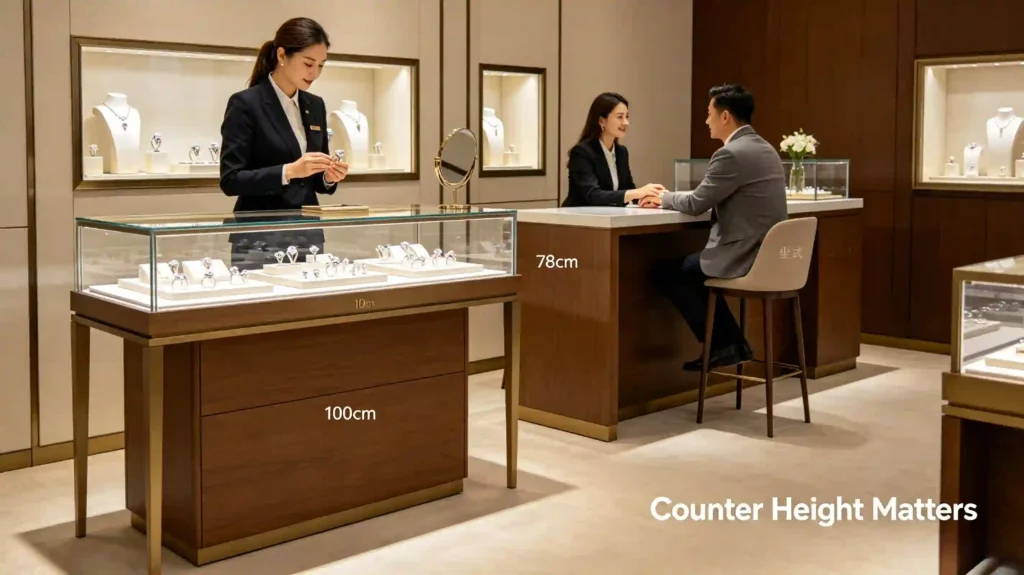
Lots of new store owners think bright lighting is enough. That’s a huge mistake. If the color temperature and CRI don’t match your gemstones, even expensive pieces end up looking like cheap costume jewelry.
We learned this the hard way with a client in Vancouver. He used 6500K cool white lights on an emerald necklace. Photos went up on Instagram, and a customer commented, “Why does it look like a plastic toy?” After switching to 4000K natural white with CRI≥97 LEDs, his in-store return rate dropped by nearly 20%.
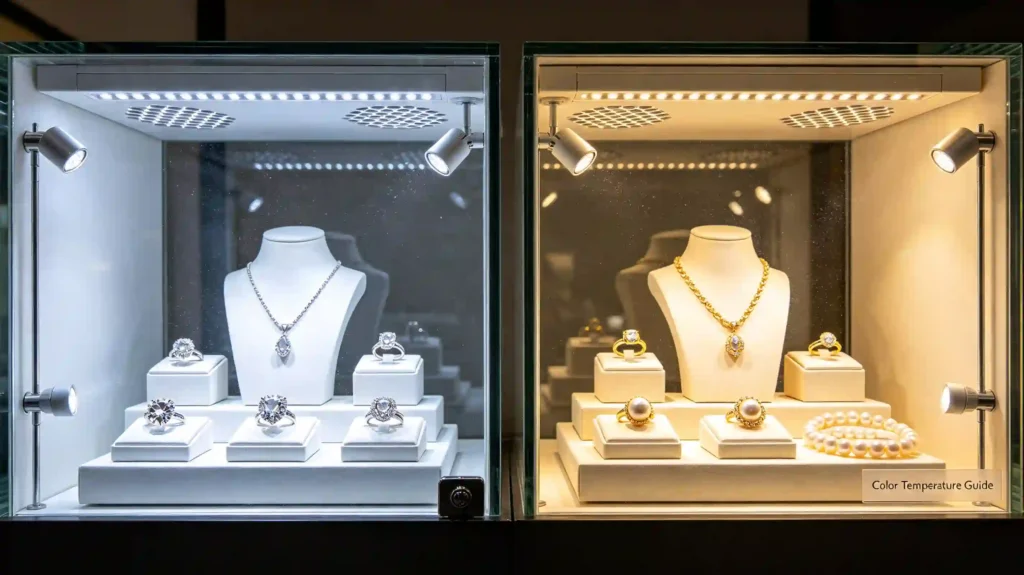
Different jewelry demands totally different light. Don’t use one lighting setup across the whole store. Here’s a practical reference to send directly to your supplier:
| Jewelry Type | Color Temperature | CRI Requirement | Common Mistake |
|---|---|---|---|
| Diamond, white gold, silver | 5000–6500K cool white | CRI≥95 | Below 4000K makes white gold look yellow |
| Yellow gold, rose gold | 3000–3500K warm white | CRI≥95 | Cool light makes gold look like pale stainless steel |
| Emerald, ruby, sapphire, tourmaline | 4000–4500K natural white | CRI≥97 | Low CRI washes out saturation and leaves colors looking gray |
| Pearl, coral | 2700–3000K warm light | CRI≥90 | Cool white dries out the pearl’s luster and makes it look aged |
One more detail: never aim spotlights directly at customers’ eyes. Tuck the light source inside the top edge of the case, let the light soften through reflection, or use LED strips with honeycomb anti-glare grids. This way, diamond fire stays brilliant, and customers don’t flinch backward.
Ordering from factories in China — how to avoid turning your shipment into a box of broken glass
B2B sourcing trips up most people not in the product quality itself, but in the details they forgot to write into the contract. A client once told me something I’ve never forgotten: “Saving $200 on packaging might cost you $2,000 replacing glass locally.”
If you’re ordering display cases from China for delivery to North America, Europe, or Australia, don’t leave these four items out:
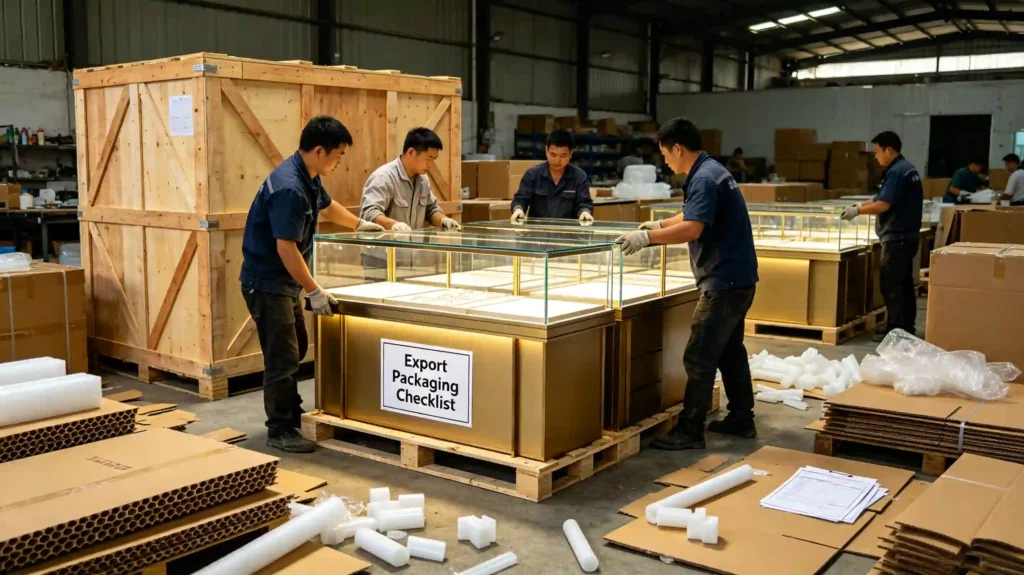
- Packaging requirements: Don’t settle for a sales rep saying “we’ll reinforce it.” Demand export-grade fumigated wooden crates, or heavy-duty honeycomb cardboard boxes with plastic corner protectors. Before placing your order, ask the factory to send photos of actual packaging they’ve used for previous shipments to your target country. This is more reliable than any certificate.
- Voltage and certifications: Display case LED systems usually run on 12V or 24V transformers. But for North America, you need power plugs with UL or ETL certification. For Europe, you need CE. If you don’t confirm this, the entire shipment arrives and you have to hire a licensed electrician to replace every plug. In California, quotes of $800–$1,200 for this are common.
- Glass breakage liability: Write into the contract that if glass breaks during transit, the factory covers free replacement and air freight. Otherwise, ocean freight claims drag on for two or three months, and your store can’t open while you wait.
- Assembly guide: Modular cases are supposed to go together like building blocks. But leveling island counters and aligning sections correctly? Local contractors with no experience often get it wrong. Ask your supplier for an English-language illustrated manual — ideally with step-by-step videos — and get these before the shipment arrives. Don’t wait until the cases are sitting in your store and you’re on a frantic video call.
Last year, a client in New York skipped corner protectors. Two side panels arrived scratched. Local repair cost: $500. From then on, he put packaging specs right at the top of every PO.
Standard glass vs. ultra-clear — the difference between cheap and premium
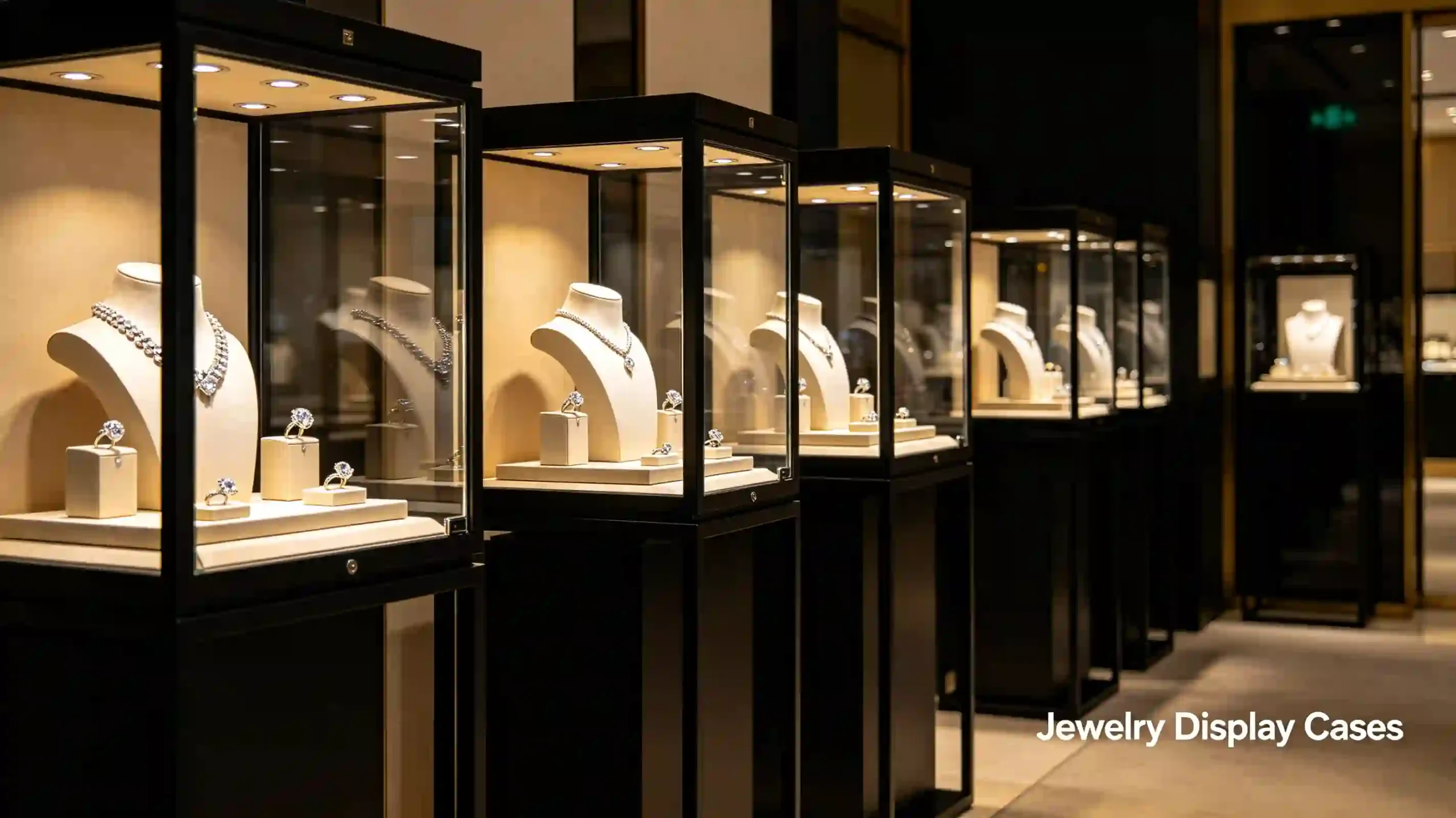
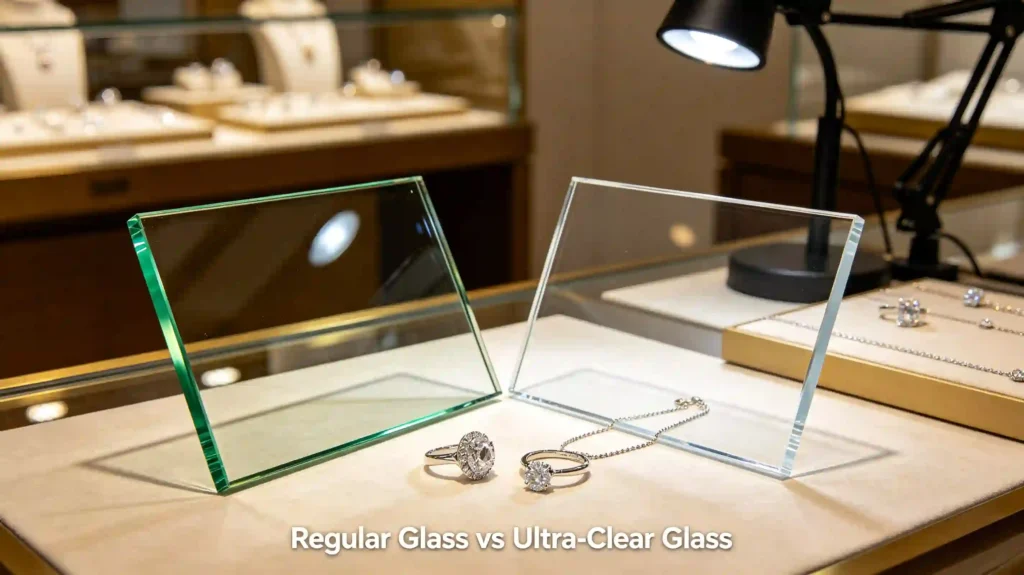
If your countertop glass has a greenish tint, even the most expensive jewelry looks like it’s sitting in an old fish tank. Regular float glass has high iron content, which creates that green edge. Light transmittance is around 86%. Ultra-clear low-iron glass pushes that to over 92%. The difference is immediately visible — a one-carat diamond’s fire pops right out.
For a typical counter, the glass surface area is under 5 square meters. Ultra-clear costs a few dozen dollars more per square meter. The total cost increase is modest, but the upgrade in perceived quality is massive. Also, always request safety-beveled edges or an anti-shatter film on top panels. One chip during handling means replacing the entire sheet, and you lose a full day’s revenue.
Tight budget? Use a mix-and-match strategy
If you can’t afford a full custom fit-out, concentrate your spending on the positions that matter most.
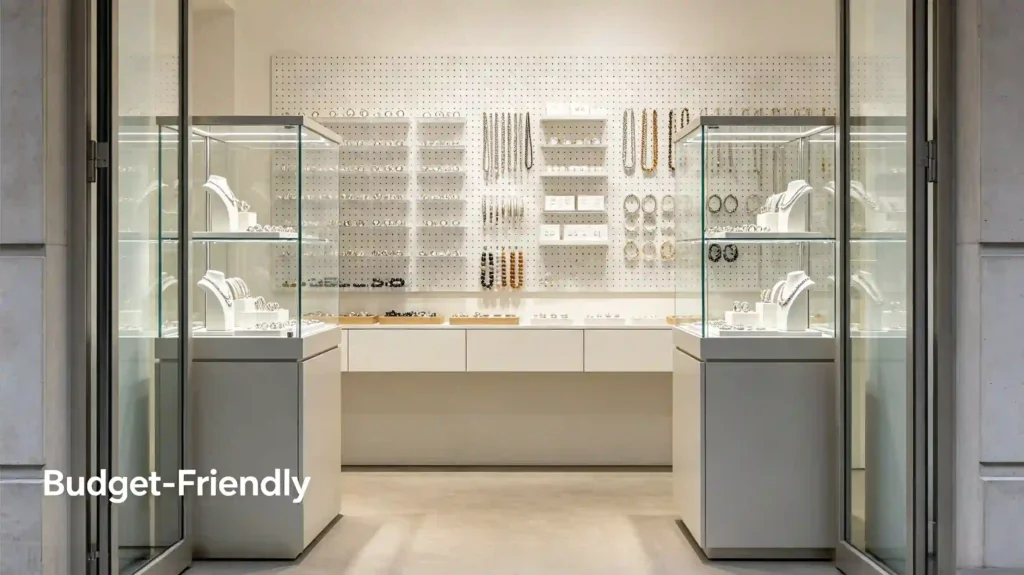
Place two or three freestanding high-end display cases in the prime zones near the entrance. Use the best lighting and glass. Feature your high-ticket, high-margin pieces there. For wall areas, switch to pegboard panels with acrylic shelves — open display at roughly one-third the cost per foot of custom cabinetry. This lightweight setup works especially well for silver rings, beaded pieces, and accessories, where customers feel comfortable picking items up themselves.
Refurbishing secondhand cases is another route. As long as the cabinet bodies aren’t warped, invest in a new spray-on film finish and replace all light strips and glass. Total cost often comes to around 40% of new cases. But don’t skimp on the lighting and glass — otherwise you’re just paying to inherit someone else’s problems.
Security setup — don’t wait until after a theft to fix it
Retail industry research shows a sobering statistic: over 70% of grab-and-run thefts in jewelry stores happen when customers can easily reach around counters or when locks are flimsy. Your case locks aren’t decoration — they’re your first line of defense.
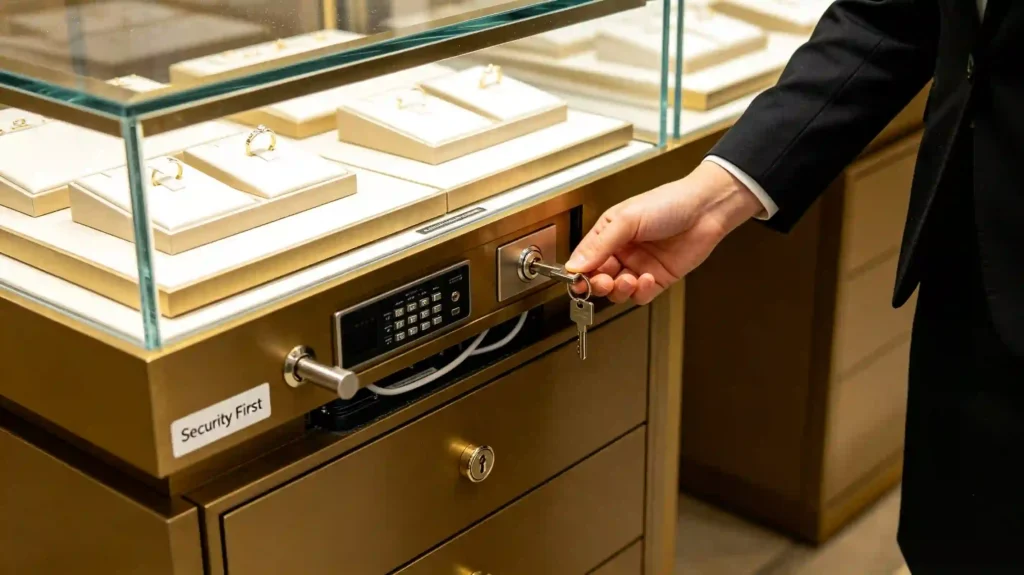
- Ditch old-style cam locks. Use magnetic electronic locks or concealed latch systems. Staff can open them fast, and customers can’t see where the release point is.
- At closing time, all trays should slide into a lockable storage compartment built into the base of the case. Heavy-duty slides lock automatically when pushed all the way in. This does a hundred times more than throwing a dust cloth over the top.
- For street-facing windows, use laminated glass with anti-shatter film. Security companies have tested this — it delays forced entry by over four minutes. That’s enough to trigger the alarm and scare off the vast majority of opportunistic thieves.
And when you’re planning linked island counters, don’t forget to leave channels for wiring and alarm sensor connections. Retrofitting these later means cutting into the cabinet structure, and that costs far more.
At the end of the day, display cases are the fixed assets that clock in earliest and clock out latest in your store. This isn’t a one-and-done purchase. An extra hour of homework upfront pays back every single month on your sales report. If you’re setting up your first store, or upgrading an existing one, drop your product category and city in the comments. I can help estimate the number of island counters you’ll need and give you a heads-up on the installation pitfalls common in your area.