Commercial Display Cases: A Complete Guide for Store Owners in 2026


If you are looking for Commercial Display Cases for your retail space in 2026, the most troublesome issue is definitely not the lack of variety in styles, but rather these three points: the delivery dates keep getting postponed, the customization requests are ignored, and only after the goods arrive in the US do you realize that all the details are not in line. What the store owners really need is a commercial display cases solution that can withstand high foot traffic and can be implemented quickly.
Why can’t we follow the same approach we took three years ago when buying commercial display cases in 2026?
Many people are still placing orders based on the pre-pandemic experience, but the rules of the supply chain have changed. In 2026 for B2B procurement, if you ignore these points, you are likely to run into problems.
1. Nearshore inventories have increased, but prices have not decreased
The number of light manufacturing and assembly lines in places like Mexico, Texas, and South Carolina has significantly increased. Many cabinets can be “assembled locally and delivered within two weeks”. It sounds fast, but the unit price is usually 20% – 35% higher than that of goods from Asia. The advantage is: there is no anxiety about the goods floating in the Pacific Ocean during shipping, and there is no need to worry about the inspection at the destination port holding up the delivery for two weeks.
2.Acrylic has almost replaced traditional glass
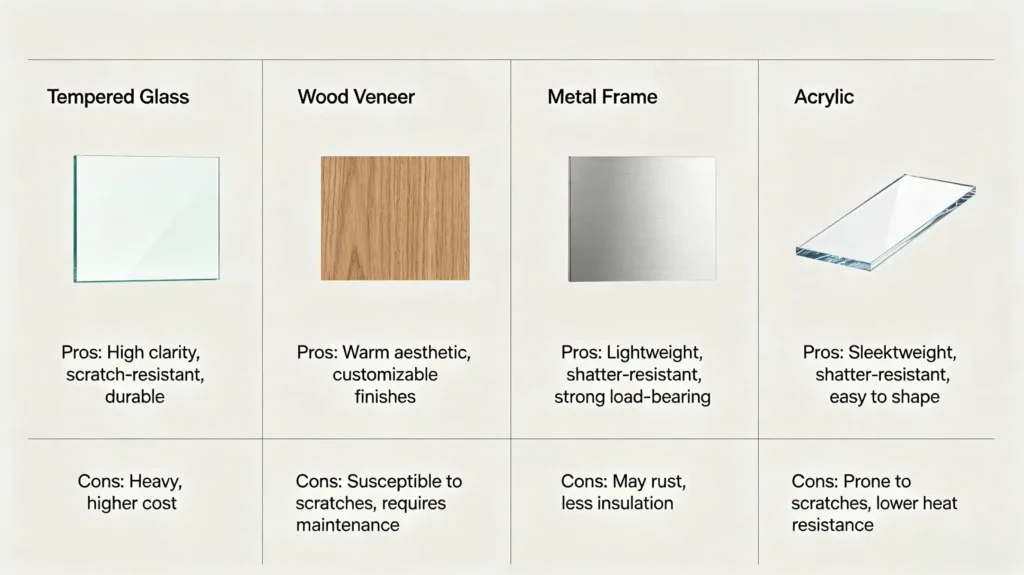
It’s not that glass has completely disappeared. Rather, the cost of replacing a broken piece of glass at the retail end is too high. By 2026, the main types of jewelry cabinets, dessert cabinets, and mobile phone display stands will all use hard acrylic or ultra-clear glass laminated glass – they are lightweight, impact-resistant, and most importantly, if they break, they won’t hurt the customers.
When making the purchase, you ask the supplier: “Are you using cast plates or extruded plates?” Cast plates have a clearer edge after laser cutting, while extruded plates are cheaper but tend to turn yellow. This one sentence alone can help you eliminate a bunch of unprofessional factories.
3.Smart modules have gone from being a gimmick to an optional feature
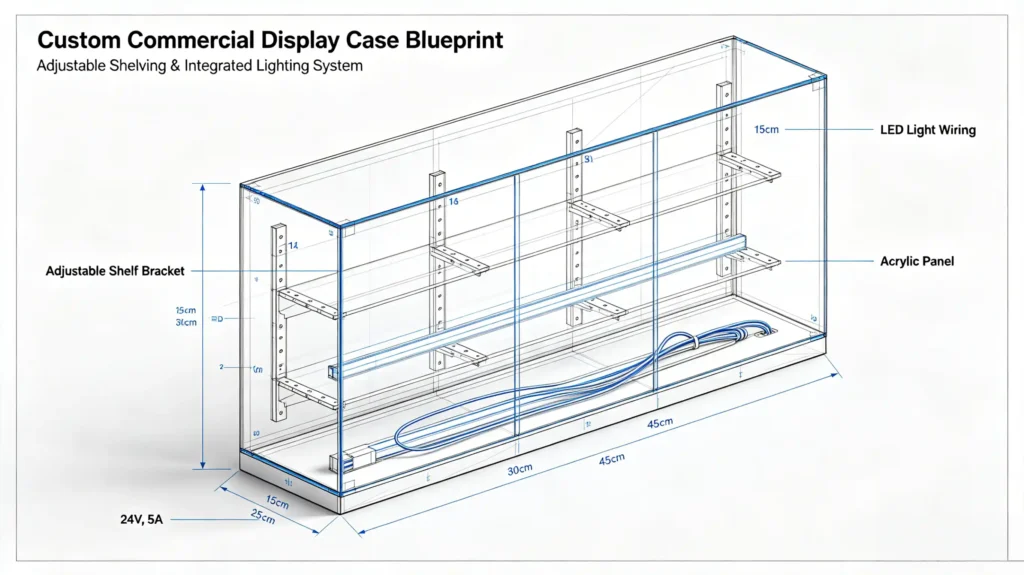
In the past, adding an LED to the cabinet would be called “smart”. But now it’s different. NFC sensor locks, built-in defogging, adjustable color temperature light strips, and even reserved power sockets for connecting store visitor cameras – all these are standard operations.
You don’t have to do it all, but the routing of the wires and the hidden space for the drivers must be determined at the design stage. Otherwise, any later modifications will be a waste of money.
5 questions to ask the factory before placing an order
Just hand these questions over to the salespeople or traders and see if they can answer them immediately. If they are evasive and hesitant, it’s a pretty good indication that there’s something more serious lurking behind.
Q1: How many sets of this model are actually in stock?
For many factories, “in stock” items only exist on their websites. When you hear “in stock,” you need to ask further: Is it a full container load or loose parts? Is it fully assembled, or does it require on-site assembly with 45-degree cuts? This is especially true for painted finishes—unless it’s standard white or black, the likelihood of having it in stock is extremely low. Only by clarifying these details can you calculate the actual delivery time.
Q2: What is the minimum order quantity? Can you mix and match styles?
3 units, 5 units, 10 units—there’s a huge variation between different factories. Reputable suppliers will let you fill a 20-foot container with seven or eight different styles, with three to five units of each, keeping the markup per unit under 8%. If they insist you buy a full container of a single style, they’re most likely middlemen reselling goods.
Q3: Is there a mold fee for prototyping? Can you provide videos of the semi-finished products first?
This is the top concern for North American buyers. If you’re truly going with a custom order, clarify whether the prototyping fee is charged in full or can be offset against the bulk order. Also, request that the supplier provide separate 15-second videos for each of the three stages—welding, sanding, and powder coating—and insist on unedited footage. You’ll find that factories willing to meet these requirements have a much lower failure rate.
Q4: How are replacement parts handled? Are there interchangeable, off-the-shelf parts available in North America?
Slide rails, locks, and LED drivers are the most prone to failure. A high-quality supplier will provide you with a Bill of Materials (BOM) listing specific brands, such as Blum rails or Mean Well drivers. Replacement parts for these brands are readily available in the U.S. If the supplier hesitates and says, “They’re all custom-made in China,” the long-term maintenance costs will give you a headache.
Q5: What is the DDP quote—the price delivered to your doorstep, including taxes?
Never look at just the FOB price. Additional tariffs on certain materials will remain in place through 2026. You must have the supplier factor in tariffs, ocean freight, and trucking costs to provide a “door-to-door” all-inclusive price. This step reveals whether the supplier has any real experience doing business in the U.S. market.
Customized display cases: Where to spend your money wisely
Customization is not like what you might think – “You can change it however you like”. The more personalized something is, the higher the cost of a mistake. However, some investments have extremely high returns.
- Light color temperature and color rendering index: The bread cabinet uses warm light with a temperature of 2700K – 3000K, while the jewelry cabinet uses neutral light with a temperature of 4000K. The color rendering index Ra is greater than 90. This parameter directly determines the “appearance” of the product. Spending a few hundred more yuan will result in a commercial display cases effect that is one level lower.
- The logo design should not be compromised: Screen printing is the cheapest method, but it is prone to falling off. Instead, directly engrave the stainless steel letters into the interior, or use backlit etching. When customers walk in, without even saying a word, this cabinet will be expressing your brand positioning for you.
- Height and depth should be calculated backward: Don’t just measure the walls; instead, calculate from the perspective of the consumer’s line of sight. The most common mistake is that the middle partition is exactly at the height of a normal person’s chest, blocking the view. Before proceeding, use tape to mark the outline of the cabinet on the wall. Have all the store staff walk around and then determine the size.
The biggest hidden pitfall in the supply chain: drawing confirmation
The factory usually follows the “drawings-first production” method. However, the effect drawings you sent might lead to completely different interpretations of the materials. Therefore, we need the other party to provide a PDF document specifying the material, thickness, and surface treatment for each component. For example, “Side panel: 18mm multi-layer solid wood board, coated with technology wood veneer, semi-gloss varnish”. Instead of simply writing “Wooden side panel”, without this document, if the goods arrive, apart from making deductions, there is no other solution.
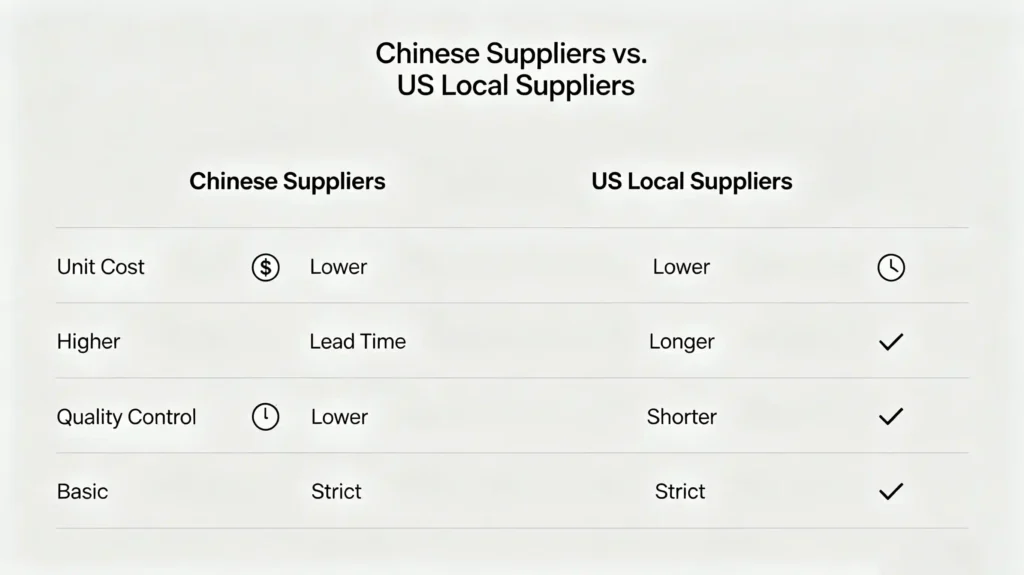
China imports vs. Local Purchases in the US, How to Choose in 2026
To be honest, there is no absolute answer, but it can help you make a decision by calculating the costs and benefits.
| Criteria | Chinese Suppliers | US Local Suppliers |
|---|---|---|
| Unit Cost | 30%–50% lower | High |
| Customization Flexibility | Extremely high; nearly all materials can be accommodated | Limited; fewer available mold options |
| Lead Time | 60–75 days (ocean freight included) | 2–4 weeks |
| After-sales Response | Time zone gap; slow spare parts delivery | Same-day spare parts dispatch |
| Quality Control | Quality relies on pre-shipment inspection | Relatively controllable |
Make decisions quickly:
By saying this, you might understand it better. If your store is located in places like New York or Los Angeles in the US, Sydney in Australia, London in the UK where the rent is outrageously high and you can’t wait for two and a half months, then although the local purchase is expensive, the two-month rent that is saved might have already been recovered.
However, there is one point you need to consider when purchasing in China. If you open more than 5 stores at once and customize in large quantities, shipping entire cabinets from China will still offer significant advantages. The compromise solution is: purchase standard cabinets locally and import customized cabinets, splitting the risks.
How to find reliable overseas suppliers?
Don’t just ask on the platform “Can it be done?”. Instead, ask for their customer cases in North America, specifying the specific cities and store names. Then use Google Street View to check if the store is still there and the condition of the cabinets. Additionally, request a video inspection of the factory. Don’t watch the polished promotional video they provided. Instead, ask the other party to walk around with a mobile phone and observe the goods being produced in the workshop, whether the welding is solid, and whether the paint booth is sealed. A 10-minute video is sufficient for you to determine if this factory is worth entrusting.
Are you planning to open a new store or upgrade your display? Custom commercial display cases built for your US retail store? Please send us the floor plan and material requirements. We will provide you with a calculated price including tax and delivery, as well as a detailed schedule for implementation. This way, you won’t have to compare prices from different suppliers and risk making mistakes.