
Wave Lights and Candy Decorations for Your Ice Cream Shop

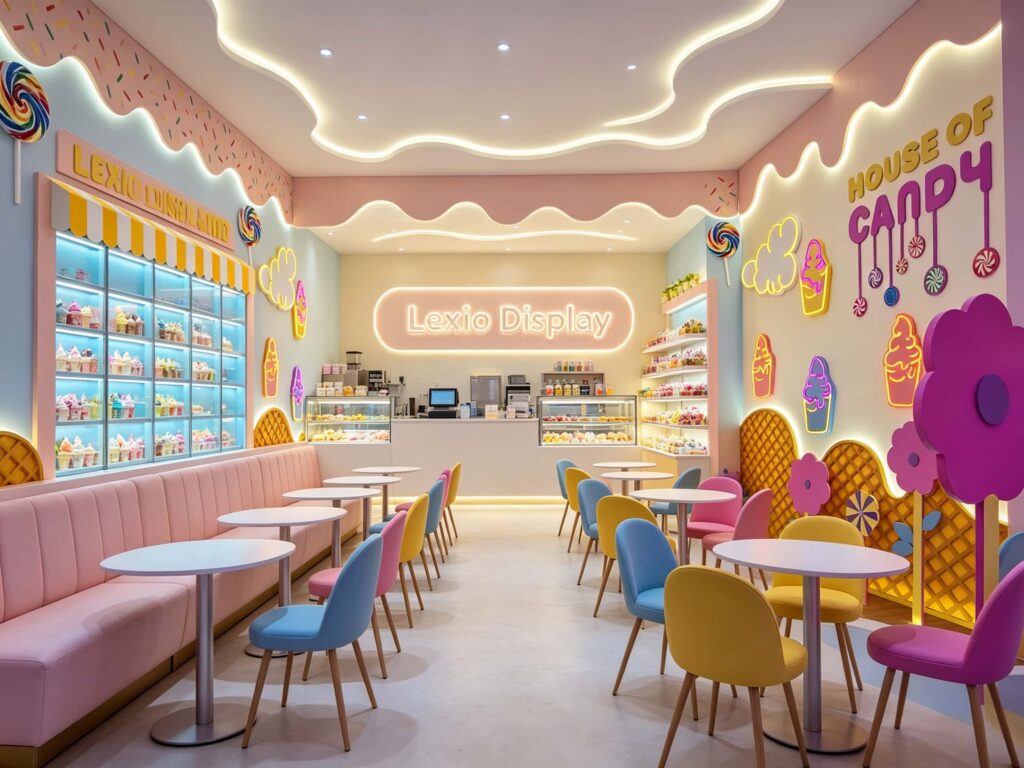
Why are wave-shaped lights and candy decorations such a perfect match for an ice cream shop? Because they can immediately capture the attention of passersby and turn your small store into a popular spot that attracts a lot of foot traffic. To be honest, just relying on that big sign at the entrance is not enough to make people feel the urge to come in. But look at this “Lexio Display” design: the circular wave-shaped light strips on the ceiling, the hanging colorful chandeliers, and the pink dripping edges on the ceiling – this intense visual impact is the best free advertisement.
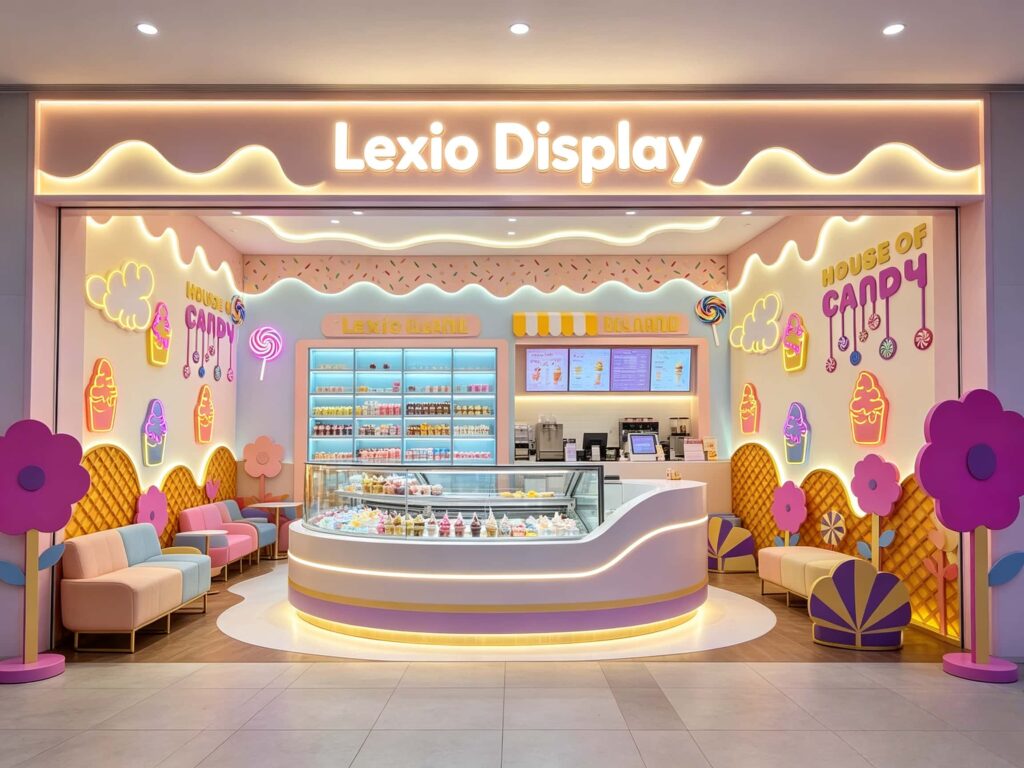
What is this “Wave Lighting” actually doing to make the shop money?
The ceiling design in this shop isn’t just for looks. It uses a floating ring-shaped hidden light strip, paired with high-CRI recessed downlights. This “see the light but not the bulb” setup is very deliberate.
Let’s check out this table to see the business benefits of this specific lighting setup:
| Lighting Type | Layout Setup | Actual Business Benefit |
|---|---|---|
| Ring-Shaped Wave Hidden Strip | Embedded in white slots around the ceiling perimeter and center. | Space Expander: Makes a smaller store look tall and spacious. Natural Guidance: The light pulls the customer’s eyes deep into the store, encouraging them to walk in. |
| Five-Color Pendants (Pink/Yellow/Blue/Green) | Hung at staggered heights right above the cashier counter. | Color Psychology: Ice cream is cold. These high-saturation warm light sources offset the coldness of the machines, making the space feel vibrant and appealing to younger crowds. |
| Ceiling Downlights | Evenly distributed on the flat ceiling area, providing high brightness. | Operational aid: Staff need enough working brightness for packing and cashing out. Too dim, and they might make mistakes on bills or miss toppings. |
Practical advice for investors:
Before you order these lights, make sure to ask the factory for the CRI (Color Rendering Index) data. You need it to be over 90. Don’t underestimate this number. If the CRI is low, you’ll find that your signature product—the purple Acai bowl—looks like mud, and the yellow fruit ice cream looks grey. If the food doesn’t look appetizing, customers will only order the cheapest items. Also, because ice cream shops have constant condensation, the slots for the recessed lighting must be sealed against moisture. Otherwise, the light strips will short-circuit and burn out within three months. The cost to tear down and reinstall the ceiling will make you wince.
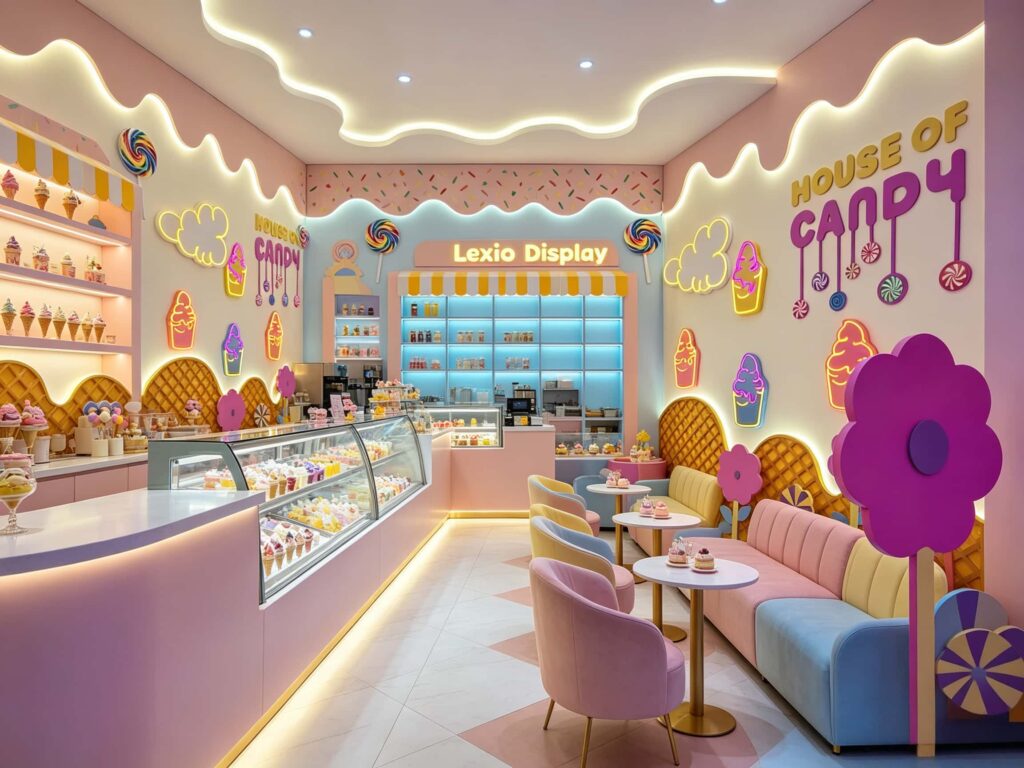
How to mix “Candy Decorations” and wooden walls for a premium look without looking cheap?
Look at the walls in this shop. They’re neither pure white nor covered in gaudy wallpaper. They chose light-colored vertical wood panels for the bulk of the wall surface. This is a very clever strategy. Wood naturally brings a sense of “warmth, handmade, and health,” counteracting the clinical, hospital-like feel that ice cream machines and freezers bring.
On top of the wooden walls, they added three core “candy decoration” elements:
- Pink drips on the ceiling edge: Mimicking melting cream. This isn’t just a decoration; it’s a giant “IP brand symbol.”
- Large hand-painted Acai berry mural on the side wall: A direct signal that “Acai bowls are our specialty.”
- Glowing neon typography and ice cream cone signs: Creating a great atmosphere for both day and night.
B2B Purchasing Perspective:
If you want to create this drip shape, do not use standard drywall and latex paint. Because ice cream shops are highly humid and full of sugar, latex paint will peel and get moldy within three months. The correct approach is to use molded Fiberglass Reinforced Plastic (FRP) or custom MDF backboards, coated with waterproof Polyurethane (PU) automotive-grade paint. This way, even if your staff wipes it down with a wet rag every day, it won’t fade. While this ceiling element might cost about 30% more than a standard ceiling, it’s money well spent because it will last for years.
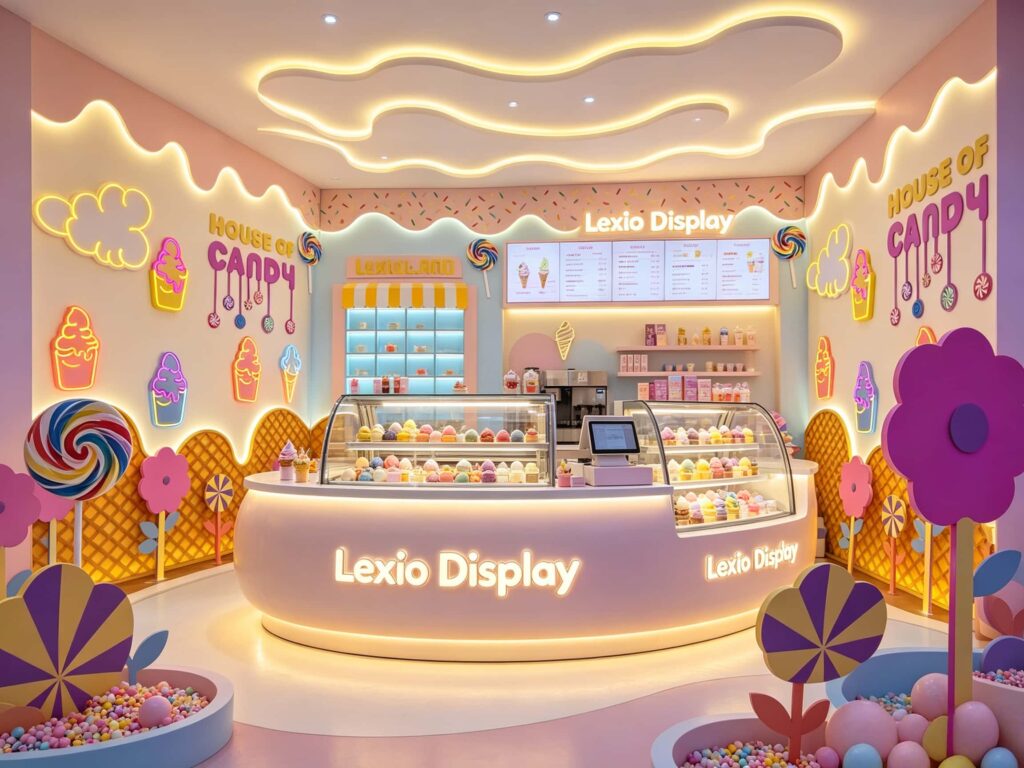
The core counter layout determines if your staff can fulfill an order in 10 seconds
Take a good look at that L-shaped/curved white main counter in the center of the store. It’s totally different from most shops that line everything up against the wall.
What are the operational benefits of this “island-style” layout?
- The staff stands right in the center. From here, they can handle the POS on their left, turn around to dispense soft serve from the machine behind them, and scoop ice cream from the glass display case in front. All actions happen within 1 square meter. During peak hours, this is the key to shortening the queue.
- It perfectly separates the “queuing area” from the “dining area.” Customers crowding at the counter to order won’t disturb the people sitting at the pink booth nearby.
A hidden challenge when buying equipment:
Many people just buy cheap freezers and coolers. But in this project, the hardware investment ratio is actually significant:
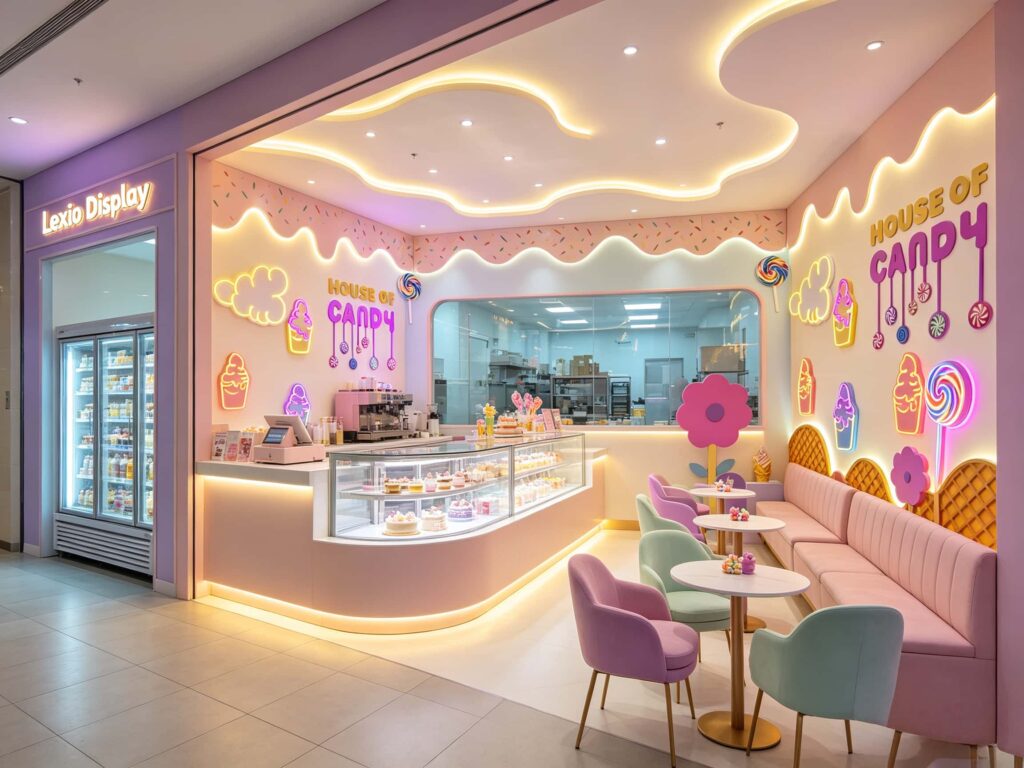
- The row of upright glass-door freezers on the left: These are perfect for pre-packaged tubs or grab-and-go desserts. It’s strongly recommended to buy frost-free air-cooled models from reputable brands. Many cheaper ones use direct cooling and get covered in frost within days. When customers pull the door open and can’t see what’s inside, your sales will tank.
- The curved glass display case on the main counter: Used for displaying various fresh ice cream scoops. It not only needs to cool quickly, but also needs easily removable baffles. Because after closing every day, this whole area needs to be washed with warm water and sanitizer.
How to choose dining chairs to maximize table turnover?
Look at the right side of the store. There’s a long pink ribbed upholstered booth, with yellow and teal molded plastic chairs on the opposite side.
There’s a very subtle business logic here. Ice cream shops are a low-frequency, low-ticket, but high-foot-traffic business.
- The pink upholstered booth: It exists to satisfy customers who “want to sit and chat for a while,” providing a sense of comfort and quality.
- The colored plastic chairs: Absolutely do not choose executive-style chairs or thick sponge dining chairs. These Eames-style plastic chairs are a bit hard. They’re perfectly comfortable for a 15-minute sit, but they get slightly uncomfortable after 40 minutes.
This isn’t about mistreating guests; it’s called “turnover control.” You want guests to finish their scoop and leave, freeing up the table for the next customer waiting in line. Plastic chairs are lightweight, and staff can easily stack them up at closing time to sweep the floor. Also, for our overseas clients: for those small white square tables, absolutely avoid wood veneer. You must use sintered stone or ceramic tabletops. Sugar syrup and water spill on the table daily. The edges of wood veneer or MDF will bubble and rot within two months. Ceramic tops are heavier, but they wipe clean to look brand new instantly.
What B2B pitfalls must you avoid when replicating this design?
Many investors see these candy-colored, high-aesthetic designs and get excited, immediately calling a contractor to start building. But before you commit, I highly recommend you tackle these three tricky points first:
1. Floor drainage and anti-slip (it’s an old cliché, but people still mess this up)
The floor in the picture uses light, matte large tiles, looking very clean. But in reality, melted ice cream and water from cleaning soft-serve machines add up to dozens of liters a day.
- The Danger: If you don’t install linear floor drains right under the counter and beside the freezers, water will flood the entire store. Not only does the floor get sticky and attract ants, but one customer slipping and falling could lead to a massive lawsuit and liability.
- Solution: Before you start any construction, make sure the plumber routes the drainage pipes directly to the base of your equipment.
2. The time gap between construction timeline and equipment delivery
A shop that includes “custom drip ceilings, wood paneling, and hidden lighting” requires many complex steps during the rough-in phase.
- If you are building a store of about 80 square meters, the construction time from finalized design to completion is usually 35 to 45 days.
- The Fatal Mistake: Many beginners start building first and buy machines later. But commercial freezers and ice cream machines require 3 to 4 weeks of lead time from the factory, especially during peak summer seasons. If you finish the renovation but have no machines, you’ll be paying rent and employee salaries while waiting empty for a month. It’s basically burning money.
3. How much budget do you actually need?
Based on current overseas material and labor costs, we can roughly estimate the budget breakdown:
| Core Item | Percentage of Total Investment | B2B Money-Saving Tips |
|---|---|---|
| Custom ceiling + Lighting System | ~25% – 30% | Find a lighting factory that includes installation so the electrician and the carpenter don’t pass the buck to each other. |
| Wood paneling, walls, and flooring | ~20% | You can relax your material standards for wood panels. Environmentally friendly laminates are fine; save your budget for the lighting. |
| Commercial freezers & Ice cream machines | ~35% | This is the top priority. Do not go cheap here. If the compressor breaks, your whole inventory spoils—costing you hundreds of dollars in product loss per day. |
| Custom furniture & Branding/LOGOs | ~15% | Get your glowing lettering and acrylic signs from a local advertising shop. It’s cheaper than buying them through the general contractor. |
Mistakes to Avoid With Candy Theme Ice Cream Shops
We’ve seen a lot of shop owners try this look and get it wrong. Here are the three biggest mistakes to skip.
First, don’t overload every wall. A common mistake is sticking candy decals, neon signs, and stickers on every inch of wall space. It ends up looking messy and cheap, not fun. Leave negative space. Let your key decor pieces breathe.
Second, don’t use the wrong light temperature. Cool white overhead light makes ice cream look dull and makes people look washed out in photos. Stick to 3000K warm white for ambient lighting, and only use cooler light inside display cases if needed for food color accuracy.
Third, don’t sacrifice function for looks. If your display counter is hard for staff to use, if your chairs are uncomfortable, or if your surfaces are hard to clean, you’ll lose money long-term. Looks get people in the door the first time; good operations bring them back.
If you’re getting ready to open a new ice cream shop, or you want to renovate your existing store to stand out from every other dessert spot in your area, we can help. At Lexio Display, we handle the full process: 3D space design, custom display cabinet manufacturing, commercial furniture production, and step-by-step installation guidance.
Every project is tailored to your store dimensions, budget, and brand. Send us your floor plan and a quick note about what you’re looking for, and we’ll send back a free custom layout proposal and detailed quote within 24 hours.