Curved Display Cabinets: A Commercial Buyer’s Guide to Vitrines, Costs & Uses

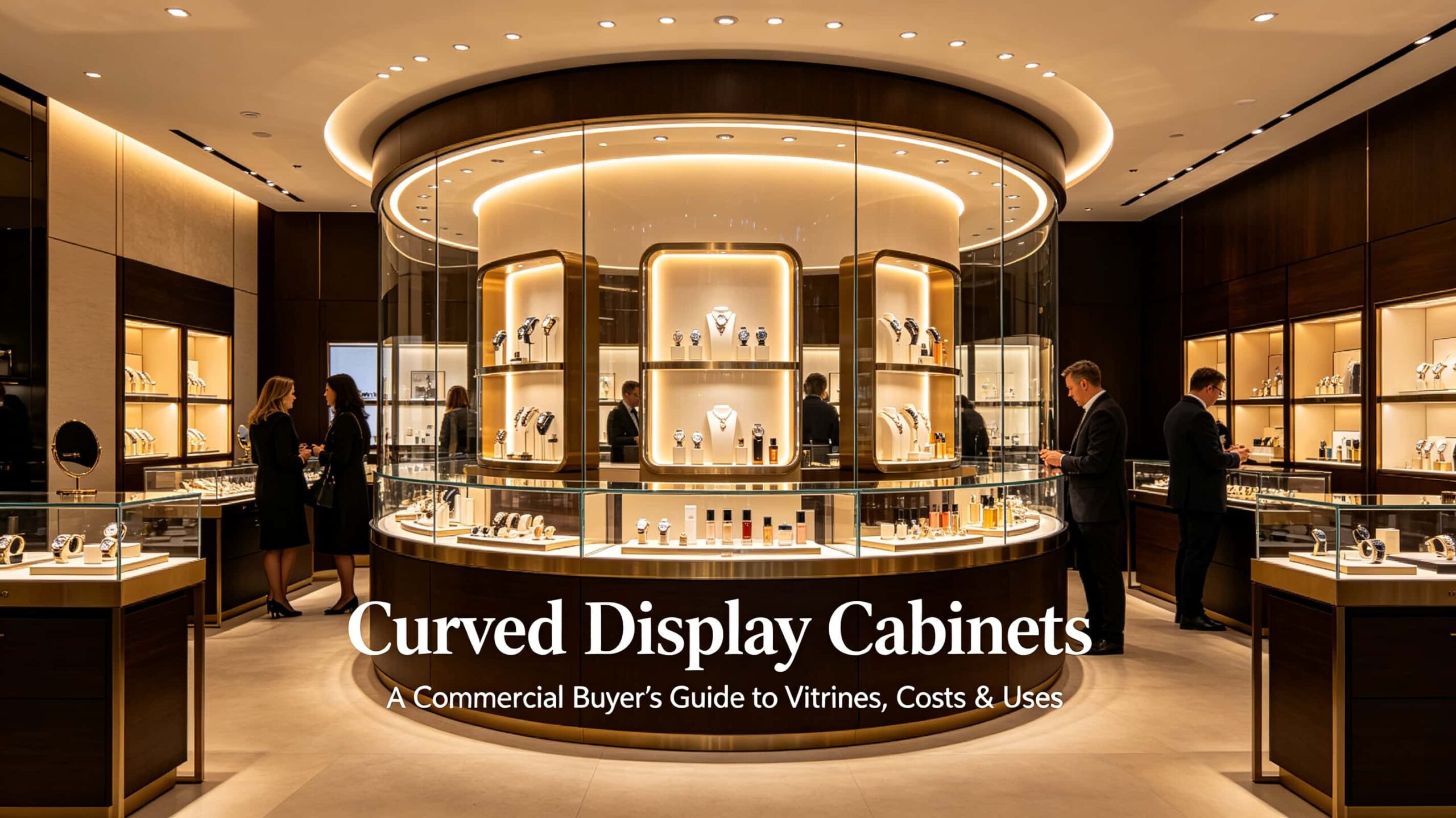
If you run a boutique, jewelry store, or high-end retail space, the furniture you choose does more than hold products—it shapes the entire customer experience. A Curved display cabinet is one of the most effective ways to elevate product presentation, drawing the eye with its seamless glass profile and architectural presence. As a factory-direct manufacturer of commercial display furniture, I’ll walk you through what these cabinets actually are, why they cost what they do, and how to source them without paying distributor markups.
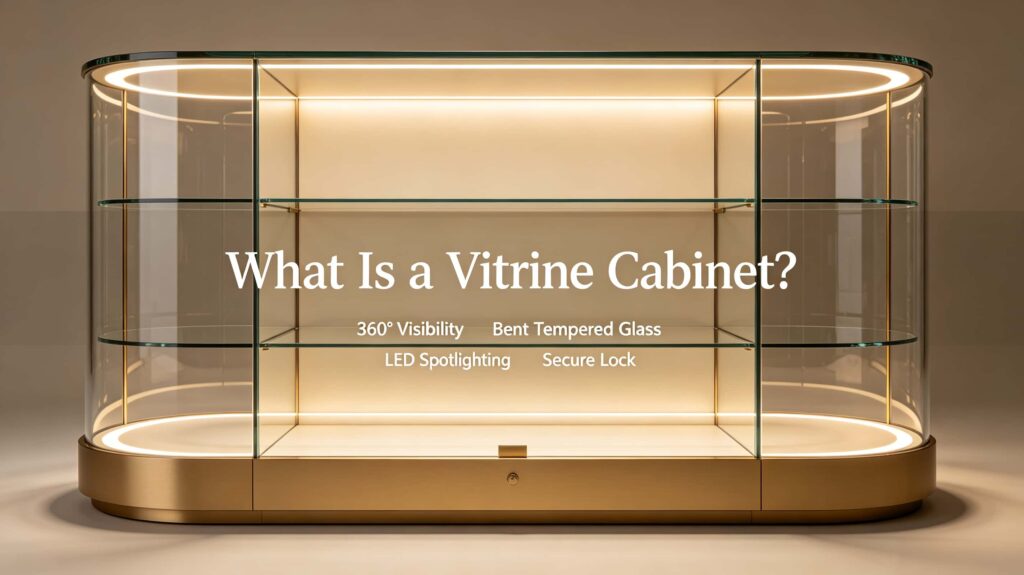
What Is a Vitrine Cabinet?
A vitrine cabinet is a high-end, glass-enclosed showcase designed specifically for luxury retail, museums, or jewelry stores. Unlike standard cabinets, vitrines focus heavily on optimal display, featuring 360-degree tempered glass visibility, LED spotlighting, and secure locking mechanisms to protect valuable goods.
In practice, a commercial curved glass showcase is a specific type of vitrine that uses bent or curved glass panels instead of flat sheets. The curve creates a panoramic viewing angle, eliminating the visual dead zones you get with square corners. This is why luxury watch boutiques and cosmetics stores favour them—the customer can see the product from multiple angles without walking around the unit. When we manufacture these at the factory, the curved glass must be precision-bent in a tempering oven to match the exact radius of the metal or timber base. Any mismatch creates stress points and eventual cracking. A curved vitrine is not a piece you can simply assemble from flat-pack parts; it requires industrial-grade glass processing and a rigid internal frame. For custom retail vitrines, the radius, height, and internal shelving layout are all built to your floor plan, not the other way around.
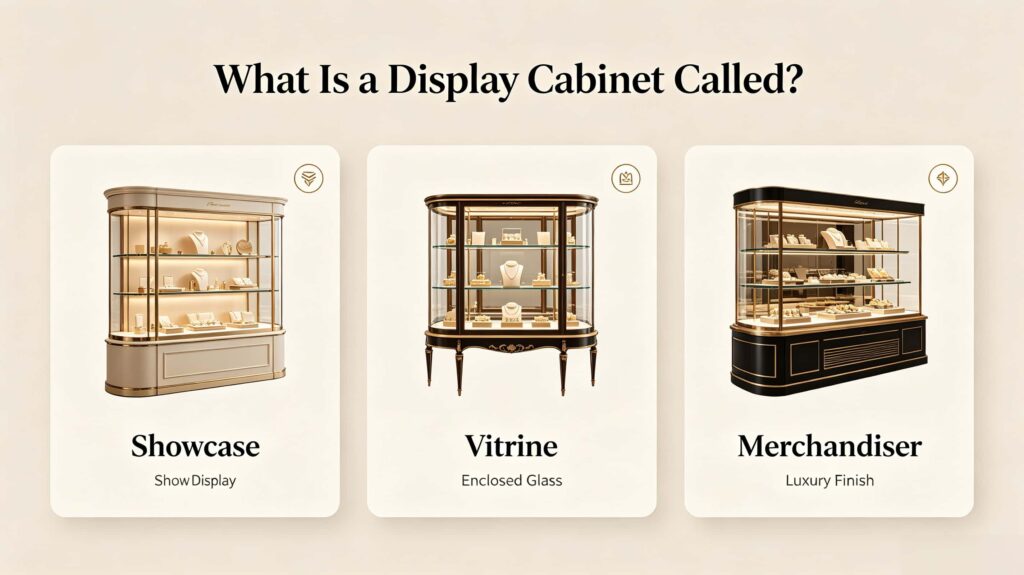
What Is a Display Cabinet Called?
In the commercial industry, display cabinets are widely known as “Showcases,” “Vitrines,” or “Merchandisers.” In high-end retail and galleries, the French term “Vitrine” is preferred, as it implies a premium aesthetic, while “Merchandisers” is commonly used in retail supply chains.
Terminology matters when you are sourcing. If you search for a generic “display cabinet,” you will get thousands of home furniture results that are not built for commercial traffic. Searching for a luxury boutique display cabinet or a commercial curved glass showcase narrows the results to professional suppliers who understand retail durability requirements. From a factory perspective, a “vitrine” usually includes a lockable sliding or hinged glass door, internal lighting, and a sealed base to keep dust out. A “merchandiser,” by contrast, might be open-fronted for self-service retail, without the full glass enclosure. The French term has migrated into English because it communicates a certain level of craftsmanship and finish. When you contact a manufacturer, using the correct term helps us understand immediately whether you need a high-security enclosed case or a more accessible display unit.
What’s the Difference Between a Curio Cabinet and a Display Cabinet?
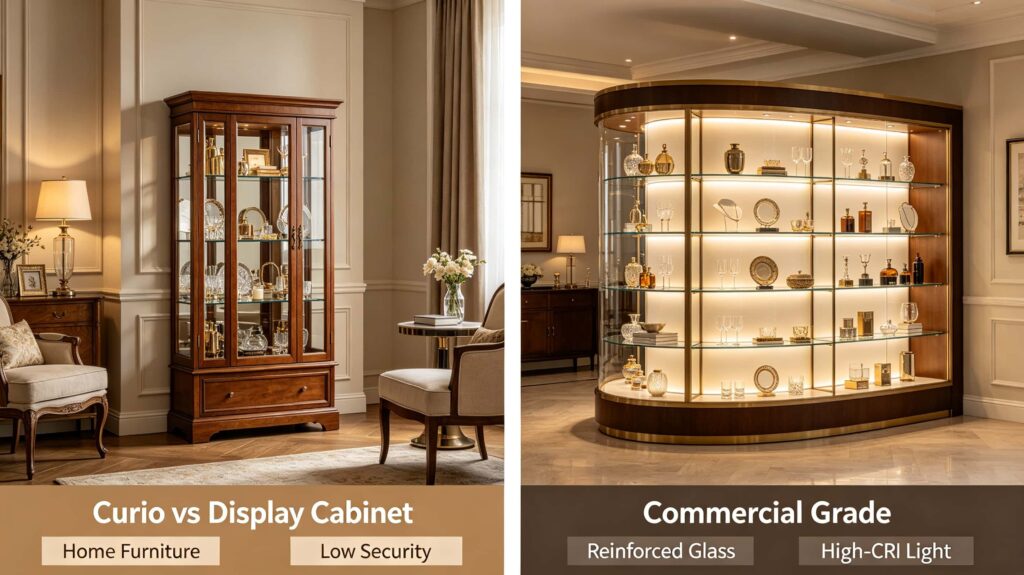
A curio cabinet is a home furniture piece designed to hold personal collectibles, often without commercial-grade security. In contrast, a commercial display cabinet is purpose-built for high-traffic retail, using reinforced tempered glass, anti-theft locks, and professional high-CRI LED lighting to sell products.
This is the most common confusion I see from first-time retail buyers. A curio cabinet from a furniture store might look beautiful in a living room, but it will fail in a boutique within months. The glass is often thinner, the hinges are not designed for hundreds of daily openings, and the finish will scratch easily. A commercial Curved display cabinet is engineered for abuse. The glass is tempered to withstand impacts, the locks are high-security cam or electronic systems, and the internal shelving is reinforced to hold multiple products without sagging. The lighting is another critical difference—home cabinets use warm domestic LEDs, while retail cabinets need high-CRI (Colour Rendering Index) lighting above 90 so that the true colours of your products are accurately represented. A diamond ring or a luxury watch must look exactly as it would in natural daylight, or you will lose sales. That level of lighting specification is simply not present in domestic furniture.
Why Are Glass Display Cabinets So Expensive?
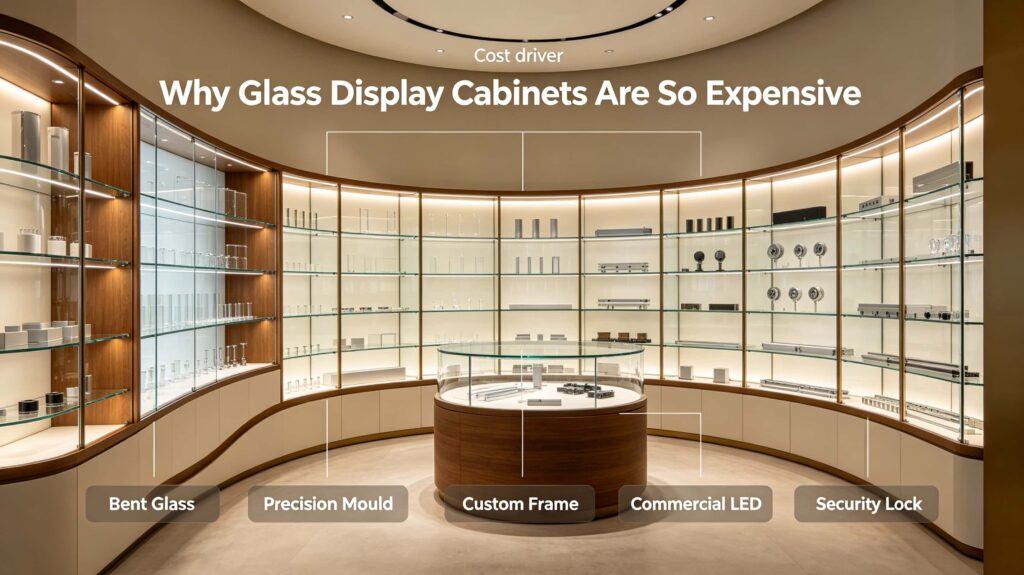
The cost is driven by the materials and craftsmanship. High-grade tempered glass, custom architectural curved metal frames, integrated dimmable LED lighting, and heavy-duty security locks all require precision engineering. Unlike flat-pack DIY cabinets, these are built-to-order for physical retail durability.
When customers receive a quote for a Curved display cabinet and compare it to a flat-pack shelf unit, they often experience sticker shock. Let me break down where the money goes. First, bent tempered glass is expensive to produce. Each panel must be cut, heated to over 600 degrees Celsius, bent over a precision mould, and then rapidly cooled. The rejection rate for curved glass is much higher than for flat sheets because any deviation from the specified radius makes the panel unusable. Second, the metal or timber frame must be fabricated to hold the curved glass perfectly. A square cabinet can hide small alignment errors; a curved cabinet cannot. Third, the integrated lighting system is not an off-the-shelf strip light—it requires custom channels, heat dissipation, and dimmable drivers that comply with commercial electrical standards. Finally, the locking hardware for a luxury boutique display cabinet is not a cheap cam lock. It often includes anti-pick mechanisms, alarm contacts, or electronic keypads. All of this adds up to a product that should last 15 to 20 years in a busy retail environment. If a supplier quotes you a price that seems too good to be true, they are likely cutting corners on glass thickness or using domestic-grade components.
Where Can I Buy a Commercial Curved Display Cabinet?
The best source is a specialized B2B commercial display manufacturer. Buying factory-direct allows you to bypass local distributors. Most reputable factories offer 3D design layout services, ensuring the curved case fits your exact boutique floor plan before manufacturing begins.
Many Australian and international retail buyers assume they need to work through a local shopfitting company. The reality is that most of those companies are simply importing from factories like ours and adding a 40-70% margin. By sourcing factory direct display cabinets, you eliminate that intermediary entirely. The process is straightforward: you send us your store floor plan, the dimensions of the space where the cabinet will sit, and the types of products you intend to display. Our design team produces a 3D rendering showing the custom retail vitrines placed in your actual layout. You review the design, request changes to shelf heights, glass radius, or finish colour, and we adjust until you are satisfied. Only then do we begin manufacturing. This direct communication prevents the costly misunderstandings that happen when messages are relayed through a distributor. It also means you can speak directly to the engineer responsible for the glass bending and frame welding, which is invaluable if you have a complex corner or an unusual store layout.
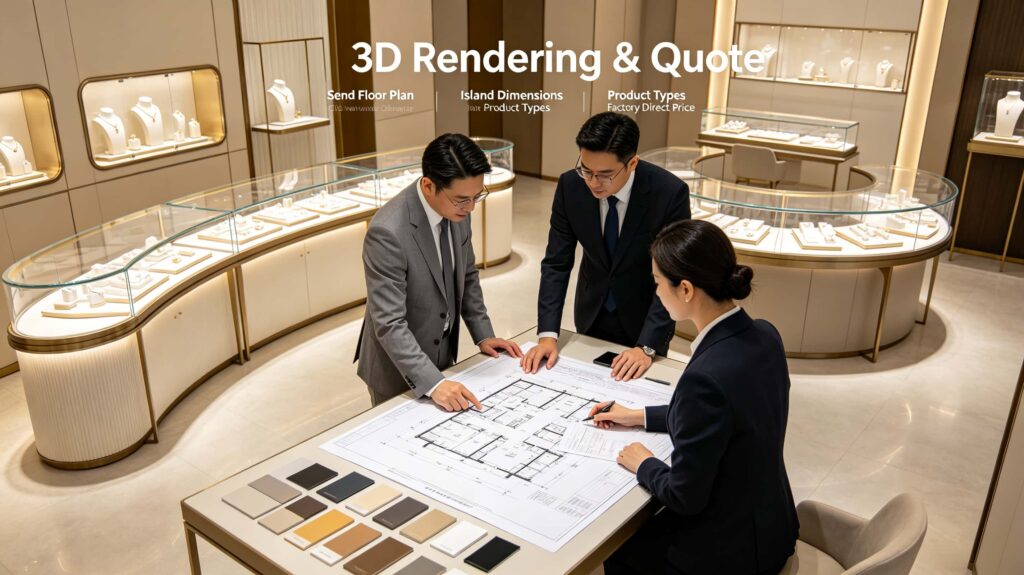
Ready to source your Curved display cabinet directly from the factory floor? Send us your store floor plan, the available wall or island dimensions, and a brief description of the products you sell. Our in-house design team will create a 3D rendering and a transparent factory quote for your commercial curved glass showcase project. You deal directly with the manufacturing team that bends the glass and welds the frames—no agents, no distributor fees, no hidden markups. Contact us today and get your custom production drawings within five business days.