Curved Tempered Glass Display Cabinet: A Complete B2B Cost & Material Guide

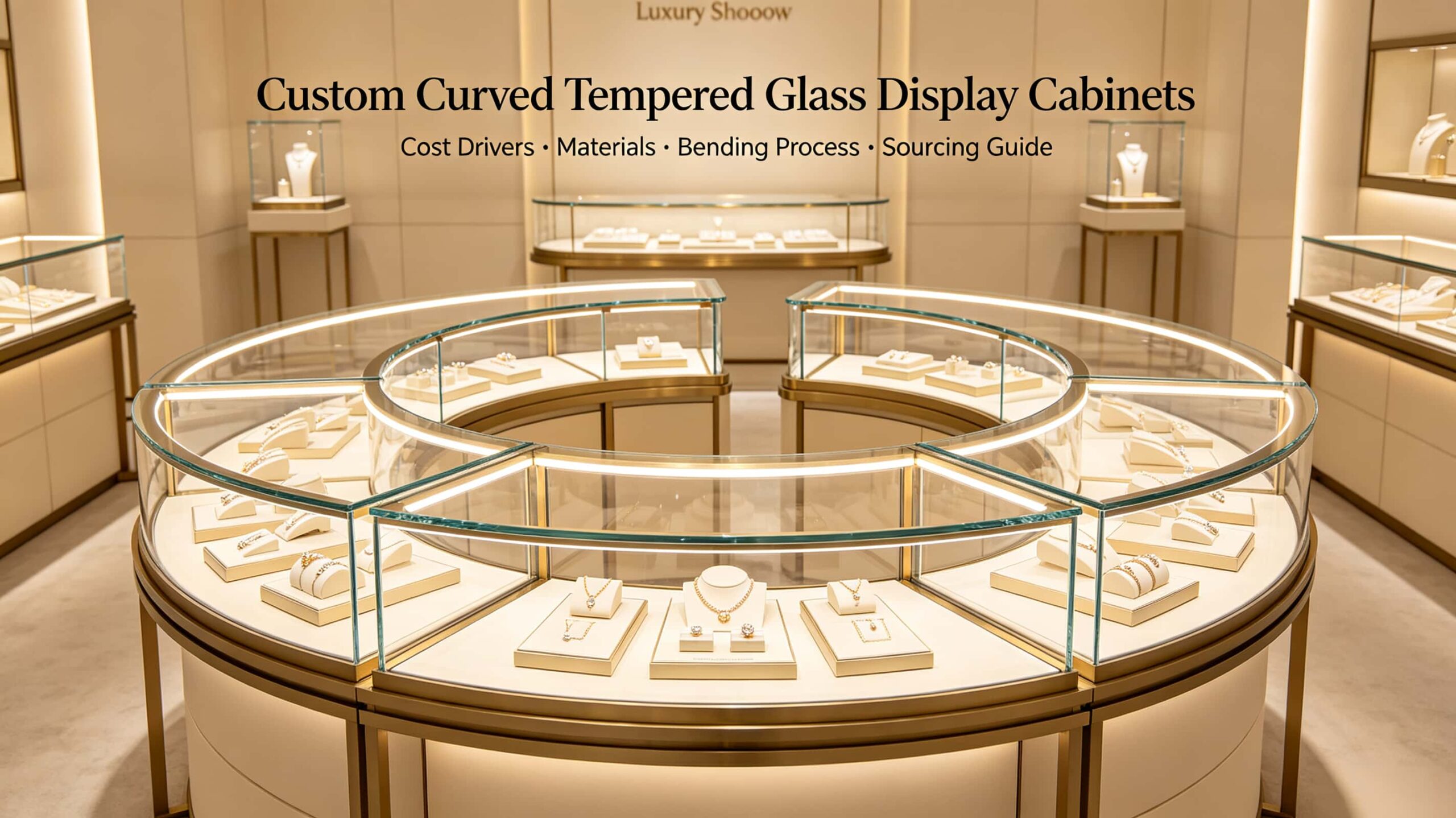
Custom curved tempered glass display cabinets cost $1,500–$5,000+ because tempered glass, precision metal frames, integrated LED systems, and custom hot-bending each add significant material and labor expenses that generic flat-glass cases simply don’t carry.
If you’re sourcing display fixtures for retail stores, jewelry showrooms, museums, or luxury brand environments, you’ve probably noticed that curved glass cabinets come with a price tag that makes standard rectangular cases look cheap. There’s a reason for that — and understanding exactly where your money goes is the first step toward negotiating a fair price and choosing the right bent glass showcase manufacturer.
This guide breaks down every cost driver, material decision, and sourcing strategy you need to make a confident B2B purchasing decision. No fluff, no vague estimates — just the numbers and specifications that matter.
Why Are Glass Display Cabinets So Expensive?
Glass display cabinets are expensive because tempered glass alone costs 3–5x more than annealed glass, and when you add precision-welded metal frames, integrated LED lighting systems, and the custom bending process, you’re paying for engineering — not just materials. A single custom cabinet can easily exceed $3,000.
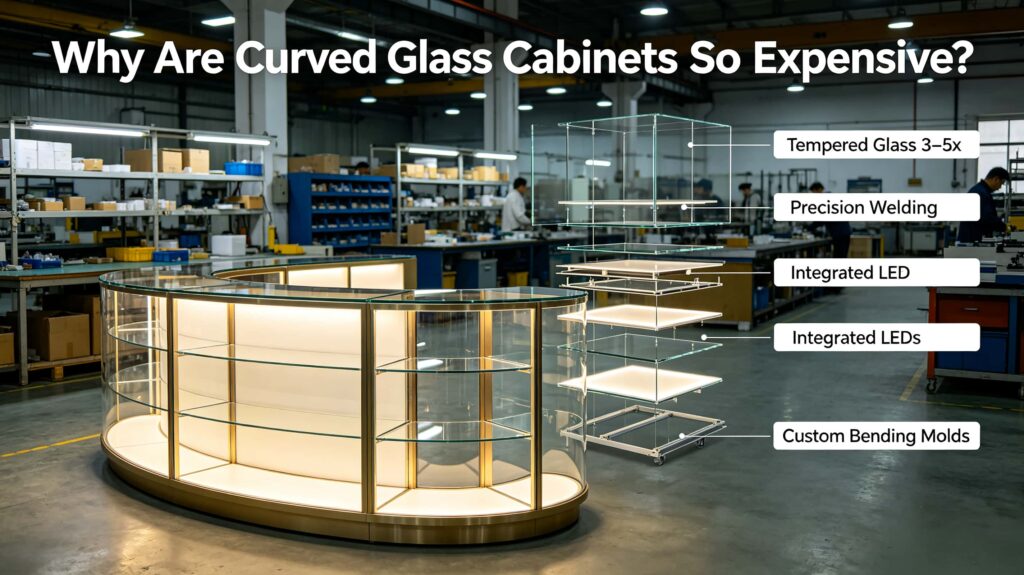
Let’s unpack each cost layer so you can see exactly where your budget is going.
Tempered Glass: The Non-Negotiable Safety Requirement
Every commercial curved glass display must use tempered glass. Period. Annealed glass shatters into dangerous shards — a liability nightmare in any public retail space. Tempered glass breaks into small, blunt granules that won’t cut customers.
But tempering isn’t cheap:
- Heat treatment: Glass must be heated to 600–700°C and rapidly cooled, which requires specialized furnace equipment.
- Size limitations: Tempering lines have maximum dimensions. Oversized curved panels may need special handling.
- Failure rate: Tempered glass has a 2–5% spontaneous breakage rate due to nickel sulfide inclusions. Manufacturers build this waste into pricing.
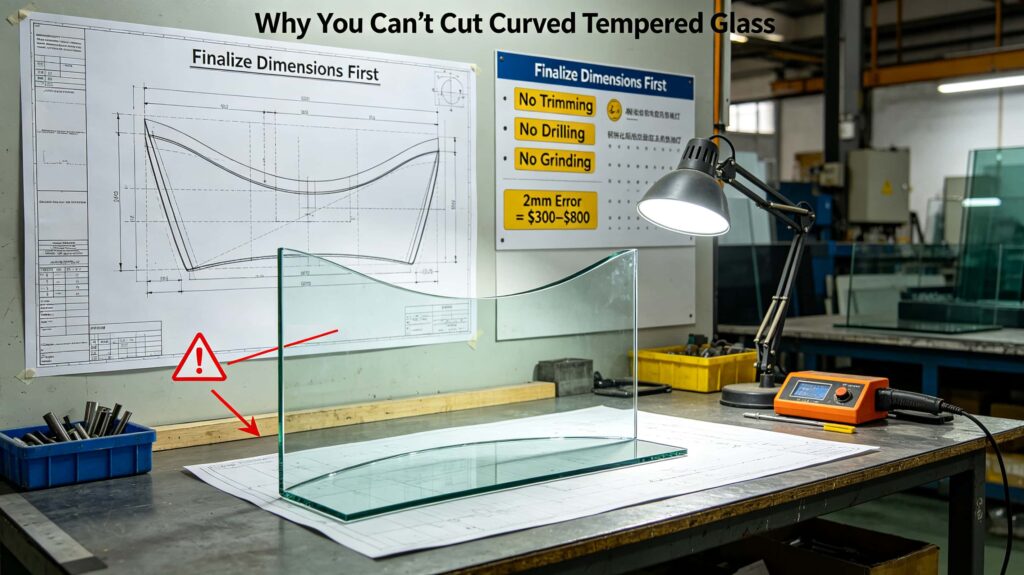
- No post-processing: Once tempered, the glass cannot be cut, drilled, or edge-polished. Every dimension must be perfect before tempering begins.
Metal Frames: Where Precision Meets Labor Cost
The frame isn’t just a skeleton — it’s a structural system that must hold heavy glass panels at precise angles while hiding wiring for lighting.
| Frame Material | Cost Level | Best For | Weight |
|---|---|---|---|
| Aluminum alloy | $$ | Most retail displays | Light |
| Stainless steel (304) | $$$ | Luxury brands, high-traffic | Heavy |
| Brass/copper | $$$$ | Premium jewelry, antiques | Heavy |
| Powder-coated steel | $ | Budget commercial | Medium |
Aluminum is the workhorse for most commercial curved glass display units. It’s lightweight, corrosion-resistant, and can be extruded into complex profiles. Stainless steel costs 40–60% more but delivers a premium feel that luxury brands demand.
The real cost driver? Welding, grinding, and polishing. A single curved frame joint may take 2–3 hours of skilled labor to perfect. Multiply that by 8–12 joints per cabinet.
LED Lighting: The Hidden Cost Center
Modern display cabinets integrate LED strips into frame channels, shelves, and base panels. Here’s what that adds:
- High-CRI LEDs (90+): Essential for accurate color rendering. Cheap LEDs make merchandise look dull.
- Heat management: LEDs generate heat. Without proper aluminum heat sinks, glass can crack.
- Wiring and drivers: Concealed wiring runs through hollow frame sections. Drivers must be remotely mounted or ventilated.
- Dimming and controls: Touch sensors, remote dimming, and programmable scenes add $150–$400 per unit.
Custom Bending: The Single Biggest Cost Multiplier
Flat glass is cheap. Curved glass is not.
The bending process requires:
- Custom steel molds (one per curve radius)
- Slow heating cycles (4–8 hours)
- Controlled gravity or press bending
- Annealing and cooling (another 6–12 hours)
- Secondary tempering (if not done inline)
A single mold can cost $500–$2,000 depending on complexity. For a one-off custom cabinet, that mold cost gets absorbed into your unit price. For production runs of 50+ units, the mold cost amortizes nicely.
Factory insider tip: Always ask your supplier whether the bending mold is new or existing. If they already have a mold matching your curve radius, you can save 15–25% on tooling.
Can Tempered Glass Be Curved?
Yes, but only before tempering. Glass is first cut to size, edge-polished, then hot-bent in a furnace, and finally tempered. Once tempered, curved glass absolutely cannot be cut, drilled, or modified — attempting to do so causes immediate shattering.
This is the single most important thing to understand about custom curved tempered glass display cabinet manufacturing.
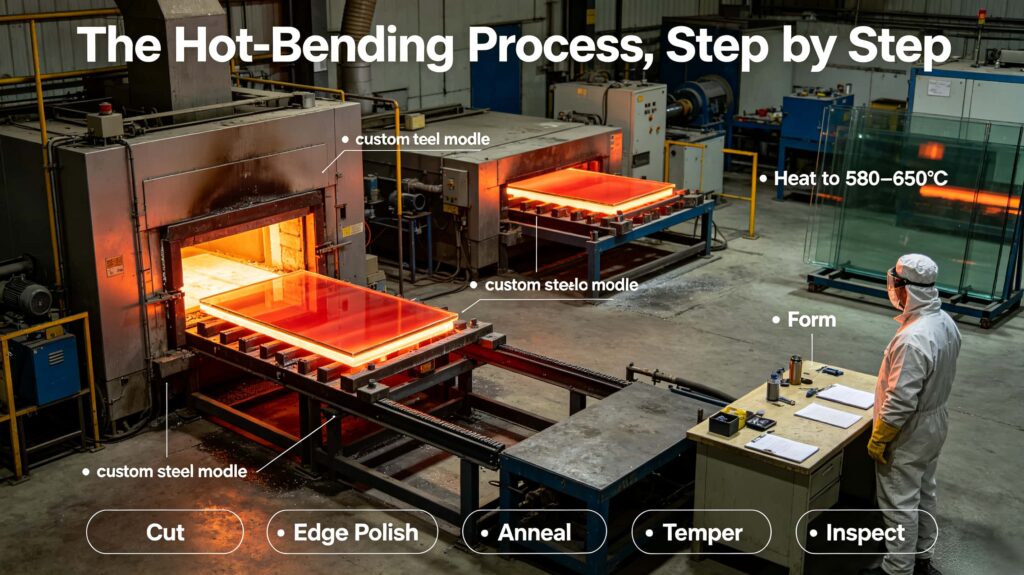
The Hot-Bending Process, Step by Step
Here’s how raw float glass becomes a precision curved panel:
- Cutting: Large glass sheets are cut to rough dimensions using CNC cutting tables.
- Edge processing: Edges are ground and polished to prevent stress fractures during bending.
- Cleaning: Any dust, oil, or contamination causes bubbles or haze during bending.
- Heating: Glass is placed on a custom steel mold and heated to 580–650°C in a bending furnace.
- Forming: Gravity causes the glass to sag into the mold shape. For tighter radii, press-bending with a male mold is used.
- Annealing: Slow controlled cooling prevents internal stress.
- Tempering: The curved glass is reheated to 600–700°C and rapidly air-quenched.
- Quality inspection: Optical distortion, radius tolerance, and surface quality are checked.
Why You Can’t Cut Curved Tempered Glass
This point deserves its own section because it’s where many buyers get burned.
Tempered glass exists in a state of balanced internal stress. The surface is in compression; the core is in tension. Cutting, drilling, or grinding breaks that balance — and the glass explodes into thousands of tiny pieces.
What this means for your project:
- Every dimension must be finalized before production.
- You cannot “trim” a curved panel that’s slightly too large.
- You cannot add a hole for a lock or cable after tempering.
- Changes after tempering = complete re-manufacture.
Factory insider tip: Always request a full-size CAD drawing approval before your bent glass showcase manufacturer cuts any glass. A 2mm error on a flat panel is fixable. A 2mm error on a curved tempered panel is a $300–$800 mistake.
How Much Does Curved Tempered Glass Cost?
A single curved tempered glass panel starts around $100, but a complete custom curved glass display cabinet typically runs $1,500–$5,000+, with luxury or oversized units exceeding $10,000. The gap between panel cost and cabinet cost comes from frames, lighting, hardware, and assembly.
Let’s break this down with real numbers.
Curved Tempered Glass Panel Pricing
| Panel Size | Thickness | Curve Radius | Estimated Cost |
|---|---|---|---|
| 300 x 300mm | 6mm | 300mm | $80–$120 |
| 500 x 500mm | 8mm | 500mm | $150–$250 |
| 800 x 600mm | 10mm | 800mm | $300–$500 |
| 1200 x 800mm | 10mm | 1000mm+ | $500–$900 |
| 1500 x 1000mm+ | 12mm | Custom | $900–$2,000+ |
These are factory-direct prices. Through a distributor or trading company, expect 30–50% markup.
Full Cabinet Pricing Breakdown
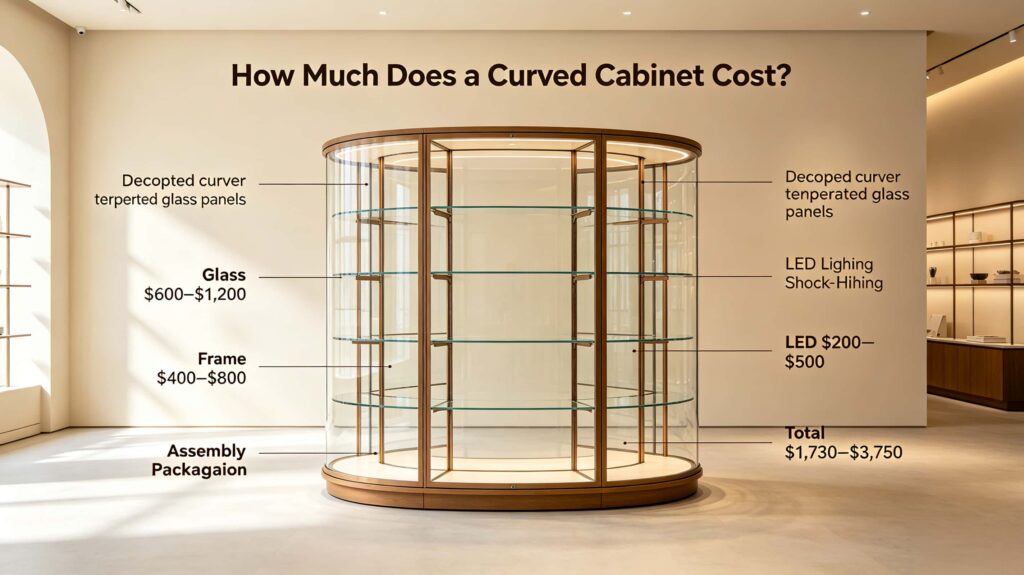
Here’s a realistic cost structure for a mid-range commercial curved glass display (approximately 1200mm wide x 600mm deep x 1800mm tall):
| Component | Cost Range | % of Total |
|---|---|---|
| Curved tempered glass panels (4–6 pieces) | $600–$1,200 | 30–35% |
| Metal frame (aluminum, powder-coated) | $400–$800 | 20–25% |
| LED lighting system | $200–$500 | 10–15% |
| Shelving (glass or metal) | $150–$400 | 8–12% |
| Locks, hinges, hardware | $100–$250 | 5–8% |
| Assembly labor | $200–$400 | 10–12% |
| Packaging (export-grade) | $80–$200 | 4–6% |
| Total | $1,730–$3,750 | 100% |
What Pushes a Cabinet Above $5,000?
- Oversized dimensions: Anything above 1800mm tall or 1200mm wide
- Low-iron ultra-clear glass: 20–40% premium over standard float glass
- Anti-reflective coating: $80–$150 per square meter
- Stainless steel or brass frames: 2–3x aluminum cost
- Motorized or rotating bases: $500–$1,500 added
- Museum-grade climate control: $1,000+ added
- Low volume (1–5 units): No economies of scale
Factory insider tip: Ordering 10+ units typically reduces per-unit cost by 18–30%. If you’re furnishing multiple retail locations, consolidate into one purchase order.
Which Tempered Glass Is Best for a Curved Display?
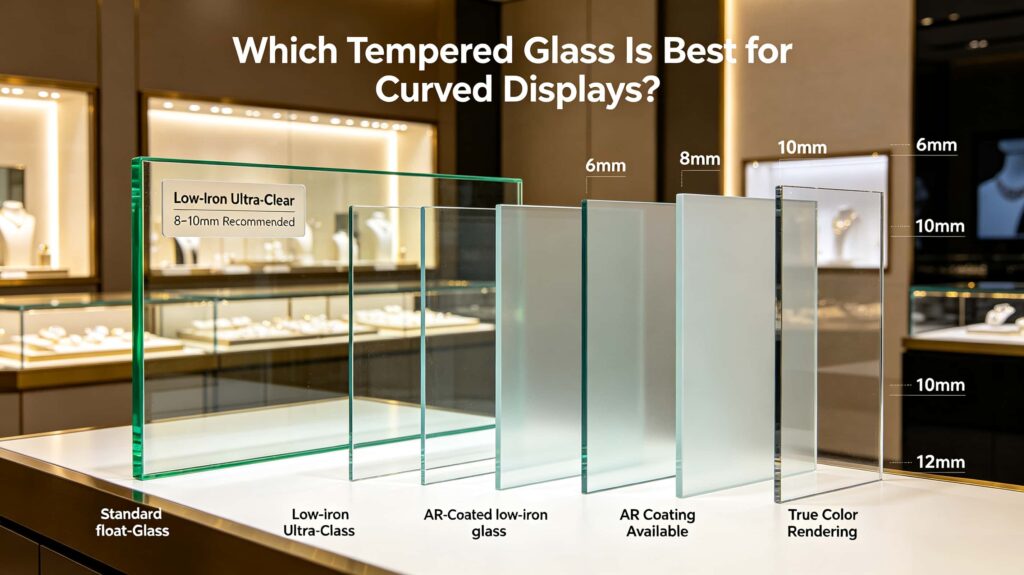
Low-iron ultra-clear glass in 8–10mm thickness with an optional anti-reflective coating delivers the best optical clarity, structural strength, and color fidelity for commercial curved glass display. Standard float glass has a green edge tint that distorts luxury merchandise colors.
Let’s compare your options.
Glass Type Comparison
| Glass Type | Clarity | Edge Color | Cost Premium | Best Application |
|---|---|---|---|---|
| Standard float | Good | Green | Baseline | Budget retail |
| Low-iron ultra-clear | Excellent | Crystal clear | +20–40% | Jewelry, luxury goods |
| AR-coated low-iron | Superior | Clear | +50–80% | Museums, high-end watches |
| Frosted/acid-etched | Diffused | N/A | +15–25% | Privacy displays |
| Tinted (grey/bronze) | Reduced | Dark | +10–20% | UV-sensitive items |
Why Low-Iron Glass Matters
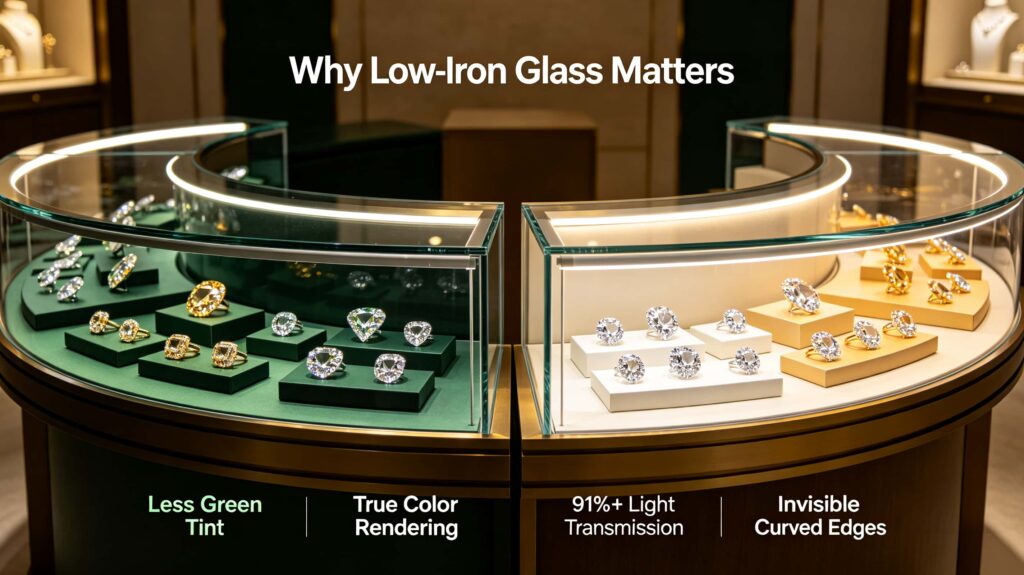
Standard float glass contains iron oxide, which gives it a noticeable green tint — especially visible on thick panels and curved edges. For a jewelry display, that green cast makes diamonds look yellow and gold look dull.
Low-iron glass reduces iron content to below 0.01%, delivering:
- True color rendering: Diamonds sparkle white; gold looks warm.
- Invisible edges: Curved corners disappear, making merchandise appear to float.
- Better light transmission: 91%+ vs. 89% for standard glass.
Thickness Recommendations
- 6mm: Small countertop displays only. Not recommended for floor-standing units.
- 8mm: Good balance of weight and strength. Suitable for most retail cabinets up to 1500mm tall.
- 10mm: Ideal for large commercial curved glass display units. Better impact resistance and less optical distortion.
- 12mm+: Oversized or high-security applications. Heavy and expensive.
Anti-Reflective (AR) Coating: Worth It?
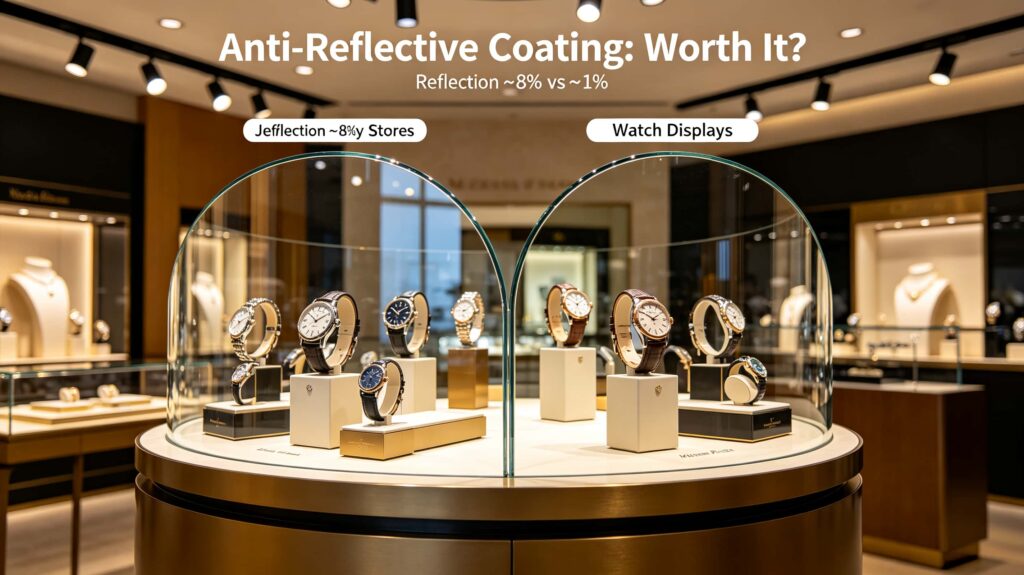
AR coating reduces surface reflections from ~8% to ~1%. In a brightly lit retail environment, this is the difference between seeing the merchandise and seeing yourself.
When AR coating pays off:
- Jewelry stores with overhead spotlights
- Watch displays with detailed dials
- Museum pieces requiring photography
- Any display facing windows
When to skip it:
- Budget-focused projects
- Dark merchandise on dark backgrounds
- Displays in low-light environments
Factory insider tip: AR coating must be applied before the bending process. If your supplier quotes AR coating after bending, they’re either outsourcing or cutting corners. Ask for the coating specification sheet.
Where Can I Buy a Custom Curved Glass Display Cabinet?
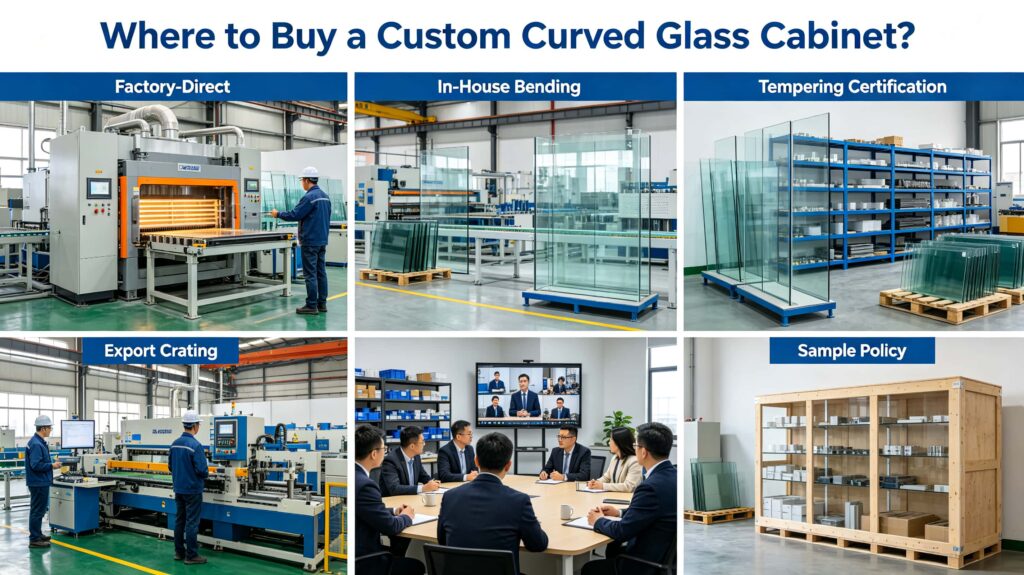
Buy factory-direct from a bent glass showcase manufacturer. Trading companies add 30–50% markup without adding value. Factory-direct sourcing gives you direct access to engineering support, mold customization, quality control, and significantly better pricing on volume orders.
Here’s how to source smart.
Factory-Direct vs. Trading Company
| Factor | Factory-Direct | Trading Company |
|---|---|---|
| Price | Baseline | +30–50% |
| Customization | Full engineering support | Limited to catalog options |
| Communication | Direct with engineers | Relay through sales reps |
| Lead time | 25–40 days | 35–55 days |
| Quality control | In-house | Variable |
| Mold ownership | You can own/retain | Usually not disclosed |
| After-sales | Direct replacement parts | Often outsourced |
What to Look for in a Manufacturer
- In-house bending furnace: Not outsourced. Ask for a video tour.
- Tempering certification: EN 12150, ANSI Z97.1, or GB 15763.2.
- Existing mold library: Reduces your tooling cost.
- Export experience: Proper crating prevents 90% of shipping damage.
- Sample policy: Reputable factories provide paid samples (expect $200–$500 for a mini cabinet).
Questions to Ask Before Ordering
- What is your monthly production capacity for curved tempered glass?
- Can you provide a 3D rendering before production?
- What is your policy on breakage during shipping?
- Do you offer installation hardware and instructions?
- What is the lead time for a 10-unit order?
Factory insider tip: Request a video call walking through the production floor. If they hesitate, walk away. Legitimate manufacturers are proud to show their bending furnaces and tempering lines.
FAQ: Curved Tempered Glass Display Cabinets
Why are glass display cabinets so expensive?
Glass display cabinets are expensive because tempered glass costs 3–5x more than standard glass, metal frames require precision welding, LED lighting adds electrical components, and custom bending demands expensive molds and slow furnace cycles. A single cabinet combines multiple trades — glass, metal, electrical — into one finished product.
Can tempered glass be curved?
Yes, but only before tempering. The glass is cut, polished, hot-bent in a furnace over a custom mold, and then tempered. Once tempered, curved glass cannot be cut, drilled, or modified in any way — attempting to do so causes immediate and complete shattering.
How much does curved tempered glass cost?
A single curved tempered glass panel starts around $100. A complete custom curved glass display cabinet runs $1,500–$5,000+, depending on size, glass type, frame material, and lighting. Oversized or museum-grade units can exceed $10,000 per cabinet.
Which tempered glass is best for a curved display?
Low-iron ultra-clear glass in 8–10mm thickness is best. It eliminates the green tint of standard glass, provides excellent structural strength, and renders merchandise colors accurately. Adding an anti-reflective coating further improves clarity in brightly lit retail environments.
Where can I buy a custom curved glass display cabinet?
Buy factory-direct from a bent glass showcase manufacturer. Factory-direct sourcing eliminates 30–50% trading company markup, gives you direct engineering support, and ensures quality control. Always request a 3D rendering and production video before committing to a large order.
Ready to Build Your Custom Curved Glass Display Cabinet?
Stop guessing at prices. Stop accepting trading company markups. Stop settling for flat glass when your merchandise deserves a curve.
Here’s what we offer:
- 3D design renderings based on your floor plan
- Factory-direct pricing with no middleman markup
- In-house hot-bending and tempering for full quality control
- Low-iron ultra-clear glass as standard (not an upgrade)
- Export-grade packaging with breakage guarantee
- 25–40 day lead times for most custom orders
Send us your floor plan today and receive a complete 3D design plus a detailed quote within 48 hours.
Whether you need a single statement piece for a flagship store or 200 units for a national retail rollout, we have the bending furnaces, the mold library, and the engineering team to deliver.
Email your floor plan now. Let’s turn your display concept into a curved glass reality.