How to Make Your Exhibition More Interesting: 2026 Trends & Custom Displays

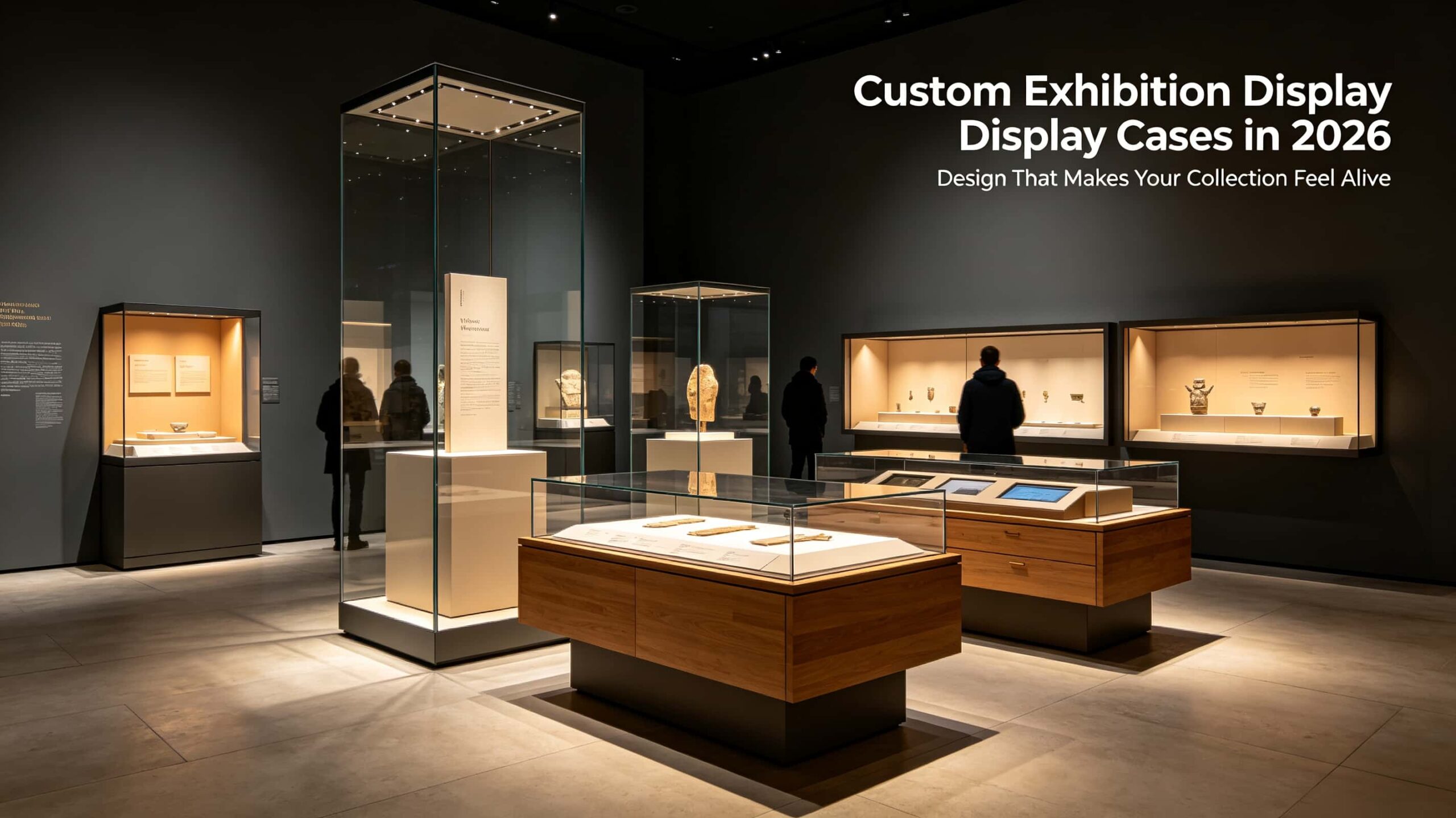
In 2026, exhibitions succeed when custom exhibition display cases, layered lighting, and interactive rhythm replace static rows. This guide shares practical trends, creative setup ideas, and factory-level tips to make your gallery or museum space feel alive and worth lingering in.
If you have been walking through exhibitions that feel flat, the problem is rarely the collection. It is the physical frame around it. I have worked with galleries and museums across different regions, and the same mistakes come up again and again: identical case heights, harsh spotlights, no pause points, and display fixtures that fight the art instead of supporting it. This article will fix that. You will learn what museum display case trends 2026 are actually worth following, how to build creative exhibition setups on a realistic budget, and what to ask display case manufacturers for galleries before you commit.
What are the key exhibition design trends for 2026?
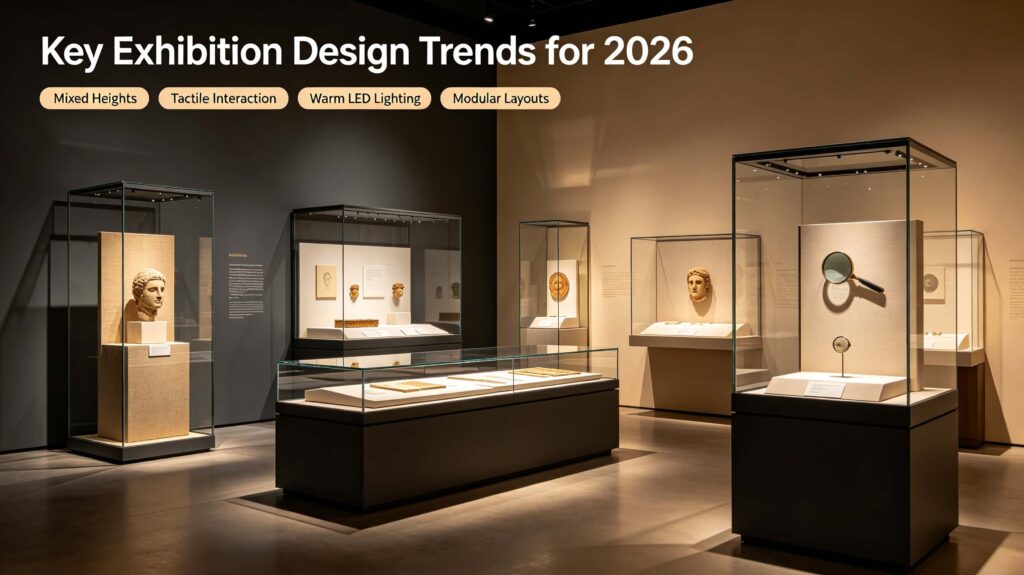
The big shift in 2026 is away from technology for its own sake and back toward physical presence. Museums and galleries are investing in custom exhibition display cases that feel like part of the story, not glass boxes dropped into a room. The most successful spaces now combine low-energy accent lighting, mixed heights, tactile surfaces, and modular layouts that can change without a full rebuild.
Sustainability is no longer optional
In 2026, visitors notice materials. Powder-coated steel, FSC-certified timber, recycled acrylic, and low-VOC finishes are becoming standard in custom gallery display fixtures. If your cases look disposable, the whole exhibition feels cheap.
- Use aluminium extrusions with recycled content for frames.
- Specify low-iron glass that transmits light without heavy coatings.
- Choose LED strips under 3000K for warm, gallery-friendly tones.
- Ask for modular end panels that can be reused for the next show.
Mixed heights and sightline choreography
One of the clearest museum display case trends 2026 is the end of uniform rows. When every case is 900mm tall, the eye glides past. Breaking height creates visual rhythm.
- Place a 1500mm vertical vitrine beside a low table case.
- Use plinths inside larger cases to lift small objects.
- Install overhead suspension cases for lightweight textiles.
- Avoid blocking the main sightline from the entrance.
Low-tech interactivity is returning
Not every interactive element needs a screen. In fact, screens often shorten dwell time. The best creative exhibition setups in 2026 use mechanical, tactile, and spatial interaction.
- Lift-up flaps with printed questions.
- Pull-out drawers with replica objects.
- Magnifying lenses mounted on case frames.
- Smell boxes with controlled scent wicks.
Lighting as a storytelling tool
Lighting is finally being treated as part of the exhibit. Instead of flooding a case with light, designers use pools of light, shadow corners, and slow fades that guide attention.
- Use 15–20 degree narrow beams for small artefacts.
- Put light strips below objects for a floating effect.
- Use dark backgrounds to increase perceived brightness.
- Avoid exposed bulbs; always hide the source.
How can I make my exhibition more interesting?
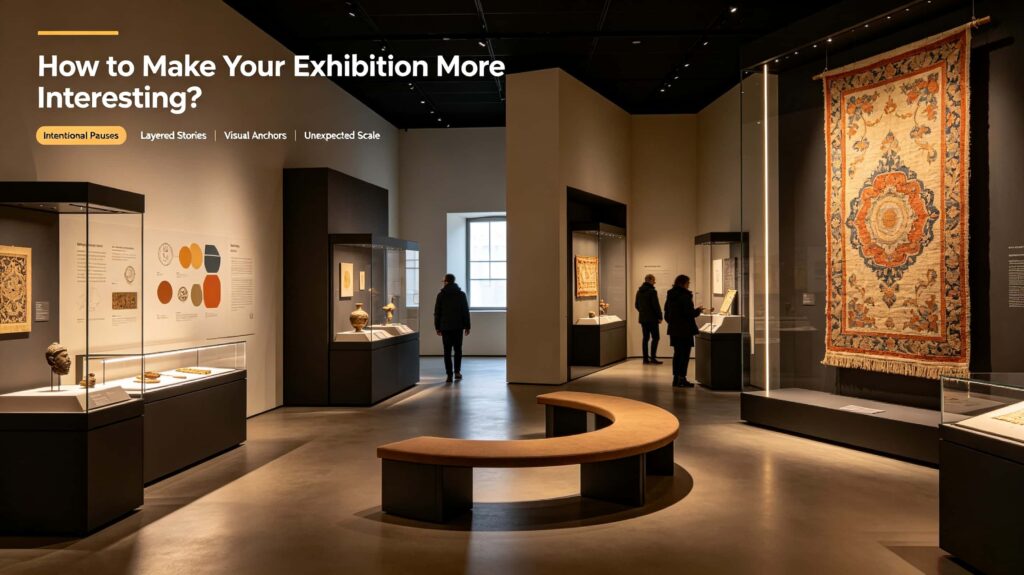
The fastest way to make an exhibition interesting is to change the pace. Give visitors a reason to stop, lean in, and move sideways instead of walking a straight line. This is not about more content. It is about how the content sits in space. Custom exhibition display cases, when placed with intent, create these pauses naturally.
Build a path with intentional friction
A long, open room feels like a corridor. You want gentle friction: a change in floor level, a half wall, a shifted case angle. That friction makes people slow down.
- Rotate one case 10 degrees off the grid.
- Add a freestanding wall with a cutout window.
- Use floor tape or carpet inlays to define sub-zones.
- Place a tall case directly in the sightline, forcing a turn.
Layer interpretation without clutter
Labels and text panels are not the only way to explain. Layering interpretation means putting different depths of information in different places, so visitors can choose how much to read.
- Keep primary labels under 30 words.
- Put deeper stories in pull-out trays.
- Use graphic panels behind the object for context.
- Record 60-second audio clips accessible via QR code.
Use custom gallery display fixtures as visual anchors
Custom gallery display fixtures do more than hold objects. They can act as landmarks. A well-designed fixture with a distinctive colour, curved profile, or integrated bench becomes a memorable point in the room.
- Use a curved bench with integrated case at the centre.
- Choose one accent colour for key fixtures.
- Add a recessed niche in a wall for a single spotlight object.
- Combine seating with display to keep people in the room.
Trigger memory with unexpected scale
People remember what surprises them. A miniature object in a huge case, or a massive object in a tight, intimate case, changes how the brain processes the object.
- Place one tiny artefact in a 2-metre-tall case with dark backing.
- Suspend a large textile within a narrow shaft of light.
- Use an oversized plinth for a small bronze sculpture.
- Pair a monumental case with a very small bench.
What are the different types of exhibition design?
Exhibition design falls into a few practical categories. Permanent and temporary spaces need different case choices. Retail-gallery hybrids, pop-ups, and immersive environments all sit under the same umbrella but demand different custom exhibition display cases and fixture strategies. Knowing which type you are working with will save you from buying the wrong system.
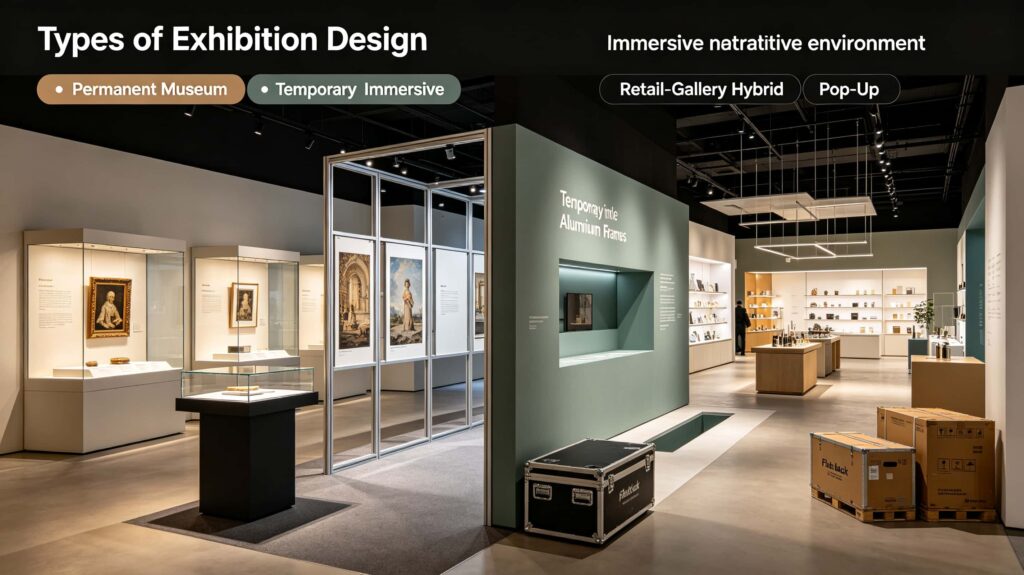
Permanent museum exhibitions
These are built to last five to ten years. Materials must handle daily wear, UV exposure, and repeated cleaning. Conservation-grade seals, stable humidity chambers, and lockable access panels are non-negotiable.
Temporary or rotating exhibitions
Temporary shows change every three to nine months. Lightweight modular cases, tool-free assembly, and reusable plinths matter more than heavy permanent structures. These spaces often use creative exhibition setups with mixed media and changing graphics.
Immersive or narrative environments
Immersive design wraps the visitor in a story. Walls, floor, sound, and scent all work together. Display cases here may be embedded into false walls, floor pits, or ceiling drops. The case is never a separate object.
Retail-gallery hybrid spaces
These spaces sell while they exhibit. Custom gallery display fixtures here combine secure storage, open shelving, and visible price points. Lighting is warmer, and cases often include integrated transaction counters or lockable drawers.
Pop-up and travelling exhibitions
Pop-ups need flat-pack cases, quick assembly, and damage-resistant finishes. They often operate in non-climate-controlled venues, so silica gel compartments and gasketed doors become essential.
| Exhibition type | Typical lifespan | Display case priorities | Best fixture approach |
|---|---|---|---|
| Permanent museum | 5–10 years | Conservation seals, high security | Built-in wall cases, fixed plinths |
| Temporary exhibition | 3–9 months | Modular panels, quick swap graphics | Reusable aluminium frames |
| Immersive environment | 1–3 years | Embedded cases, integrated lighting | False walls, floor recesses |
| Retail-gallery hybrid | Ongoing | Retail security, price visibility | Counter cases, open shelving |
| Pop-up / travelling | 2–8 weeks | Lightweight, flat-pack, gasketed doors | Crate-mounted cases |
Why custom exhibition display cases beat off-the-shelf units
Off-the-shelf cases force you to compromise. They come in fixed sizes, fixed finishes, and fixed lighting angles. Your objects do not fit them. Custom exhibition display cases are built around your collection, your ceiling height, and the story you are trying to tell. This is not about luxury; it is about control.
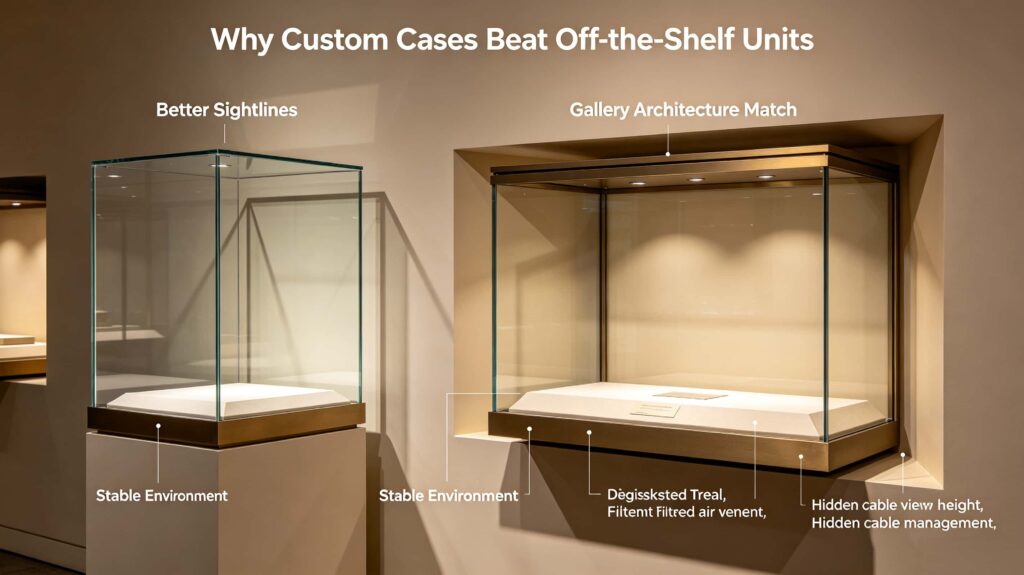
You control the internal environment
Humidity swings, dust ingress, and UV damage ruin objects silently. A custom case lets you specify gaskets, desiccant trays, filtered air vents, and low-UV glass. Standard cases rarely offer these options.
You get better sightlines
A case that is 50mm too tall or too wide can create reflections that hide the object. Custom dimensions put the viewing window exactly where you need it. This is especially true for seated visitors, children, and wheelchair users.
You can match the gallery architecture
Custom cases can be powder-coated to match wall colours, recessed into alcoves, or built around awkward columns. That kind of fit is impossible with stock units.
How to choose display case manufacturers for galleries
Most galleries only buy display cases once or twice. That means you do not have years of vendor experience. The key is to ask the right questions before you pay a deposit. Display case manufacturers for galleries are not all the same. Some specialise in conservation; others focus on retail aesthetics. You need someone who understands both.
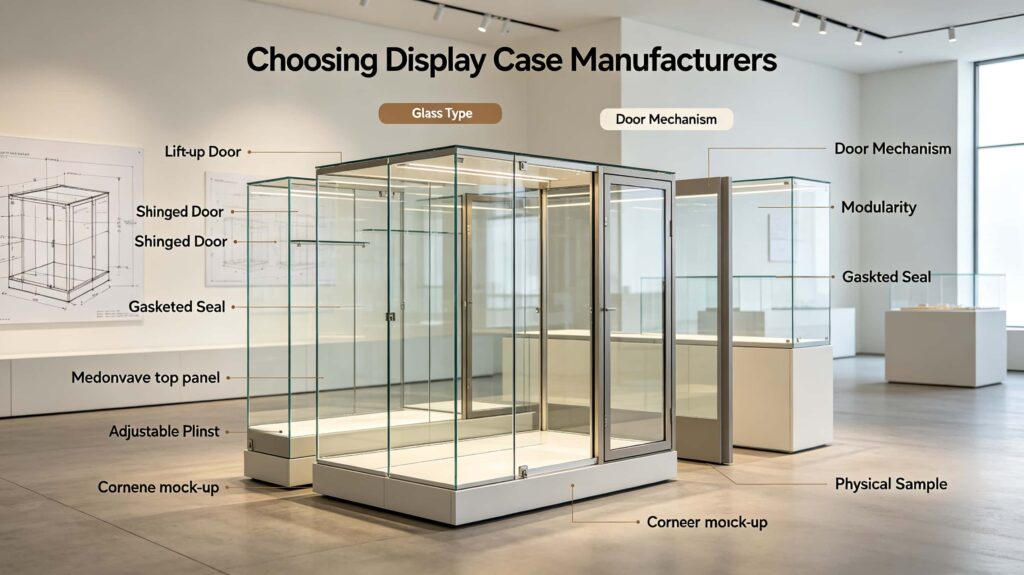
Check the build details before quoting
- What glass type? Low-iron? Laminated? UV-filtering?
- Are doors lift-up, sliding, or hinged? Which is safer for your objects?
- Is the case gasketed? What seal material?
- Can the base hide power and data cables?
- What is the lead time for custom sizes?
Ask about modularity and future reuse
A good manufacturer will offer a system that can be reconfigured. End panels, plinth heights, and shelf positions should be adjustable. If every case is welded into one fixed shape, you will pay for new cases next year.
Request a sample corner or small mock-up
Never order twenty cases without seeing one physical sample. Ask for a corner section, a door mechanism sample, or a small table case built to your finish. The feel of the lock, the weight of the glass, the smoothness of the drawer—these details only show in person.
Factory insider tips for ordering custom display cases in 2026
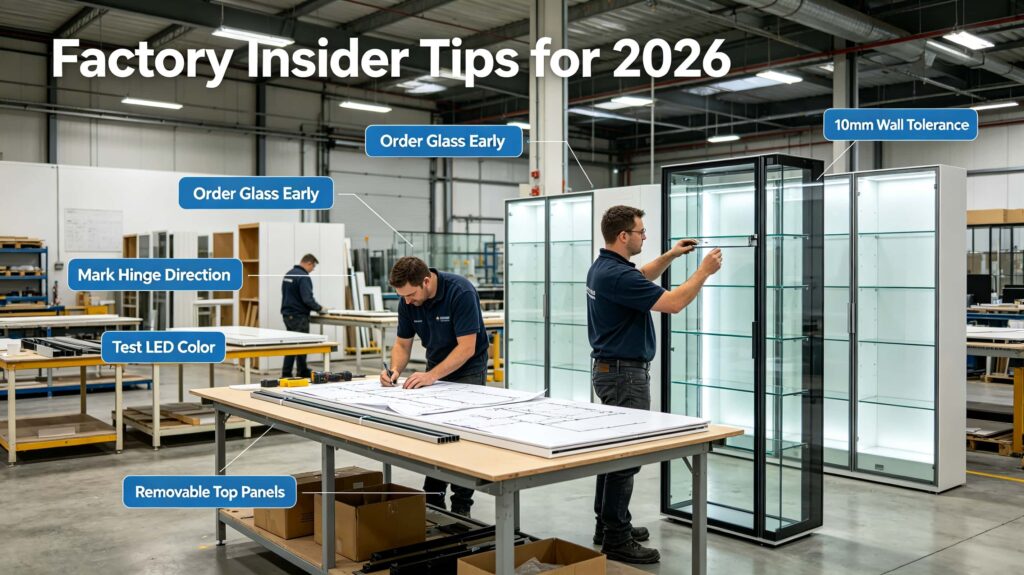
Here is what we tell our own clients, straight from the production floor. These are the details that prevent expensive mistakes and delayed openings.
- Factory insider tip 1: Order glass early. Low-iron laminated glass often has a 3–5 week lead time. Confirm glass availability before you approve the case drawings.
- Factory insider tip 2: Specify hinge direction on drawings. Most production delays come from doors swinging the wrong way. Mark it on every elevation.
- Factory insider tip 3: Leave a 10mm tolerance around wall recesses. Old walls are never straight. Build the case slightly smaller than the opening and finish with a shadow gap or trim.
- Factory insider tip 4: Test LED colour temperature with your actual objects. 2700K can make some metals look dead. Test 3000K, 3500K, and 4000K on a small strip before committing.
- Factory insider tip 5: Ask for removable top panels. If a large object needs to be lowered in by crane, the case must open from above. This is often forgotten until installation day.
How to plan creative exhibition setups without blowing the budget
Creative does not mean expensive. Some of the most interesting spaces we have seen use simple materials in unexpected ways. The trick is to spend on the few elements that visitors will touch or lean on, and save on the background.
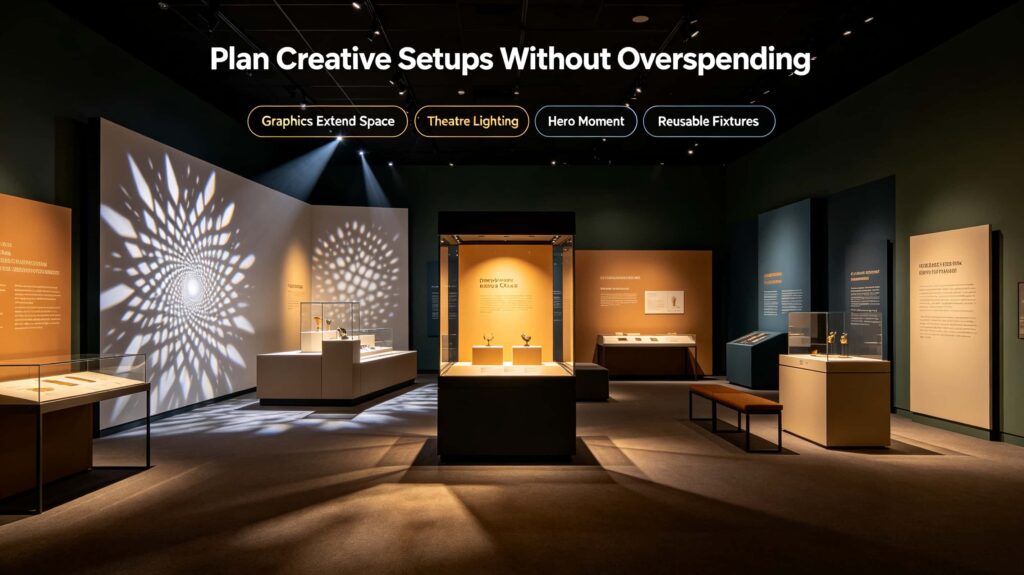
Use graphics to extend physical space
A printed vinyl panel can make a small case feel like part of a larger scene. Instead of building more cases, wrap the wall behind with a scaled photograph, map, or material swatch. This adds depth without adding hardware.
Borrow from theatre lighting
Cheap theatrical fixtures, like gobos or gel frames, can project patterns onto floors and walls. Use them to define zones or add texture behind a row of custom exhibition display cases.
Create a “hero moment” at the midpoint
Do not distribute your strongest objects evenly. Save one object for a central, dimly lit, single-purpose case. That moment of focus becomes the memory visitors carry out.
Common mistakes that make exhibitions feel boring
If your exhibition feels flat, one of these is usually the cause.
- Every case is the same height and width.
- Labels are too small or too long.
- Lighting washes everything equally.
- The entrance sightline is blocked by a large wall.
- No seating anywhere, so visitors rush through.
- Objects are arranged in straight lines with no focal point.
- Cases reflect ceiling lights because glass angle was not checked.
Fix even three of these and the room changes immediately.
A practical checklist for 2026 exhibition planning
Use this checklist when you start planning your next show.
- Define the visitor journey from entrance to exit.
- Identify the one “hero object” for each zone.
- Choose case heights based on object size and eye level.
- Plan lighting angles before case positions.
- Specify low-iron, anti-reflective glass for key cases.
- Include at least two tactile or interactive moments.
- Allow seating near long label panels.
- Order physical samples for finishes and mechanisms.
- Confirm power and data locations early.
- Leave 10mm tolerance for all built-in recesses.
Make the space feel intentional
An exhibition becomes interesting when every object looks like it belongs exactly where it is. That does not happen by accident. It happens when the case, the light, the plinth, and the label all work as one unit. Custom exhibition display cases are not an extra line item. They are the single most effective tool you have to control how people see your collection.
If you are planning a gallery, museum, or pop-up in 2026, do not guess. Send us your floor plan and elevations. We will prepare a free 3D design that shows exactly how custom exhibition display cases, custom gallery display fixtures, and creative exhibition setups will look in your actual space. You will see sightlines, lighting pools, and visitor flow before you spend anything on production. That is how the best shows start.
FAQ: Custom Exhibition Display Cases & 2026 Trends
What are museum display case trends for 2026?
Museum display case trends for 2026 focus on mixed heights, conservation-grade low-iron glass, warm LED lighting, tactile low-tech interactivity, and modular cases that can be reconfigured without heavy rebuilding.
How long do custom exhibition display cases take to produce?
Most custom cases take 4 to 8 weeks depending on size, glass type, and finish. Complex built-in units with climate control may take 10 to 12 weeks. Always confirm glass lead time before approving drawings.
Can I get a 3D design before ordering?
Yes. Reputable display case manufacturers for galleries will prepare a 3D design based on your floor plan and elevations. This helps you see sightlines, reflections, and visitor flow before production.
What is the difference between museum and retail display cases?
Museum cases prioritise conservation seals, low-UV glass, and security locking. Retail cases focus on open access, visible pricing, and frequent restocking. Hybrid gallery-retail spaces need a balance of both.