
Custom Ice Cream Cart for Sale: The Ultimate B2B Guide to Costs, Cooling & Power

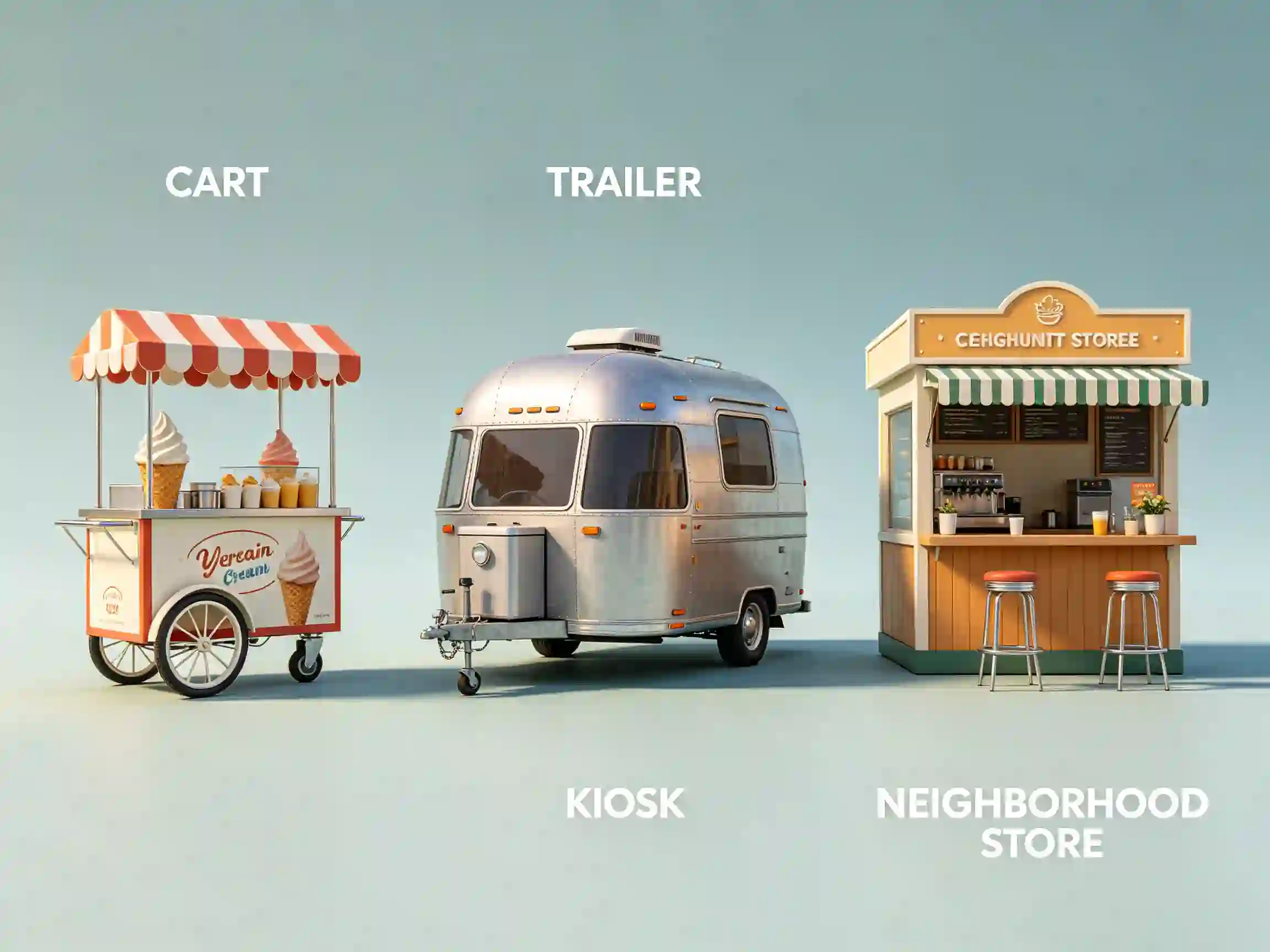
Custom ice cream carts cost $2,000–$8,000+ factory-direct. Cooling uses eutectic plates or battery refrigeration. Power comes from generators, deep-cycle batteries, or solar. Below is the complete B2B buying guide.
A custom ice cream cart is a mobile, food-grade vending unit designed for commercial frozen dessert sales. It combines high-density insulation, a reliable cooling system, and an independent power source—engineered for street vending, events, and seasonal routes. Unlike standard models, custom carts are built to your exact dimensions, branding, and power requirements.
How much would it cost to buy a commercial ice cream cart?
Commercial ice cream cart pricing ranges from $2,000 to $8,000+ depending on cooling technology, power system, and customization level. Factory-direct B2B orders cut out middlemen, saving 25–40% compared to retail. A basic cart starts near $2,000; a fully loaded solar-powered custom unit can exceed $8,000.
Price breakdown by configuration:
- Entry-level (passive cooling): $2,000–$3,500 — eutectic plates, no onboard power, push-cart mobility.
- Mid-range (battery refrigeration): $3,500–$5,500 — deep-cycle battery, 12V/24V compressor, 8–12 hour runtime.
- Premium (solar + custom branding): $5,500–$8,000+ — solar panels, hybrid power, stainless steel body, custom wraps.
- Factory-direct savings: Ordering 5+ units typically drops per-unit cost by 15–30%.
Key cost factors:
- Cooling method — Passive eutectic plates are cheapest; battery refrigeration adds $1,200–$2,500.
- Power source — Gas generators are low-cost; solar systems add $800–$2,000.
- Material — Food-grade 304 stainless steel costs more than painted steel but lasts 3× longer.
- Customization — Branding, LED lighting, and custom dimensions add $300–$1,500.
| Configuration | Cooling | Power | Price Range |
|---|---|---|---|
| Basic | Eutectic plates | None | $2,000–$3,500 |
| Standard | 12V compressor | Deep-cycle battery | $3,500–$5,500 |
| Premium | Dual compressor | Solar + battery | $5,500–$8,000+ |
Factory insider tip: Always ask for the compressor brand and insulation density (kg/m³). Cheap carts use low-density foam that fails in 2–3 years. High-density polyurethane (40–45 kg/m³) holds cold 30% longer and is the single best indicator of cart quality.
How do ice cream carts stay cold?
Ice cream carts stay cold through high-density insulation, eutectic plates, or battery-powered refrigeration. Passive carts rely on pre-frozen plates; active carts use 12V/24V compressors. The best custom carts combine both for redundancy. Holding temperature must stay below -18°C (-0.4°F) for hard ice cream.
Core cooling technologies:
- High-density insulation — Polyurethane foam (40–50 kg/m³) in walls and lid. Thicker insulation = longer hold time.
- Eutectic plates — Pre-frozen gel plates absorb heat. Freeze overnight, hold 6–10 hours. No power needed during vending.
- Battery-powered refrigeration — 12V/24V compressor runs continuously. Maintains -18°C to -22°C. Requires deep-cycle battery.
- Hybrid systems — Eutectic plates + compressor backup. Best for all-day events and hot climates.
Performance comparison:
| Cooling Method | Hold Time | Power Needed | Best For |
|---|---|---|---|
| Eutectic plates | 6–10 hours | None (pre-freeze) | Short routes, low volume |
| Battery refrigeration | 8–14 hours | 12V/24V battery | All-day vending |
| Hybrid | 14–20 hours | Battery + pre-freeze | High-volume, hot climates |
Factory insider tip: Demand a “pull-down test” report. A quality cart cools from +20°C to -18°C in under 90 minutes. If the factory can’t provide this data, the insulation or compressor is undersized.
How do ice cream carts power their freezers?
Ice cream carts power freezers via gas generators, deep-cycle batteries, or solar panels. Gas generators offer unlimited runtime but are noisy and emit fumes. Deep-cycle batteries are silent and clean but need recharging. Solar extends battery life and suits outdoor events. The right choice depends on route length and noise restrictions.
Power options compared:
- Gas generators — 1,000–3,000W output. Runtime: unlimited with fuel. Noise: 60–75 dB. Not allowed in some indoor venues.
- Deep-cycle batteries — 100–300Ah capacity. Runtime: 8–14 hours. Silent, zero emissions. Recharge in 6–8 hours.
- Solar panels — 100–400W roof-mounted. Extends battery runtime by 20–40%. Best in sunny climates.
- Hybrid (battery + solar) — Most flexible. Solar trickle-charges while vending. Reduces grid dependency.
Power selection checklist:
- Calculate daily amp-hour draw — Compressor + lights + display = total Ah/day.
- Match battery bank — Double your daily draw for safety (e.g., 100Ah draw = 200Ah battery).
- Check venue rules — Indoor malls ban generators; outdoor festivals allow them.
- Plan recharge logistics — Do you have overnight access to a 110V/220V outlet?
Factory insider tip: Ask for a wiring diagram and fuse ratings. Cheap carts use undersized wiring that overheats and fails. Proper carts use 10AWG or thicker for compressor lines and marine-grade fuse blocks.
What are the disadvantages of owning an ice cream business?
The main disadvantages of owning an ice cream business are high upfront costs ($2,000–$8,000+ per cart), power dependency, and seasonal demand. However, a high-quality custom cart directly mitigates these issues through better insulation (lower power draw), durable materials (longer lifespan), and flexible power options (more vending locations).
Common challenges and cart-based solutions:
- High upfront cost — Factory-direct pricing cuts 25–40%. A $5,000 cart lasts 5–7 years vs. a $2,000 cart lasting 2 years.
- Power access — Solar + battery hybrids eliminate generator dependency. Vend anywhere.
- Seasonal sales — Custom carts with interchangeable branding serve ice cream, frozen yogurt, and popsicles year-round.
- Maintenance — Food-grade 304 stainless steel resists rust and cleans easily. Cheaper materials corrode.
- Mobility — Heavy carts are hard to move. Custom carts use lightweight alloys and pneumatic tires for easy transport.
| Challenge | Low-Quality Cart | High-Quality Custom Cart |
|---|---|---|
| Lifespan | 1–2 years | 5–7 years |
| Power draw | High (poor insulation) | Low (high-density foam) |
| Repair frequency | Frequent | Rare |
| Resale value | Near zero | 40–60% of original |
Factory insider tip: Ask about the warranty on the compressor and insulation. Top factories offer 2–3 years on compressors and 5 years on structural insulation. If they only offer 6 months, walk away.
How to choose the best ice cream cart for your business?
Choose the best ice cream cart by prioritizing mobility, power access, and food-grade stainless steel. Match the cart to your vending route: narrow streets need compact widths; all-day events need hybrid cooling. Always verify material certifications and compressor brand before ordering.
Selection criteria:
- Mobility — Pneumatic tires (10–12 inch) for cobblestones; swivel casters for indoor floors. Weight under 150kg for solo transport.
- Power access — If venues have outlets, battery carts recharge overnight. If not, solar + battery is essential.
- Food-grade stainless steel — 304 or 316 grade. Avoid painted steel or aluminum interiors. Easy to sanitize.
- Cooling capacity — Minimum 80L for 200–300 servings. Larger for high-volume routes.
- Custom dimensions — Fit through standard doors (minimum 80cm width). Check your typical venues.
Due diligence checklist:
- Request a 3D design based on your floor plan before paying a deposit.
- Ask for compressor brand (Embraco, Danfoss, or equivalent).
- Verify insulation density (40–50 kg/m³ polyurethane).
- Confirm wiring and fuse specs meet local electrical codes.
- Get a pull-down test report and warranty terms in writing.
Factory insider tip: Never buy from a factory that won’t let you speak to a past B2B client. Real factories have repeat buyers. If they hide their client list, they’re hiding quality problems.
FAQ: Custom Ice Cream Cart for Sale
How much does a custom ice cream cart cost?
Custom ice cream carts cost $2,000–$8,000+ depending on cooling, power, and branding. Factory-direct B2B orders save 25–40%.
How long do ice cream carts stay cold?
Passive carts hold 6–10 hours. Battery refrigeration holds 8–14 hours. Hybrid systems hold 14–20 hours.
Can I use an ice cream cart without electricity?
Yes. Eutectic plate carts need no electricity during vending. Pre-freeze plates overnight and vend for 6–10 hours.
What power source is best for an ice cream cart?
Deep-cycle batteries are best for quiet, indoor, and eco-friendly vending. Gas generators suit long outdoor routes. Solar extends battery life.
What material should an ice cream cart be made of?
Food-grade 304 stainless steel is the industry standard. It resists rust, cleans easily, and lasts 5–7 years.
Do custom ice cream carts increase profit?
Yes. Better insulation reduces power costs. Durable materials cut repairs. Custom branding attracts more customers and higher prices.
Ready to Order Your Custom Ice Cream Cart?
Send us your floor plan today and receive a free 3D design within 48 hours. Our factory-direct team will engineer your cart for optimal cooling, power, and mobility—built to your exact specifications.
Contact us now to lock in B2B pricing and start your custom build.
Email your floor plan → Get your 3D design → Approve → We build → You sell.
Don’t settle for generic carts. Get a custom ice cream cart engineered for your business.