
Wholesale Display Cases: How to Attract High-Value Customers & Boost Retail Sales

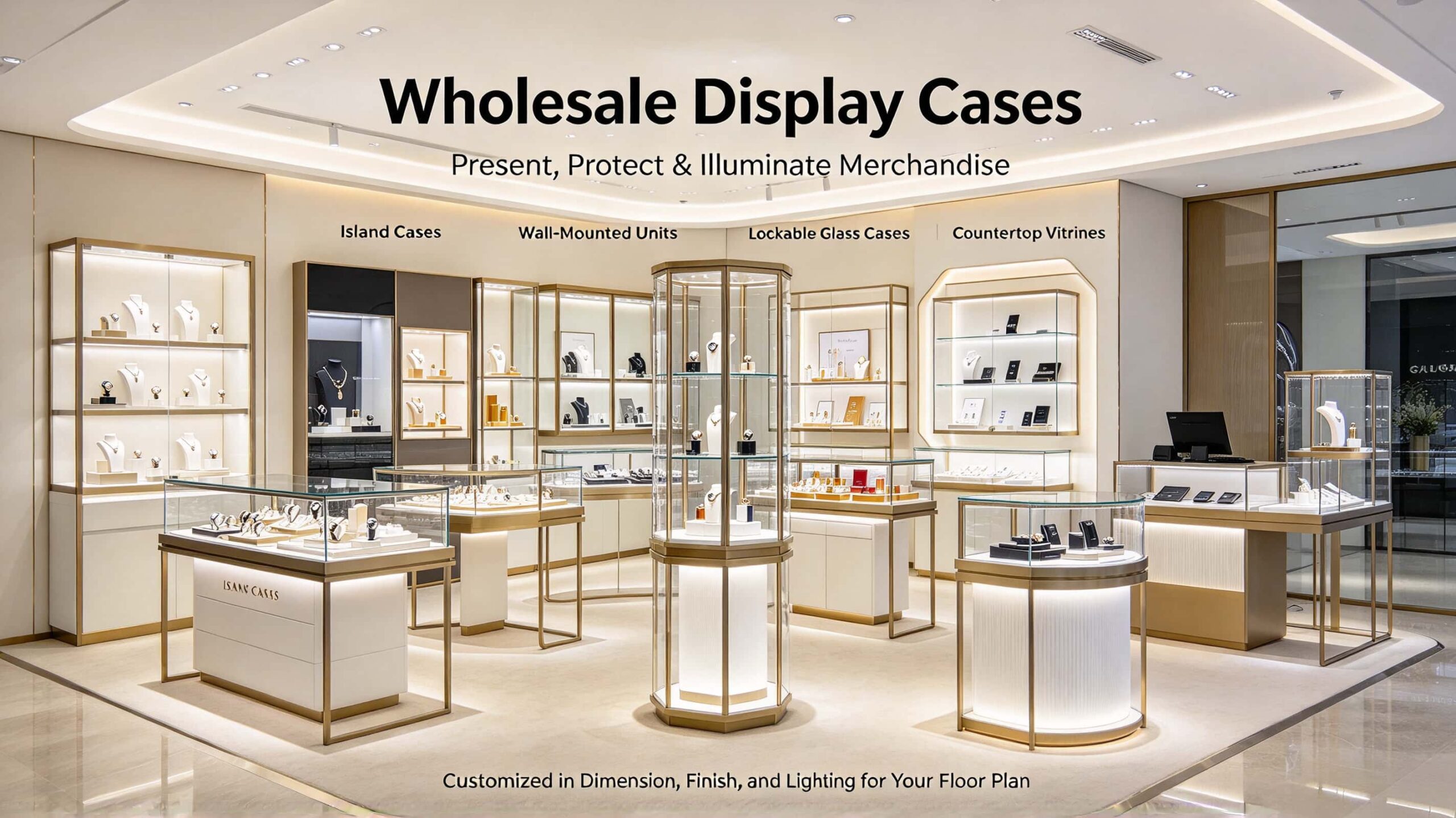
The short version: Your display case is the first salesperson a customer meets. Better glass, better light, better layout raises perceived value, and higher perceived value raises basket size without a single discount.
Wholesale display cases are retail fixtures purchased in bulk directly from a manufacturer at tiered pricing. Most are built from tempered glass, aluminum, steel, or acrylic, and used to present, protect, and illuminate merchandise. Buyers order 10 to 500+ units, typically customized in dimension, finish, and lighting to fit a specific floor plan.
What Is the Biggest Issue Facing Retail Right Now?
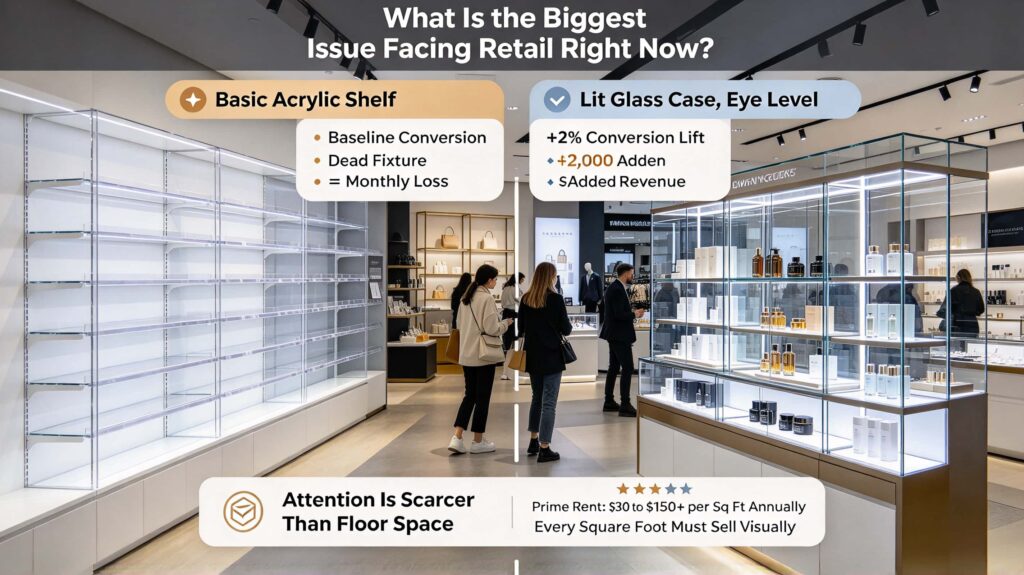
The biggest issue is that attention has become scarcer than floor space, and floor space keeps getting more expensive. Rent, staffing, and utilities rise while a shopper’s decision window shrinks to a few seconds. Every square foot now has to sell visually, which pushed visual merchandising from decoration into core operations.
Retailers are fighting two battles at once. One is for eyeballs. The other is for margin per square foot.
- Attention economy: The average shopper gives a fixture 2 to 4 seconds before moving on. If the product isn’t lit and elevated, it doesn’t exist.
- Space costs: Prime retail rent runs $30 to $150+ per square foot annually in major markets. A dead fixture is a monthly loss, not a one-time mistake.
- Staff costs: Fewer floor associates mean the display has to answer questions a salesperson used to answer.
- Online competition: Showrooming means your case has to justify the in-store price premium in seconds.
The Math Most Retailers Miss
A display that lifts conversion by 2% on a $500 average ticket isn’t a design expense. It’s an asset.
| Scenario | Avg. Ticket | Monthly Transactions | Monthly Revenue | Conversion Lift | Added Revenue |
|---|---|---|---|---|---|
| Basic acrylic shelf | $500 | 200 | $100,000 | baseline | $0 |
| Lit glass case, eye level | $500 | 200 | $100,000 | +2% | +$2,000 |
| Premium island + lighting | $500 | 200 | $100,000 | +5% | +$5,000 |
Factory Insider Tip: Ask your supplier for light output in lumens and CRI, not just “LED.” A 12W strip at 4000K with CRI 90+ makes gold and gemstones look real. A 6000K strip at CRI 70 makes everything look like a hospital corridor. We’ve watched retailers reject entire container loads over this one spec.
How Do I Attract High-Value Customers With My Displays?
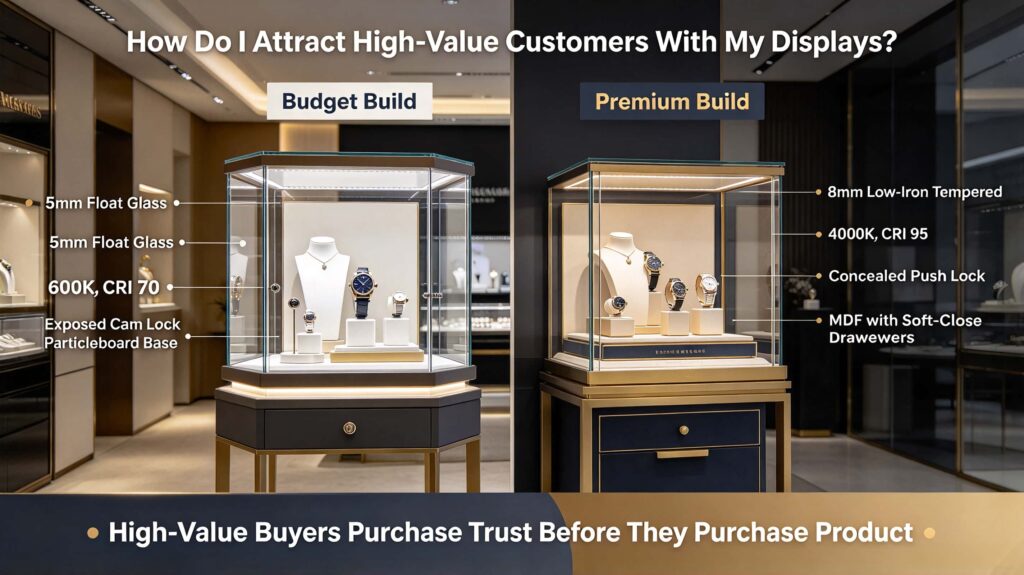
High-value buyers purchase trust before they purchase product. Premium materials, optical-grade glass, and controlled lighting tell them the item inside is worth protecting, and therefore worth the price. Cheap acrylic and uneven strip lighting communicate the opposite, no matter how good the merchandise actually is.
Attracting a $2,000 buyer requires a different fixture than attracting a $20 buyer. Here’s what actually moves the needle.
- Low-iron glass over standard float glass. Standard glass has a green edge tint that dulls color. Low-iron (often called ultra-clear) transmits 91%+ of light and keeps diamonds, watches, and cosmetics color-accurate.
- Tempered glass, 6mm to 10mm. Thicker glass reads as more valuable and resists the chips that turn a premium case into a liability.
- Locking hardware that feels expensive. Silent, smooth locks. Nothing destroys trust faster than a jammed key in front of a paying customer.
- Lighting at 4000K, CRI 90 or higher. Warm enough to flatter skin-tone-adjacent products, cool enough to keep metals crisp.
- Brushed brass, matte black, or powder-coated steel. These finishes photograph well and hold up. Chrome is dated in most categories.
- Interior back panels in suede, velvet, or matte laminate. Contrast makes product pop and hides fingerprints.
Premium vs. Budget Display: What Customers Actually Notice
| Feature | Budget Build | Premium Build | Customer Perception |
|---|---|---|---|
| Glass | 5mm float, green tint | 8mm low-iron, tempered | “This is real.” |
| Lighting | 6000K strip, CRI 70 | 4000K, CRI 95, diffused | “These look expensive.” |
| Locks | Exposed cam lock | Concealed push lock | “They take it seriously.” |
| Base | Particleboard laminate | MDF with soft-close drawers | “This store is established.” |
| Finish | Painted steel | Powder coat or brushed brass | “This brand has taste.” |
Factory Insider Tip: Order one sample case before committing to 200 units. Photograph it under your actual store lighting, not ours. Half the disputes we see start because a buyer approved a finish under factory LED panels and hated it under warm retail halogens.
What Are the Key Retail Display Trends for 2026?
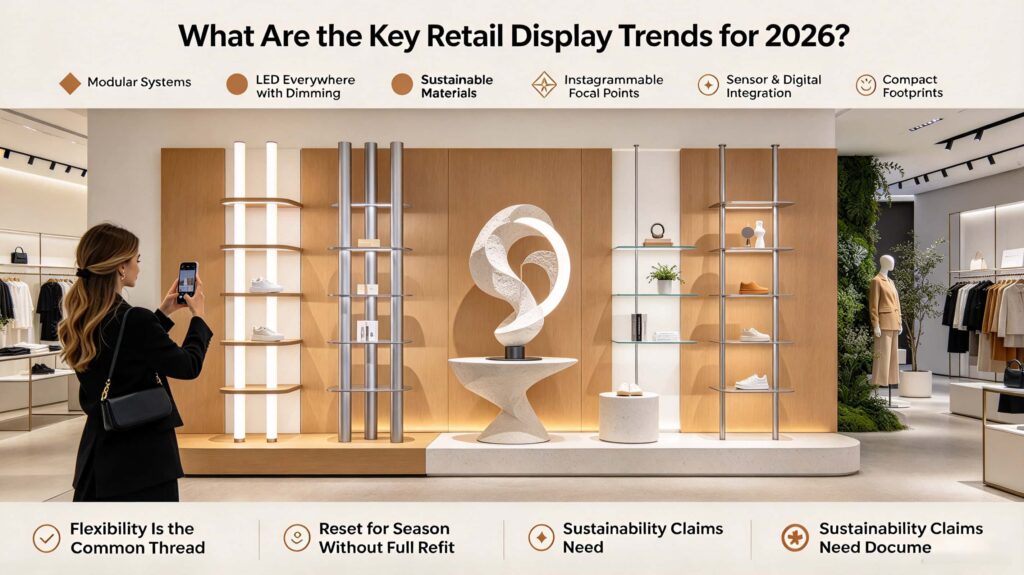
2026 displays are modular, LED-lit, built from lower-impact materials, and designed to be photographed. The common thread is flexibility: fixtures that reconfigure for a seasonal reset without a full refit, plus focal points shoppers actually pull their phones out for.
Sustainability claims without documentation are now a liability. Buyers want receipts.
- Modular systems. Interchangeable posts, shelves, and bases let one frame become a floor island, a wall unit, or a tower.
- LED everywhere, with dimming. Dimming matters in jewelry and eyewear, where 100% brightness all day washes out product.
- Sustainable materials. FSC-certified wood, recycled aluminum, water-based powder coatings, and low-VOC adhesives.
- Instagrammable focal points. One deliberately sculptural piece per zone, placed where the light is best and the background is cleanest.
- Sensor and digital integration. Motion-triggered lighting, digital price tags, and inventory sensors built into the case frame.
- Compact footprints. Smaller stores mean taller, narrower cases that use vertical space instead of floor space.
Trend vs. Business Impact
| Trend | Setup Cost | Payback Horizon | Best Fit |
|---|---|---|---|
| Modular frames | Medium | 6–12 months | Multi-store chains with seasonal resets |
| Dimming LED | Low | 3–6 months | Jewelry, watches, eyewear |
| Recycled aluminum | Medium | Brand value, not ROI | Brands with ESG reporting |
| Photogenic focal point | Low to high | 1–3 months | Fashion, beauty, lifestyle |
| Sensor lighting | High | 12–18 months | Flagship and concept stores |
What Makes a Good Product Display?
A good display puts product at eye level, keeps the sightline uncluttered, and survives years of daily handling. Those three things, placement, restraint, and durability, matter more than any decorative flourish. Everything else is secondary to whether a customer can see it, reach it, and trust it.
Designers overcomplicate this. The fundamentals are boring and they work.
- Eye level wins. Products between 52″ and 66″ off the floor get looked at first. Below 30″ gets ignored. Above 72″ gets glanced at and forgotten.
- One hero per case. Crowded cases reduce perceived value. Three items displayed well outsell twelve displayed badly.
- Leave negative space. Empty space inside a case signals confidence. Filling every inch signals desperation.
- Durability is a sales feature. Powder-coated steel, tempered glass, and soft-close hinges mean the case still looks new in year three.
- Cleanability. Fingerprints, dust, and smudges kill the premium look faster than anything else. Matte surfaces hide more than gloss.
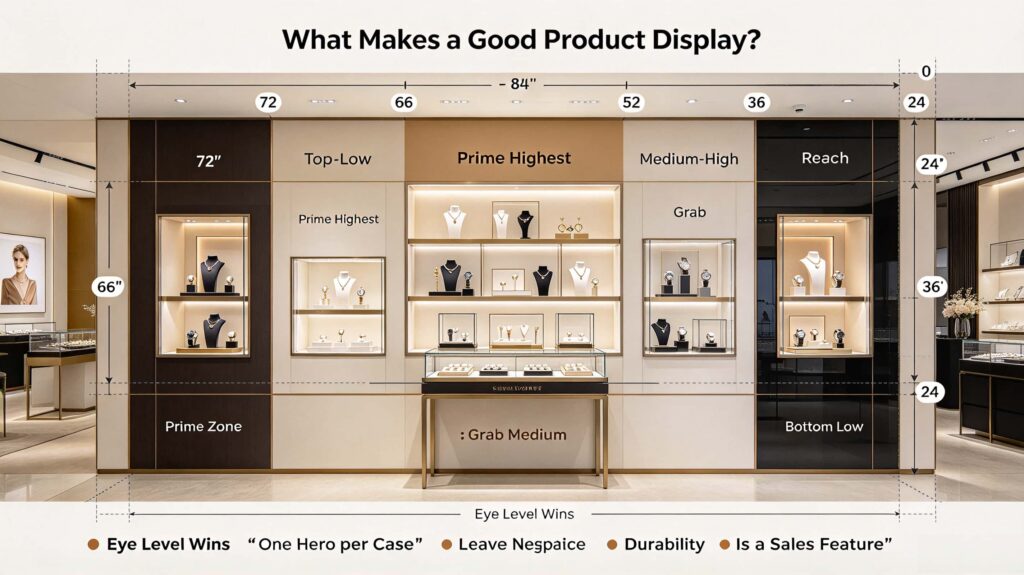
Eye-Level Placement Chart (Average Adult Shopper)
| Height Range | Zone | Attention Level | Best Use |
|---|---|---|---|
| 72″–84″ | Top | Low | Brand signage, oversized hero items |
| 52″–66″ | Prime | Highest | High-margin, high-ticket products |
| 36″–52″ | Reach | Medium-high | Complementary items, add-ons |
| 24″–36″ | Grab | Medium | Impulse, accessories |
| 0″–24″ | Bottom | Low | Bulk, refills, storage drawers |
Factory Insider Tip: If you’re specifying a custom height, order 54″ cases, not 60″. At 60″, the top shelf sits above the average customer’s natural sightline and you lose your best display real estate to a shelf nobody looks at. We build thousands of these a year and 54″ consistently outperforms.
What Are the Different Types of Display Cases?
The main types are island cases, wall-mounted units, rotating towers, lockable glass cases, and countertop vitrines. Each solves a different problem: traffic flow, wall efficiency, 360-degree viewing, security, or impulse buying at the register. Choosing the wrong one wastes floor space you already paid for.
Match the case to the job. Don’t buy a tower because it looked good in a showroom photo.
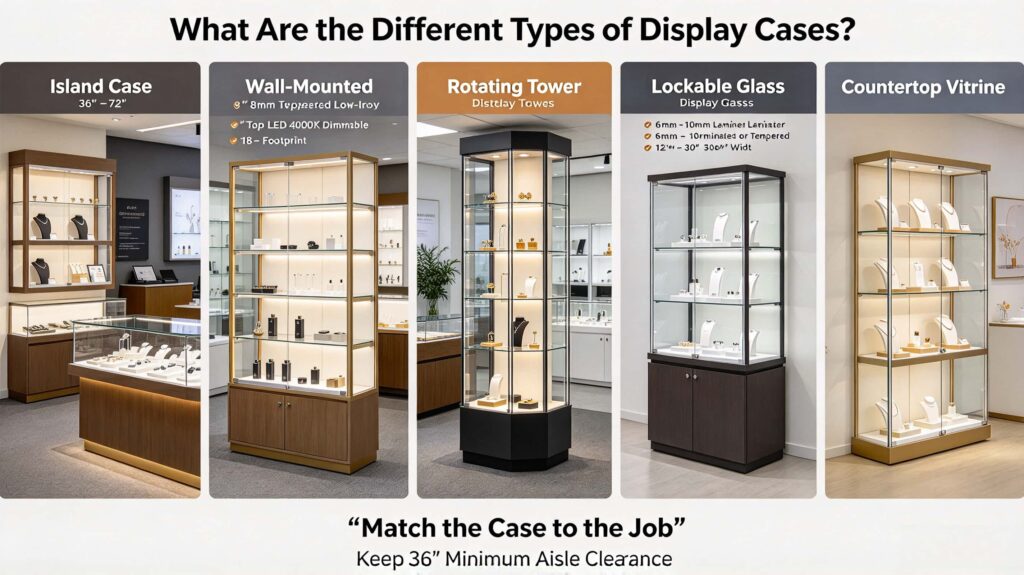
Island Display Cases
Free-standing units with glass on all four sides. They act as anchors in open floor space.
- Best for: jewelry, watches, phones, cosmetics
- Typical size: 36″–72″ long, 20″–24″ deep, 36″–40″ high
- Glass: 8mm tempered, low-iron
- Lighting: top-mounted LED, 4000K, dimmable
- Watch out for: blocking traffic aisles. Keep 36″ minimum clearance.
Wall-Mounted Display Cases
Mounted to a wall or recessed into a millwork run. They convert vertical space into selling space.
- Best for: eyewear, small electronics, collectibles, pharmacy
- Typical size: 24″–48″ wide, 12″–18″ deep
- Glass: 6mm tempered, hinged or sliding doors
- Lighting: LED strip along the top interior
- Watch out for: wall structure. Recessed units need blocking installed during build-out, not after.
Rotating Display Towers
Motorized or manual turntables that show product from every angle.
- Best for: high-ticket items where 360-degree inspection builds confidence
- Typical size: 18″–24″ footprint, 60″–72″ tall
- Rotation: manual bearing base or 2–6 RPM motor
- Lighting: internal LED with slip ring for continuous power
- Watch out for: motor noise. Anything above 30dB is distracting in a quiet store.
Lockable Glass Display Cases
Security-focused cases with concealed locks, reinforced frames, and sometimes alarmed glass.
- Best for: jewelry, firearms, luxury watches, high-theft categories
- Typical size: varies, often island or counter configurations
- Glass: laminated or tempered, 8mm–10mm
- Locking: cam lock, push lock, or keyless electronic
- Watch out for: cheap locks. A $15 lock on a $5,000 case is a false economy.
Countertop Vitrines
Small cases that sit on a checkout counter or service desk.
- Best for: impulse purchases, add-ons, promotional items
- Typical size: 12″–30″ wide, 12″–18″ tall
- Glass: 4mm–6mm tempered
- Lighting: battery or USB LED
- Watch out for: overcrowding. These work best with three to five items.
Quick Comparison
| Type | Floor Space | Security | Best Category | Typical Wholesale Price |
|---|---|---|---|---|
| Island case | High | Medium | Jewelry, watches | $280–$900 |
| Wall-mounted | Low | Medium-high | Eyewear, electronics | $150–$600 |
| Rotating tower | Low | Medium | Luxury, collectibles | $320–$1,100 |
| Lockable glass | Medium | High | Jewelry, firearms | $400–$1,500 |
| Countertop vitrine | Very low | Medium | Impulse, promos | $60–$250 |
Prices reflect FOB factory pricing at 50+ unit volumes and vary with glass spec, lighting, and finish.
How to Buy Wholesale Display Cases Without Getting Burned
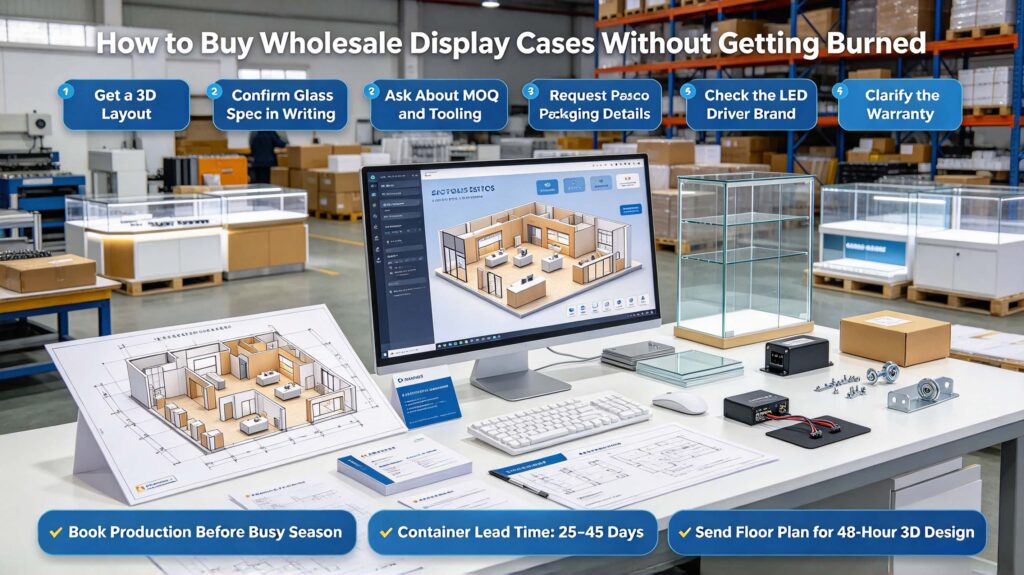
Start with your floor plan, not a catalog. The store fixture that looks perfect on a webpage often blocks an aisle, hides a security camera, or arrives with glass that doesn’t match the rest of your store.
- Get a 3D layout before you pay a deposit. Guessing dimensions is how retailers end up with 40 cases that don’t fit.
- Confirm glass spec in writing. Thickness, tempering standard, and tint (low-iron vs. standard).
- Ask about MOQ and tooling. Custom finishes often carry a 50–100 unit minimum. Standard finishes ship faster.
- Request packaging details. Glass in transit is the number one source of claims. Ask for foam-lined crates and corner protection.
- Check the LED driver brand. Cheap drivers fail in 12–18 months. Ask for Meanwell or equivalent.
- Clarify the warranty. Frame, glass, lighting, and locks should each have stated coverage.
Factory Insider Tip: Book production slots before your busy season, not during it. Container lead times from Asia to the US West Coast run 25–45 days, and Chinese New Year shuts factories for two to three weeks. Retailers who order in October for a March opening are fine. Retailers who order in February are not.
Frequently Asked Questions
What is the minimum order quantity for wholesale display cases?
Standard finishes typically start at 20–50 units. Custom sizes, finishes, or branded hardware usually start at 50–100 units because of tooling and setup time.
How much do wholesale display cases cost?
Countertop vitrines run $60–$250. Wall-mounted units run $150–$600. Island cases run $280–$900. Large lockable jewelry cases run $400–$1,500. Price depends on glass thickness, lighting, locking, and finish.
Can display cases be customized to my store’s dimensions?
Yes. Nearly every wholesale order involves custom lengths, heights, and depth. Send a floor plan and you should receive a 3D rendering before production begins.
What glass is best for high-end retail display cases?
Low-iron tempered glass, 6mm to 10mm. It removes the green tint of standard float glass, transmits more than 91% of light, and holds up to daily handling.
How long does production and shipping take?
Standard production runs 20–35 days. Ocean freight adds 25–45 days depending on destination port. Add two to three weeks if your order lands around Chinese New Year.
Do you provide 3D design before manufacturing?
Yes. A dimensioned floor plan is all that’s needed to produce a 3D layout showing case placement, sightlines, lighting positions, and traffic flow.
Ready to See Your Store With the Right Cases In It?
Send us your floor plan and we’ll send back a 3D design. No cost, no obligation, no generic catalog renders. You’ll see exactly which case types fit your space, where the sightlines land, and what the lighting will look like on your actual products.
Here’s what to send:
- A rough floor plan (hand-drawn is fine) with dimensions and door locations
- Your product categories and typical item sizes
- Your target budget per unit and total quantity
- Any brand colors, finishes, or reference photos you already like
In return you get:
- A 3D rendering of your store layout with cases placed to scale
- A recommended mix of island, wall, tower, and lockable units
- Glass, lighting, and finish specifications in writing
- A full wholesale quote with MOQ, lead time, and shipping estimate
Email your floor plan today and we’ll have your 3D design back within 48 hours. The best retail spaces aren’t designed around fixtures. They’re designed around what makes a customer stop, look, and pull out a credit card. Let’s build that.