
How to Source Custom Store Fixtures for Your New Shop

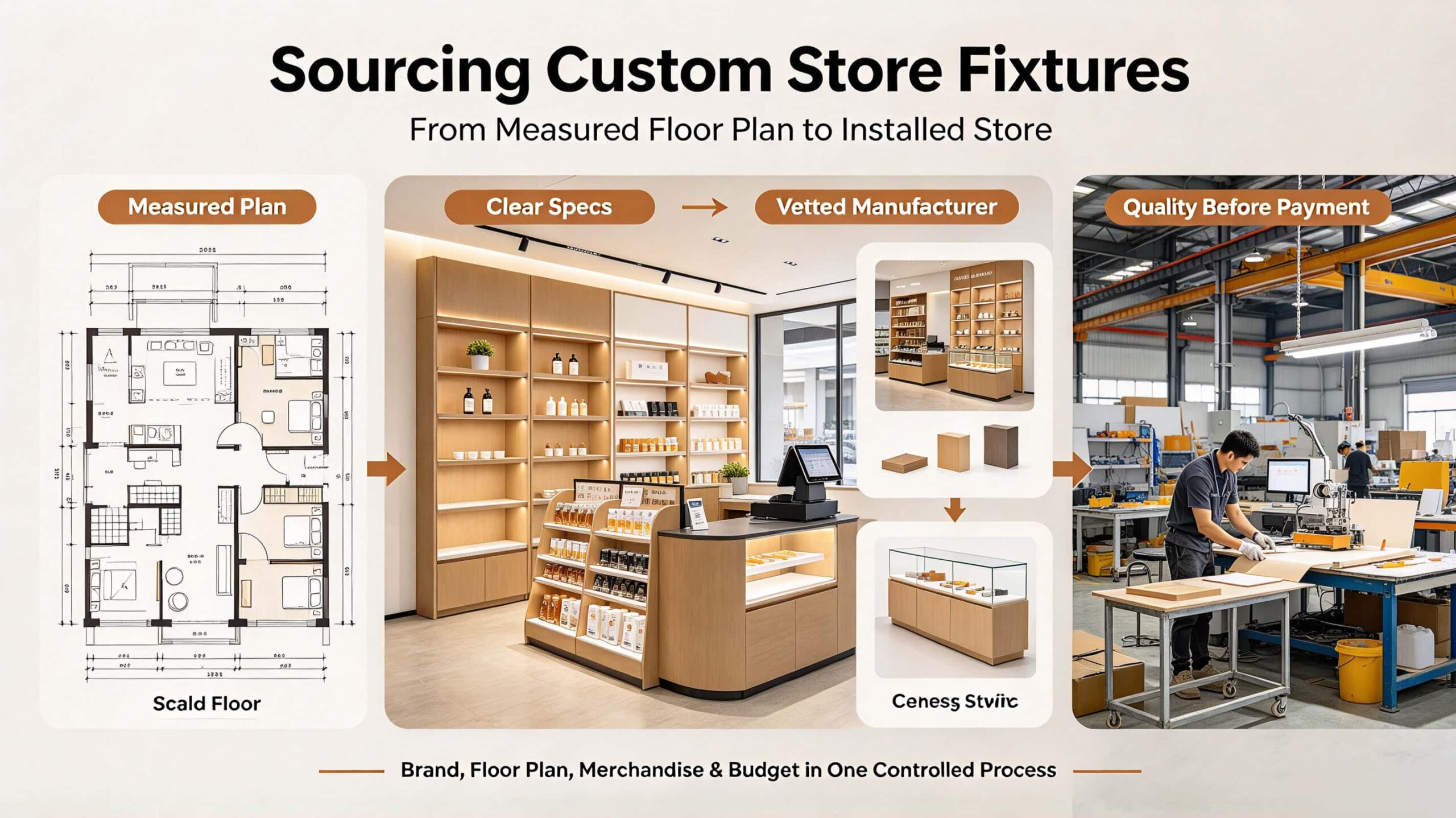
Sourcing custom store fixtures for your new shop means matching your brand, floor plan, merchandise, and budget to a vetted manufacturer, then managing samples, production, freight, and installation without guessing. Start with a measured plan, clear specs, and a supplier who proves quality before you pay in full.
Custom store fixtures are bespoke retail display and storage units—wall bays, gondolas, cash wraps, tables, racks, and fitting rooms—designed to exact dimensions, finishes, and branding for one store. They differ from catalog fixtures because they are engineered around your floor plan, merchandise mix, and customer flow.
Start With a Measured Floor Plan, Not a Fixture Catalog
Before you request quotes, get a scaled floor plan showing walls, doors, windows, columns, ceilings, electrical, plumbing, and traffic paths. A fixture catalog cannot solve a bad layout. The plan tells every supplier exactly what must fit, where it goes, and what constraints drive cost.
Your floor plan is the single most important document in the entire fixture sourcing process. Without it, you are guessing. With it, you can compare quotes, spot problems early, and avoid paying for fixtures that arrive wrong.
- Measure every wall, corner, column, and door swing.
- Mark electrical outlets, data ports, plumbing, sprinklers, and HVAC vents.
- Note ceiling height, beam locations, and any low-clearance zones.
- Draw customer flow: entrance, decompression zone, browse paths, cash wrap, exit.
- Include stockroom, office, and receiving areas because back-of-house fixtures matter too.
- Use a scale like 1/4 inch = 1 foot so suppliers can read dimensions accurately.
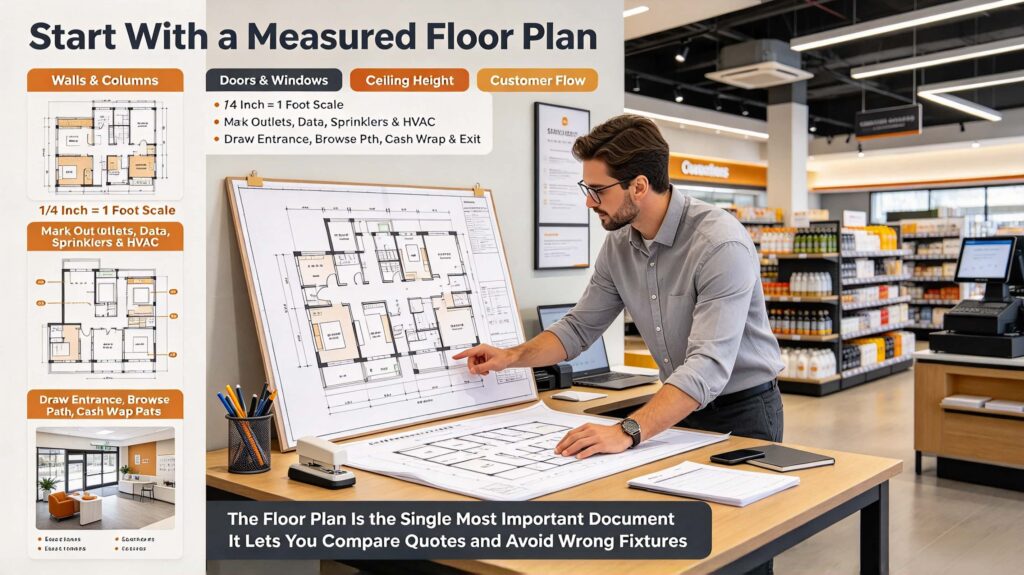
What Your Floor Plan Must Show
| Element | Why It Matters |
|---|---|
| Walls and columns | Determines fixture depth, anchoring, and custom sizes |
| Doors and windows | Affects sightlines, security, and display placement |
| Electrical | Needed for lit fixtures, cash wraps, and signage |
| Plumbing | Matters for coffee bars, floral shops, or fitting rooms |
| Ceiling height | Limits tall wall units and hanging displays |
| Sprinklers and vents | Cannot be blocked by fixtures |
| Aisle widths | Affects ADA compliance and customer comfort |
| Receiving access | Determines crate sizes and installation route |
Decide Which Fixtures Must Be Custom
Not every fixture deserves custom treatment. Custom makes sense when standard sizes waste space, when your brand needs a signature look, or when merchandise has unusual weight, security, or display needs. Standard fixtures can fill backroom, stockroom, and low-visibility areas.
Think in tiers. Front-of-house fixtures sell the brand. Back-of-house fixtures support operations. Spend custom money where customers actually look, touch, and judge.
- Custom: wall bays that run floor-to-ceiling around columns or windows.
- Custom: cash wraps that hide POS hardware, drawers, bags, and security tags.
- Custom: fitting rooms that match your brand and fit odd wall angles.
- Custom: jewelry, eyewear, or electronics cases with locks and lighting.
- Standard: stockroom shelving, receiving tables, and office storage.
- Hybrid: standard gondolas with custom end caps and branded headers.
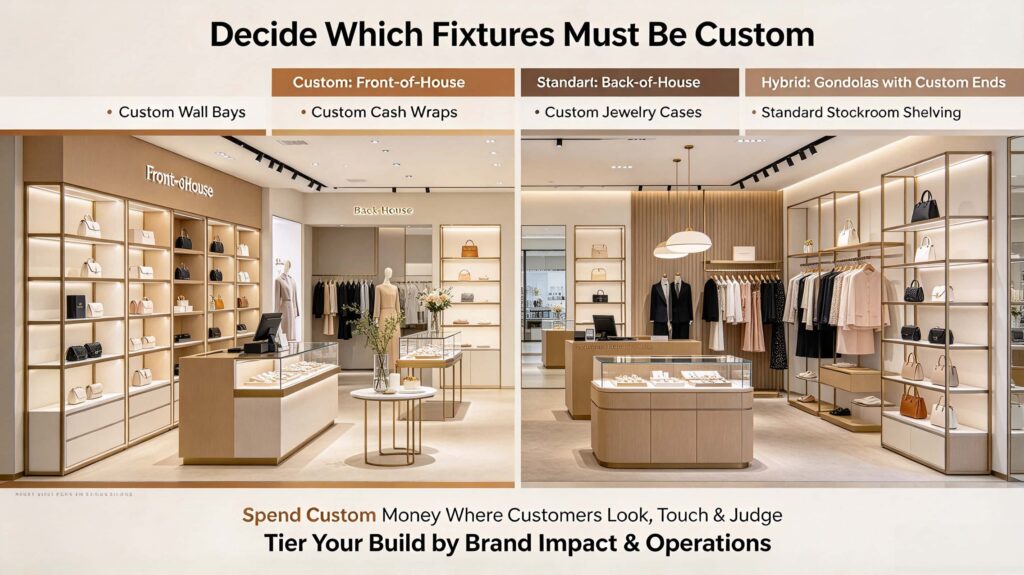
Custom vs. Standard Fixture Guide
| Fixture Type | Custom or Standard? | Reason |
|---|---|---|
| Front wall display | Custom | Brand impact and exact wall fit |
| Center floor gondola | Standard or hybrid | Cost savings with custom ends |
| Cash wrap | Custom | Workflow, security, and brand |
| Fitting room | Custom | Size, privacy, and style |
| Stockroom shelving | Standard | Function over form |
| Display table | Custom or standard | Depends on merchandise and finish |
| Window display | Custom | One-off shape and lighting |
| Signage holders | Standard | Easy to replace and upgrade |
Choose Materials That Match Wear, Weight, and Wow
Material choice affects cost, lead time, weight, maintenance, and how premium the store feels. Pick surfaces by touchpoint: high-touch areas need durable finishes, while high-visibility areas can carry richer materials. Always ask for real samples under your store lighting before approving.
Do not choose materials from a website photo. A matte laminate can look cheap under warm light and expensive under cool light. A powder-coated steel shelf can feel solid in one store and cold in another. Samples prevent expensive mistakes.
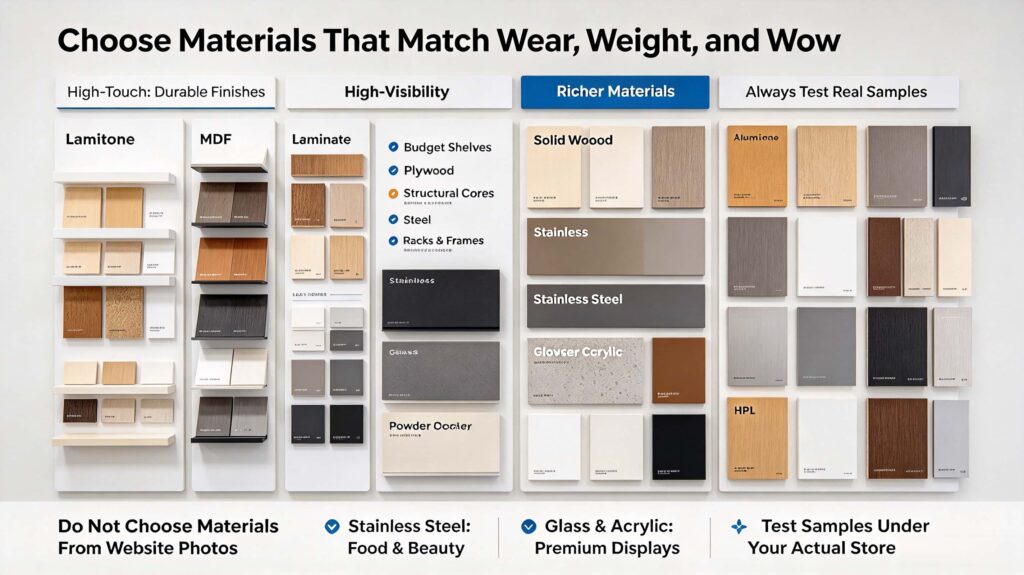
Common Fixture Materials
| Material | Best For | Watch Out For |
|---|---|---|
| Laminate | Budget-friendly shelves and cabinets | Chipping on edges |
| MDF | Painted panels and shaped fronts | Heavy and sensitive to moisture |
| Plywood | Structural cores and built-ins | Needs edge banding |
| Solid wood | Premium counters and trim | Cost, movement, and maintenance |
| Steel | Racks, frames, and industrial looks | Weight and rust if uncoated |
| Aluminum | Lightweight frames and displays | Dents and softer finish |
| Stainless steel | Food, beauty, and high-touch areas | Fingerprints and cost |
| Glass | Jewelry, cosmetics, and premium displays | Breakage and cleaning |
| Acrylic | Lightweight signage and risers | Scratching and static |
| Powder coat | Metal finishes in many colors | Touch-up can be tricky |
| HPL | High-wear surfaces | Visible seams if poorly made |
| Veneer | Warm wood look | Moisture and sunlight fading |
Set a Real Budget Before You Talk to Factories
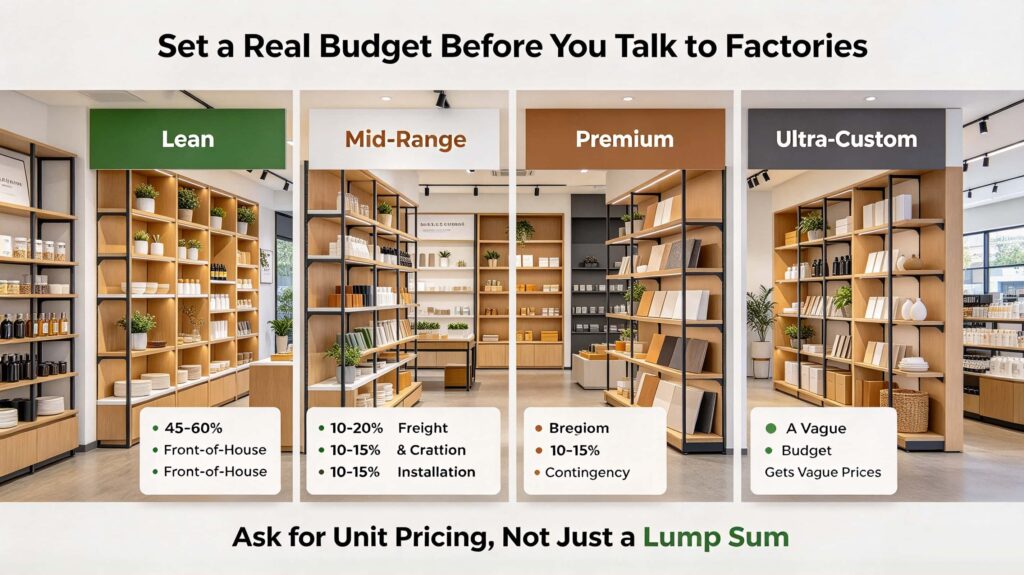
Custom fixtures are quoted by drawings, materials, hardware, finish, quantity, and installation. A vague budget gets vague prices. Decide your total fixture spend, then split it into front-of-house, back-of-house, lighting, freight, and installation. Keep 10–15% contingency for changes because freight and site surprises rarely stay quiet.
A realistic budget keeps you from falling in love with a fixture package you cannot afford. It also helps suppliers recommend the right materials instead of guessing.
Typical Budget Tiers
| Tier | Best For | Likely Materials | Trade-Off |
|---|---|---|---|
| Lean | Pop-ups and small shops | Laminate, MDF, standard hardware | Less custom shaping |
| Mid-range | Boutique retail | Plywood, laminate, steel, acrylic | Good balance |
| Premium | Flagship or luxury | Veneer, solid wood, stainless, glass | Higher cost and lead time |
| Ultra-custom | Brand experiences | Mixed materials, integrated lighting | Complex production |
- Allocate 45–60% to front-of-house fixtures.
- Allocate 10–20% to freight, crating, and customs.
- Allocate 10–15% to installation and site adjustments.
- Keep 10–15% contingency untouched until the store opens.
- Ask for unit pricing, not just a lump sum.
Find the Right Supplier Type for Your Project
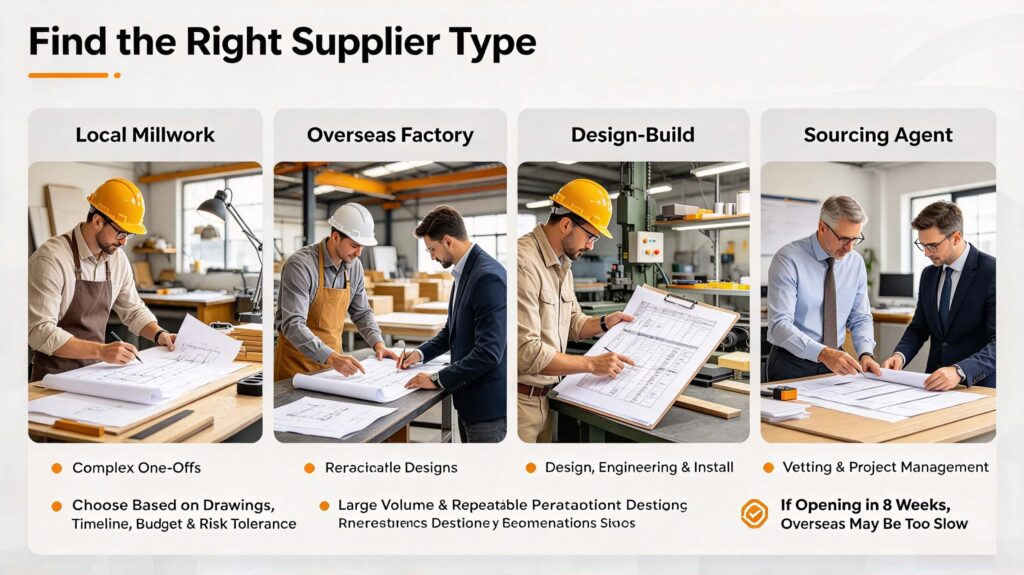
There is no single best supplier. Local millwork shops excel at complex installs and fast changes. Overseas factories win on volume and price. Design-build firms simplify everything but cost more. Sourcing agents can bridge the gap if you lack time or factory knowledge.
Choose based on your drawings, timeline, budget, and risk tolerance. If your store opens in eight weeks, overseas production may be too slow. If you need 200 identical display tables, local millwork may be too expensive.
Local Millwork Shops
- Great for complex, one-off fixtures.
- Easier communication and faster revisions.
- Higher labor cost per unit.
- Best when installation and fit matter most.
Overseas Factories
- Strong for large quantities and repeatable designs.
- Lower unit cost but higher freight and risk.
- Requires clear drawings, inspections, and patience.
- Best when you have 12–16 weeks or more.
Design-Build Firms
- Handle design, engineering, production, and install.
- Fewer vendors to manage.
- Usually the most expensive option.
- Best for flagship stores and tight brand control.
Sourcing Agents
- Help find and vet factories.
- Can manage samples, inspections, and freight.
- Fees vary by project size.
- Best when you lack factory experience.
How to Vet a Custom Fixture Manufacturer
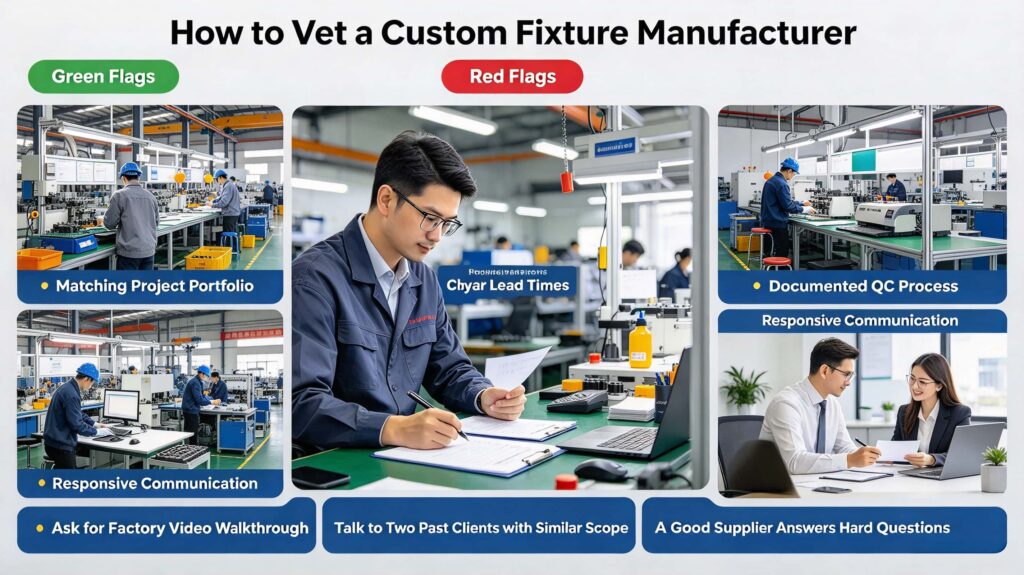
Vetting is not about pretty photos. Ask for recent projects in your fixture type, factory capacity, lead times, material sourcing, quality control steps, and installation support. Request a video walkthrough of their production floor. Then talk to two past clients with similar scope.
A good supplier will answer hard questions without defensiveness. A weak supplier will avoid specifics, rush you, or promise everything.
Green Flags
- Recent projects that match your fixture type.
- Clear lead times with production milestones.
- Physical samples and finish options.
- Documented QC process.
- Willingness to sign a detailed purchase order.
- Responsive communication in your time zone.
Red Flags
- No factory photos or video walkthrough.
- Quotes without drawings or specs.
- Pressure to pay a large deposit immediately.
- No warranty or inspection terms.
- Vague answers about materials and hardware.
- Extremely low price with no explanation.
Write an RFQ That Gets Accurate Quotes
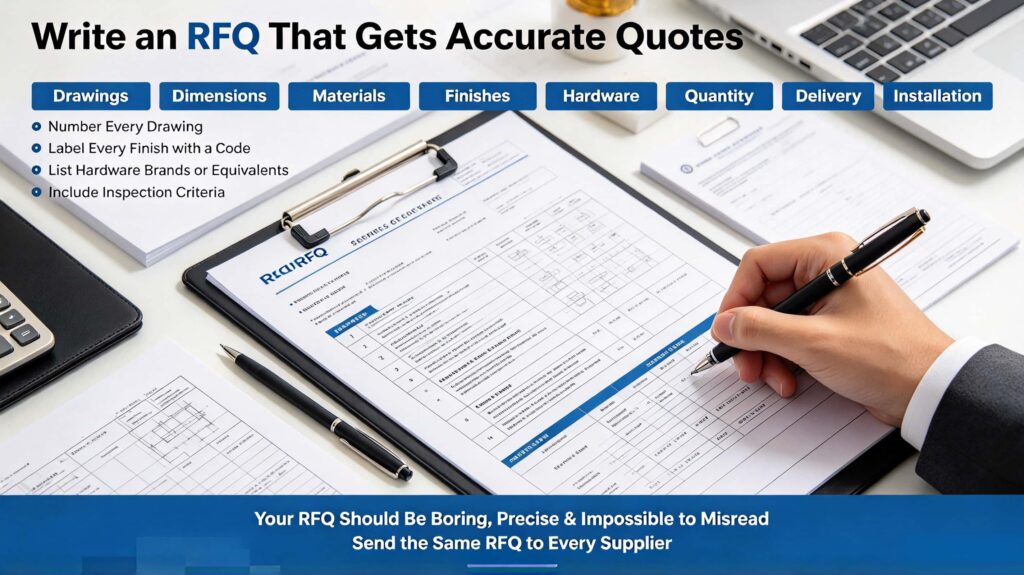
An RFQ is not a casual email. It is a controlled document with drawings, dimensions, materials, finishes, hardware, quantities, packaging, delivery terms, and deadlines. The clearer your RFQ, the fewer change orders and surprises you will face later. Send the same RFQ to every supplier so quotes compare apples to apples.
Your RFQ should be boring, precise, and impossible to misread. That is a good thing. Ambiguity is where profit disappears.
RFQ Checklist
| Item | What to Include |
|---|---|
| Drawings | Plan, elevation, section, and detail views |
| Dimensions | Width, depth, height, thickness, and tolerances |
| Materials | Core, surface, edge, backing, and hardware |
| Finishes | Color codes, sheen, texture, and sample approval |
| Lighting | Voltage, color temperature, drivers, and switches |
| Quantity | Per SKU, per store, and spare parts |
| Packaging | Crating, labeling, and protection |
| Delivery | Address, Incoterms, and unloading responsibility |
| Installation | Who installs, who supervises, and who repairs |
| Deadline | Sample date, production date, ship date, install date |
- Number every drawing.
- Label every finish with a code.
- List hardware brands or equivalents.
- State whether prototypes are required.
- Include inspection and acceptance criteria.
- Ask for lead time broken into phases.
Prototypes, Samples, and Finish Approvals
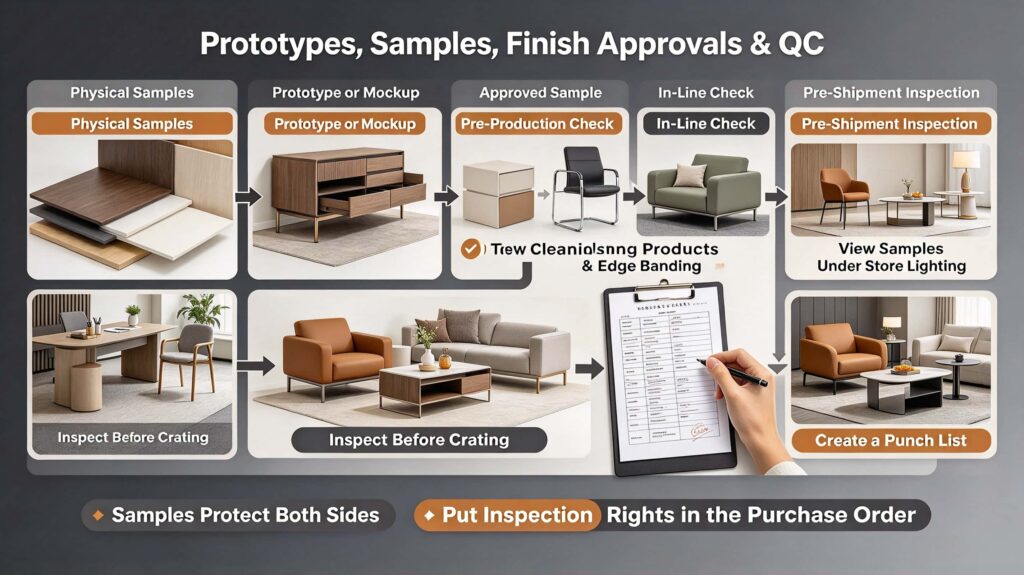
Never approve a finish from a phone screen. Ask for physical samples of laminate, veneer, paint, powder coat, metal, glass, and edge banding. For complex fixtures, build a prototype or a partial mockup. Sign and date every approved sample before production begins.
Samples protect both sides. You get what you expect. The factory gets a clear target. When a dispute happens, the approved sample is the referee.
- Request two samples of each finish when possible.
- View samples under your actual store lighting.
- Test surfaces with cleaning products you plan to use.
- Check edge banding, welding, and hardware movement.
- Approve hardware pulls, locks, hinges, and shelf pins.
- Keep one approved set and send one to the factory.
Quality Control and Inspections
Quality control must happen before, during, and after production. Pre-production checks catch drawing errors. In-line checks catch material and assembly issues. Pre-shipment inspections catch packing, hardware, and finish defects before freight leaves. Put inspection rights in the purchase order. Otherwise you own problems across an ocean.
Do not rely on a final photo set. Photos hide scratches, gaps, and weak welds. A third-party inspection or your own checklist can save thousands.
QC Stages
| Stage | Focus | Action |
|---|---|---|
| Pre-production | Drawings, materials, samples | Approve before cutting |
| In-line | Dimensions, joinery, finish | Check during production |
| Pre-shipment | Assembly, hardware, packing | Inspect before crating |
| Pre-install | Site readiness, counts, damage | Verify before install |
| Post-install | Function, touch-ups, warranty | Sign off with punch list |
- Create a punch list for every defect.
- Photograph all crates and labels before unpacking.
- Check hardware bags against the packing list.
- Test locks, drawers, doors, and lighting.
- Document damage immediately with the carrier.
Freight, Customs, and Delivery to Your Shop
Freight is where budgets bleed. Decide who pays, who clears customs, who handles damages, and who unloads. For overseas orders, clarify Incoterms, HS codes, duties, and delivery address. For local orders, confirm liftgate, inside delivery, and unpacking. Insure the shipment for full replacement value.
The cheapest freight quote often excludes the services you actually need. A low price means nothing if the truck cannot reach your street or the driver will not unload.
Freight Questions to Ask
- Is the quote door-to-door or port-to-port?
- Who pays duties, taxes, and customs brokerage?
- Is liftgate service included?
- Will the carrier bring crates inside?
- Who removes packing materials?
- What is the claims deadline for damage?
- Is the shipment insured for replacement value?
Installation and Site Readiness
Installation fails when the site is not ready. Confirm floors are level, walls are painted, power is live, ceilings are clear, and access routes fit the largest crate. Schedule fixtures after major construction but before merchandise. Hire installers approved by the manufacturer to protect warranty.
A great fixture package can still look bad if it is installed crooked, scratched, or rushed. Site readiness is not glamorous, but it decides whether opening day feels polished or patched together.
- Verify floor level within acceptable tolerance.
- Confirm wall finishes are complete and dry.
- Test electrical outlets and lighting circuits.
- Clear freight elevator, hallway, and door access.
- Protect finished floors during installation.
- Keep a touch-up kit on site.
- Schedule a final walkthrough before merchandise arrives.
Timeline: What to Expect
A custom fixture project usually takes 10–20 weeks from approved drawings to installed store. Simple local orders can move faster. Overseas production plus ocean freight often needs 12–16 weeks. Add time for sampling, revisions, inspections, and site delays. Start before you sign the lease if possible.
Timelines slip when decisions are slow. Every unanswered email adds days. Every unapproved sample pauses production. Assign one decision-maker and set weekly check-ins.
Typical Project Timeline
| Phase | Time Needed | Key Task |
|---|---|---|
| Planning | 1–3 weeks | Floor plan, fixture list, budget |
| Design | 2–4 weeks | Drawings, materials, 3D design |
| Quoting | 1–2 weeks | RFQ, supplier comparison |
| Sampling | 1–3 weeks | Finish and prototype approval |
| Production | 4–10 weeks | Manufacturing and QC |
| Freight | 1–6 weeks | Shipping and customs |
| Installation | 3–10 days | Site install and punch list |
Common Mistakes That Cost New Shops Money
Most fixture mistakes happen before production: no scaled plan, vague specs, skipped samples, cheapest quote, no inspection, and no installation plan. These errors create rework, delays, damaged freight, and fixtures that do not fit. Slow down at the specification stage and you will save money later.
The cheapest quote is rarely the cheapest project. It often means thinner materials, weaker hardware, poor packing, or no support when something goes wrong.
- Ordering fixtures before measuring the space.
- Ignoring ceiling height and sprinkler clearance.
- Forgetting cash wrap storage and workflow.
- Choosing finishes from a screen.
- Skipping a prototype on complex fixtures.
- Not inspecting before shipment.
- Assuming installation is included.
- Leaving no contingency budget.
How to Save Money Without Looking Cheap
You can cut cost without cutting impact. Use custom fixtures where customers touch and look, standard fixtures in stockrooms, and paint or laminate instead of solid wood. Reduce unique SKUs, simplify curves, buy hardware in bulk, and consolidate shipments. Spend on lighting and cash wrap.
Lighting makes average fixtures look premium. A beautiful fixture with bad lighting looks dull. A simple fixture with great lighting looks intentional.
- Standardize shelf depths and widths.
- Reuse one cabinet design across multiple areas.
- Choose paint instead of veneer in low-touch zones.
- Use open shelving instead of closed cabinets.
- Buy locks, pulls, and shelf pins in bulk.
- Combine orders to reduce freight.
- Skip custom logos on hidden surfaces.
- Invest in adjustable shelves and lighting.
Sustainability and Compliance
Sustainability is now a sourcing requirement, not a bonus. Ask about FSC-certified wood, low-VOC finishes, recycled metal, and replaceable parts. Check fire ratings, ADA clearances, child safety, seismic anchors, and local permits. Document compliance before production, not after installation. It protects your opening date and your customers.
Compliance varies by city, state, and country. Your fixture supplier may not know local codes. You are responsible for confirming what your store needs.
- Request material certificates when available.
- Choose low-VOC paints and adhesives.
- Design fixtures for disassembly and reuse.
- Check ADA aisle and counter heights.
- Confirm fire ratings for fabrics and panels.
- Anchor tall fixtures for seismic safety.
- Keep compliance documents with your lease file.
FAQ
These are the questions new shop owners ask most when sourcing custom store fixtures. The short answers below help you avoid the biggest delays and cost overruns. Use them as a checklist before you contact any manufacturer or supplier. For project-specific advice, send your floor plan.
How long does it take to source custom store fixtures?
Most projects take 10–20 weeks from approved drawings to installation.
- Local simple orders: 6–10 weeks.
- Overseas orders: 12–16 weeks or more.
- Add 1–3 weeks for sampling and revisions.
- Add freight and customs time for imports.
How much do custom store fixtures cost?
Cost depends on size, materials, hardware, lighting, quantity, and installation.
- Lean fixtures: lower cost, simpler materials.
- Mid-range fixtures: balanced cost and durability.
- Premium fixtures: higher cost, richer materials.
- Always ask for unit pricing and freight separately.
Should I buy fixtures from overseas or locally?
It depends on quantity, timeline, budget, and risk.
- Overseas: lower unit cost, longer lead time, more risk.
- Local: higher cost, faster changes, easier support.
- Hybrid: custom overseas, standard local.
- Use inspections for any overseas order.
What is the minimum order quantity?
Many factories set minimums by material, finish, or production run.
- Simple metal fixtures may have low minimums.
- Custom wood fixtures often require larger runs.
- Local millwork may build one-off pieces.
- Ask about sample and prototype fees.
Do I need an architect or designer?
Not always, but you need accurate drawings.
- A designer helps with flow and brand.
- A drafter can turn measurements into plans.
- A fixture supplier can engineer from your plan.
- Complex stores benefit from a design-build team.
What if my fixtures arrive damaged?
Document everything immediately.
- Photograph crates before unpacking.
- Note damage on the delivery receipt.
- Notify the carrier and supplier within the claims window.
- Keep damaged parts for inspection.
- File a claim with insurance if needed.
Can I mix custom and standard fixtures?
Yes, and most smart shops do.
- Custom front-of-house for brand impact.
- Standard back-of-house for cost savings.
- Hybrid gondolas with custom end caps.
- Standard shelving inside custom cabinets.
What do you need to create a 3D design?
Send your floor plan and basic project details.
- Scaled floor plan with dimensions.
- Photos of the space.
- Merchandise list and quantities.
- Brand colors, logos, and style references.
- Budget range and opening date.
Send Your Floor Plan, Get a 3D Design
Ready to stop guessing and start building? Send us your floor plan, merchandise list, and brand direction. Our team will turn them into a practical fixture layout and a 3D design you can review before you spend money on production. We help with materials, budgets, samples, and installation.
Contact our team today. Send your floor plan and get a free 3D design concept for your new shop. Let’s make your fixtures fit your space, your brand, and your budget—before you place a production order.