
9 Popular Types of Kiosks Used in Airports, Malls & Restaurants

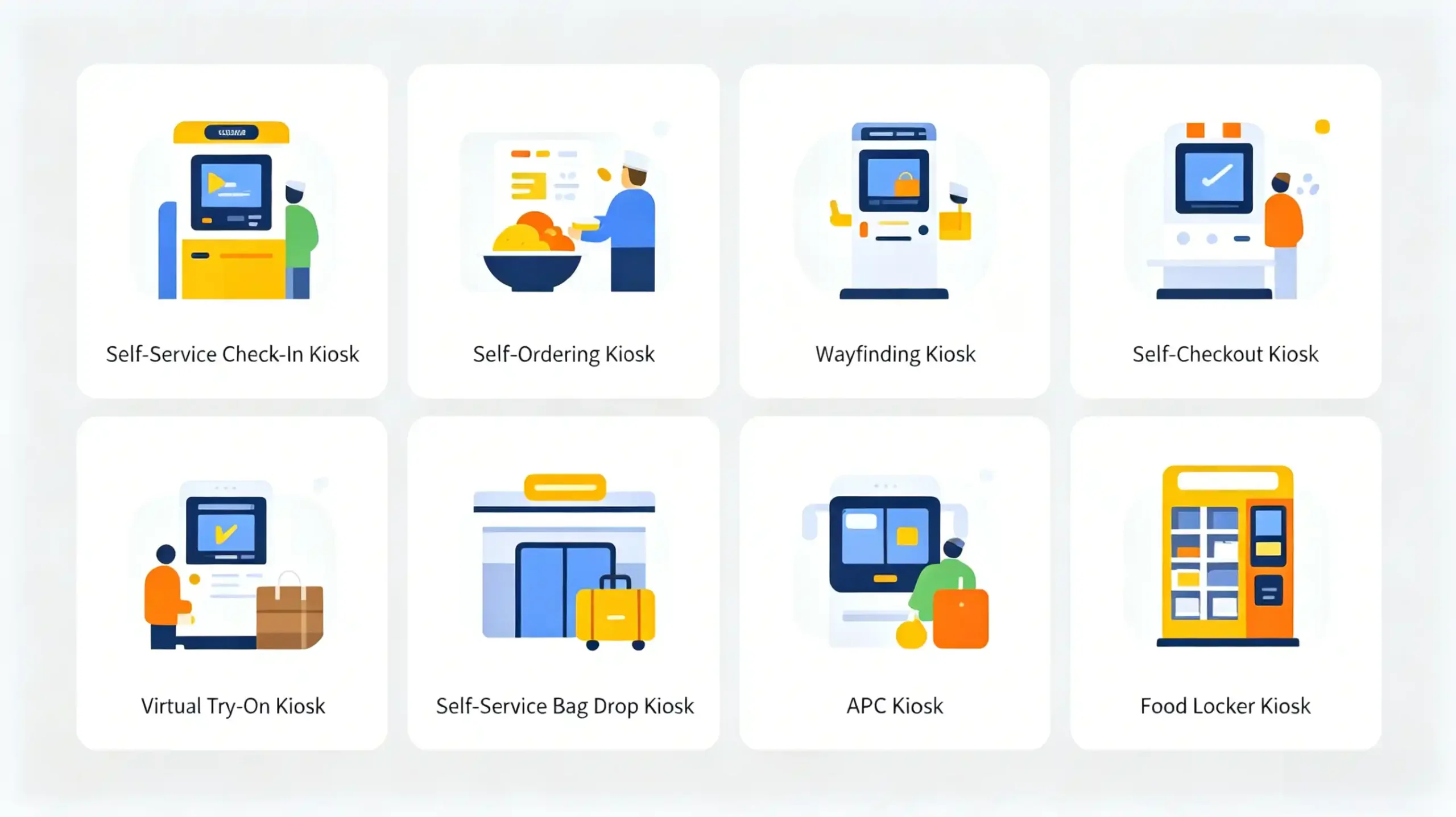
You want to introduce self-service terminals in airports, shopping centers and restaurants in the US, but don’t know where to start? In the US, there are at least 9 popular kiosks that are quietly changing the flow of consumers. They are: self-service check-in kiosks, self-service ordering kiosk, Wayfinding Kiosk, Self-Checkout Kiosk, Virtual Try-On Kiosk, luggage drop-off kiosks, Self-Service Bag Drop Kiosk,APC Kiosk, Ticketing Kiosk and Food Locker Kiosk. Today, let’s explain them one by one to help you find the one that best suits your business scenario.
1.Check-In Kiosk: How can you get your boarding pass in 3 minutes?
The queues at the check-in counters for domestic flights in the US can be so long that you might question the very existence of time. The solution adopted by airlines is quite simple: they return the check-in process to the passengers.
The vertical machines you see in the boarding halls of Delta Air Lines, United Airlines or Southwest Airlines are called self-check-in kiosks. They usually scan your passport, swipe your credit card or enter your reservation code, and can complete seat selection, printing of boarding passes and luggage tags within 3 minutes.
Some models even support language switching, making them particularly friendly for international passengers. Nowadays, more and more airports have turned them into “fully automated lanes”, with not even a single ground staff to be found nearby – not because of a shortage of staff, but because it is truly unnecessary.
Function Breakdown:
- Read passport, driver’s license, or booking code
- Select seat, purchase extra baggage allowance
- Print boarding pass and baggage tag directly
- Don’t underestimate this machine; it saves airlines nearly half the labor costs and space compared to a regular counter.
2.Self-Ordering Kiosk:McDonald’s and Panera are both betting on it
You might have used the self-service ordering machines many times at McDonald’s, Shake Shack or Panera Bread. In the US QSR industry, these machines are almost standard equipment.
The most remarkable aspect of it is not that “no one helps you place the order”, but that it knows better than you what you want to add to your purchase. When you select a hamburger, the screen immediately pops up with “Would you like to add a serving of fries and a milkshake?” This upsell logic is fixed, but the conversion rate is astonishingly high.
Why do American business owners love it?
- Average order value increases by 15% – 30%
- Ordering error rate drops dramatically; no more repeatedly telling staff “no pickles”
- Peak traffic flow is reduced, halving the pressure on the front desk. Many businesses located in food courts even place their order kiosks directly in the hallways, allowing customers to order as they pass by, with the kitchen issuing tickets immediately. No need to enter the store. It caters to restaurants, airport food courts, and shopping mall dining floors.
3.Wayfinding Kiosk:The mall is so big, how can we prevent people from getting lost?
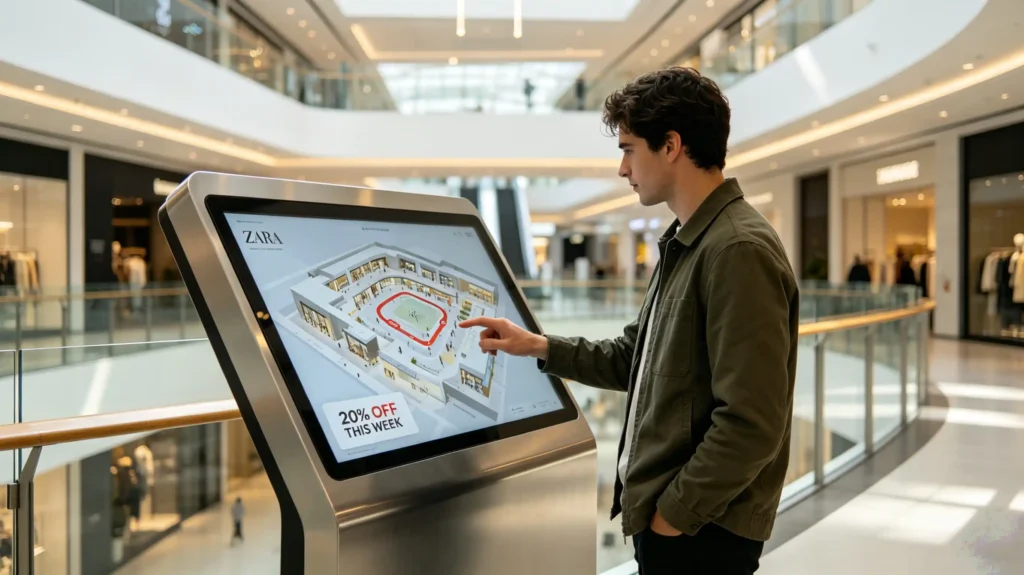
The super-regional malls in the United States are often several million square feet in size. For first-time visitors, they are very likely to get lost. The wayfinding kiosks are like the “living maps” of the malls.
You can search for a specific brand store on the touchscreen, and it will directly generate a 3D route, even marking out “where there are restrooms, elevators and popular cafes along the way”. It has been installed very densely in many shopping centers under the Simon Property Group.
More advanced features:
- Integrate merchant promotional information. Search for ZARA, and a “ZARA ¥20 off ¥100” pop-up appears at the bottom of the screen.
- Sync your phone. Scan the QR code to send the route to your mobile phone.
- Collect customer flow heat maps, which the mall operations team treasures.
- For shops, this means more foot traffic; for the operations team, it’s like having a 24/7 sales assistant.
4.Self-Checkout Kiosk:Silent cashiers in supermarkets and fast food restaurants
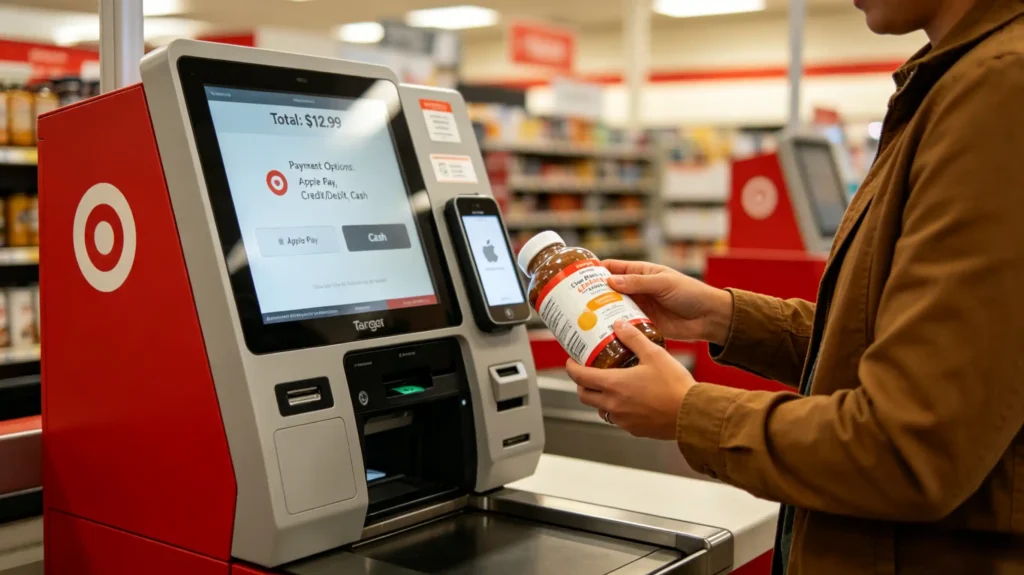
Don’t think that only Target and Walmart need it. Now, Uniqlo in American malls and Hudson, an airport convenience store, are also using Self-Checkout Kiosk.
Its value goes beyond saving the salary of the cashiers. What’s more important is eliminating the anxiety of waiting. Americans really appreciate this – buying a bottle of water or a sandwich, they really don’t want to queue up. Just scan the product barcode, tap Apple Pay, and then leave.
Applicable Scenarios:
- Airport Grab-and-Go convenience stores
- Fast fashion stores in shopping malls
- Restaurants with self-service beverage areas. When used in restaurants, it’s usually a separate unit from the ordering system, but there are also all-in-one models that integrate hardware and software. It’s recommended to choose hardware that supports EMV and NFC, which is a significant requirement in the US market.
5.Virtual Try-On Kiosk: Cutting-Edge Technology in Clothing Stores
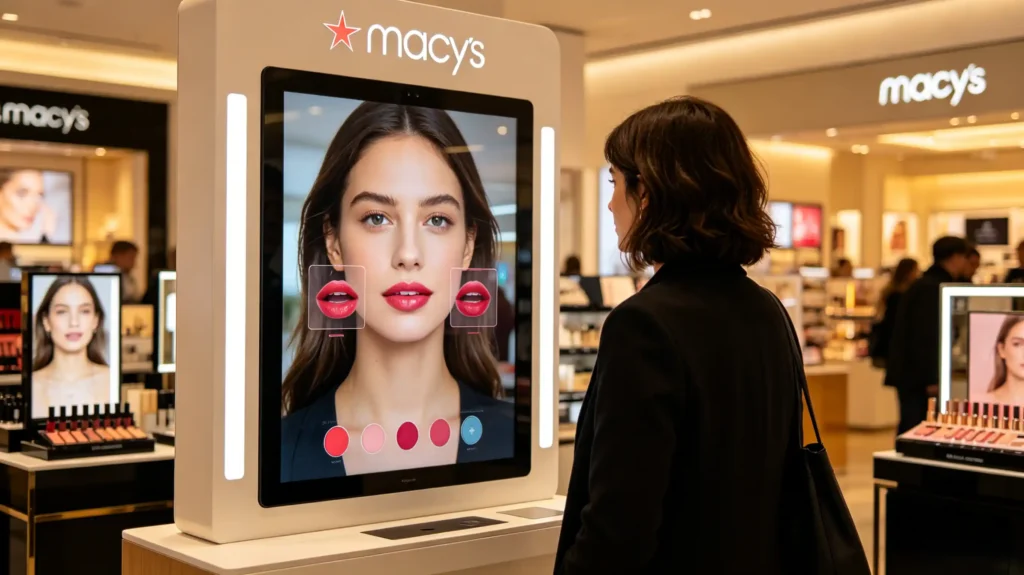
This is not a science fiction movie. Walk into Macy’s or any upscale shopping mall’s beauty section, and you will see a large standing screen. Stand in front of it and it can “wear” clothes, lipstick and even sunglasses on your body.
The underlying technology is AR overlay. Customers don’t need to actually enter the fitting room. Just by turning their heads, they can see the effects of different colors of lipsticks. For categories such as makeup, glasses, and hats, the virtual fitting stations often directly lead to purchases.
Real-world value:
- Longer dwell time and significantly higher conversion rates for customers interacting for over 2 minutes.
- Reduced waste and hygiene risks associated with sample use.
- Creates social media buzz; many people will take photos and post them on Instagram.
- American customers, in particular, value the experience; this machine in the store is more effective than hanging 10 posters.
6.Self-Service Bag Drop Kiosk: Swallow your luggage
If you have ever experienced the frustration of “waiting 5 minutes for check-in and another 40 minutes for luggage check-in”, you will understand how life-saving this device is.
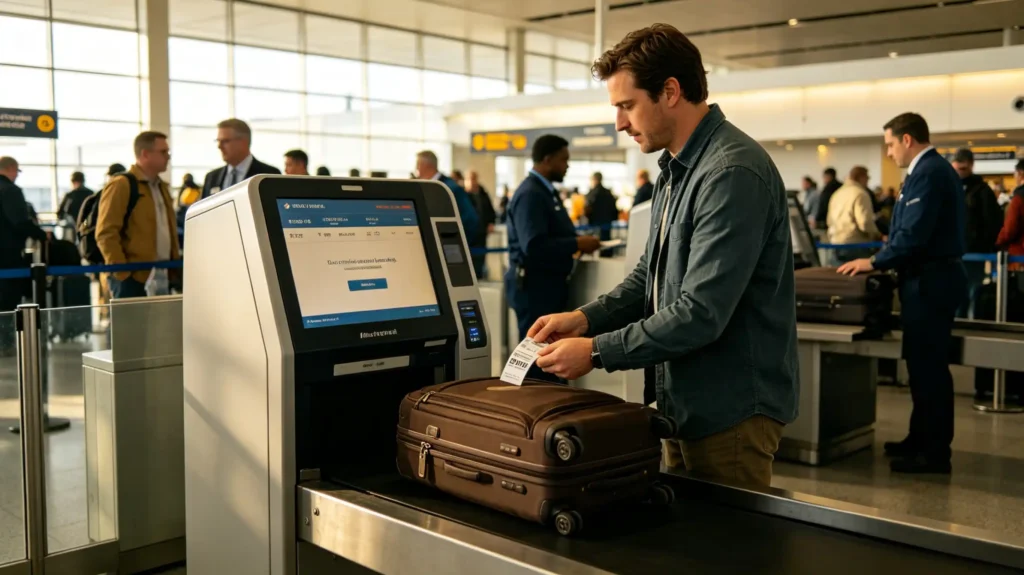
It looks somewhat like an upgraded version of the check-in counter, but it has an additional conveyor belt and an electronic label printer. At major hub airports in the United States, passengers affix their luggage tags themselves, place their boxes on the conveyor belt, and the machine will automatically weigh, scan, and verify the flight information, and then directly send the luggage into the sorting system.
Currently, American Airlines and Delta Air Lines have installed many of these kiosks at their hubs such as Dallas and Atlanta. The biggest challenge is that they need to be compatible with the airport’s baggage sorting system, and the deployment cost is not low. However, for high-throughput terminals, the return on investment is achieved quickly.
7.APC Kiosk: The first “gate” to entering the United States
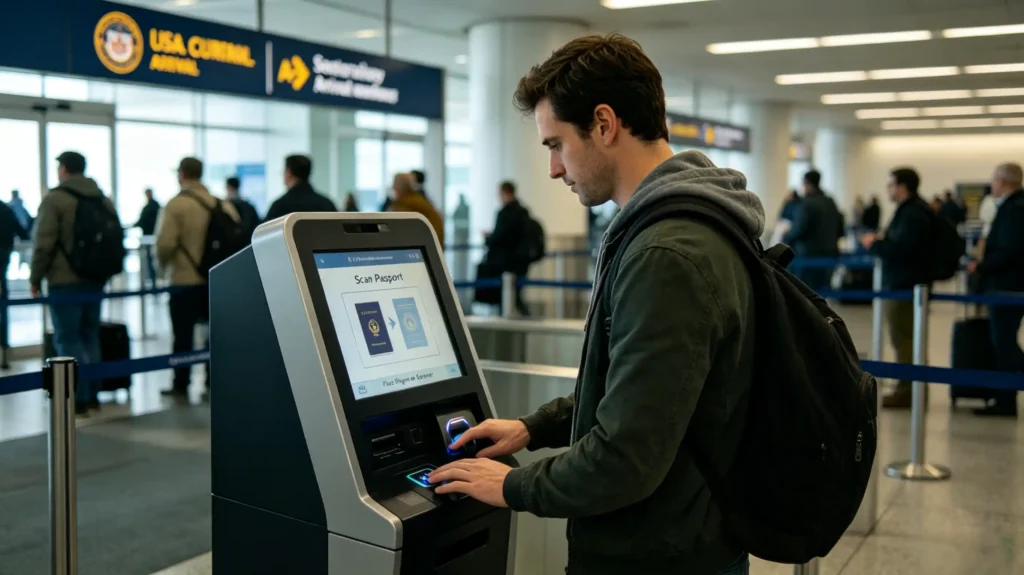
Strictly speaking, it is a fast clearance kiosk designed for Global Entry members and passengers holding US/Canadian passports. You will definitely see it in the customs arrival hall.
It will guide you to scan your passport, take fingerprints, take a not-so-attractive photo, and then give you a small piece of paper with a barcode. With this paper, you can go to the official and pass through in just a few seconds. Compared to the traditional window, on average each person saves 30-40 minutes.
For businesses operating in airports, understanding this means knowing where to place your information kiosks or self-service kiosks so that passengers, already fatigued after clearing customs, are most likely to see them first.
The location of your APC kiosk is your prime traffic entry point.
8.Ticketing Kiosk: Sells everything from movie tickets to sightseeing bus tickets
At the entrance of AMC cinemas in American shopping malls, or at the tourist counters in large shopping centers, self-service ticket booths can be found. They do not sell food; they only issue tickets.
You can choose the movie screening time, select the seats, and use your membership points for deduction. Some sightseeing shuttle buses and aquarium combo tickets in the malls can also be directly booked at this kiosk.
The advantages are obvious:
- Lock in impulse purchases: Customers passing by are easily persuaded to place an order when the screen flashes “Buy tickets now and get free popcorn.”
- It operates 24/7; it remains open even after the mall closes, simply by being placed at a separate entrance.
- For the operator, the ticket booth also serves as a data collection point, providing a clear overview of the time slot, film, and price.
9.Food Locker Kiosk: Order via mobile phone, scan the code to open the door
This is one of the fastest-growing dining terminals in the United States after the pandemic. In Asia, it might be called “order pickup kiosk“, while in the US, the common term is “smart storage kiosk”.
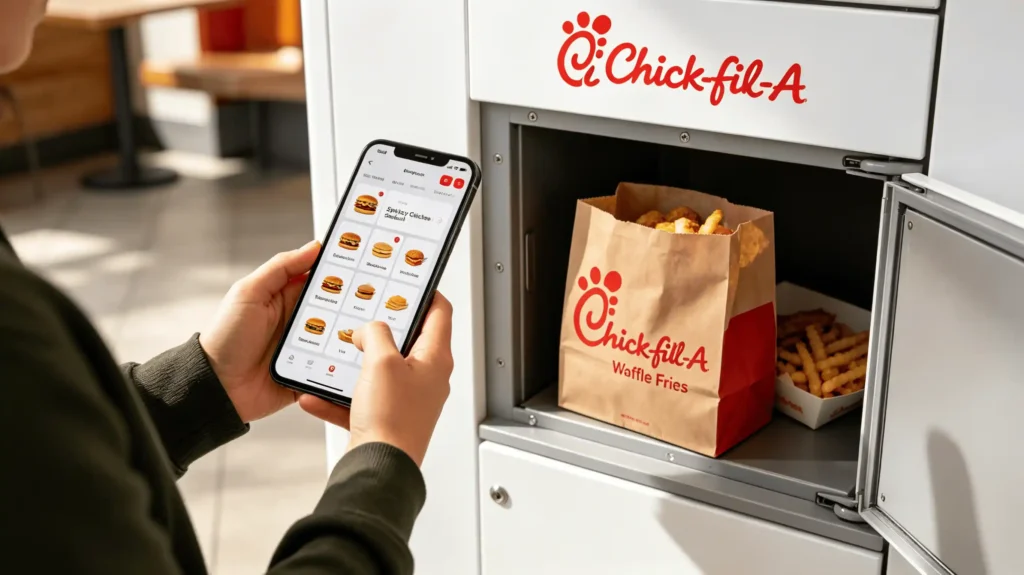
At the pickup points of Chick-fil-A or some ghost kitchens, you will see an entire wall of grids. When you place an order via your phone and make the payment, the restaurant will put the prepared food into a cabinet with heating or insulation functions. When you arrive at the store, scan the QR code and “click” sound, the cabinet door will pop open.
Why did it suddenly become so popular?
- Completely contactless delivery: riders and customers pick up their own food separately.
- This avoids misplacing or forgetting meals.
- It saves manpower on front desk packing and ordering. It’s also available at Grab-and-Go stores in airport terminals: passengers order near their boarding gates, scan the code at the pickup locker, and take their food immediately. The timing and workflow are perfectly synchronized.