Retail Store Organization Products: The Ultimate Guide for Wholesale Buyers

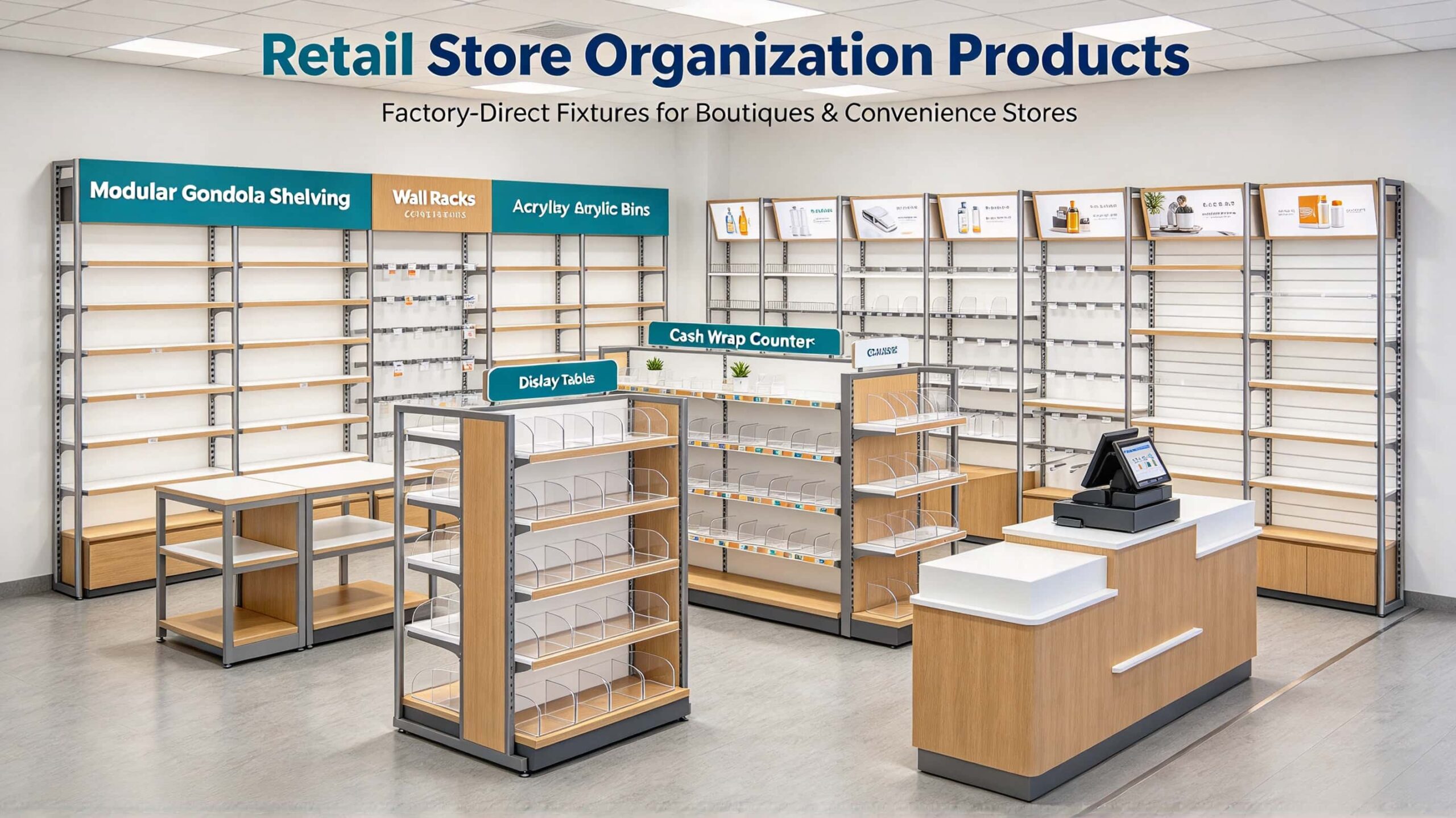
I’ve spent 18 years on the factory floor, bending metal, cutting wood, and watching containers of retail store organization products leave our dock. Most buyers overpay for generic fixtures that don’t fit their aisles. This guide is what I tell wholesale buyers before they place a PO. No fluff, just what works.
What Are the Best Organization Products for Retail Stores?
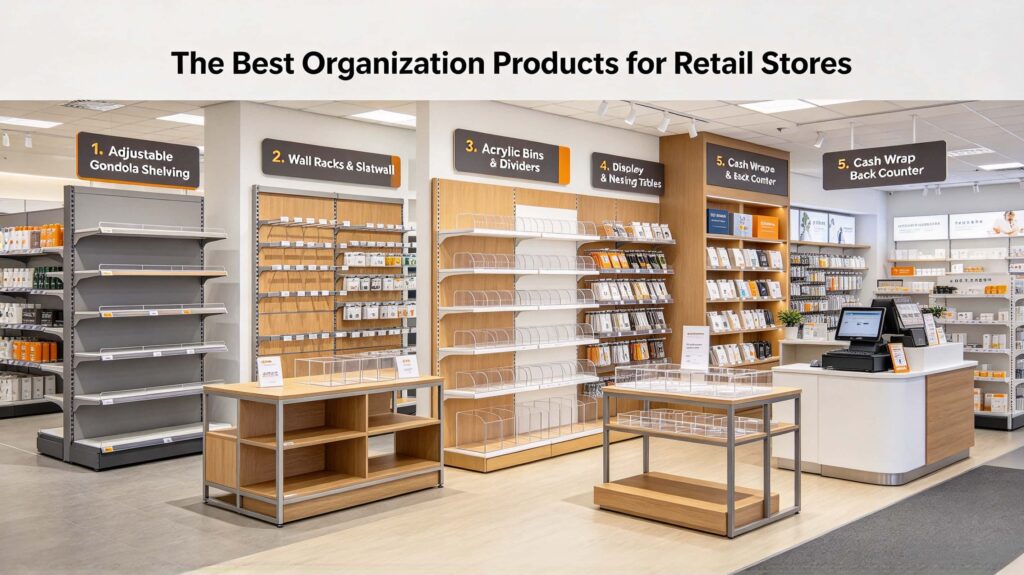
The best retail store organization products are modular gondola shelving, wall-mounted racks, acrylic bins, display tables, and cash wrap counters. They must match your product size, traffic flow, and brand look. For wholesale buyers, I recommend starting with adjustable shelving, then adding bins and racks as your SKU count grows. Avoid one-size-fits-all kits.
Let me break that down from a factory perspective. We build thousands of store fixtures every month. The winners adjust. A shelf that moves up or down by one inch saves you from re-ordering when packaging changes. A rack that holds 80 lbs per arm beats a pretty rack that sags in six months. Wholesale buyers should think in modules, not matched sets.
1. Adjustable Gondola Shelving
Gondola shelving is the backbone of convenience stores, pharmacies, and grocery aisles. We roll-form steel, then powder-coat it. Key specs: 1.5-inch hole spacing, 300-500 lb capacity per shelf, and a solid or perforated back panel. Order end caps separately—they sell high-margin impulse items.
2. Wall Racks and Slatwall
Wall racks free up floor space. We cut slatwall from MDF with aluminum inserts, or weld steel wall-mounted racks for heavy tools. Boutiques love faceouts and waterfall arms. Convenience stores prefer straight arms and deep shelves. Tell your factory the weight per item; we’ll pick the gauge.
3. Acrylic Bins and Dividers
Acrylic bins organize small, high-theft items: cosmetics, phone accessories, batteries. We bend 3mm or 5mm acrylic, then polish edges. Cheap bins crack at screw holes. Ask for custom acrylic dividers that lock into your shelf pitch. That keeps retail store organization products working as one system.
4. Display Tables and Nesting Tables
Display tables create a pause in the shopping loop. We build nesting tables with birch plywood and laminate, or steel frames with wood tops. Boutiques use them for seasonal stories. Convenience stores use small versions for promo stacks. Get casters if you change layouts often.
5. Cash Wrap and Back Counter
Your cash wrap is the last chance to sell. We integrate impulse bins, bag racks, and lockable drawers. The back counter hides clutter and holds returns. Measure your register, scanner, and bag sizes before you approve the drawing. A 2-inch mistake means a bad install day.
How to Choose the Right Retail Organization Products for Your Store?
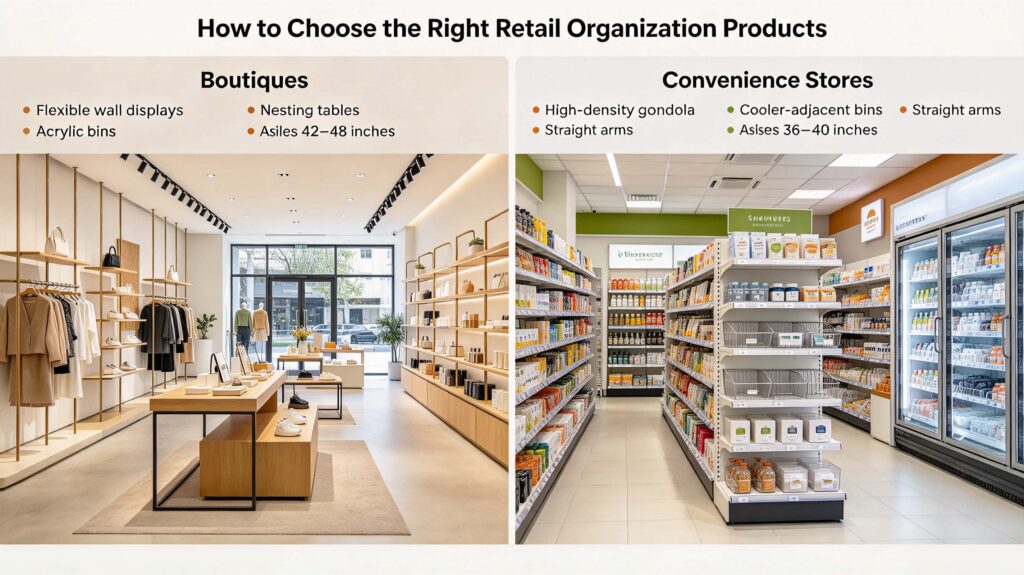
Choose by format first. Boutiques need flexible wall displays, nesting tables, and acrylic bins to rotate seasonal goods. Convenience stores need high-density gondola shelving, cigarette racks, and cooler-adjacent bins for fast turnover. Measure your aisles, count SKUs, and set a wholesale fixture budget before you request samples.
I’ve walked hundreds of stores. The ones that feel easy to shop have fixtures that match the buying mission. A boutique customer touches, browses, and compares. A convenience customer grabs, pays, and leaves. Your retail organization products must support that behavior, not fight it.
Boutiques vs. Convenience Stores: A Factory Comparison
For boutiques, we use lighter steel, wood veneers, and adjustable wall displays. Aisles can be 42-48 inches. You want negative space. For convenience stores, we use heavy-duty gondola shelving with 1.5-inch pitch, wire baskets, and cooler-adjacent bins. Aisles drop to 36-40 inches. You want density. Same factory, different spec sheet.
Questions to Ask Before You Buy
What is the load rating per shelf? What is the finish—powder coat, laminate, or raw wood? What is the MOQ for custom retail displays? What is the lead time? What is the freight class? If a supplier can’t answer these, you’re talking to a trader, not a factory.
How We Help Retailers Update Their Product Offering
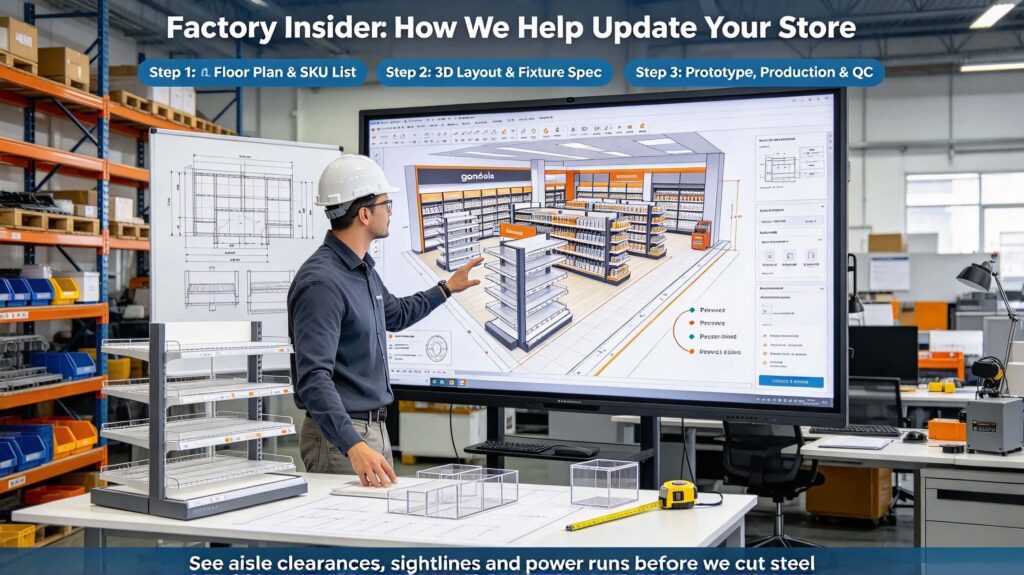
We start with your store floor plan, SKU list, and photos. Then our engineers build a 3D layout using custom retail displays and standard store fixtures. You see aisle clearances, sightlines, and power runs before we cut steel. That cuts rework, freight waste, and “oops” moments at install.
Here’s the real factory view. Most retailers don’t need a full remodel. They need a smart update. We take your existing gondola shelving and add new end caps, acrylic bins, or a cash wrap upgrade. That refreshes the store for 20-30% of a full rebuild. Wholesale buyers love this because they can test a new layout in one zone before rolling it out.
Step 1: Send Your Floor Plan and SKU List
We need dimensions, door locations, power outlets, and ceiling height. A phone photo of your current aisles helps. A simple SKU list with item sizes and weights tells us shelf depth and load rating. If you have a store floor plan in PDF or CAD, even better. We redraw it in 3D.
Step 2: 3D Layout and Fixture Spec
Our engineers place gondola shelving, wall racks, display tables, and impulse bins. You see the shopping loop, aisle widths, and sightlines. We adjust until it works. Then we send a fixture spec: material, finish, dimensions, load rating, and quantity. No surprises.
Step 3: Prototype, Production, and QC
For custom retail displays, we build a sample or a 3D render first. After approval, we cut steel or wood, powder-coat or laminate, and assemble. QC checks welds, edges, and hole alignment. We load the container with wholesale store fixtures and send photos before it leaves. You know exactly what’s coming.
Why Choose Custom Factory Direct vs. Buying Ready-Made?
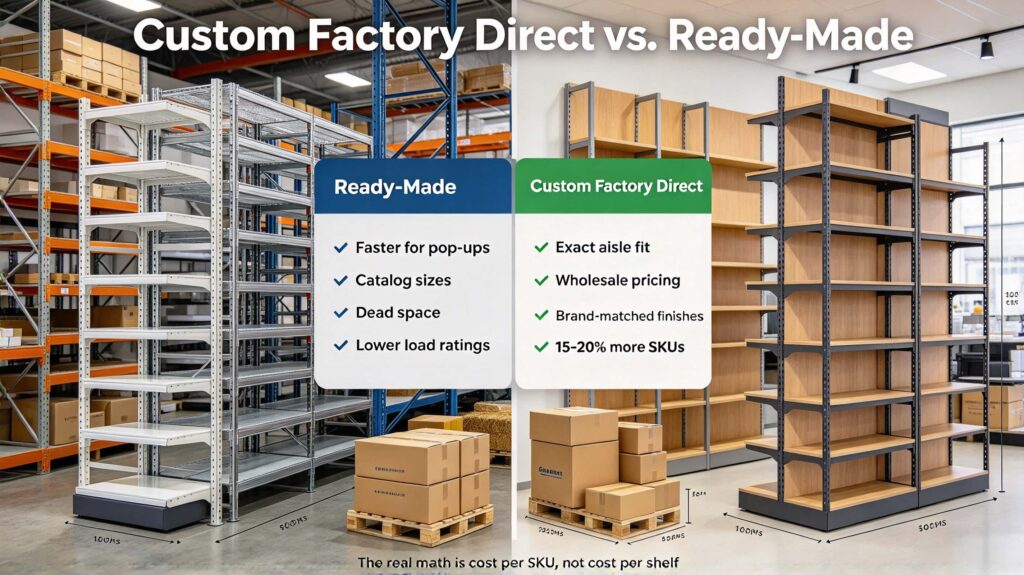
Custom factory direct wins when your aisles, brand, or SKU mix don’t fit catalog sizes. You get exact dimensions, wholesale pricing without middleman markup, and control over materials and finishes. Ready-made is faster for pop-ups, but you pay for compromises: dead space, weak load ratings, and generic look.
I’ll be blunt. Ready-made fixtures are fine if you’re opening a temporary shop or you have a perfect 48-inch aisle. But most stores have a column, a weird corner, or a cooler that eats 6 inches. Custom factory direct solves that. You pay for the fixture, not for three layers of sales reps. And you can brand the finish to match your logo.
Cost Comparison: Custom vs. Ready-Made
Ready-made looks cheaper per unit. But add freight, duty, and the cost of dead space. A custom retail display that fits your aisle often holds 15-20% more SKUs. That’s more sales per square foot. For wholesale buyers, the real math is cost per SKU, not cost per shelf. Ask your factory for a loaded cost comparison.
Lead Times and MOQs
Ready-made ships in 3-7 days from a local warehouse. Custom factory direct takes 25-45 days plus ocean freight. MOQs are usually 50-100 units per SKU. If you need 20 gondola shelving units, ready-made may win. If you need 200 units with a custom color, factory direct wins on price and fit.
What Materials and Finishes Should Wholesale Buyers Look For?
Match material to traffic and product weight. Powder-coated steel for convenience store shelving; birch plywood or MDF with laminate for boutique displays; acrylic for small parts and impulse bins. Ask for edge-banding, scratch tests, and load ratings. Cheap particleboard fails in humid stores; thin acrylic cracks at screw points.
This is where I see wholesale buyers lose money. They approve a sample that looks great, then the production run uses a thinner gauge or a cheaper finish. You must lock the spec. Write “18-gauge steel” not “metal.” Write “3mm acrylic” not “plastic.” Write “powder coat 60-80 microns” not “black.” Your factory should welcome this. Good factories want clear specs.
Steel vs. Wood vs. Acrylic
Steel is for high traffic, heavy goods, and fire-rated spaces. Wood is for warmth, brand, and light goods. Acrylic is for visibility, small parts, and impulse buys. We mix them: steel gondola shelving with wood end panels and acrylic bins. That gives you durability and a boutique look. Tell your factory the mix you want.
Finish Checklist for Wholesale Buyers
Ask for: powder coat thickness, salt spray test hours, laminate grade, edge-banding type, acrylic thickness, and load rating per shelf. Also ask for a pre-production sample. If the factory refuses, walk away. A real factory will send a sample because they know a bad container costs more than a sample.
How to Plan Your Retail Store Layout with Organization Products?
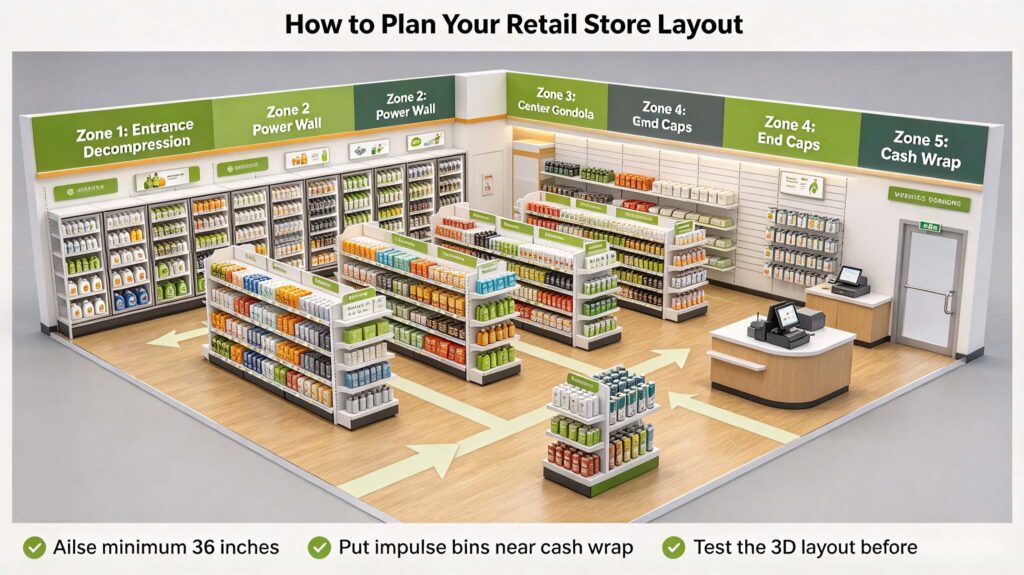
Start with a measured floor plan and mark your power outlets, doors, and fixed walls. Then place gondola shelving and wall racks to create a clear loop. Keep aisles at least 36 inches for wheelchairs and carts. Put impulse bins near the cash wrap. Test the 3D layout before you order.
Layout is not decoration. It’s traffic engineering. We use a simple 5-zone model. You don’t need software. You need a tape measure and a factory that will draw it in 3D. Wholesale buyers who plan the loop before ordering fixtures save 10-15% on freight because they don’t order extra pieces “just in case.”
The 5-Zone Retail Layout
Zone 1: Decompression at the entrance. Keep it open. Zone 2: Power wall on the right—high margin. Zone 3: Center gondola shelving for daily needs. Zone 4: End caps for promotions. Zone 5: Cash wrap with impulse bins. This loop works for boutiques and convenience stores. Adjust aisle widths by format.
Common Layout Mistakes Factories See
Blocking power outlets. Forgetting ceiling height for tall wall racks. Ordering gondola shelving without end caps. Putting acrylic bins in direct sunlight. Using 48-inch aisles in a convenience store. These mistakes cost money. Send us your plan early. We’ll catch them before production.
Send Your Floor Plan and Product Mix for a 3D Layout and Factory Quote
Send us your store floor plan, product mix, and photos. Our factory team will return a 3D layout and a factory quote for custom retail displays, gondola shelving, and wholesale store fixtures. No middleman, no guesswork. Tell us your aisle widths and SKU counts. Let’s build fixtures that fit your store, not a catalog.
This is the part where I stop talking and start drawing. Send your store floor plan and product mix. We’ll send back a 3D layout and a factory quote. You’ll see exactly how retail store organization products fit your space. No obligation. No pushy sales. Just a factory opinion from someone who has loaded thousands of containers.
Contact our factory engineering team today. Email your floor plan and SKU list. We’ll reply with a 3D layout and a factory quote within 3 business days. Let’s build wholesale store fixtures that sell.