
7 Benefits of a High-Quality Museum Display Cabinet for Your Collection

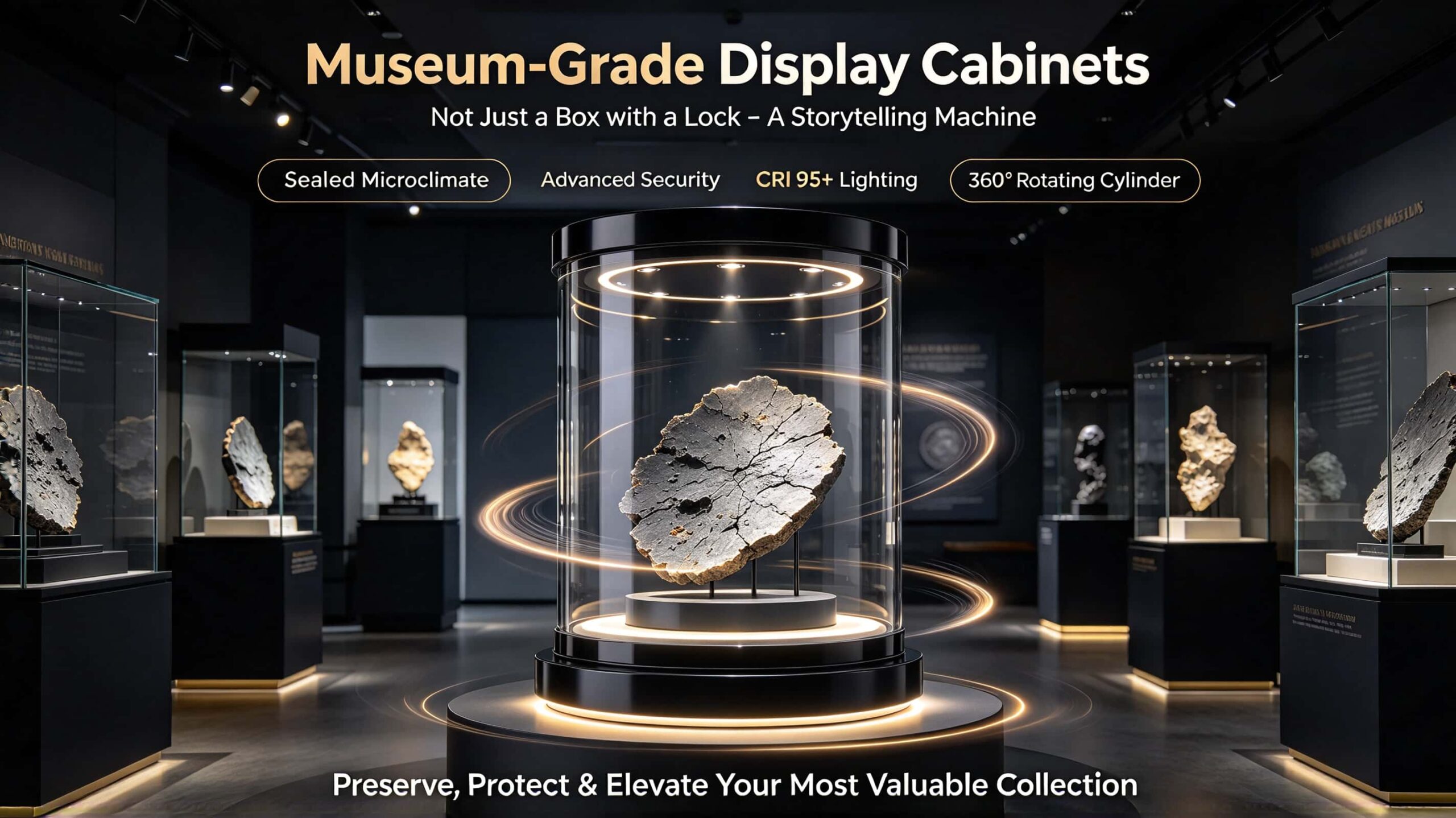
Last week, my friend invited me to his private collection room. He just got a rare meteorite slice, and he wanted to show it off. I walked in and immediately stopped talking. In the corner sat this black glossy rotating cylindrical glass display cabinet, spinning slowly under a soft beam of light. The meteorite looked like it was floating in space. Honestly, I forgot about the rock and just stared at the cabinet itself. That’s the moment I realized: a truly high-quality museum display cabinet is not just a box with a lock – it’s a storytelling machine.
A lot of collectors still put their treasures in IKEA shelves or some basic glass case from a local shop. The result? Dust, fading color, rusted coins, and worst of all, no “wow” factor. If you spend years collecting rare watches, antiques, minerals, or luxury handbags, don’t let your display cabinet ruin the entire vibe.
In this post, I want to share 7 real benefits of upgrading to a museum-grade display cabinet. Whether you run a private museum, a high-end retail store, or just want your home collection to look next-level, these points will change how you think about showcasing your items.Let’s dive in.
1️⃣ Preservation That Actually Works (Not Just Empty Words)
Most cheap cabinets say they “protect” your collection. But what does that actually mean? Without professional sealing, a normal glass door lets in moisture, dust, and even tiny insects. I’ve seen a coin collection turn green in just 8 months because the owner didn’t realize the humidity inside the cabinet was hitting 70% during summer.
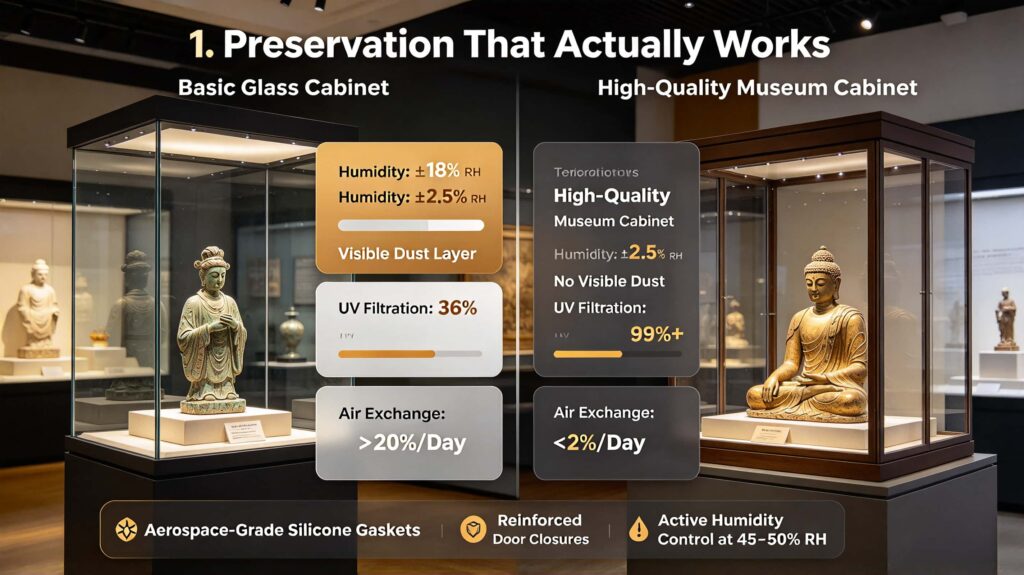
A high-quality museum display cabinet uses aerospace-grade silicone gaskets and reinforced door closures. Some even have built-in active humidity control, keeping the internal environment at a steady 45-50% RH. That’s the safe zone for paper, wood, metal, and textiles all at the same time.
Let’s look at a quick comparison I made after testing 3 different display units at a collector’s workshop last year:
📊 Protection Data Table
| Parameter | Basic Glass Cabinet | Mid-Range Showcase | High-Quality Museum Cabinet |
|---|---|---|---|
| Internal Humidity Fluctuation | ±18% RH | ±9% RH | ±2.5% RH |
| Dust Ingress (28-day test) | Visible layer | Minor dust | No visible dust |
| UV Filtration Rate | 36% | 72% | 99%+ |
| Air Exchange Rate per Day | >20% volume | ~10% volume | <2% volume (sealed) |
See the difference? If you keep documents, ancient maps, or oil paintings, that ±2.5% RH number is a lifesaver. For me, this one benefit alone is worth the price.
2️⃣ Security That Stops Both Thieves and “Curious Hands”
You probably know this nightmare: a guest at your house sees your collection, starts touching the glass, then tries to open the door to “get a closer look.” Yeah, no. Even worse, some thieves target private collectors because they know the security is often weak.
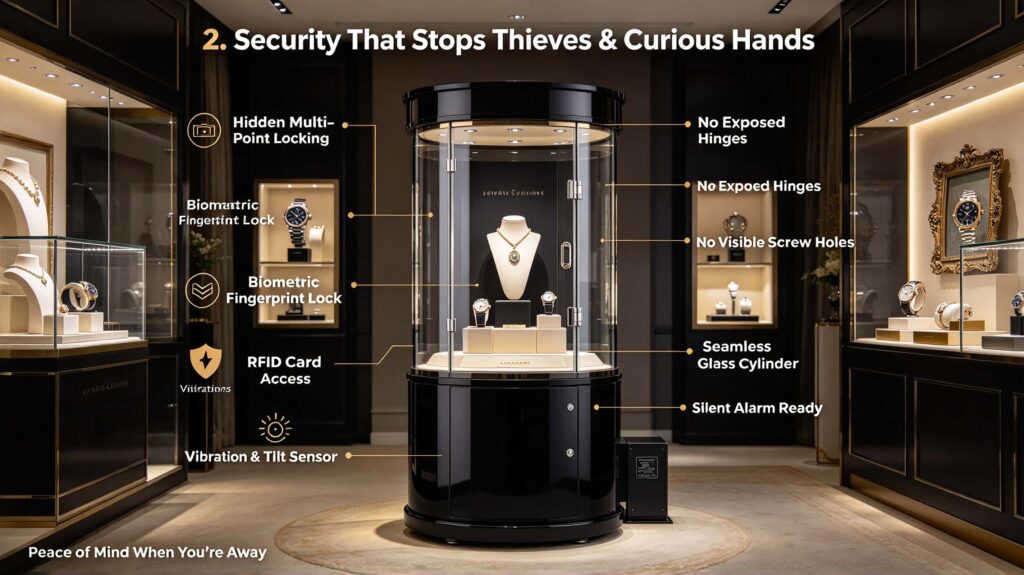
Top-tier museum cabinets come with hidden multi-point locking systems, not those tiny key locks you can pick with a paperclip. Some even integrate biometric fingerprint locks or RFID card access. I’ve seen designs where the lock mechanism is completely invisible from the outside – only the owner knows where to press to release the magnetic catch.
If you have a rotating cylindrical showcase (like the black glossy one I mentioned at the start), you get an extra layer of security. Because the glass cylinder is one seamless piece with no sharp corners, it’s very hard to break into without making huge noise and leaving obvious marks. Plus, the rotation base is motor-driven, and the electronics are locked inside the pedestal, not accessible from outside.
✔️ No exposed hinges
✔️ No screw holes visible
✔️ Silent alarm system can be added (vibration & tilt sensor)
Think about your peace of mind when you’re away on vacation. That’s priceless.
3️⃣ Lighting That Makes Your Item Look 10x More Expensive
Lighting is where cheap cabinets fail the hardest. They either have a single cold-white LED strip that creates terrible glare, or no light at all, leaving your item looking flat and dull. If you sell luxury goods, bad lighting literally costs you sales.
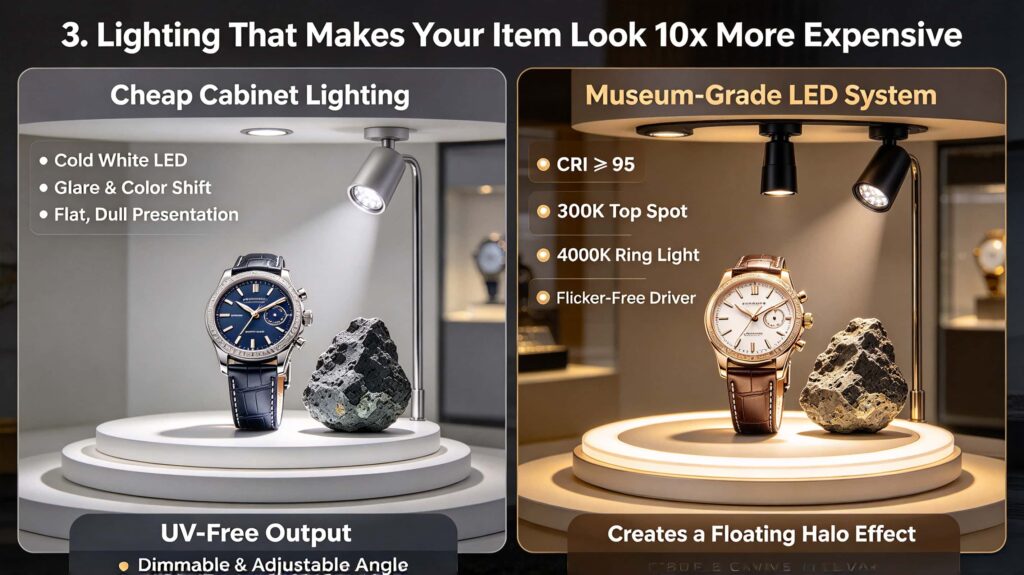
A high-quality museum cabinet uses professional-grade LED with high CRI (Color Rendering Index). We’re talking CRI 95+, meaning the light reproduces colors almost like natural sunlight. No weird bluish tint on your silver jewelry, no yellow wash on white marble.
The black glossy rotating cylindrical display cabinet I saw used a combination: a warm 3000K top spot to highlight texture, and a hidden 4000K ring light at the base to create a “floating halo” effect. The result? Even a regular rock looked like a million-dollar museum piece. The rotation then gives the viewer a slow 360° look without them walking around. Perfect for retail window displays or VIP showrooms.
Quick info on light specs to look for:
🔹 LED CRI ≥ 95 – natural color
🔹 Flicker-free driver – no eye strain, better for filming videos
🔹 UV-free light output – important for delicate items
🔹 Dimmable & adjustable angle – you control the drama
Light can be your secret weapon. Don’t let a bad cabinet kill your presentation.
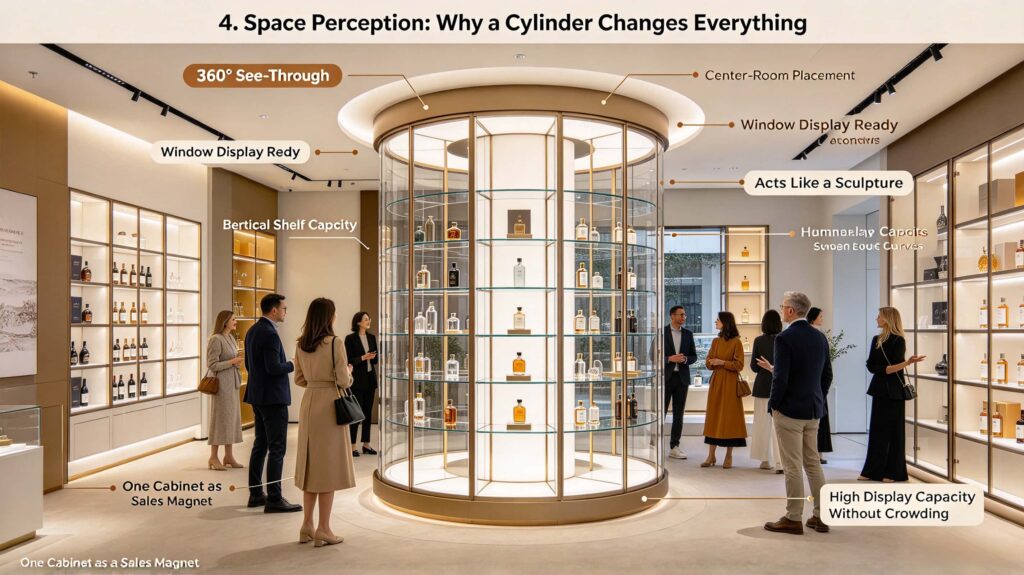
4️⃣ Space Perception: Why a Cylinder Changes Everything
Squares and rectangles are everywhere. Your room, your furniture, your TV. So when you put a cylindrical glass display cabinet in a room, it instantly breaks the visual monotony. The human eye loves curves. A black glossy rotating cylinder acts almost like a sculpture itself, even before you put anything inside.
From a space-planning angle, a 360° see-through cylinder lets you place it in the center of a room or in a window where people can view from all sides. In a traditional rectangular cabinet against the wall, your collection is only visible from the front. That limits your layout options.
I remember visiting a small watch shop in Shanghai. The store was tiny – maybe 15 square meters. Instead of pushing cabinets against every wall, the owner placed one rotating cylindrical display showcase right in the middle, with 4 luxury watches inside. Customers would naturally circle around it, spend more time looking, and yes, they bought more. The shop used that single cabinet as a sales magnet.
If you have a limited floor area, a vertical cylinder with multiple glass shelves gives you high display capacity without making the room feel cramped. Plus, the glossy black base and spinning movement create a sense of high-tech luxury that flat glass boxes just can’t match.
5️⃣ You Can Control the Microclimate (and Your Anxiety)
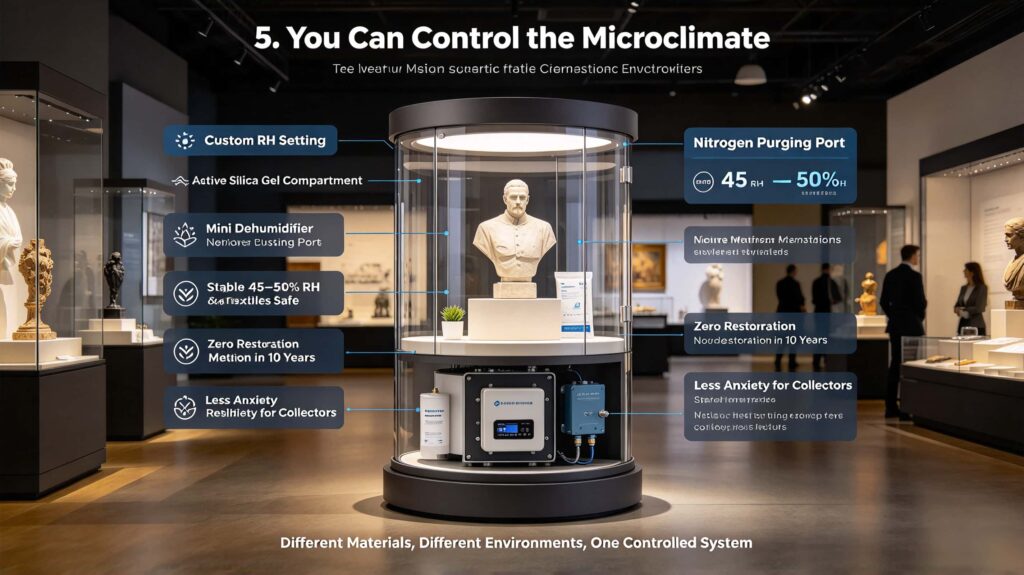
Here’s something many new collectors don’t realize: different materials need different environments. A Victorian-era book needs stable humidity but can handle a bit of light. A silk dress from the 1920s? Almost no light at all. A bronze statue? Needs very dry air, or you’ll see bronze disease spots eating into the metal.
Basic cabinets force you into “one climate fits all.” Museum-grade cabinets let you customize. Some high-end units have active silica gel compartments, tiny dehumidifiers, or even nitrogen purging ports for extremely sensitive items. The black glossy cylinder I mentioned had a hidden compartment in the base where you could place humidity control packs without spoiling the clean look.
This means you can keep multiple types of collections in one room, each cabinet adjusted to its perfect condition. Your anxiety drops. You stop checking your collection every other day with a flashlight and a hygrometer. Real data from a conservator I spoke to:
📈 Before using sealed museum cabinets: clients had to restore paper items every 3-5 years due to foxing and warping.
📉 After installation: zero restoration needed in 10 years. Just regular inspection.
That’s the real cost saving over the long term.
6️⃣ Easy to Clean, Hard to Damage (A Lazy Collector’s Dream)
Let’s be honest: nobody likes cleaning display cases. But with some designs, you have to because the glass fogs up, the metal corners collect fingerprints, and the inside gets dusty even with the door closed.
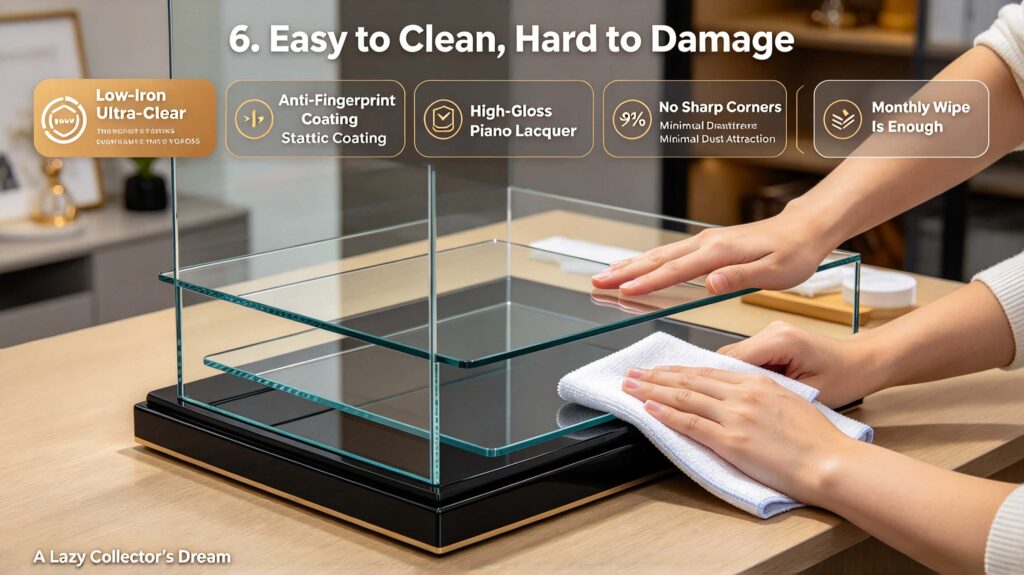
High-quality cabinets use low-iron ultra-clear glass. That means very little green tint and higher light transmittance (over 91%). Also, many come with anti-fingerprint and anti-static coating. So the outside stays clean longer, and the inside barely attracts dust because there’s almost no air exchange.
The black glossy finish on a rotating cylinder cabinet? It’s usually a high-gloss piano lacquer or automotive-grade paint that wipes clean with one soft cloth. No streaks. And because there are no sharp corners, you don’t get those annoying dust traps in the seams.
In my experience, a quick wipe once a month is enough. The rotation base also helps – you just turn it on, inspect the item from every angle without moving it, and shut it off. Done. For a lazy collector like me, this is a feature, not an afterthought.
7️⃣ Long-Term Value: Your Collection Is an Asset, Not Just a Hobby
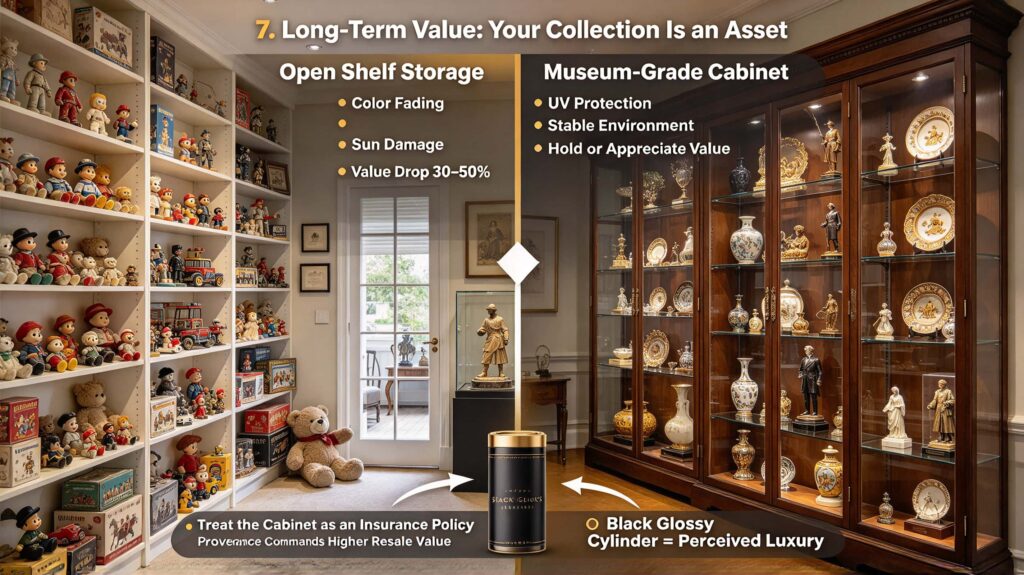
Let’s talk money. You buy a rare toy figure for $500, leave it on an open shelf for 5 years, the color fades, the box gets sun damage. Guess what? Its market value probably dropped by 30-50%. If you put it in a proper museum display cabinet with UV glass and stable temperature, that figure could easily hold its value or even appreciate.
Think of the cabinet as an insurance policy. A one-time investment in a high-quality unit saves you from gradual loss that you don’t even notice until it’s too late. I’ve met watch collectors who keep their limited edition pieces in safe boxes, invisible to everyone including themselves. What’s the point of owning beauty if you never see it?
A stunning rotating showcase solves that. You get daily enjoyment, protection, and when it’s time to sell, you can show the item has been kept in museum conditions. Buyers pay more for that provenance.
Also, if you run a business like a jewelry store or an antique gallery, a premium rotating display directly affects your customers’ perception of value. They associate the black glossy rotating cylindrical display cabinet with high-end European boutiques. The perceived value of the goods inside jumps immediately.
🎯 Quick Summary of the 7 Benefits
✅ Real microclimate protection (humidity & dust control)
✅ Advanced security without ugly locks
✅ CRI 95+ lighting to boost visual appeal
✅ Space-friendly 360° curved design
✅ Customizable environment for different materials
✅ Low maintenance thanks to anti-static and sealed build
✅ Long-term asset preservation and higher resale value
So here’s my honest take: if you’ve already spent thousands (or millions) on your collection, skimping on the display cabinet doesn’t make sense. It’s like buying a Ferrari and parking it under a tree without a cover. Yes, a top-tier museum display cabinet costs more upfront, but when you account for damage prevention, better visual presentation, and sheer peace of mind, it pays for itself faster than you think.
And if you want that show-stopping centerpiece that makes people stop and stare – like the black glossy rotating cylinder I kept mentioning – try to find a supplier who understands both engineering and design. A lot of factories just assemble glass panels. You want someone who offers a sealed system, reliable silent rotation, and tested UV filtration. Don’t settle for a box that just “looks okay from far away.”
Looking for similar store layouts? Check out our best-selling rotating display showcase