
Commercial Coffee Counter: The Ultimate B2B Guide to Sizes, Materials & Costs

The right commercial coffee counter drives workflow, durability, and profit. This guide covers standard dimensions, the best materials for heavy use, real 600 sqft build costs, and 2025 design trends — everything B2B buyers need before ordering a custom unit.
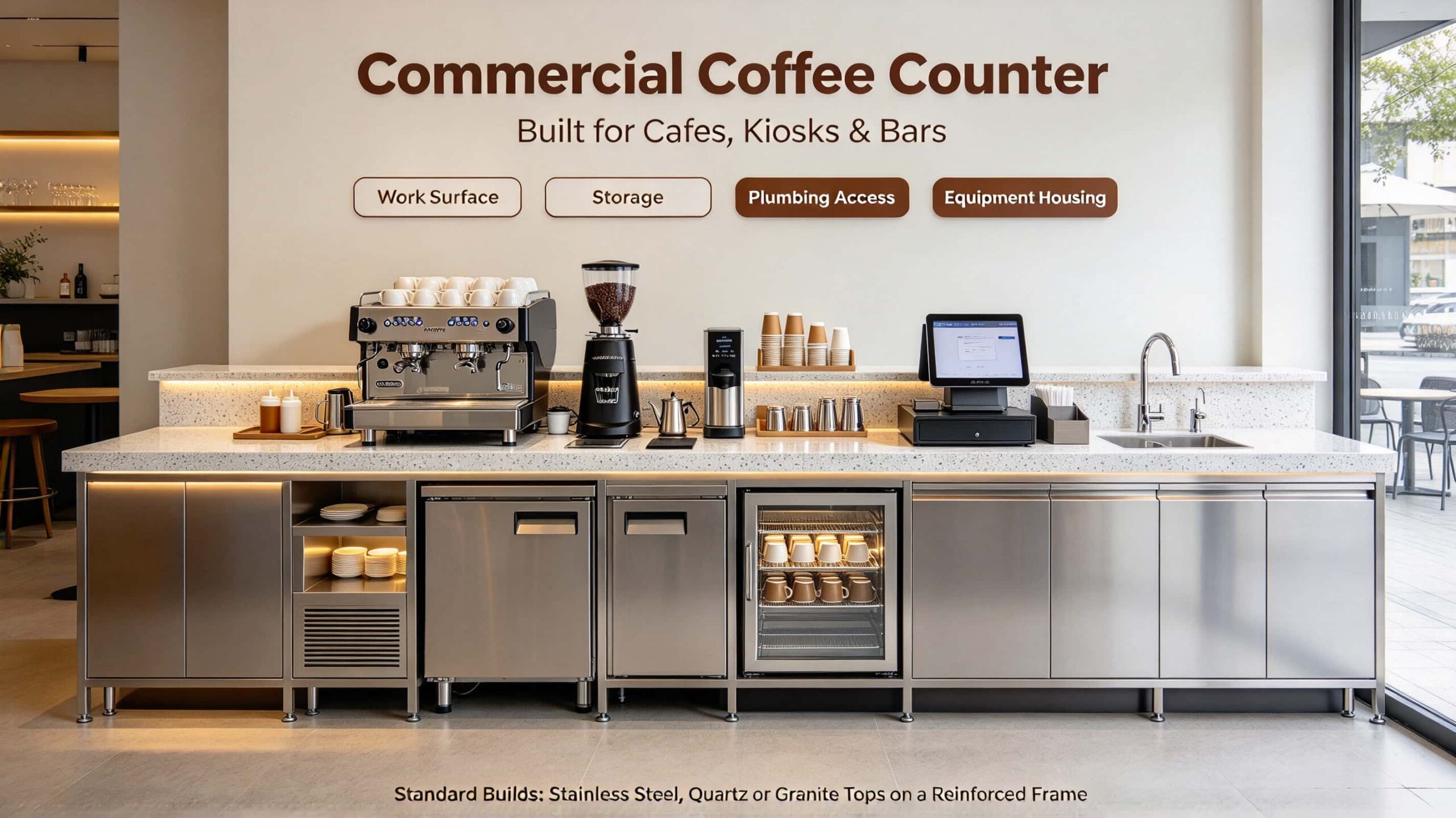
A commercial coffee counter is a heavy-duty service station built for cafes, kiosks, and bars. It combines a work surface, storage, plumbing access, and equipment housing in one unit. Standard builds use stainless steel, quartz, or granite tops on a reinforced frame, sized to fit espresso machines, grinders, POS systems, and customer flow.
What is the standard size of a coffee counter?
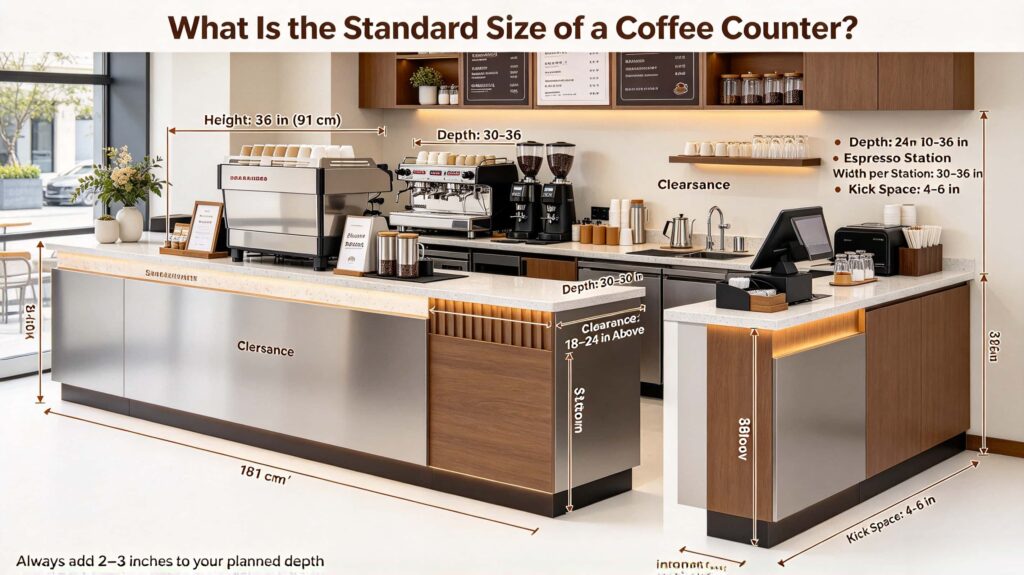
The standard commercial coffee counter is 36 inches high, 24–30 inches deep, and 30–36 inches wide per station for espresso machines. Height suits standing baristas; depth handles grinders and tampers; width gives each machine breathing room. Custom builds adjust these numbers to your floor plan.
- Height: 36 in (91 cm) finished top — ergonomic for standing work
- Depth: 24–30 in (61–76 cm) for basic service; 30–36 in for espresso stations
- Width per station: 30–36 in (76–91 cm) for a 2-group espresso machine
- Clearance: 18–24 in above counter for steam wands and hoppers
- Kick space: 4–6 in recessed toe kick for comfort and cleaning
Factory Insider Tip: Always add 2–3 inches to your planned depth. Baristas never complain about too much room, but they will complain about a grinder hanging over the edge.
How deep should a coffee counter be?
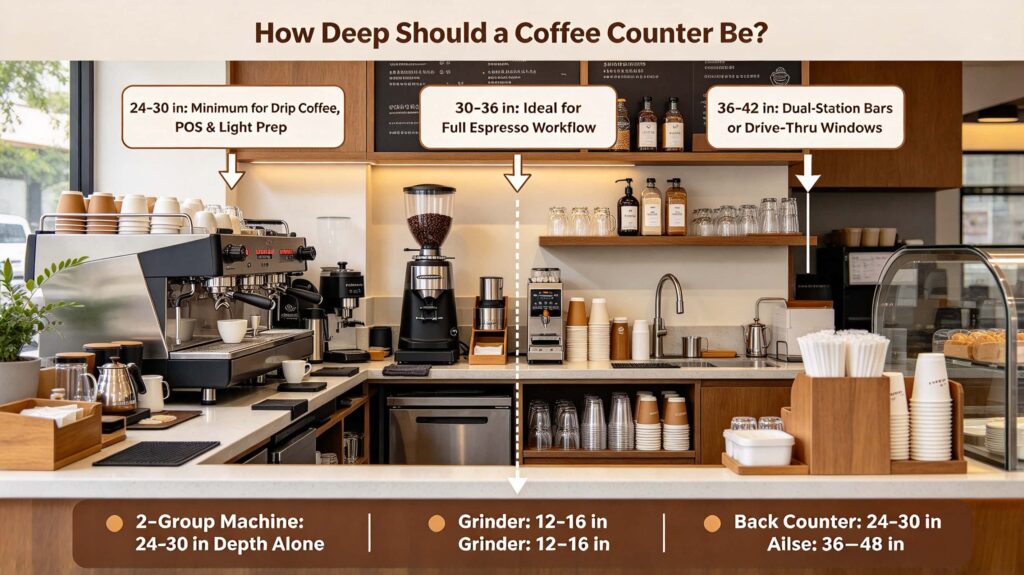
For a working cafe, make your coffee counter 30–36 inches deep. That range gives you room for an espresso machine, grinder, scale, tamp station, and cup storage without crowding. Anything under 24 inches forces baristas to work sideways and slows peak-hour service.
- 24–30 in: Minimum for drip coffee, POS, and light prep
- 30–36 in: Ideal for full espresso workflow — machine, grinder, tamp, knock box
- 36–42 in: Needed for dual-station bars or drive-thru windows
- Back counter: 24–30 in deep, leaving 36–48 in aisle between front and back
Layout math: A 2-group espresso machine needs 24–30 in of depth alone. Add a grinder (12–16 in) and you are already at 36–42 in if you want them side by side. Most cafes run the grinder on a separate riser or shelf.
Factory Insider Tip: If your space is tight, go deeper rather than wider. A 32-inch deep counter with a 10-inch riser beats a 24-inch counter every time.
What is the best countertop material for a commercial bar?
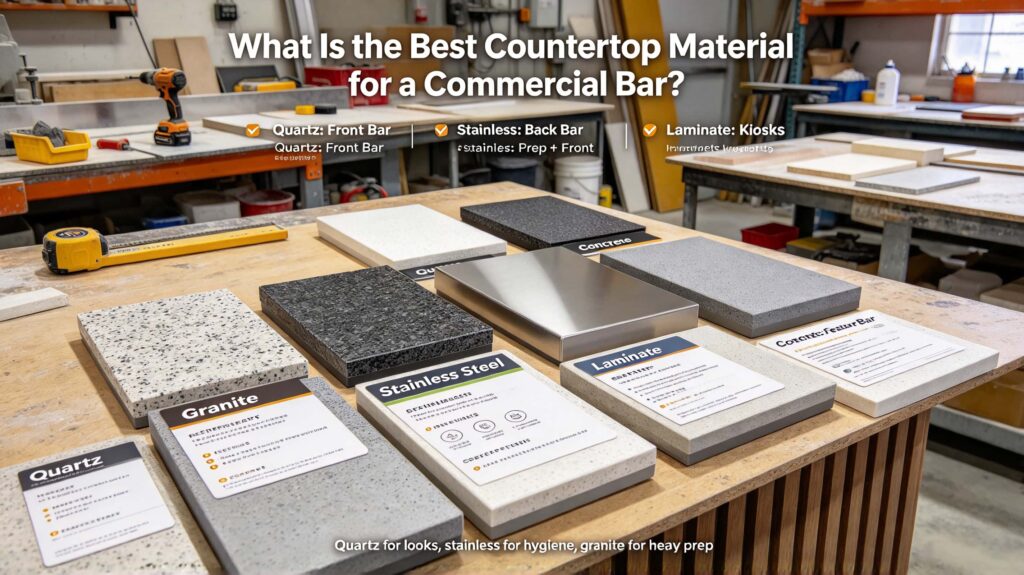
The best countertop material for a commercial bar depends on heat, stains, and traffic. Quartz wins for looks and non-porosity. Stainless steel wins for hygiene and heat. Granite wins for raw durability on a budget. Most B2B buyers pick quartz for front-of-house and stainless for back-of-house.
- Quartz: Non-porous, stain-resistant, 93% natural stone + resin. Handles heat up to ~300°F with trivets. Best for customer-facing bars.
- Granite: 100% natural, heat-proof, scratch-resistant. Needs sealing every 1–2 years. Great for heavy prep zones.
- Stainless steel: Non-porous, heat-proof, NSF-approved. Shows scratches and smudges. Standard for back bars and prep.
- Laminate: Cheap, light, not heat-proof. Only for low-volume kiosks.
- Concrete: Trendy, heavy, can crack. Requires professional sealing.
| Material | Heat Resistance | Stain Resistance | Cost per sq ft | Best Use |
|---|---|---|---|---|
| Quartz | High (300°F) | Excellent | $50–$120 | Front bar |
| Granite | Excellent | Good (sealed) | $40–$100 | Prep + front |
| Stainless | Excellent | Excellent | $30–$80 | Back bar |
| Laminate | Low | Fair | $15–$40 | Kiosk |
| Concrete | High | Fair | $60–$150 | Feature bar |
What is the strongest most durable countertop?
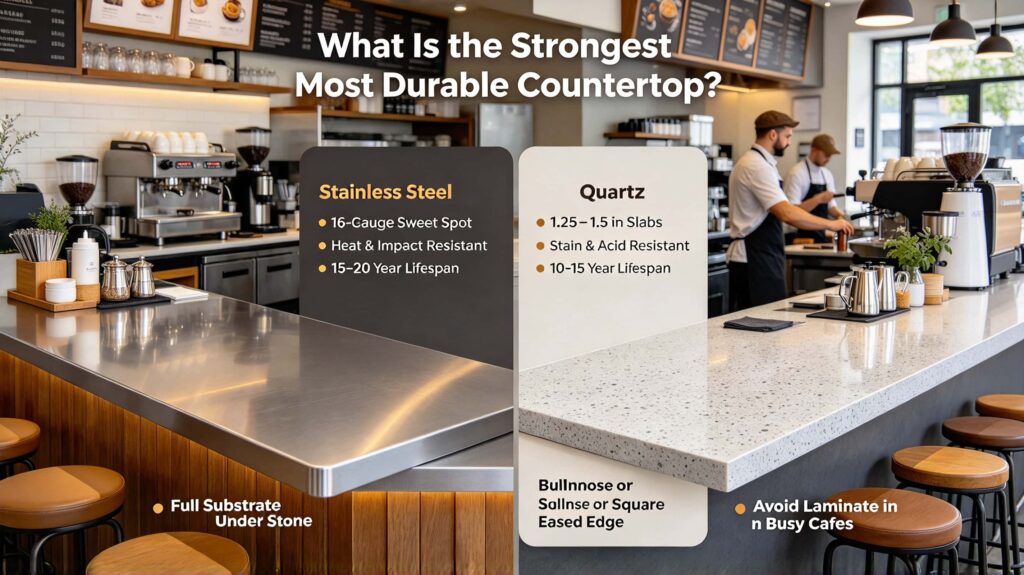
Stainless steel and quartz are the strongest, most durable countertops for commercial coffee use. Stainless steel takes heat, impact, and daily sanitizing without cracking. Quartz resists scratches, stains, and acids better than granite. For a 10-year cafe build, spec one of these two — not laminate.
- Stainless steel: 16-gauge is the sweet spot. 18-gauge dents; 14-gauge is overkill for most cafes.
- Quartz: 1.25–1.5 in thick slabs outlast 0.75 in. Look for brands with a 10-year commercial warranty.
- Granite: Strong but porous. Sealing failures cause stains.
- Edge profile: Bullnose or square eased edges resist chipping better than sharp 90° corners.
Factory Insider Tip: Ask for a full substrate under quartz. A 1.5-inch quartz top glued directly to a steel frame will crack at the sink cutout within 18 months. We see it every week.
How much would it cost to build a coffee shop in a 600 sqft?
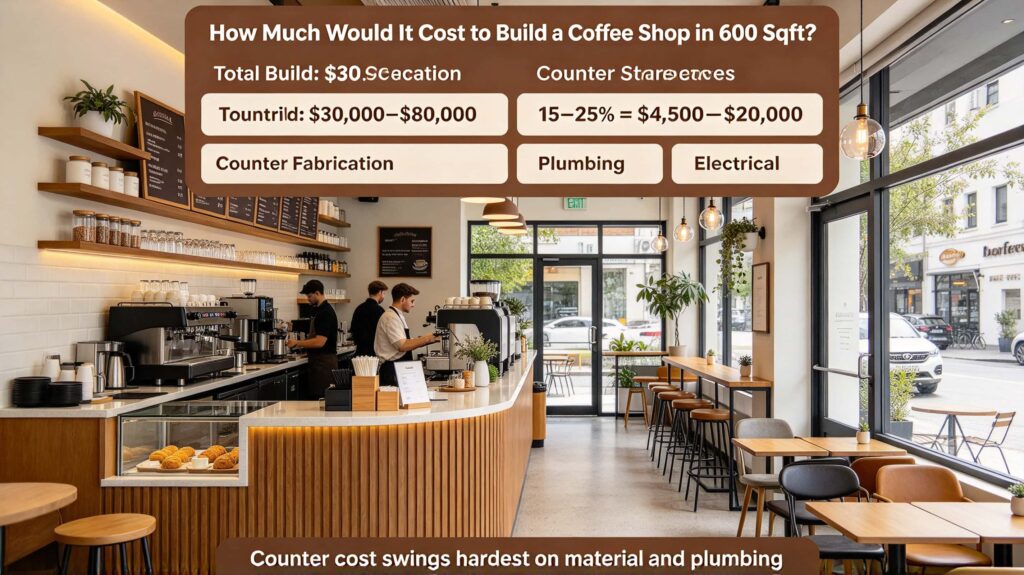
A 600 sqft coffee shop typically costs $30,000–$80,000 to build out, with the counter at 15–25% of that budget. That puts a custom commercial coffee counter at $4,500–$20,000 depending on size, material, and plumbing. Labor, permits, and equipment are separate line items.
- Total build (600 sqft): $30k–$80k
- Counter share: 15–25% = $4,500–$20,000
- Base counter (laminate, 8 ft): $2,500–$5,000
- Mid-range (quartz, 10 ft, sink + storage): $6,000–$12,000
- High-end (stainless + quartz, 12 ft, custom): $12,000–$25,000
- Plumbing rough-in: $1,500–$4,000
- Electrical (220V for espresso): $1,000–$3,000
Cost breakdown table:
| Item | Low | High |
|---|---|---|
| Counter fabrication | $4,500 | $20,000 |
| Espresso machine | $3,000 | $18,000 |
| Grinder | $500 | $3,000 |
| Refrigeration | $2,000 | $8,000 |
| Plumbing | $1,500 | $4,000 |
| Electrical | $1,000 | $3,000 |
| Flooring | $2,000 | $6,000 |
| Signage + permits | $1,500 | $5,000 |
| Total | $30,000 | $80,000 |
Factory Insider Tip: Counter cost swings hardest on material and plumbing. Moving a sink 3 feet can add $800–$1,500 in labor. Lock your layout before fabrication starts.
What is the newest trend in countertops for coffee shops?
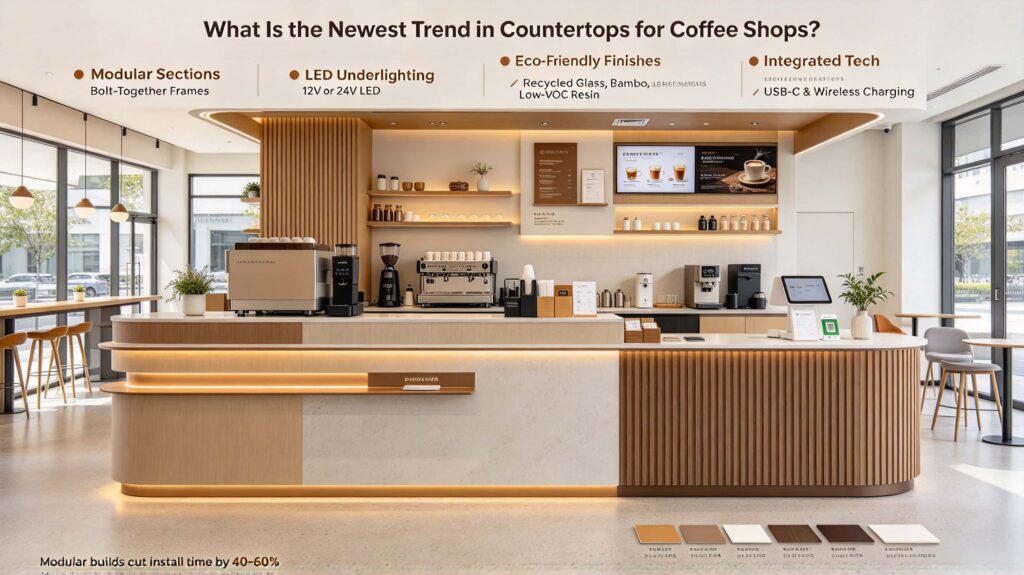
The newest trend in coffee shop countertops is modular, lit, and eco-friendly. Operators want counters that ship in sections, glow with LED underlighting, and use recycled or low-VOC finishes. Modular builds cut install time by 40–60% and let you reconfigure without a full tear-out.
- Modular sections: Bolt-together frames for fast install and future layout changes
- LED underlighting: Hidden strips for ambiance and safety; 12V or 24V
- Eco-friendly finishes: Recycled glass, bamboo, low-VOC resin, FSC-certified wood
- Integrated tech: USB-C, wireless charging pads, built-in scales
- Slim profiles: 0.75–1.25 in tops with hidden brackets for a floating look
Factory Insider Tip: Modular counters are great, but only if the factory uses CNC-cut frames. Hand-welded modular sections rarely line up on site. Ask for a tolerance spec — ±1.5mm is good, ±3mm is junk.
Custom Commercial Coffee Counter: What B2B Buyers Must Spec
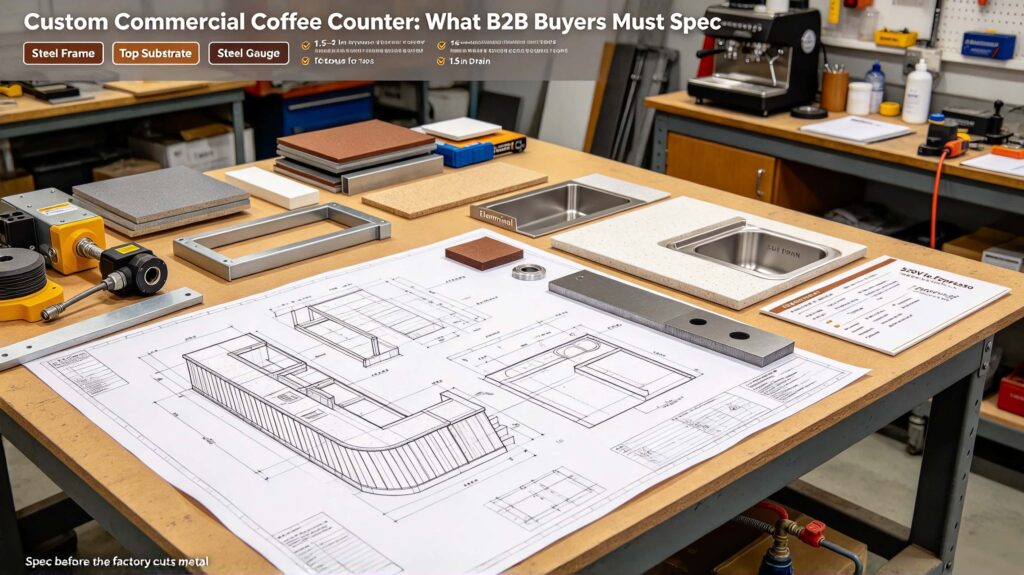
A custom commercial coffee counter is not a furniture order. It is a piece of commercial equipment. You need to spec steel gauge, substrate, edge profile, cutouts, plumbing, and electrical before the factory cuts metal. Miss one and you pay for it on install day.
- Frame: 1.5–2 in square steel tube, powder-coated or galvanized
- Top substrate: 0.75 in plywood or 18mm marine board under stone
- Steel gauge: 16-gauge for tops, 18-gauge for panels
- Cutouts: Espresso machine, sink, knock box, POS, cable grommets
- Plumbing: 1.5 in drain, 0.5 in supply, shut-off valves inside cabinet
- Electrical: Dedicated 220V circuit for espresso, 110V for grinders and POS
| Spec | Minimum | Recommended |
|---|---|---|
| Steel frame | 1.5 in | 2 in |
| Top substrate | 0.5 in | 0.75 in |
| Steel gauge | 18 | 16 |
| Edge profile | Square | Bullnose |
| Drain size | 1.25 in | 1.5 in |
Commercial Coffee Counter Dimensions: Front Bar vs Back Bar
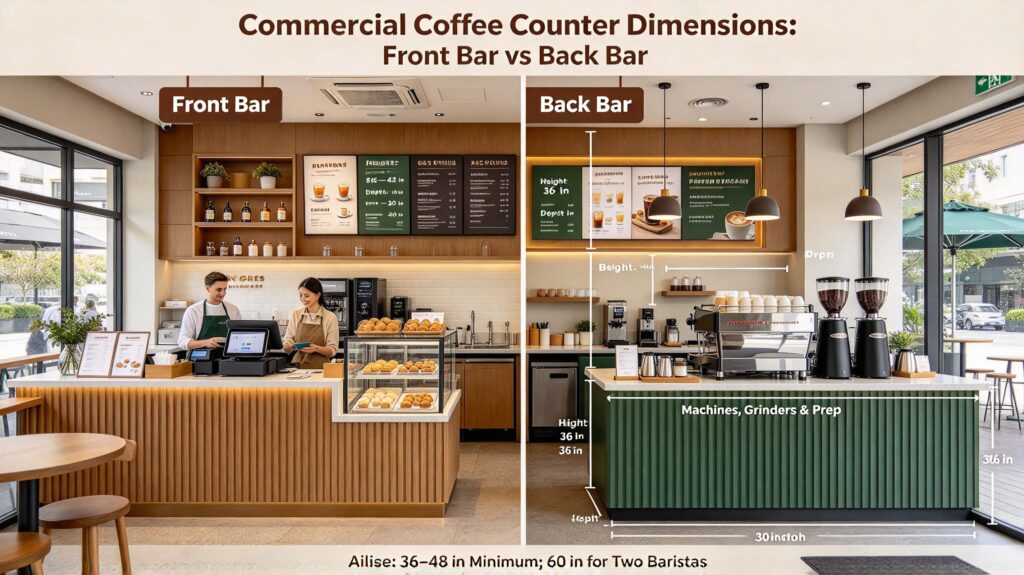
Front bar and back bar serve different jobs, so they need different dimensions. The front bar faces customers and holds POS, display, and pickup. The back bar holds espresso machines, grinders, and prep. Mixing them up creates a bottleneck at peak hour.
- Front bar height: 36–42 in (42 in for standing service, 36 in for seated)
- Front bar depth: 24–30 in
- Back bar height: 36 in
- Back bar depth: 30–36 in
- Aisle between: 36–48 in minimum for one barista; 48–60 in for two
Factory Insider Tip: If you run a two-barista bar, make the aisle 60 inches. Two people passing in a 36-inch aisle costs you 4–6 seconds per drink. At 200 drinks a day, that is 20 minutes of lost time.
Durable Commercial Countertops: What Actually Lasts
Durable commercial countertops last 10–15 years in a busy cafe. The top three killers are heat, water, and impact. Quartz and stainless steel handle all three. Wood, laminate, and unsealed concrete do not. If you want a 10-year counter, avoid these three mistakes.
- No substrate under stone — cracks at cutouts within 18 months
- Wrong steel gauge — 18-gauge tops dent under a 2-group machine
- No drip edge — water runs into cabinets and rots the frame
- Quartz lifespan: 10–15 years with proper substrate
- Stainless lifespan: 15–20 years with 16-gauge tops
- Granite lifespan: 15+ years if sealed yearly
- Laminate lifespan: 3–5 years in a busy cafe
Coffee Shop Counter Cost: Where the Money Goes
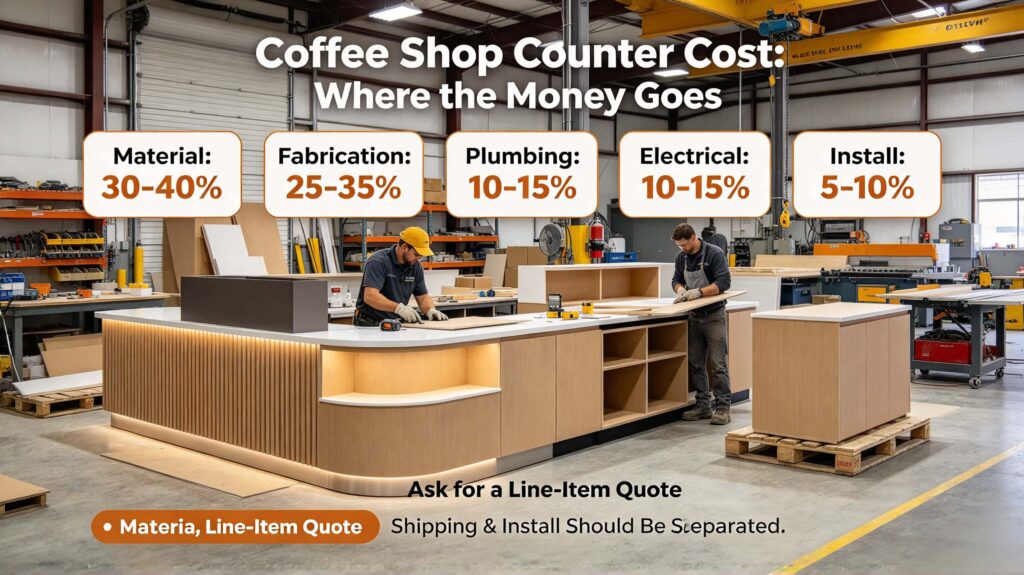
Coffee shop counter cost breaks into four buckets: material, fabrication, plumbing, and electrical. Material is 30–40% of the total. Fabrication is 25–35%. Plumbing and electrical are 20–30%. Labor rates vary by region, but the ratios stay consistent.
- Material: 30–40% — stone, steel, substrate, finish
- Fabrication: 25–35% — cutting, welding, assembly, shipping
- Plumbing: 10–15% — sink, drain, supply, rough-in
- Electrical: 10–15% — outlets, 220V circuit, LED wiring
- Install: 5–10% — on-site assembly and leveling
Factory Insider Tip: Ask for a line-item quote. If a factory quotes one lump sum with no breakdown, you cannot compare bids. We give every B2B client a full cost sheet — material, labor, shipping, install.
Custom Cafe Bar Counter Factory: How to Vet a Supplier
A custom cafe bar counter factory should give you drawings, a tolerance spec, a warranty, and a shipping timeline before you pay a deposit. If they cannot, walk away. The best factories send a 3D design first, then a shop drawing, then a production schedule.
- 3D design: Free or low-cost, before deposit
- Shop drawings: Signed off before cutting
- Tolerance spec: ±1.5mm for modular, ±3mm for welded
- Warranty: 3–5 years on frame, 1–2 years on finish
- Shipping: Crated, insured, with tracking
- Install support: Phone or video during install
| Check | Red Flag | Good Sign |
|---|---|---|
| Design | No 3D before deposit | 3D in 48 hours |
| Drawings | Verbal only | Signed shop drawings |
| Tolerance | No spec | ±1.5mm stated |
| Warranty | None | 3–5 years in writing |
| Shipping | Uninsured | Insured + tracking |
FAQ: Commercial Coffee Counter
What is the standard height of a coffee counter?
36 inches (91 cm) is the standard finished height for a standing barista. Seated service counters run 30–32 inches.
How deep should a coffee counter be for an espresso machine?
30–36 inches deep. A 2-group machine needs 24–30 inches alone, plus 12–16 inches for a grinder.
What is the best countertop material for a cafe?
Quartz for front-of-house, stainless steel for back-of-house, granite for heavy prep. All three handle commercial use.
How much does a custom commercial coffee counter cost?
$4,500–$20,000 depending on size, material, and plumbing. It is 15–25% of a 600 sqft cafe build.
How long does a commercial coffee counter last?
10–20 years. Stainless steel lasts longest; quartz is second; laminate fails in 3–5 years.
Can I install a modular counter myself?
Yes, if the factory provides CNC-cut frames and a tolerance spec. Hand-welded modular sections rarely line up.
Ready to Build a Counter That Works as Hard as You Do?
Send us your floor plan and we will return a 3D design within 48 hours. No obligation. No pressure. Just a clear, buildable plan from a factory that ships worldwide.
Email your plan today — let’s make your cafe the busiest corner on the block.
What you get when you contact us:
- 3D design based on your floor plan
- Line-item quote with material, labor, and shipping
- Tolerance spec and warranty in writing
- Production schedule before deposit
- Install support by phone or video
Do not order a custom commercial coffee counter without a 3D design. Send your plan now and see exactly what you are buying before you pay a deposit.
Contact us today. Your baristas — and your profit margin — will thank you.