
Building a Toy Store? Display Furniture You Can’t Skip

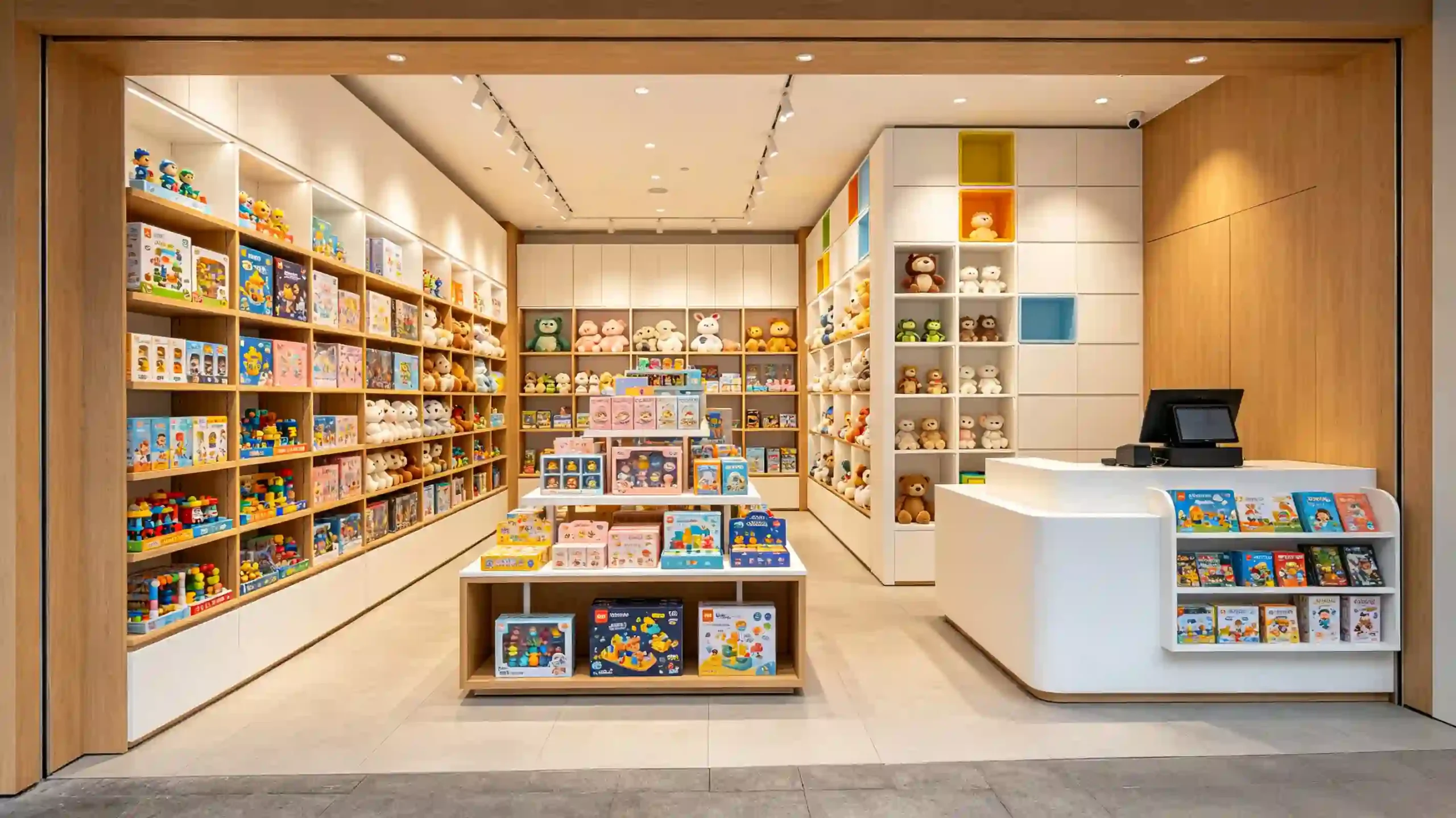
If you’re planning a toy store—whether it’s a standalone shop or a spot inside a mall—there are a few pieces of display furniture you need to put on your purchase list right now. Skip them, and the cost to fix things later will definitely double.
The ones most people overlook but that actually matter the most: low open shelving, a display table with a try-me function, a modular wall display system, and a heavily underestimated checkout counter display area. Miss even one of these, and your sales per square foot will drop by at least 20%.
Why Ordinary Shelving Will Ruin Your Toy Store
A lot of shop owners instinctively reach for generic shelving first. It’s cheap and easy to get. But toy retail works on a completely different logic: your main decision-maker is the kid, not the adult.
A child’s eye level, arm reach, and whether they can touch something right away directly determine your conversion rate.
I was involved in a toy store renovation project in Miami. The shop originally used standard supermarket shelving, 1.8 meters tall, packed tight. The sightlines were completely blocked. Parents were afraid to walk deeper into the store because they worried their kids would knock stuff over. After we switched to cabinets no taller than 1.2 meters, that same month’s sales per square foot jumped 27%. That number came straight from their POS system.
There are only three non-negotiable rules for toy store display furniture:
- A child standing in the main aisle should be able to see the front of the toy at a glance.
- They shouldn’t need to stand on tiptoes or drag a parent over just to reach it.
- The display structure itself shouldn’t cause scratches or pinch little fingers.
These three rules will guide every purchase decision you make later.
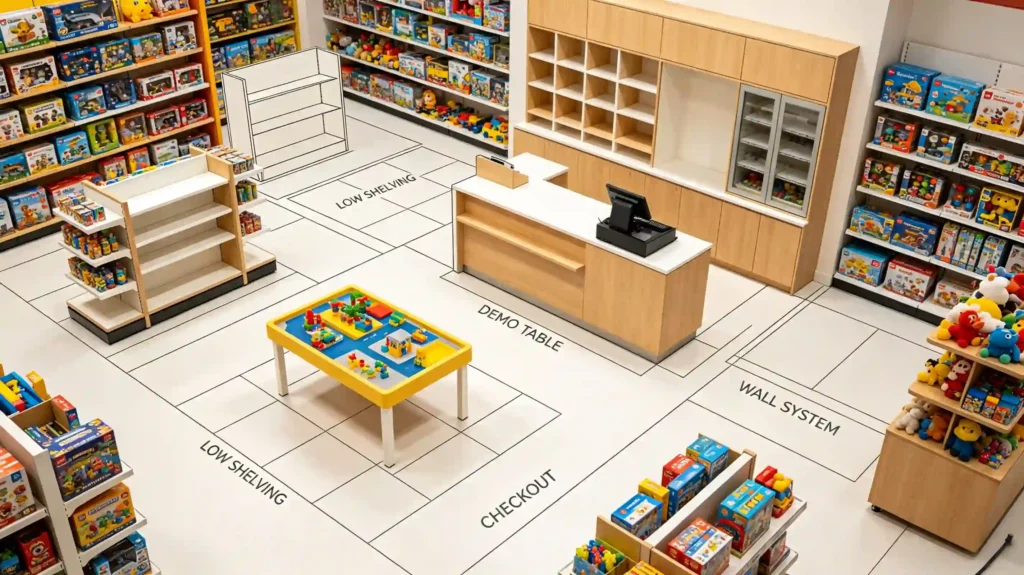
5 Must-Have Display Furniture Categories (Skip One and You’ll Feel It)
The five categories below aren’t “nice-to-have” suggestions. They’re the basic building blocks we’ve pulled together from dozens of overseas toy store projects. You can swap materials based on your budget, but don’t skip a single function.
| Type of Display Furniture | Core Function | Common Pitfall | Data Worth Noting |
|---|---|---|---|
| Low Open Shelving | Boosts the chance kids will pick something up on their own | Shelves too deep, so toys at the back get ignored | Front display positions account for over 65% of shelf sales |
| Demo Table / Try-Me Table | Extends dwell time, triggers try-to-buy conversion | Samples not secured, gone within minutes | Areas with a try-me setup see an average dwell time increase of over 70 seconds |
| Wall Display System | Uses vertical space without making the store feel cramped | Fixed shelves only; no way to change display logic later | A modular wall system can cut re-fit costs by about 30% |
| Checkout Counter Display Area | Drives impulse purchases and add-on sales | Just a bare countertop left with nothing on it | Add-on sales at the checkout area can make up 12%-18% of total store revenue |
| Plush Toy Display Tower / Transparent Bin | Creates a strong visual anchor, handles bulky SKUs | Over-stuffed bins that just look cheap | Tower displays for plush zones deliver 1.4 times the sales per square foot of normal shelving |
I’m not telling you to buy all of these at once. But before you open, you need to reserve the floor positions and power supply for these five types—especially the demo table, which will need charging points. If you have to add them later, you’ll need to tear into your layout, and the costs will climb.
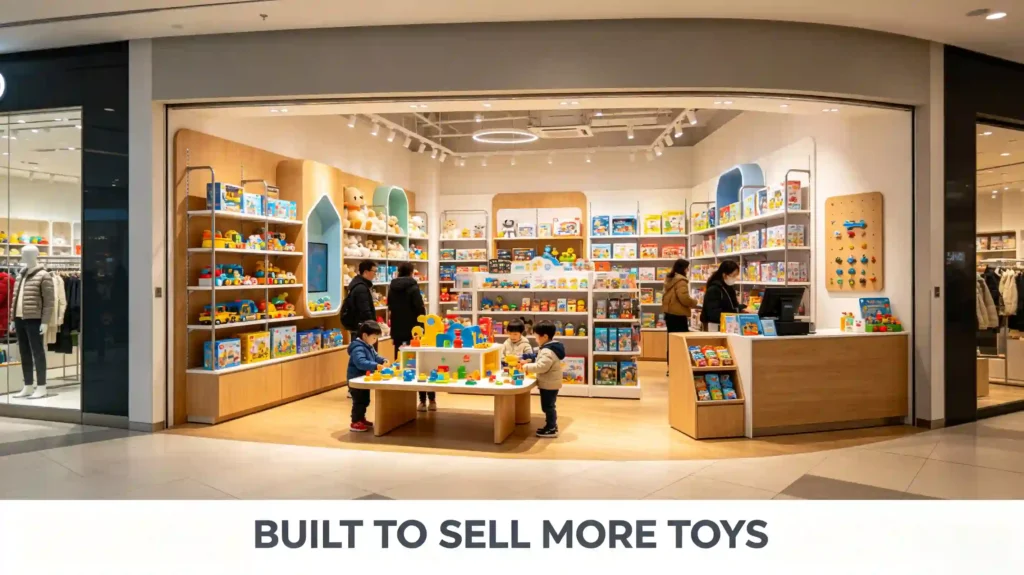
Low Shelving: Is It Just About Being Low?
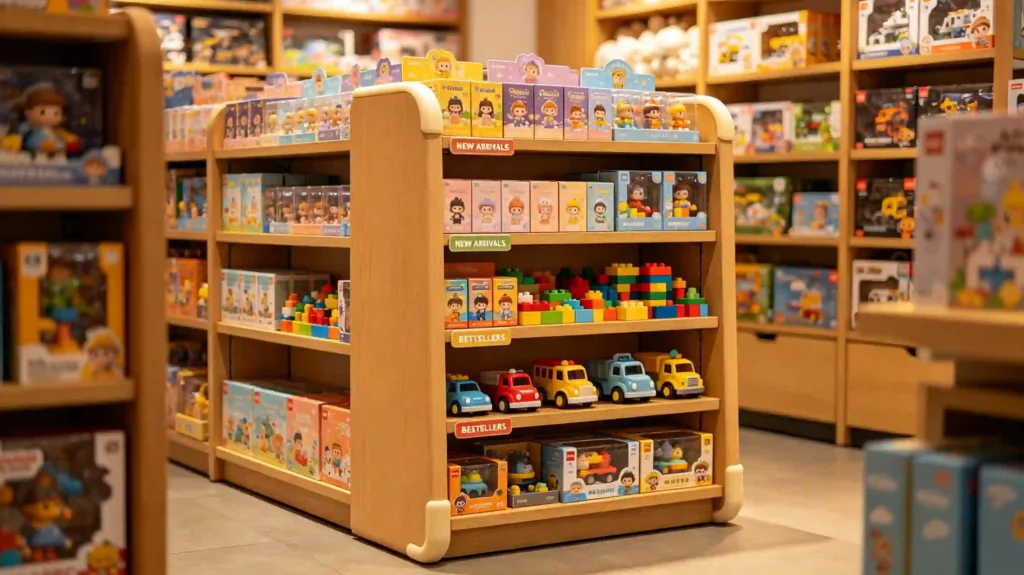
It’s not just about height. We’ve found that the real money zone in a toy store is between 40 cm and 110 cm from the floor—roughly the eye-level and hand-reach range for kids aged 2 to 10.
So, a good low shelf needs two things: first, it has to be really stable. Second, the shelf angle needs to be adjustable. A lot of top-selling items like building blocks and blind boxes look flat and lifeless when you lay them down. You can’t see the details at all. Tilting the shelf by 5 to 15 degrees lets the front of the package face the child properly.
One more thing to watch when you’re sourcing: all shelf edges must be rounded or fitted with a silicone safety bumper. In the US market we ship to, the ASTM F963 toy safety standard doesn’t directly cover display furniture, but the store’s public liability insurance will definitely require that the fixtures don’t present obvious safety risks. Don’t try to save a few bucks by picking sharp-edged steel frames and then get forced to fix them later.
How Important Is a Demo Table Really? We Checked the Numbers
Plenty of people think you just put out a table with a few opened toys and call it a day. Try it and you’ll see—within an hour, the samples are mixed up, missing pieces, or simply walked away.
A demo table that actually works needs at least three things:
- Secured samples with display cords or magnetic anti-theft devices – so the products don’t just disappear.
- Age-zone separation – toddler area tucked further inside with soft mats, older kids’ zone closer to the main walkway.
- Charging and lighting – light-up toys and electric train displays look dead without proper illumination.
We ran an A/B test in a client’s London store. The same magnetic tile set was placed on a normal shelf versus on a demo table where kids could actually build something. The average transaction value didn’t change much, but the conversion rate was 4.3 times higher on the demo table. It’s not just about selling more; without the hands-on experience, a lot of people wouldn’t even bother to touch the box.
From a B2B angle, if you’re looking for a supplier, ask them straight up whether the demo table comes with built-in cable management channels, replaceable acrylic protective panels, and whether the sample-securing setup can be customized. Suppliers who just offer a plain plank and call it a “demo table” are basically giving you something useless.
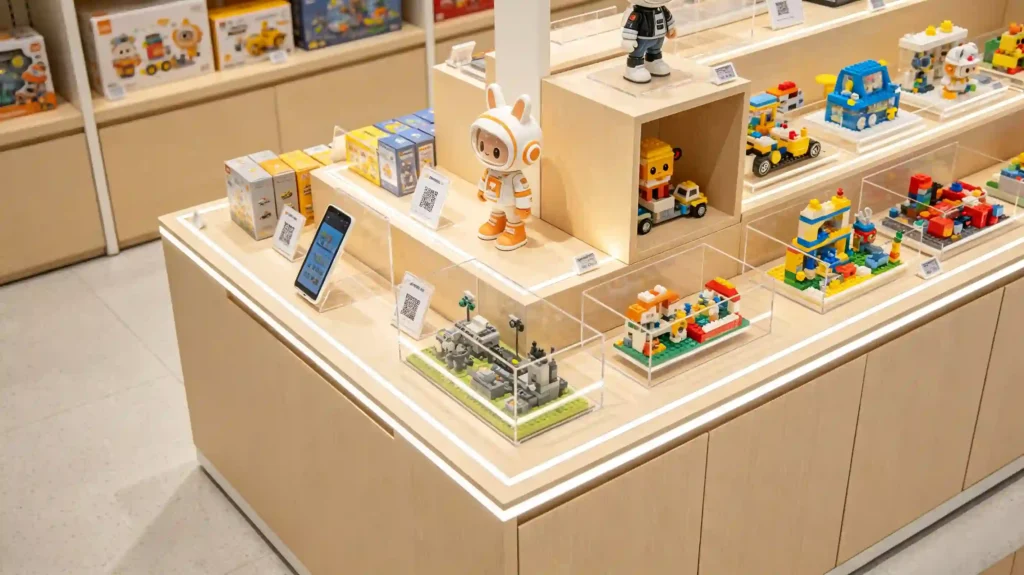
Wall Systems – Don’t Just Hang a Few Shelves
A lot of toy store owners tell me, “I’ll just get the fit-out guys to knock up a few wall shelves.” The problem is, a toy store’s SKUs change constantly: seasonal themes, new launches, licensed IP merch—you’ll be switching up your display logic at least 5 to 8 times a year. With fixed shelves, every change means drilling new holes, and your wall quickly turns into a mess.
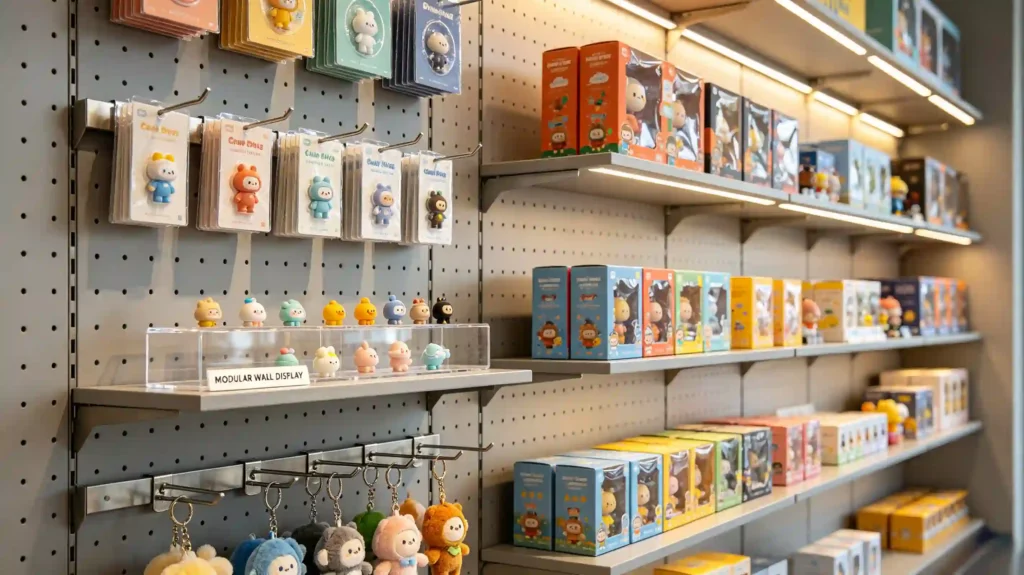
A modular wall system is the proper solution. There are three common types:
- Pegboard + hooks/hanging baskets: super flexible, but load capacity is limited. Good for carded items and small-box toys.
- Metal grid wall: handles medium-sized boxes well. Add magazine-rack style shelves and you can adjust heights fast.
- Slatwall system: the strongest load capacity. You can hang whole display cases on it. Costs the most, but lasts the longest.
Our approach is to provide clients with three different density layouts (dense display / themed atmosphere / open space for activities), all using the same vertical rail system. Later, when you want to launch a new seasonal theme, you just swap the graphic inserts and acrylic brackets—no need to tear down the whole wall. Spend a little more on this during your initial purchase, and the labor hours you save during operations will more than make up for the difference.
The Checkout Counter Is Not for Taking Money, It’s the Final Push
You need to flip your mindset on this one. A toy store’s checkout counter handles at least 15% of total revenue—money made from kids grabbing one or two small things while waiting in line.
So the checkout display area has to have that “low-level temptation” built in: place it right at belly-to-chest height for a child, and stock it with mini blind boxes, light-up spinning tops, stickers, little snacks—all under five bucks. For one Australian toy chain we worked with, we built a checkout counter with a clear acrylic stepped display at the front and easily accessible hang-strips at the back. Their add-on rate jumped from 8% to 21%.
When you’re sourcing a checkout counter, ask the factory three things directly:
- Does it have a spot for customers to put their bags? (Free hands mean more rummaging through small items.)
- Does the bottom section have removable small drawers for easy restocking and end-of-day cash-up?
- Can the front panel be screen-printed with your logo or a brand IP character?
Plush Toys: Stop Throwing Them into Big Bins
Dumping them in bulk bins only works for clearance sales. Selling plush toys at full price is all about that “soft, I want to hug it” feeling.
Our go-to setup is: a clear acrylic display tower with a bottom access opening, or a multi-layer slanted plush display rack that makes sure every toy’s face is looking outward. For animal plush especially, their eyes need to meet the child at the same level.
Here’s a number worth paying attention to: in the same 3-square-meter plush zone, switching from bulk bins to a display tower boosted one US Midwest client’s monthly sales by 42%. It wasn’t a promotion that did it—it was purely the change in how the products were displayed.
5 Questions You Must Ask Before Purchasing (A B2B Pitfall Guide)
From the custom toy store display projects we handle for overseas clients, we’ve seen most people hit the same sticking points during the sourcing stage. The next time you send an inquiry, throw these five questions straight at your supplier:
- Is the material E0/E1 grade board or solid wood? Does the surface coating pass EN71-3 (the part of the European toy safety standard dealing with migration of heavy metals)? This isn’t you being fussy. If there’s any exposed wood in your store that a child might chew on, you’re facing a compliance risk.
- Is the MOQ based on pieces or on cubic meters? Some factories quote a low minimum order quantity, but when you want to reorder later, they hit you with a high mold fee—especially if you’ve got custom acrylic shapes.
- Can the structure be shipped flat-packed? Does assembly require a professional carpenter? This directly impacts your overseas customs clearance and on-site installation costs. From our experience, designing things as KD (knock-down) structures means you can fit about 30% more goods into a 40HQ container.
- Does the lead time include surface finishing? Many people forget about the curing time for paint or veneer. They think the goods will ship in 25 days, but it drags on to 45. The store is already open, and the counters haven’t arrived.
- Are there pre-cut cable holes and a cash drawer space ready for the POS system? So many checkout counters look great but can’t actually fit any POS equipment. In the end, you have to cut holes on site and ruin the structure.
Run through these five questions, and you’ll probably filter out half the unprofessional suppliers right away.
New Directions for Toy Display in 2025 – Stick to the Old Ways and Get Left Behind
Over the past two years, at trade shows and in client projects, we’ve spotted a few definite trends. I’m putting them here for you to think about:
- Sustainable materials are speeding up adoption: Clients in Northern and Western Europe are already explicitly asking for FSC-certified wood or panels made from recycled ocean plastic. It’s not just a slogan—some shopping centers now require material traceability paperwork before you can even move in.
- Modular is upgrading to “recombinable”: It’s no longer just about adjustable height. The same display component can be turned on its side to become a building-block play table or stood upright to become a wall unit—adapting to different store sizes across branches.
- Lighting is becoming part of the display furniture itself: Inquiries for display cabinets with built-in 4000K neutral LED strip lights jumped about 35% in the second half of 2024 (based on our internal inquiry records). The reason is simple: parents are way more willing to shoot short videos and post them on social platforms.
- AR touchpoints need to be planned from the start: Some brands are starting to embed NFC sensor zones or QR code holder slots right into their display tables, linking to interactive games. This doesn’t require fancy technology, but it does need slots cut into the structure early on so the later installation doesn’t look like an ugly add-on.
None of this is just for big chains. For a small 60-square-meter neighborhood toy store we worked on, we embedded recombinable low cabinets and light strips into the plan. Everything was shipped flat-packed from Shenzhen to Rotterdam. The total cost didn’t exceed that of ordinary veneered shelving by more than 20%, but the whole in-store experience landed on a completely different level.
Here’s the honest truth: in a toy store, your display furniture is essentially your “silent salesperson.” Can it squat down and talk to a child? Can it let a mom see the price tag without bending over? Can it make a plush toy look like it’s waving hello? These things directly decide whether your rent money turns into sales or dead stock.
If you’re currently fitting out a store, I’d strongly suggest you lock down the layout and power supply for these five types of furniture first—before you even touch the ceiling and flooring. Get the order wrong, and everything after that becomes a compromise.
If you’re planning a toy store and need custom display furniture sized to your space, or want detailed layout references, feel free to reach out to us anytime.