
Custom Coffee Bar Counters: The Ultimate B2B Guide to Materials, Sizes & Design

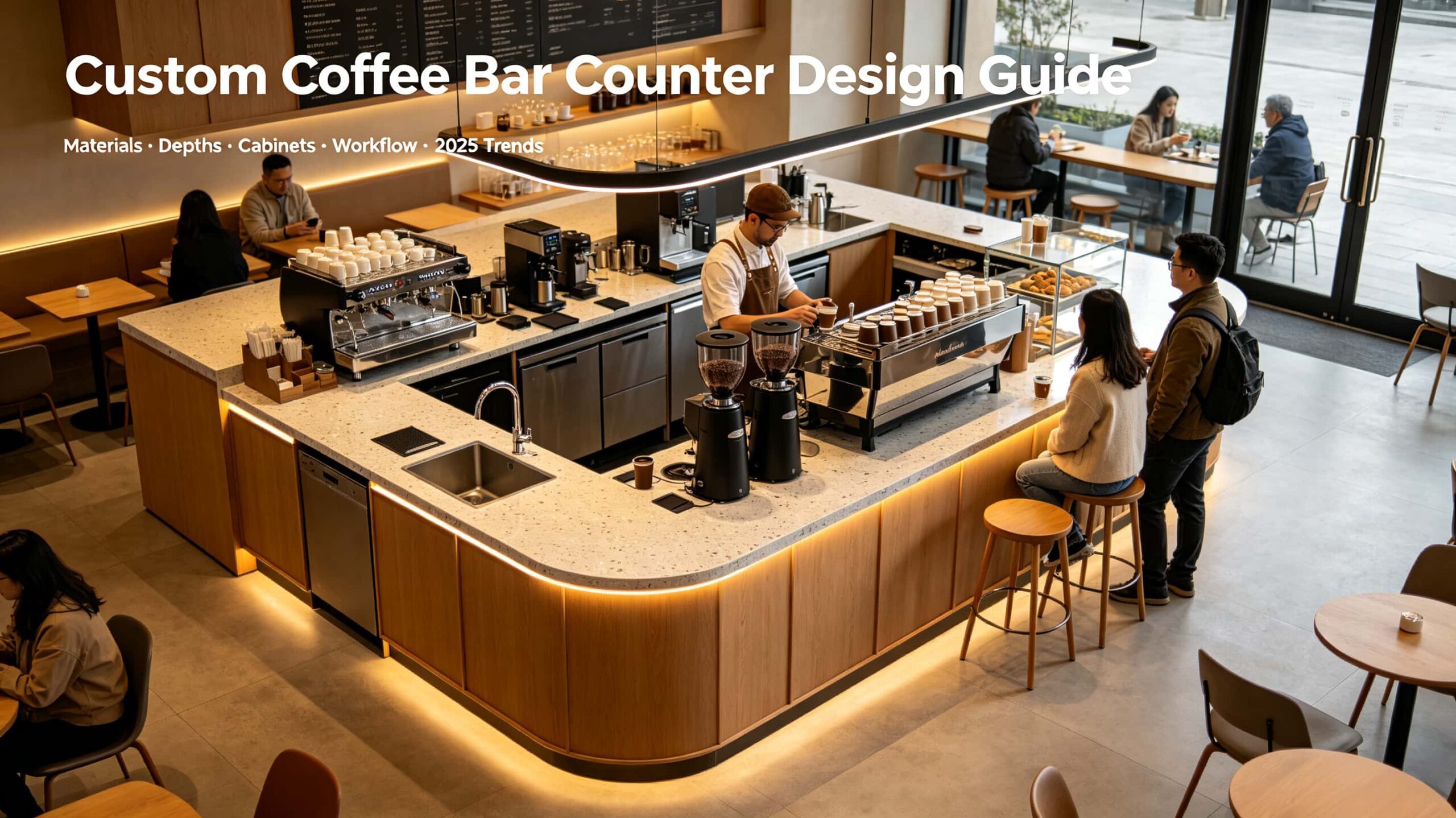
Custom coffee bar counters combine commercial-grade materials, precise dimensions, and workflow-driven design to boost efficiency and brand appeal. This guide covers top materials, exact depths, cabinet choices, design steps, and 2025 trends for your project.
A custom coffee bar counter is a made-to-order service station designed specifically for commercial coffee preparation. It integrates the countertop, base cabinets, plumbing, and electrical systems into one cohesive unit. Unlike stock fixtures, it is engineered around your espresso machine dimensions, staff workflow, and available floor space.
What type of countertop is best for a coffee bar?
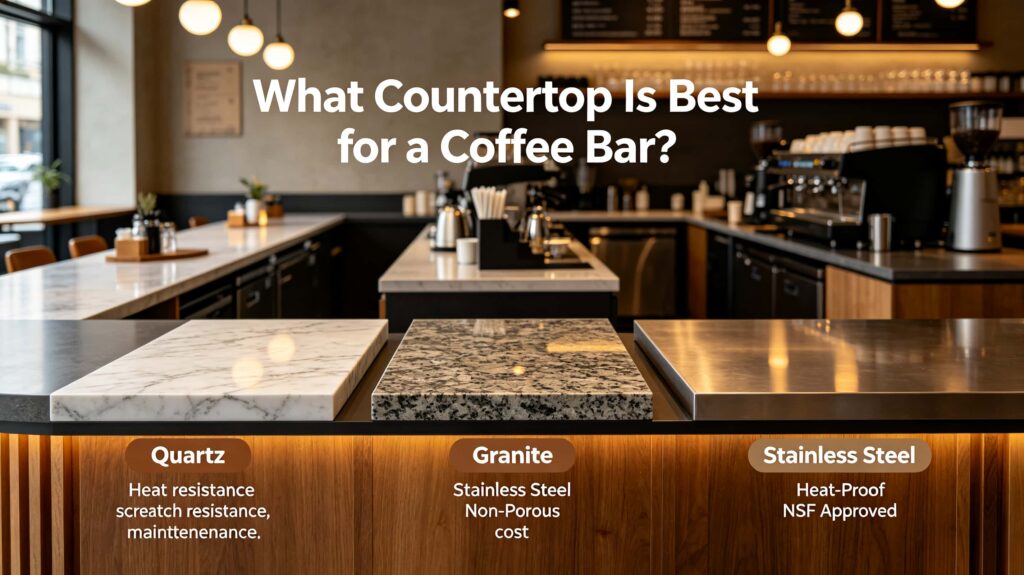
Quartz wins for most cafés, granite suits heavy traffic, and stainless steel dominates back-of-house prep zones. Each material balances heat resistance, hygiene, and aesthetics differently.
- Quartz – Non-porous, stain-resistant, 93% natural stone. Best for front-of-house aesthetics. Avoid placing hot portafilters directly on edges.
- Granite – Naturally heat-proof and scratch-resistant. Requires annual sealing. Ideal for high-volume bars.
- Stainless Steel – NSF-approved, heat-proof, and easy to sanitize. Common in drive-thru and back counters. Dents easily; shows fingerprints.
| Material | Heat Resistance | Scratch Resistance | Maintenance | Relative Cost |
|---|---|---|---|---|
| Quartz | High | High | Low | $$$ |
| Granite | Very High | Very High | Medium | $$$$ |
| Stainless Steel | Very High | Medium | Low | $$ |
Factory Insider Tip: Ask your manufacturer to pre-cut the sink and faucet holes before shipping. On-site cutting voids the quartz warranty and creates silica dust.
How deep should a coffee bar counter be?
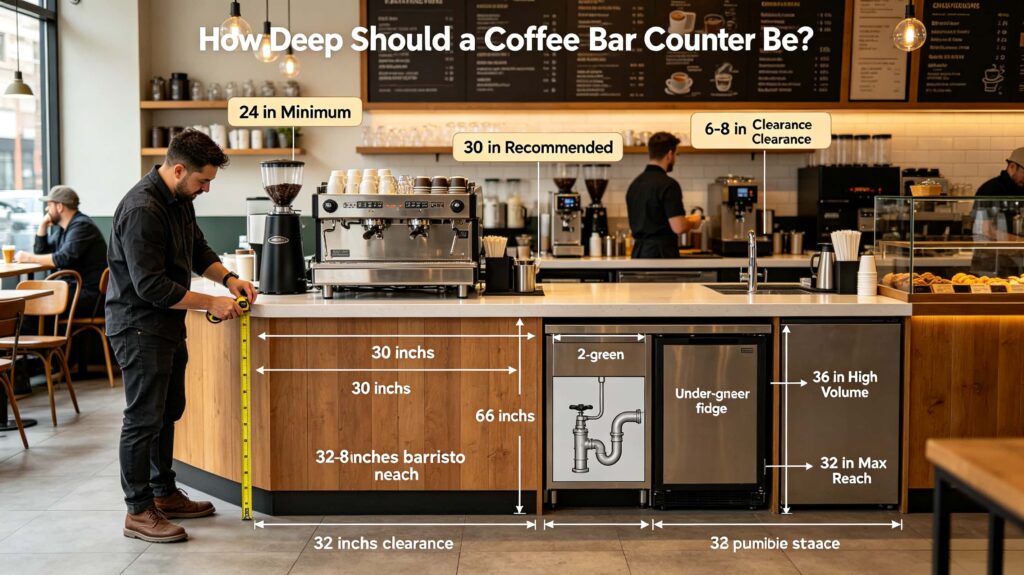
Standard commercial coffee bar counter depth is 24–30 inches. For large espresso machines (2–3 group heads), plan 30–36 inches. Add 6–8 inches behind the machine for plumbing and ventilation clearance.
- 24 inches – Minimum for pour-over stations, drip brewers, and small single-group machines.
- 30 inches – Recommended for most cafés with a 2-group espresso machine and under-counter refrigeration.
- 36 inches – Required for 3-group machines, dual grinders, and high-volume drive-thru windows.
Ergonomic rule: The barista’s reach should never exceed 32 inches from the front edge to the farthest point of the machine. Deeper counters force wasteful steps.
Custom coffee bar counter depth also depends on whether you need a front-facing service counter or a pass-through design. Pass-through counters typically run 30–42 inches deep to accommodate both sides.
What is the best cabinet for a coffee bar?
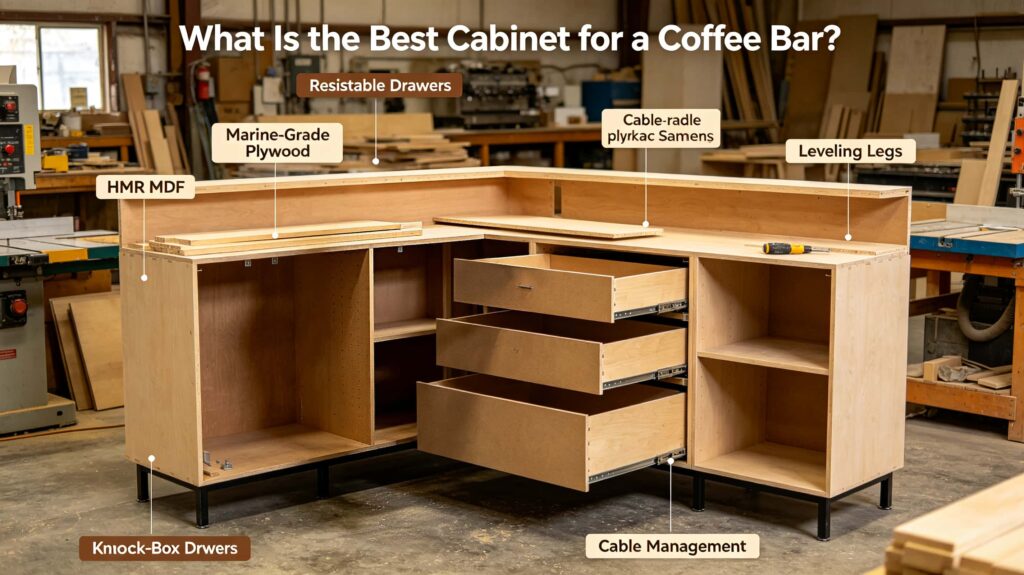
Moisture-resistant MDF (HMR MDF) is the top choice for custom coffee bar cabinets. It resists steam and spills far better than standard particleboard. Add lockable drawers and cable management for a professional setup.
- Moisture-resistant MDF – Sealed edges prevent swelling. Ideal under espresso machines and sink areas.
- Marine-grade plywood – Best for extremely wet or humid environments. Higher cost, superior durability.
- Lockable drawers – Secure expensive tools, portafilters, and cash. Use stainless steel locks.
- Cable management – Integrated grommets, raceways, and vertical channels keep power cords and water lines organized.
Custom coffee bar cabinets should include:
- Adjustable shelving for cups and syrups.
- A dedicated knock-box drawer with a rubber-lined base.
- Ventilation slots if housing a mini-fridge or grinder motor.
Factory Insider Tip: Request a cabinet with a 4-inch toe kick and leveling legs. Uneven café floors are common. Leveling legs save hours of shimming on install day.
How to design a coffee bar?
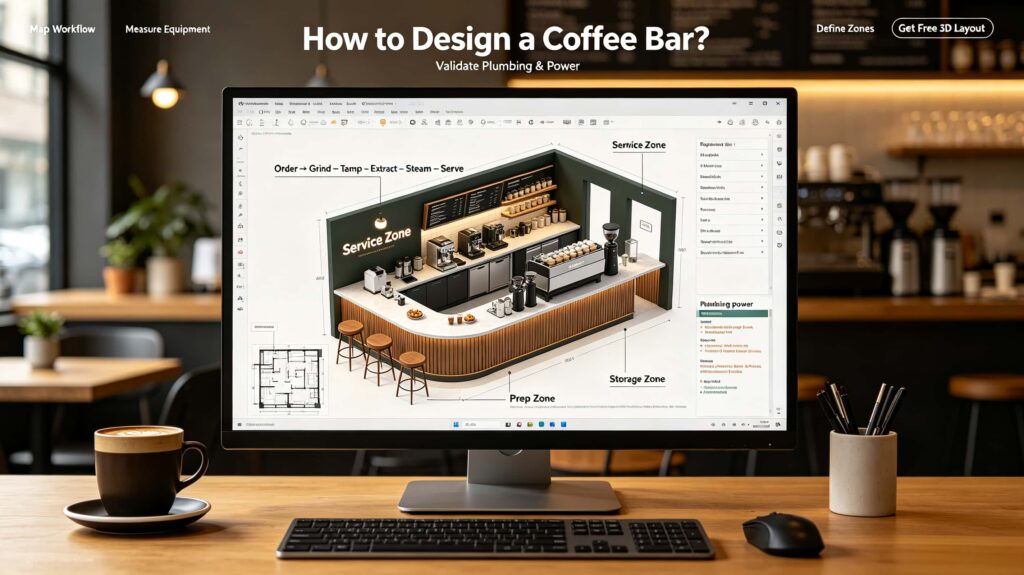
Workflow mapping comes first. Map the barista’s path from order to pickup before drawing any cabinet lines. Then get a free 3D layout from a factory to validate ergonomics and equipment clearance.
- Step 1: Map workflow – Order → grind → tamp → extract → steam → serve. Each step should occupy 12–18 inches of linear counter.
- Step 2: Measure equipment – Espresso machine depth, grinder height, fridge clearance, and pitcher rinser location.
- Step 3: Define zones – Service zone (front), prep zone (middle), storage zone (back).
- Step 4: Get a free 3D layout – Factories that manufacture custom counters often provide this at no cost. Use it to spot bottlenecks before production.
- Step 5: Validate plumbing and power – Confirm voltage, amperage, drain slope, and water filtration placement.
Coffee bar counter dimensions must account for:
- Counter height: 36 inches (standard) or 34 inches for shorter baristas.
- Overhang: 1–2 inches for seating; 0 inches for standing service.
- Backsplash height: 4–6 inches minimum.
Factory Insider Tip: Send your floor plan and equipment list to the factory. A good manufacturer will redline your layout for free and flag code violations before you pay a deposit.
What are the latest bar counter trends?
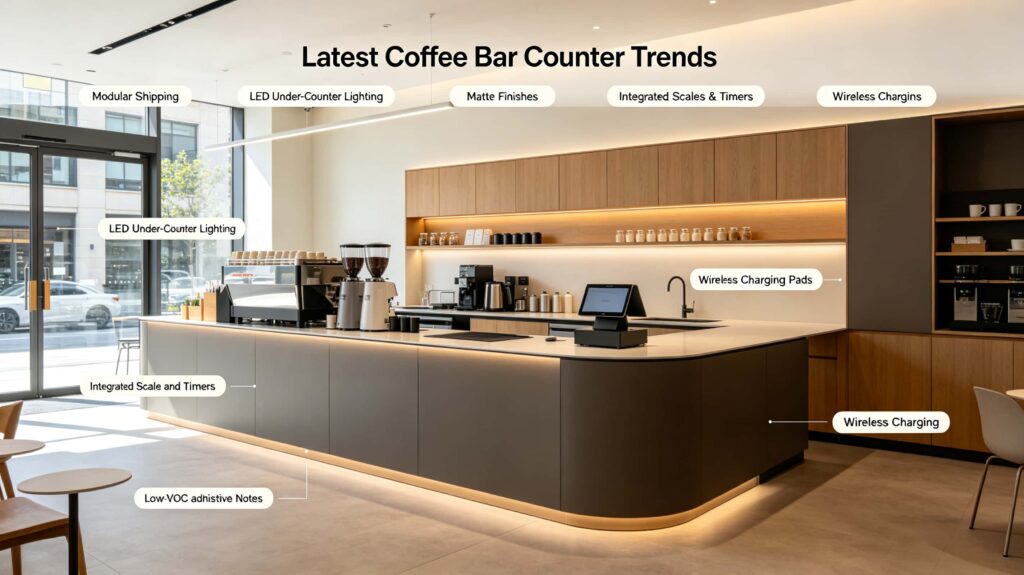
Modular shipping, LED under-counter lighting, and matte finishes dominate 2025 coffee bar counter design trends. These reduce installation time, improve safety, and align with minimalist branding.
- Modular shipping – Counters ship in 2–4 pre-assembled modules. Bolt together on-site. Cuts install from 3 days to 6 hours.
- LED under-counter lighting – Improves visibility for baristas and creates a floating effect. Use IP65-rated strips near water.
- Matte finishes – Fingerprint-resistant, scratch-hiding, and photogenic. Popular in quartz and powder-coated steel.
- Integrated scales and timers – Built into the counter surface for consistent extraction.
- Wireless charging pads – For customer phones at seating overhangs.
| Trend | Benefit | Best For |
|---|---|---|
| Modular shipping | Faster install, lower labor | Remote or tight spaces |
| LED under-counter | Safety + ambiance | Front service bars |
| Matte finishes | Low maintenance | High-traffic cafés |
Coffee bar counter design trends also favor recycled materials and low-VOC adhesives for green building certifications.
FAQ
What is the standard height for a coffee bar counter?
Standard height is 36 inches (91 cm) from floor to top surface. For seated bars, 42 inches is typical. For ADA compliance in the US, include a 34-inch-high section at least 36 inches wide.
Can I use granite for a coffee bar counter?
Yes. Granite handles heat and scratches well. It requires sealing every 12–18 months. Avoid dark granites near milk steamers—they show water spots. Quartz is lower maintenance for most cafés.
How much does a custom coffee bar counter cost?
Expect $2,500–$8,000 for a 6–10 foot counter, depending on material and cabinet complexity. Stainless steel and quartz run higher. Modular designs save 15–25% on installation labor.
Do I need a sink in my coffee bar counter?
Most health codes require a hand sink and a three-compartment sink or under-counter dishwasher. Confirm local regulations. A pitcher rinser is not a substitute for a hand sink in many jurisdictions.
How long does it take to manufacture a custom coffee bar counter?
Typical lead time is 3–6 weeks after drawing approval. Modular counters ship in 2–3 weeks. Add 1–2 weeks for quartz fabrication. Rush options exist but raise cost by 20–30%.
What is the best countertop material for a coffee shop on a budget?
Stainless steel or HMR MDF with a laminate top. Both resist moisture and cost 40–60% less than quartz. Laminate edges must be sealed properly to prevent swelling.
Ready to Build Your Custom Coffee Bar Counter?
Stop guessing. Send us your floor plan and equipment list. We will return a free 3D layout, exact dimensions, and a factory-direct quote within 48 hours.
Our team has manufactured custom coffee bar counters for cafés, drive-thrus, and roasteries across 14 countries. We know the codes, the workflow, and the hidden costs.
Click “Contact” now. Attach your plan. Get your 3D design. No obligation. No sales pressure. Just a factory insider’s honest layout review.
Your baristas will thank you. Your customers will notice. Your bottom line will grow.